
肿瘤免疫治疗

Search documents
从“天价”到普惠:肿瘤免疫治疗十年巨变,进入“全周期可及”新时代
Yang Zi Wan Bao Wang· 2026-01-26 07:36
Core Viewpoint - The establishment of the Jiangsu Provincial Anti-Cancer Association's Tumor Immunology and Biological Therapy Professional Committee marks a significant advancement in the field of cancer treatment, particularly in immunotherapy, which is evolving from high-cost treatments to more accessible options covered by insurance, thereby transforming cancer treatment in China [1][6]. Group 1: Immunotherapy Development - Immunotherapy is often misunderstood as merely "enhancing immunity," whereas it primarily involves immune checkpoint inhibitors like PD-1/PD-L1, which reactivate T cells to target cancer cells [2]. - The history of immunotherapy includes key milestones from the discovery of PD-1 in the early 1990s to the approval of the first PD-1 inhibitor in 2014 and the Nobel Prize awarded in 2018 for foundational research in this area [2]. Group 2: Accessibility and Application - Immunotherapy has transitioned from being prohibitively expensive to a more affordable treatment option due to the introduction of domestic drugs and insurance coverage, making it accessible to a broader population [3]. - The application of immunotherapy has expanded beyond late-stage cancer to include various stages of treatment for multiple cancer types, such as esophageal cancer, lung cancer, and triple-negative breast cancer, among others [3]. Group 3: Synergy with Radiotherapy - The synergy between radiotherapy and immunotherapy can enhance treatment outcomes, particularly for patients with locally advanced esophageal cancer, by improving the tumor microenvironment and activating systemic anti-tumor immunity [4]. - Clinical data indicate that combining radiotherapy with immunotherapy can significantly increase the pathological complete response rate in certain patients [4]. Group 4: Rational Perspective on Immunotherapy - While acknowledging the effectiveness of immunotherapy, it is essential to view it as a tool rather than a universal solution, as its efficacy is closely linked to biomarkers like PD-L1 expression and tumor mutation burden [5]. - Effective management of side effects is crucial, as immunotherapy can lead to severe adverse reactions, necessitating treatment in experienced medical centers with close monitoring [5]. Group 5: Future Directions - The establishment of the professional committee signifies a new phase in the standardization of clinical practices, academic exchanges, and research collaboration in tumor immunotherapy within Jiangsu Province [6]. - The integration of immunotherapy with traditional treatments like surgery, radiotherapy, and chemotherapy represents a paradigm shift towards comprehensive cancer care, aiming to improve patient survival and quality of life [6].
开年最大核聚变融资诞生 | 上海融资周报(2026年第3期)
Sou Hu Cai Jing· 2026-01-20 07:32
Financing Overview - From January 12 to January 18, Shanghai enterprises experienced 24 financing events, with 15 disclosing financing amounts, totaling 2.8485 billion yuan [2] - The number of financing events remained the same as the previous week, with the highest number occurring in the Pudong New Area, which had 7 events [2] Artificial Intelligence - SenseTime Medical completed nearly 100 million yuan in strategic financing on January 12, with investment from Henan Huirong Fund [4] - Wuzhitai Technology, a robot leasing platform, secured several tens of millions in Pre-A round financing on January 15, with investments from Lion City Capital, Baidu Investment, and existing shareholder Jingya Capital [5] - Qingtian Rental, another robot leasing platform, completed seed round financing on January 15, led by Hillhouse Venture Capital and supported by several other investors [6] - Futuring Robotics, focusing on dual-arm household service robots, raised 200 million yuan in angel round financing on January 12, with investments from ZhenFund, Yuanlai Capital, and Lianxin Capital [7] Integrated Circuits - Zhanwang Technology, an IC design company, completed 100 million yuan in angel round financing on January 14, led by Zijin Port Investment and金沙江联合资本 [8] - Lijiao Technology, specializing in semiconductor RF and plasma systems, completed Pre-A+ round financing on January 14, with investments from Shangrong Capital, Zhongbi Fund, and Shanghai Dingyu [9] - Yunshen Technology, focusing on semiconductor materials and equipment, completed A round financing on January 14, with investment from Yida Capital [10] Biomedicine - Yuanqi Bio, specializing in tumor immunotherapy, completed 70 million USD in C round financing on January 12, led by Beijing Pharmaceutical Health Industry Investment Fund and QIA [11] - Fanfang Medical, focusing on medical devices, completed angel round financing on January 12, with investment from Tianshi Innovation Capital [12] - Ailios, specializing in pharmaceutical process filtration, completed over 100 million yuan in Pre-B round financing on January 15, led by Guotou Chuanghe [13] - Xinyao Paike, focusing on drug packaging materials and medical devices, completed 100 million yuan in B+ round financing on January 15, led by Guangfa Xinde [14] - Shengshengji, specializing in precision intelligent health technology, completed several tens of millions in angel financing on January 15 [15] Future Industries - Shuli Innovation, focusing on brain-machine interfaces, completed several hundred million yuan in B+ round financing on January 16, with investments from the National SME Development Fund and Dongfang Fuhai [16] - Jinghai Weixiang, specializing in synthetic biology, completed nearly 100 million yuan in B round financing on January 12, with investment from Jiazhizhi Fund [17] - Huanliang Technology, focusing on AI new materials, completed strategic financing on January 13, with investment from Qicai Chemical [18] - Jingxiang Technology, specializing in flexible tactile sensors, completed angel round financing on January 14, with investments from Zhongke Chuangxing and Pudong Fund [19] - Xinhang Micro, focusing on vacuum components, completed several tens of millions in angel round financing on January 12, with investments from Yushan Capital and Daohua Investment [20] - Youji Technology, specializing in machine tool intelligence, completed B round financing on January 14, with investment from Changyingxin Investment [21] - Xinghuan Juneng, focusing on fusion energy commercialization, completed 1 billion yuan in A round financing on January 12, with investments from multiple institutions [22] - Chaomagnet New Energy, specializing in high-temperature superconducting strong field magnets, completed several hundred million yuan in angel round financing on January 16, led by Dingfeng Chuangke [23]

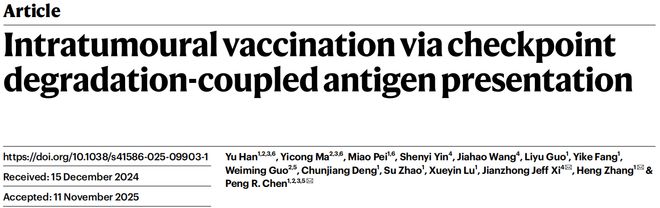
北大团队巧施“特洛伊木马”行动,取得癌症疫苗新突破
Guan Cha Zhe Wang· 2026-01-08 07:29
Core Insights - The emergence of tumor immunotherapy, particularly PD-1/PD-L1 antibodies, has transformed cancer treatment, but over 60% of patients with non-small cell lung cancer do not respond to existing therapies, highlighting the challenge of "cold tumors" that evade immune detection [1][2] - A new study published in Nature by teams from Peking University and Shenzhen Bay Laboratory introduces a novel approach to reactivate "cold tumors" through a mechanism called "checkpoint degradation-coupled antigen presentation" [1][2] Group 1: Research Findings - The research team developed a dual-function chimeric molecule called iVAC that simultaneously achieves "immune checkpoint degradation" and "high-quality antigen delivery," effectively reprogramming cancer cells to present antigens [4][6] - iVAC molecules can activate antigen-specific CD8+ T cells, showing efficacy comparable to bone marrow-derived dendritic cells (BMDCs) in stimulating immune responses [7] - The study identified cytomegalovirus (CMV) antigens as a target for iVAC, leveraging the presence of dormant memory T cells in the human body that can be awakened to attack tumors [8][10] Group 2: Technological Innovations - The meTPD technology enables targeted degradation of membrane proteins, allowing cancer cells to present high-quality antigens, thus transforming them into effective vaccine carriers [3][6] - iVAC's design integrates three components: a covalent PD-L1 nanobody, a degradation moiety, and an immune peptide segment, facilitating a Trojan horse strategy to convert immune-suppressive cancer cells into immune system messengers [6][10] - The research indicates that iVAC can effectively activate memory T cells in various cancer patients, demonstrating significant potential for broader applications in cancer immunotherapy [8][10]
布局TCE肿瘤疗法千亿蓝海,时迈药业能否博得市场青睐?
Zhi Tong Cai Jing· 2025-12-09 05:40
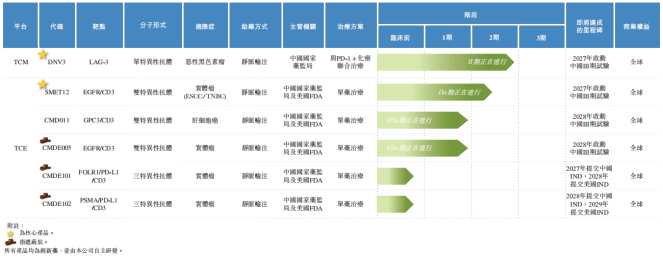
Core Viewpoint - Zhejiang Shimai Pharmaceutical Co., Ltd. has submitted an IPO application to the Hong Kong Stock Exchange, aiming to capitalize on the growing T cell engager (TCE) therapy market, which is experiencing rapid development and increasing interest from major international pharmaceutical companies [1][6]. Company Overview - Founded in 2017, Shimai Pharmaceutical is a pioneer in next-generation TCE therapies, focusing on utilizing the human immune system to combat cancer [1]. - The company has developed a next-generation TCE therapy that can be selectively activated in tumors for the treatment of solid tumors [1]. Financial Performance - Shimai Pharmaceutical is currently in the clinical research phase with no commercialized products. The company reported revenues of 14.649 million, 6.618 million, and 2.278 million RMB for 2023, 2024, and the first half of 2025, respectively [2]. - The company has incurred losses of 74.943 million, 59.899 million, and 25.42 million RMB over the same periods, showing a trend of narrowing losses [2]. - Research and development expenses were 76.109 million, 53.382 million, and 22.389 million RMB for the same periods, with employee costs being a significant component [2]. Product Pipeline - Shimai Pharmaceutical has four innovative drug candidates in clinical stages and two additional candidates in preclinical stages targeting solid tumors [2][5]. - The lead candidate, DNV3, targets LAG3 and has shown promising clinical data, including a 44.4% objective response rate in melanoma patients previously treated with PD-(L)1 inhibitors [3][4]. - SMET12, another candidate, is a potential first-in-class intravenous TCE for EGFR-positive advanced solid tumors and is currently in Phase IIa clinical trials [5]. Market Potential - The global TCE market is projected to grow from $400 million in 2020 to $3 billion by 2024, with a compound annual growth rate of 67.6%, and could reach $47.5 billion by 2030 and over $120 billion by 2035 [9][11]. - The TCE therapy offers advantages over CAR-T therapies and antibody-drug conjugates (ADCs), making it a promising direction for next-generation cancer immunotherapy [6][9]. Competitive Landscape - The TCE field is witnessing significant interest, with over $8.5 billion in transactions in 2024 alone, as major pharmaceutical companies enter the market [8]. - Currently, only two TCE drugs for solid tumors have been globally approved, indicating a substantial market opportunity for companies like Shimai Pharmaceutical that focus on this area [11][13]. Strategic Positioning - Shimai Pharmaceutical's focus on solid tumor TCE therapies positions it well in a market with limited competition, as most domestic players are still concentrated on hematological malignancies [13][14]. - The company’s innovative drug candidates are developed through specialized platforms, creating a competitive barrier in the TCE space [5].
科望医药三闯港交所 持续亏损,明星资本押注双抗能否破局?
2 1 Shi Ji Jing Ji Bao Dao· 2025-12-03 00:00
Core Insights - The article discusses the third attempt of Kewang Pharmaceuticals to list on the Hong Kong Stock Exchange, highlighting its financial struggles and the pressure to go public to avoid bankruptcy [1][11]. Financial Situation - Kewang Pharmaceuticals has accumulated losses exceeding 2 billion yuan (approximately 20.67 billion yuan) over the years, with significant losses reported from 2022 to 2024 [3][8]. - As of the end of 2024, the company had a net debt of 2.738 billion yuan, with a cash reserve of only 32.82 million yuan, down 88% from the previous year [2][3]. - The company’s cash and cash equivalents were reported at 93.93 million yuan as of September 30, 2025, with a net cash outflow of 97.2 million yuan during that period [8]. R&D and Pipeline - Kewang Pharmaceuticals has a pipeline of seven major assets, with four in clinical stages, including its core product ES102, a six-valent OX40 agonist antibody [1][4]. - The clinical data for ES102 has raised concerns, showing a low objective response rate (ORR) of 11.1%, which is below the average for other cancer treatments [9][10]. - The company has not yet validated its proprietary research capabilities, as its two fastest-moving core pipelines are licensed from other companies [10]. Market and Valuation - The market's valuation logic for innovative drug companies has shifted from the quantity of pipelines to the quality, emphasizing the need for clear differentiation in research capabilities and clinical data [2][4]. - Kewang Pharmaceuticals' valuation has seen significant fluctuations, with a market-to-research ratio of approximately 37 times based on 2024 R&D costs, which is notably higher than the industry average [5][10]. - The company’s previous attempts to go public in the U.S. and Hong Kong faced challenges, and the current listing attempt is seen as a critical moment for its survival [11][12].