证券资管

Search documents
上海国泰海通证券资管首席信息官变更 陈颖接替叶明
Cai Jing Wang· 2026-03-24 09:20
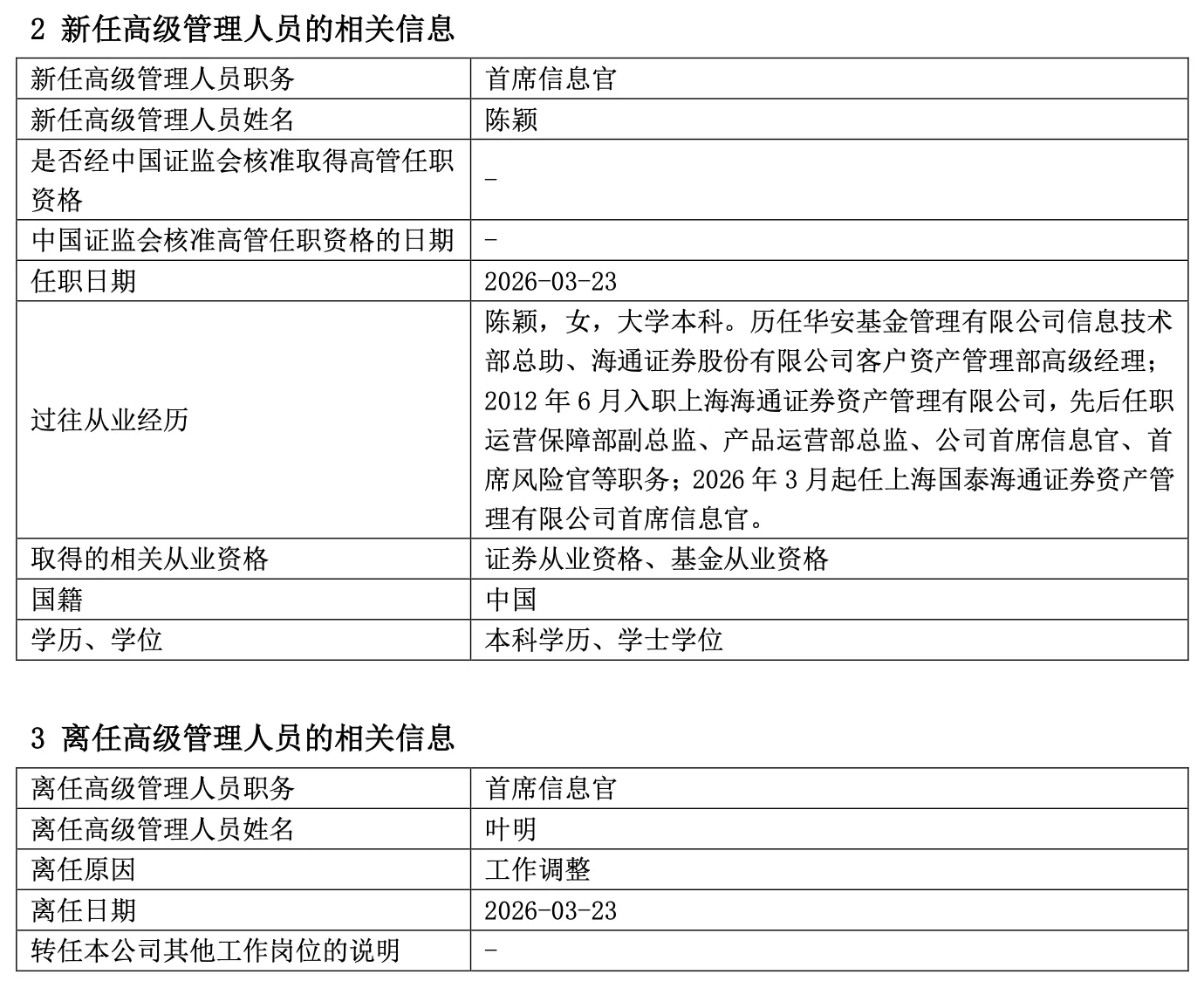
Core Viewpoint - Shanghai Guotai Haitong Securities Asset Management Co., Ltd. announced the completion of the handover of its Chief Information Officer, with Chen Ying officially taking over the position on March 23, 2026, following the departure of the previous CIO, Ye Ming, due to routine personnel adjustments [1][3]. Group 1: New Appointment - Chen Ying has over ten years of experience in financial technology and operations management, having previously worked at Huashan Fund and Haitong Securities Asset Management [1][2]. - Chen holds both securities and fund practitioner qualifications and has a bachelor's degree [1][2]. - The appointment of Chen Ying was approved by the company's board and complies with regulatory requirements [3]. Group 2: Departure of Previous CIO - Ye Ming left the position of Chief Information Officer on March 23, 2026, due to "work adjustments" and will not take on any other roles within the company [1][3]. - The departure is classified as a routine personnel change with no unusual disclosures [1].


告别纯债依赖!券商资管集体转向“固收+多策略”
券商中国· 2026-03-18 07:13
Core Viewpoint - The brokerage asset management industry is undergoing a significant transformation in investment strategies due to declining market interest rates, narrowing traditional credit bond yields, and weakening confidence in local government bonds [1][2]. Group 1: Shift in Investment Strategies - The industry is moving away from pure bond investments to a comprehensive "fixed income + multi-strategy" approach, which is seen as a necessary optimization of product and strategy, as well as a systemic restructuring of research, revenue structure, and risk management [2][3]. - Firms like Caixin Asset Management have noted that the low absolute yield is a common challenge across the industry, making it difficult to meet investor demands solely through single assets [2][3]. - The transition from traditional "fixed income +" to "fixed income + multi-strategy" is becoming the core evolution direction for brokerage asset management, emphasizing diversification, tool utilization, and all-weather strategy layouts [3][4]. Group 2: Implementation of Multi-Strategy Approaches - Caixin Asset Management has been an early adopter of the "fixed income + multi-strategy" model, having developed a comprehensive strategy toolbox that includes convertible bonds, quantitative finance, derivatives, and overseas assets since 2016 [3]. - Guangzheng Asset Management has also transitioned from a single yield approach to a multi-yield strategy, focusing on active trading and enhancements through equity timing, convertible bond selection, quantitative hedging, and options, while controlling volatility within acceptable limits [4]. - Other firms like Guohai Asset Management and Guojin Asset Management are also advancing the "fixed income + multi-strategy" model, with Guojin focusing on expanding asset types and optimizing performance through trading strategies and derivatives [5].

光证资管迎新掌门!乔震正式出任董事长
券商中国· 2026-03-05 06:04
Core Viewpoint - The article highlights the formal appointment of Qiao Zhen as the chairman of Everbright Securities Asset Management Co., marking a significant leadership transition within the company and the broader asset management industry in China [1][2][7]. Company Leadership Transition - Qiao Zhen has officially taken over as chairman after serving in an acting capacity since August 2025, following the departure of former chairman Xiong Guobing [2][7]. - The asset management industry is experiencing a wave of leadership changes, with several firms, including Xing Securities Asset Management and Huatai Securities Asset Management, undergoing similar adjustments [2][10]. Qiao Zhen's Background - Qiao Zhen has over a decade of experience in the company, having held various key positions such as general manager and assistant general manager, which gives him a deep understanding of the company's business structure and development [3][6][7]. - He graduated from Shanghai Jiao Tong University and has previously worked at China Merchants Bank and Huatai-PineBridge Fund [6]. Company Growth and Strategy - As of June 2025, the total assets under management by Everbright Securities Asset Management reached 322.5 billion yuan, reflecting a 3.6% increase from the beginning of the year [8]. - The company has decided to withdraw its application for a public fund management license, marking a strategic shift after two years of unsuccessful attempts to obtain approval [8][9]. - For 2026, the company plans to focus on expanding its product offerings, particularly in "fixed income plus," multi-strategy, and specialized equity products, aiming to create a diverse and forward-looking product ecosystem [9]. Industry Context - The leadership change at Everbright Securities Asset Management is part of a broader trend in the asset management sector, with multiple firms adjusting their core management teams in response to evolving market conditions [10].


“固收+”面临挑战!券商资管推动策略迭代,哪些会是解题思路?
券商中国· 2026-02-06 01:05
Core Viewpoint - The "fixed income +" products are a key focus for brokerage asset management this year, as residents continue to shift their asset allocation towards financial assets, balancing stability and aggressiveness [1] Group 1: Challenges Facing "Fixed Income +" Products - "Fixed income +" products are currently facing dual pressures from declining bond yields and increasing difficulty in enhancing equity components, leading to a deep transformation of related strategies [2][3] - The traditional operation model of "fixed income +" strategies is challenged by low bond yields and structural market conditions, reducing the safety net function of bonds and complicating equity enhancement due to market differentiation [3][4] - The volatility of bond yields has increased, impacting the stability of portfolios, while the structural differentiation in the equity market has raised the difficulty of stock selection, leading to decreased certainty in overall strategy returns [4][5] Group 2: Iteration and Upgrading of "Fixed Income +" Products - Brokerage asset management firms are advancing the iteration of "fixed income +" products through multiple dimensions, including expanding asset boundaries, enhancing quantitative tools, and improving risk control [5][6] - Expanding asset boundaries involves incorporating low-correlation alternative assets to enhance portfolio resilience against cycles, moving beyond the traditional stock-bond framework [5][6] - Strengthening quantitative and systematic investment capabilities is essential, with firms utilizing data-driven methods to avoid over-reliance on single market opportunities and to construct long-term effective strategies [6] Group 3: Market Outlook for 2026 - Institutions generally expect bond market performance to improve compared to last year, with yields anticipated to remain volatile, while the equity market is expected to strengthen amidst fluctuations [7][8] - The bond market is projected to present more investment opportunities in 2026, with a potential steepening of the yield curve and increased trading value in long-term bonds [7] - In the equity market, structural opportunities are anticipated, with a focus on sectors such as technology, cyclical stocks, and emerging themes like AI, as well as recommendations for specific industries to target [9]

天风资管孙永亮谈科技赋能FOF投资新范式
Zheng Quan Ri Bao Wang· 2026-02-04 13:52
Core Viewpoint - The article highlights the increasing competition in the asset management sector and emphasizes the importance of leveraging AI to enhance investment research and improve client experience, as demonstrated by Tianfeng Asset Management's new AI-driven FOF research platform [1]. Group 1: AI and Digital Transformation - Tianfeng Asset Management has successfully built a next-generation AI-driven FOF research platform as part of its digital transformation strategy [1]. - The firm has established a multidisciplinary FOF research team that integrates financial engineering, computer science, and mathematics to support its digital initiatives [1]. - The team adheres to a principle of empirical validation, ensuring that all investment views undergo rigorous quantitative verification [1]. Group 2: Investment Strategy and Future Direction - The core of Tianfeng's technology-enabled FOF investment model is the deep integration of technology with investment research, breaking traditional boundaries [1]. - The application of digital empowerment, AI technology, and specialized talent is aimed at building core competitiveness in FOF investments [1]. - Tianfeng Asset Management plans to continue leveraging technology to empower finance and data-driven decision-making, furthering its digital transformation and contributing to high-quality financial development [1].
规模激增,分化加剧,券商资管公募的“红海”新局
Zhong Guo Ji Jin Bao· 2026-02-01 13:09
Core Insights - The asset management industry of securities firms is experiencing significant growth, with total management scale expected to exceed 1 trillion yuan by 2025, achieving an annual growth rate of 17% [1] - The industry is witnessing a divergence, with some firms showing rapid growth while others face substantial declines, highlighting the importance of sustained research and investment capabilities [1] Group 1: Growth and Scale - The top securities firms continue to strengthen their advantages, with five firms entering the "billion club," including Dongfanghong Asset Management at 216.27 billion yuan, a 30% increase year-on-year, and Huatai Securities Asset Management at 180.83 billion yuan, a 31% increase [2] - Smaller firms like Changjiang Securities Asset Management and Shandong Securities Asset Management have shown remarkable growth rates of 47% and 49%, respectively, while some firms like Guodu Securities and Zheshang Asset Management have seen declines of 32% and 8% [2] Group 2: Product Structure and Strategy - Firms are adopting differentiated product strategies based on their strengths, with Dongfanghong focusing on mixed funds, while Huatai emphasizes money market funds, which account for over 85% of its product structure [2] - The growth in management scale is attributed to a combination of a recovering capital market, policies encouraging long-term capital inflow, and the ability of firms to innovate and collaborate effectively [3] Group 3: Research and Client Services - The strategic focus on enhancing research capabilities and client services is crucial for the transformation of asset management institutions, with firms aiming to build differentiated research systems and optimize product offerings [4] - Dongfanghong Asset Management emphasizes long-term and value investing, while also expanding its product lineup to meet diverse investor needs, particularly for high-net-worth clients [4] Group 4: Future Investment Strategies - The investment outlook for 2026 remains optimistic, driven by factors such as the "deposit migration" effect, improving profit cycles, and a generally loose global liquidity environment [6] - Firms are focusing on specific product categories to cater to different risk preferences, with low-volatility short-term bond funds targeting retail clients and medium-volatility credit bond funds aimed at institutional investors [6][7] - Opportunities in traditional cyclical sectors and technology growth areas, particularly AI, are being closely monitored, with expectations of significant benefits from increased capital expenditure and domestic production [7]
海通资管旗下三只集合计划同时清盘 其中一只跑输业绩比较基准52个百分点
Xi Niu Cai Jing· 2026-01-28 10:33
Core Insights - Haitong Securities Asset Management Co., Ltd. has announced the liquidation of three collective plans: Haitong Core Advantage, Haitong Quality Upgrade, and Haitong Quantitative Value Selection, all set to terminate on December 31, 2025 [4] Group 1: Liquidation Details - The three collective plans will be liquidated according to relevant laws and asset management contracts without the need for a meeting of plan holders [4] - The plans were established at different times: Haitong Core Advantage in April 2020, Haitong Quantitative Value Selection in February 2021, and Haitong Quality Upgrade in January 2022 [4] Group 2: Financial Performance - As of the end of 2025, the net asset values of the three plans are approximately CNY 109 million (Haitong Core Advantage), CNY 56 million (Haitong Quality Upgrade), and CNY 26 million (Haitong Quantitative Value Selection) [4] - Haitong Core Advantage has seen a unit net value decline of 23.64% since inception, underperforming its benchmark by 52.19 percentage points, while Haitong Quality Upgrade has declined by 19.34%, underperforming its benchmark by 27.31 percentage points [5] Group 3: Market Strategy - The Haitong Core Advantage plan primarily focuses on manufacturing and technology sectors, aiming to identify companies with strong business models and significant growth potential [6]

华泰证券资管换帅!核心高层大调整
2 1 Shi Ji Jing Ji Bao Dao· 2026-01-25 07:16
Group 1: Management Changes - Huatai Securities Asset Management Co., Ltd. (Huatai Securities AM) has undergone a significant management reshuffle, with Jiang Xiaoyang appointed as chairman and Zhu Qian as the new general manager [1][4] - Liu Bowen, the compliance director and board secretary, has taken on the role of chief risk officer, replacing the former chief risk officer, Qin Jie, due to work changes [1][4] - Jiang Xiaoyang has a long history with Huatai Securities, having joined in 2001 and transitioned to Huatai Securities AM in January 2024 [1][4] Group 2: Company Performance - In the first half of 2025, Huatai Securities AM reported revenues of 1.21 billion yuan and a net profit of 713 million yuan, with a management scale reaching 627.03 billion yuan, reflecting a year-on-year growth of 23.92% [1][4] - The company has evolved from a single business model to a dual-license operation, focusing on both asset management and public fund businesses, with notable achievements in asset securitization [3][6] Group 3: Historical Context - Huatai Securities AM was established in 2014, evolving from the asset management department founded in 1999, and obtained its public fund license in 2016 [1][4] - The former chairman, Cui Chun, who joined at the inception of Huatai Securities AM in 2015, stepped down due to work changes, allowing Jiang Xiaoyang to take over leadership [2][5] Group 4: Industry Position - Huatai Securities AM is one of the few brokerages with a public fund license and has made significant strides in the asset securitization sector, with its ABS issuance exceeding 1 trillion yuan by the end of 2025 [3][6]

国泰海通资管徐刚:构建全产业链服务能力,打造REITs旗舰品牌
Zhong Guo Zheng Quan Bao· 2026-01-19 14:26
Core Insights - The public REITs market in China has accelerated its issuance process over the past two years, providing stronger support for revitalizing existing assets and promoting high-quality development of the real economy [1][2] Group 1: Market Development - As of December 2025, there are 78 publicly listed REITs with a total issuance scale of 210.657 billion yuan and a total market value of 214.883 billion yuan, indicating a continuous increase in both the number and scale of market issuances [2] - The China Securities REITs total return index increased by 4.34% in 2025, showing a trend of rising first and then falling, followed by a significant rebound at year-end [2] - The public REITs market is expected to maintain rapid development and high attention in 2025, driven by favorable regulatory policies, continuous supply of quality assets, strong demand for stable dividend assets in a low-interest-rate environment, and improved operational stability of underlying assets [2] Group 2: Company Strategy - Guotai Junan Asset Management has established a dual-driven development pattern of "initial issuance + expansion" in the public REITs market, significantly enhancing market vitality [2][4] - The company views public REITs as a strategic business to provide financial services to the real economy and has formed a dedicated committee to coordinate resources for promoting public REITs [4] - The company has a leading advantage in the public REITs business, having secured multiple national firsts, and aims to create more value for investors through systematic promotion and refined operational management [4] Group 3: Asset Focus - Guotai Junan Asset Management focuses on various asset classes closely related to the real economy and people's livelihood, including commercial real estate, affordable rental housing, renewable energy, and municipal sectors, which possess stable cash flows and anti-cyclical properties [5] - The company is also continuously reserving cyclical assets such as industrial parks and logistics warehouses to provide diversified investment options for investors [5] Group 4: Future Plans - The future development plan of Guotai Junan Asset Management in the public REITs business will focus on four core areas: deepening regional presence, serving people's livelihood, empowering the real economy, and enhancing capabilities [6][7] - The company aims to strengthen its asset type expansion and regional layout, particularly in key areas like the Yangtze River Delta and the Guangdong-Hong Kong-Macao Greater Bay Area, while also exploring new infrastructure and long-term rental apartments [6] - The company plans to provide one-stop services for enterprises with asset revitalization needs, including investment banking, asset management, and operational services [7]

直面转型阵痛!券商资管,最新布局曝光!
券商中国· 2026-01-16 04:22
Core Viewpoint - The brokerage asset management industry is undergoing significant changes due to two major events: the transition of public collective investment schemes ending by the end of 2025 and the obstacles faced in obtaining public fund licenses for brokerage asset management [1][2]. Group 1: Strategic Focus Areas - "Fixed Income +" and multi-asset allocation are identified as the two strategic focuses for brokerage asset management in 2026, aimed at meeting investor demand for stable returns in a low-interest-rate environment [3][6]. - Companies plan to enhance their competitive edge by developing differentiated strategies in areas such as Fund of Funds (FOF), equity, quantitative strategies, cross-border investments, and retirement products [3][4]. Group 2: Development of "Fixed Income +" Products - Brokerage firms are focusing on building a product lineup with varying risk characteristics in the "Fixed Income +" space, with firms like First Capital Asset Management emphasizing low-volatility products and ESG-focused offerings [4]. - Other firms, such as Caitong Asset Management, are refining their "Fixed Income +" strategies by creating a gradient of products from low to high volatility, while Guoxin Asset Management aims to expand its fixed income strategies while maintaining its traditional credit enhancement advantages [4]. Group 3: Multi-Asset and Diversified Strategies - Many firms are prioritizing multi-asset and diversified strategies, with Guangfa Asset Management planning to leverage its platform and digital capabilities to expand into "Fixed Income +", multi-strategy, and distinctive equity products [5]. - Caitong Asset Management is increasing its focus on QDII and retirement products, while Zhongtai Asset Management is set to emphasize FOF, active equity, and "Fixed Income +" products in 2026 [5]. Group 4: Passive Investment Tools - The trend towards passive investment is becoming increasingly significant, with firms developing index-enhanced and ETF products to improve asset allocation efficiency and reduce costs for clients [7][8]. - Companies like Guojin Asset Management are actively developing tool-based FOF and index-enhanced strategies, while Caitong Asset Management is working on a quantitative index-enhanced product line [8]. Group 5: Alternative Assets for Revenue Expansion - In the current low-interest-rate environment, alternative assets such as REITs, commodities, and derivatives are gaining traction as they offer low correlation with traditional assets and potential for enhanced returns [9][10]. - First Capital Asset Management has been a pioneer in public REITs investment and plans to deepen its involvement in this area, while Caitong Asset Management is focusing on a diversified investment approach that includes ABS and REITs [9][10].