
资管行业转型

Search documents
中国资管群星汇颁奖典礼暨私募基金高质量发展论坛圆满落幕
Xin Lang Cai Jing· 2026-01-27 02:17
Core Insights - The Chinese asset management industry is transitioning from "scale expansion" to "structural optimization and quality improvement" under national strategies such as financial services for the real economy and the development of pension finance [1][35] - The "Jianan Star Awards" ceremony and private equity fund high-quality development forum were held to explore development trends and share insights among leading asset management institutions and media [1][35] - The event recognized outstanding asset management firms and introduced a new evaluation track for private equity funds [1][35] Group 1: Event Overview - The "Jianan Star Awards" ceremony was co-hosted by Jianan Jinxin and Huatai Securities, featuring over 100 asset management executives and media leaders [1][36] - The awards aimed to foster an open, collaborative, and win-win financial ecosystem [1][35] - The event highlighted the importance of collaboration among banks, securities firms, private equity, and rating agencies in the asset management ecosystem [4][38] Group 2: Institutional Insights - Jianan Jinxin, as an independent third-party institution, emphasizes fairness and transparency in its rating and award processes to promote healthy industry development [2][36] - The awards are supported by various research institutions, including Renmin University and Shanghai Financial Development Laboratory, showcasing a collaborative effort in the asset management sector [2][36] Group 3: Industry Trends - Huatai Securities is focusing on a technology-driven, customer-centric approach, aiming to enhance wealth management services through AI and a global service network [6][40] - The firm has launched the "Private Equity High Ground" initiative to support the private equity industry and improve service efficiency [7][41] - The low-interest-rate environment is prompting financial institutions to shift from scale expansion to quality improvement and diversified income structures [15][49] Group 4: Future Directions - The asset management industry is expected to face challenges and opportunities due to the evolving financial landscape, with a focus on serving key sectors like technology, green finance, and pension management [16][50] - The "Private Equity Public Evaluation" system aims to empower private equity managers and enhance their competitiveness in the market [9][43] - The discussions at the forum indicated a shift towards performance verification in the stock market and a return to fundamental logic in the bond market [13][47]


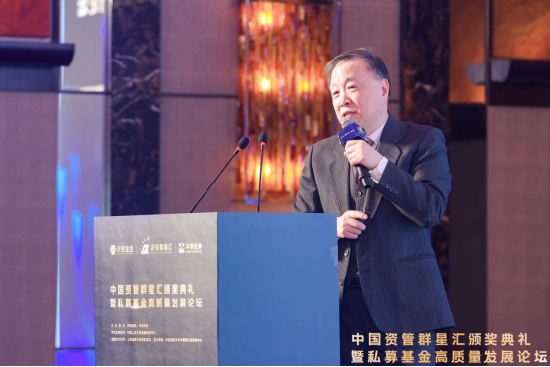
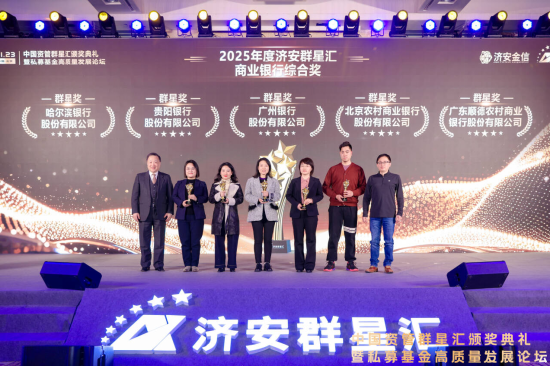
实力银行理财、商业银行、养老金管理人荣膺济安群星汇多项殊荣奖项,私募基金评选隆重上线
Xin Lang Ji Jin· 2026-01-23 09:24
Group 1 - The core viewpoint of the article highlights the transition of China's asset management industry from "scale expansion" to "structural optimization and quality improvement" in line with national strategies [1] - The "Jianan Stars" award ceremony and private equity fund high-quality development forum was held to explore development trends and share insights among industry elites [1] - The event recognized outstanding asset management institutions and introduced new evaluation categories for private equity funds [1] Group 2 - Jianan Jinxin is an independent third-party institution with qualifications for both public rating and awards in securities investment funds, promoting healthy industry development [4] - The "Jianan Stars" awards were established in collaboration with various authoritative research institutions and experts [4] - The institutions awarded the 2025 Jianan Stars Comprehensive Award include Everbright Wealth Management, Xinyin Wealth Management, and others [4][6][8] Group 3 - The 2025 Jianan Stars awards for specific categories include various institutions recognized for their performance in fixed income, mixed, equity, and cash management [10][12][14][16] - The awards for commercial banks also recognize institutions for their comprehensive and specific management categories [18][20][22][24][26][28][30] Group 4 - The pension product market has grown significantly, with the scale increasing from 14.9 billion yuan in 2013 to 2.46 trillion yuan by Q3 2025, maintaining a 36% market share in enterprise and occupational annuities [32] - Jianan Jinxin has been involved in pension product ratings and management since 2021, aiming to promote high-quality development in the pension market [32] - The 2025 Jianan Stars awards for pension management include institutions like Ping An Pension and Taikang Asset, as well as specific pension products recognized for their performance [36][37][39]
资管行业分化加剧 差异化定位成中小机构破局关键
Zhong Guo Zheng Quan Bao· 2026-01-07 00:55
Core Insights - The asset management industry is undergoing significant transformation due to the implementation of new regulations, leading to a pronounced "Matthew Effect" where larger firms gain competitive advantages while smaller firms struggle to adapt [1][2][3] Industry Overview - The asset management sector is experiencing unprecedented adjustments, with active management becoming a central consensus for development [2] - Larger institutions leverage their comprehensive advantages in funding, branding, and research to solidify their market position, while smaller firms face dual pressures of survival and transformation [2][3] Challenges for Smaller Firms - Smaller institutions are hindered by their reliance on single product innovation for growth, facing challenges in cost control, talent acquisition, technology investment, and brand development [2][3] - The difficulty in building core competencies and meeting collaboration requirements exacerbates the challenges for smaller firms [2][3] Differentiation Strategies - Differentiation is crucial for smaller firms to break through market barriers, with a focus on activating unique capabilities and deepening expertise in specific areas such as fixed income and quantitative investments [3][4] - The integration of asset management with asset securitization and the exploration of unique business models like ABS and public REITs are recommended to create competitive advantages [3][4] Research and Development Framework - A shift towards a "scientific + digital" driven research framework is essential, moving away from reliance on individual star managers and emphasizing technology's role in enhancing research efficiency and risk control [3][6] - Establishing a long-term performance-oriented assessment mechanism is vital for supporting active management transformation [3][5] Case Study: Bohai Huijin - Bohai Huijin has established a "three-pronged" approach focusing on specialization, differentiation, and premium offerings, with a strong emphasis on fixed income and ABS [4][5] - The company aims to create a differentiated product system by focusing on "fixed income+" strategies and exploring unique investment avenues [4][5] Talent and Technology Integration - Addressing talent retention and development is critical, with Bohai Huijin implementing an "internal talent" system to enhance performance and adaptability [6] - The integration of AI technology into business processes is being pursued to standardize operations and improve research efficiency [6][8] Strategic Alignment with National Goals - The asset management business should align with national strategic initiatives, focusing on product innovation in areas like green finance and regional development [7][8] - The emphasis on "fixed income+" products is crucial in a low-interest-rate environment, necessitating a multi-dimensional research approach to enhance strategy stability [7][8] Building Core Competencies - Companies are advised to develop core capabilities through technology-driven risk management, flexible business models, and organizational resilience [8] - Emphasizing cultural cohesion and organizational values is essential for adapting to industry changes and ensuring rapid response to market dynamics [8]
渤海汇金总经理吴国威:资管行业分化加剧 差异化定位成中小机构破局关键
Zhong Guo Zheng Quan Bao· 2026-01-07 00:38
Core Insights - The asset management industry is undergoing significant transformation due to the implementation of new regulations, leading to a pronounced "Matthew Effect" where larger firms gain competitive advantages while smaller firms struggle to adapt [1][2][3] Industry Overview - The asset management sector is experiencing unprecedented adjustments, with active management becoming a central consensus for development [2] - Larger institutions leverage their comprehensive advantages in funding, branding, and research to solidify their market position, while smaller firms face dual pressures of survival and transformation [2][3] Challenges for Smaller Firms - Smaller institutions are hindered by their reliance on single product innovation for growth, facing challenges in cost control, talent acquisition, technology investment, and brand development [2][3] - The difficulty in building core competencies and meeting collaboration requirements exacerbates the challenges for smaller firms [2][3] Differentiation Strategies - Differentiation is crucial for smaller firms to break through market barriers, with a focus on activating unique capabilities and deepening expertise in specific areas such as fixed income and quantitative investments [3][4] - The integration of asset management with asset securitization and the exploration of specialized business models are essential for creating competitive advantages [3][4] Research and Development Framework - A shift towards a "scientific + digital" driven research framework is necessary, moving away from reliance on individual star managers and emphasizing technology's role in enhancing research efficiency and risk control [3][6] - Establishing a long-term performance-oriented assessment mechanism is vital for supporting active management transformation [3][5] Case Study: Bohai Huijin - Bohai Huijin has established a professional, specialized, and boutique development positioning, focusing on fixed income and related areas to create a replicable transformation model [4][5] - The company emphasizes a diversified product system, integrating fixed income with innovative strategies in areas like convertible bonds and asset-backed securities (ABS) [4][5] Cultural and Structural Support - To ensure effective implementation of its strategy, Bohai Huijin has built a support system across cultural, assessment, and compliance dimensions [5][6] - The company promotes a culture centered on long-term value creation and has developed a performance assessment system that prioritizes investor returns [5][6] Talent and Technology Integration - Addressing talent retention, Bohai Huijin has created an "internal talent" system that encourages performance-based advancement and flexibility in roles [6] - The integration of AI technology into business processes aims to enhance operational efficiency and compliance, ensuring a robust risk management framework [6][8] Strategic Opportunities - The asset management business should align with national strategic goals, focusing on product innovation in areas like green finance and regional development [7][8] - Bohai Huijin aims to optimize its research and service offerings through a multi-dimensional product system and collaborative partnerships tailored to client needs [7][8] Building Core Competencies - The company suggests constructing core capabilities through technology-driven risk management, flexible business models, and organizational resilience [8] - Emphasizing a culture of adaptability and responsiveness to industry changes is critical for maintaining competitive advantage [8]
渤海汇金总经理吴国威: 资管行业分化加剧 差异化定位成中小机构破局关键
Zhong Guo Zheng Quan Bao· 2026-01-06 21:59
Core Insights - The asset management industry is undergoing significant transformation due to the implementation of new regulations, leading to a pronounced "Matthew Effect" where larger firms gain competitive advantages while smaller firms struggle to adapt [1][2] - Differentiated positioning is crucial for smaller firms to navigate the challenges of transformation, emphasizing the need for a focus on unique strengths and capabilities [2][4] Industry Transformation and Challenges - The shift towards active management is a consensus in the industry, with larger firms leveraging their resources to dominate the market, while smaller firms face dual pressures of survival and transformation [1][2] - Smaller firms are increasingly challenged by the need to balance resource allocation across cost control, talent acquisition, technology, and brand development [2][3] Strategic Positioning for Smaller Firms - Smaller firms should activate their unique characteristics and focus on niche areas such as fixed income, quantitative investment, and derivatives to build a competitive edge [2][4] - The integration of asset management with asset securitization is essential for exploring unique business models and creating differentiated products [2][4] Research and Investment Framework - Building a robust research and investment framework is critical for the transition to active management, moving away from reliance on individual star managers to a more systematic approach [3][6] - Emphasizing a "scientific + digital" driven investment research framework can enhance efficiency and risk control [3][6] Implementation Strategies - The company has established a "three-pronged" approach focusing on specialization, differentiation, and premium offerings, particularly in fixed income and asset-backed securities [4][5] - A multi-dimensional assessment system prioritizing long-term investor returns over short-term gains is being implemented to support this strategic positioning [5][6] Talent and Technology Integration - Addressing talent retention and development is vital, with the establishment of an internal talent system that promotes performance-based advancement [6][7] - The integration of AI technology into business processes is being pursued to enhance operational efficiency and compliance [6][8] Strategic Opportunities and Core Competencies - Aligning asset management with national strategic goals is essential, focusing on areas like green finance and regional development [7][8] - A multi-faceted investment research and service model is being developed to adapt to market changes and enhance product offerings [7][8]
资管行业分化加剧差异化定位成中小机构破局关键
Zhong Guo Zheng Quan Bao· 2026-01-06 20:43
Core Insights - The asset management industry is undergoing significant transformation due to the implementation of new regulations, leading to a pronounced "Matthew Effect" where larger firms gain competitive advantages while smaller firms struggle to adapt [1][2] Industry Overview - The asset management sector is experiencing profound adjustments, with active management becoming a central consensus for development [2] - Larger institutions leverage their comprehensive advantages in funding, branding, and research to accelerate their lead, while smaller firms face dual pressures of survival and transformation [2] - The differentiation in the industry is becoming increasingly evident, with smaller firms unable to sustain growth through traditional product innovation [2] Challenges for Smaller Firms - Smaller institutions are encountering difficulties in balancing resource allocation across cost control, talent acquisition, technology, and branding [2] - The transition to innovative business models is hindered by the increasing complexity of market regulations, making it challenging to build core competencies [2] - Even with differentiated advantages, smaller firms must accumulate core strengths over time to meet partnership entry requirements, resulting in prolonged transformation cycles [2] Strategic Recommendations for Smaller Firms - Differentiation in positioning is crucial for smaller firms to break through traditional competition in public funds [3] - Smaller firms should activate their unique characteristics and focus on niche areas such as fixed income, quantitative investment, and derivatives to enhance their product offerings [3] - A shift towards a "scientific + digital" driven research framework is essential, emphasizing the integration of technology in research and establishing long-term performance evaluation mechanisms [3] Case Study: Bohai Huijin - Bohai Huijin has established a development positioning centered on specialization, differentiation, and premium offerings, focusing on fixed income and related sectors [4] - The company aims to create a differentiated product system by leveraging its strengths in fixed income and asset-backed securities (ABS) [4] - Bohai Huijin's strategy includes a focus on "fixed income +" products, ABS, and innovative equity investment approaches to avoid traditional competitive pressures [4] Implementation Framework - To ensure effective implementation of its strategy, Bohai Huijin has developed a support system across cultural, assessment, and compliance dimensions [5] - The company emphasizes a long-term return-oriented assessment mechanism and a strong commitment to risk management and compliance [5] - Talent retention and technological integration are critical for successful transformation, with initiatives to build an internal talent system and leverage AI technology for operational efficiency [5] Alignment with National Strategy - The asset management business should align with national strategic goals, focusing on product innovation in areas like green finance and regional development [6] - Bohai Huijin aims to enhance its existing advantages in the ABS sector while exploring new opportunities in data asset securitization [6] - The company proposes a "multi-dimensional research + refined service" approach to navigate the challenges posed by a low-interest-rate environment and increasing competition [6] Building Core Competencies - To address uncertainties in the market, Bohai Huijin suggests constructing core capabilities through technology-driven risk management, business flexibility, and organizational resilience [7] - The establishment of an intelligent risk control framework and a modular research model are key components of this strategy [7] - Strengthening organizational culture and values is essential for ensuring quick responses to industry changes [7]
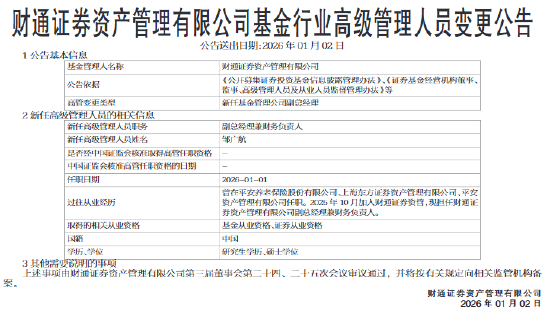
财通资管新任任邹广航为副总经理兼财务负责人
Xin Lang Cai Jing· 2026-01-06 04:07
Core Viewpoint - The appointment of Zou Guanghang as the new Deputy General Manager and Chief Financial Officer of Caitong Securities Asset Management is a strategic move aimed at enhancing the company's management capabilities and aligning with recent leadership changes within the organization [1][3]. Group 1: Management Changes - Zou Guanghang will officially assume his role on January 1, 2026, and brings extensive experience from previous positions at major financial institutions, including Ping An Pension Insurance and Shanghai Dongfang Securities Asset Management [2][6]. - The recent management adjustment also includes the appointment of Lu Zhen as Assistant General Manager, who has a strong background in channel management from his tenure at Industrial and Commercial Bank of China [3][6]. Group 2: Company Overview - Caitong Securities Asset Management, established in December 2014, is a wholly-owned subsidiary of Caitong Securities, the only provincial-level securities firm in Zhejiang [3][6]. - As of December 2025, the company reported an asset scale of 107.78 billion yuan, with non-monetary assets amounting to 94.248 billion yuan, ranking 49th out of 164 in the industry [3][6]. Group 3: Business Strategy - The company has developed a "one main, two wings" business model, focusing on active management in equity investment, fixed income, and multi-asset investment, while also engaging in asset securitization and capital market services [5][8]. - In March 2025, Caitong Securities Asset Management became the first securities firm to obtain QDII business qualifications, marking a significant step in its international business expansion [5][8]. Group 4: Industry Context - The asset management industry is experiencing a wave of executive changes, with many firms undergoing leadership transitions as they adapt to regulatory changes and increased competition [5][8]. - The shift from traditional channel business to active management is a critical trend in the industry, highlighting the importance of Zou Guanghang's dual background in insurance and securities for the company's future development [5][8].

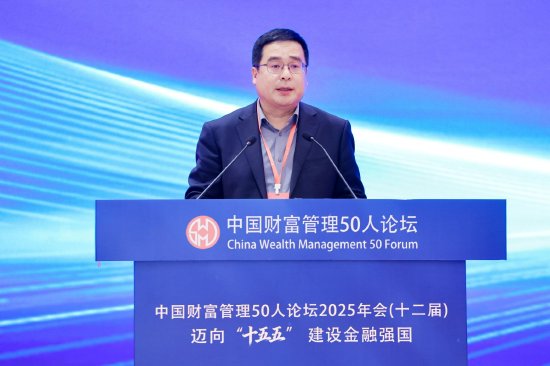
理财需求持续扩容 银行理财子公司如何实现能力跃迁?
Zheng Quan Ri Bao Wang· 2025-12-29 06:25
Core Insights - The asset management industry is facing a complex market environment characterized by low interest rates, increased volatility in the bond market, and a shift in wealth allocation among residents towards diversified financial assets [1][2] Group 1: Industry Trends - The asset management industry is transitioning from a "scale-oriented" approach to a "value-oriented" one, with the dynamic market environment presenting both challenges and opportunities for high-quality development [2] - There is a notable trend of wealth shifting from bank deposits to diversified financial assets, driven by factors such as population aging and a low interest rate environment [2] - Institutional clients are increasingly transitioning from borrowers to investors, indicating significant growth potential in the wealth management market [2] Group 2: Investment Environment - The ongoing low interest rate environment and increased volatility in the bond market are putting pressure on the investment operations of bank wealth management subsidiaries [2] - The equity market is expected to exhibit a slow bull trend by 2025, with structural differentiation, particularly in sectors like AI and high-end manufacturing, which presents new investment opportunities [3] Group 3: Strategic Development - To adapt to the high-quality development needs of the "15th Five-Year Plan," bank wealth management must meet residents' demands for higher returns and lower volatility while enhancing service quality for the real economy [4] - There is a consensus among bank wealth management subsidiaries to strengthen multi-asset and multi-strategy investment capabilities, reflected in product structures that include "fixed income plus," long-term, retirement, and cross-border wealth management products [4][5] - Enhancing core research and investment capabilities is essential, with a focus on building a macro-factor-driven asset allocation framework and a standardized, results-oriented research and investment system [5] Group 4: Client Experience and Risk Management - Improving client product holding experiences, strengthening risk management, and deepening industry collaboration are critical for bank wealth management subsidiaries [5]
武兴锋:资管行业正处于从“规模导向”向“价值导向”转型关键阶段
Xin Lang Cai Jing· 2025-12-27 11:38
Core Viewpoint - The Chinese wealth management industry is transitioning from a "scale-oriented" approach to a "value-oriented" strategy, driven by low interest rates, tightening regulations, and narrowing returns on quality assets, which presents both challenges and opportunities for sustainable development [3][9][20] Funding Side - As of November 2025, the bank wealth management market's outstanding scale reached 31.67 trillion yuan, and public fund scale surpassed 36 trillion yuan, indicating steady expansion in the asset management industry [4][14] - The shift in residents' wealth allocation is deepening, with a trend towards financial assets as GDP per capita exceeds $10,000, aligning with national strategies to increase property income [4][14] - With over 60 trillion yuan in fixed deposits maturing by 2026, the low interest rate environment is expected to accelerate the shift of funds towards financial products, laying a solid foundation for industry growth [4][14] Asset Side - Wealth management institutions face multiple pressures in investment operations, particularly in the bond market, where volatility has increased, challenging traditional "buy and hold" strategies [5][15] - The A-share market is expected to show a slow bull trend in 2025, with significant structural differentiation, particularly in new economy sectors like AI and high-end manufacturing, requiring institutions to enhance their research depth and risk control [5][15] - Institutions need to focus on core capabilities, enhancing research and investment capabilities, and innovating products to transition from "scale competition" to "value creation" [6][16][20] Investment Research Capability - Institutions should develop a "multi-asset, multi-strategy" approach to adapt to the dual pressures of low interest rates and asset scarcity, utilizing diverse tools to enhance returns and manage risks [6][17] - Establishing a macro-factor-driven asset allocation framework and a standardized, results-oriented research system is essential for effective investment management [6][17][18] - Implementing suitability management is crucial for protecting consumer rights and ensuring appropriate product matching for investors [7][18] Product Development - Institutions must innovate product forms and integrate them with various investment scenarios to meet diverse investor needs [8][19] - Focusing on national strategies, institutions should expand product lines in areas like pension, inclusive finance, green finance, and digital finance, thereby supporting the real economy and enhancing long-term capital market stability [8][19]
银证携手共建高适配性资产供给生态
Zhong Guo Zheng Quan Bao· 2025-12-19 20:10
Core Viewpoint - The banking and securities asset management sectors are undergoing significant transformation due to low interest rates and strict regulations, necessitating collaboration to build a high-quality development ecosystem [1][2]. Group 1: Industry Changes - The asset management industry is experiencing profound changes driven by market and regulatory forces, with a focus on risk prevention, standardization, and protecting investor rights by 2025 [1]. - High-interest deposits are declining, leading to a demand for low-volatility, stable products, as risk appetite for new investment funds continues to decrease [2]. - Customer needs are evolving from a singular focus on returns to comprehensive asset allocation services, requiring full lifecycle wealth planning solutions [2]. - Small and medium-sized banks are accelerating their transition to light asset management, focusing more on distribution and wealth management, which opens up significant market opportunities for collaboration with securities firms [2]. Group 2: New Collaboration Models - The collaboration between banks and securities firms has evolved from traditional channel connections to a new paradigm of "joint creation + outsourcing" and "fixed income +" cooperation [2]. - The joint creation BOF model addresses the challenges faced by small and medium-sized banks by helping them replace existing bond assets and retain core customers through collaborative product creation [2]. - The outsourcing BOF model allows wealth management companies to delegate fixed-income asset management to securities firms, enhancing returns through strategic operations while extending cooperation into the "fixed income +" domain [2]. Group 3: Future Development - In the context of investor education, banks and securities firms should establish mechanisms for co-creation of content and joint activities, enhancing customer experience and trust through practical educational materials and regular market updates [2]. - The industry should collaboratively participate in setting standards, clarifying roles, risk control processes, and disclosure requirements, while leveraging financial technology to optimize asset allocation and improve risk management efficiency [2]. - Future opportunities lie in expanding into pension finance and inclusive finance, developing products and services tailored to long-term retirement needs and small, flexible investment tools for middle and small investors [3].