
消费板块投资

Search documents
食品饮料行业周报:白酒调整渐进深水区,持续跟踪观测景气度回升进度-20260315
Xiangcai Securities· 2026-03-15 10:15
Investment Rating - The industry investment rating is maintained as "Buy" [2] Core Insights - The food and beverage industry is experiencing a gradual adjustment in the liquor sector, with a focus on tracking the recovery of market sentiment [6] - The industry is currently at a historically low valuation, with a PE ratio of 20X, ranking 26th among the Shenwan primary industries [5][16] - The white liquor industry is undergoing a significant transformation, shifting from pure scale expansion to structural optimization, indicating a potential reshuffling of the industry landscape [6][7] Summary by Sections Industry Performance - From March 9 to March 13, the food and beverage industry rose by 1.08%, while the Shanghai and Shenzhen 300 Index increased by 0.58%. The industry index underperformed the market by 1.18 percentage points [4][10] Valuation Analysis - As of March 13, 2026, the food and beverage industry's PE ratio is 20X, with sub-sectors like other alcoholic beverages (49X), snacks (34X), and health products (33X) having higher valuations, while white liquor (18X), beer (22X), and dairy (23X) are lower [5][16] White Liquor Sector Insights - The white liquor sector is in a deep adjustment phase, with demand pressure becoming a norm. Only a few major companies reported slight revenue increases in Q3 2025, indicating a shift in growth logic and brand value [6] - Major companies like Moutai and Wuliangye are adopting different strategies to adapt to market changes, focusing on consumer-centric approaches and enhancing brand value [7] Investment Recommendations - The report suggests focusing on three main lines for investment: stable demand leaders, companies innovating in products and channels, and undervalued consumer goods sector leaders. Specific companies to watch include Baba Food, Yanjing Beer, Chongqing Beer, Yili, and Nanjiao Food [8][44]
湘财证券晨会纪要-20260303
Xiangcai Securities· 2026-03-03 00:26
Core Insights - The food and beverage industry experienced a decline of 1.54% from February 23 to February 27, 2026, underperforming the Shanghai and Shenzhen 300 Index by 2.33 percentage points [2] - The overall valuation of the food and beverage industry is at a historically low level, with a PE ratio of 21X as of February 27, 2026, ranking 24th among the Shenwan first-level industries [2] - The industry is witnessing a moderate recovery in inflation, with the CPI remaining stable year-on-year, indicating a gradual improvement in economic conditions [3] Industry Valuation - The food and beverage industry PE ratio is 21X, with sub-sectors like other alcoholic beverages (51X), snacks (36X), and health products (34X) showing higher valuations, while white liquor (19X), beer (22X), and dairy (23X) are at the lower end [2] - The investment recommendation highlights that despite some macroeconomic data being weak, the sector's valuation has adequately priced in pessimistic expectations, suggesting potential for recovery [4] Investment Recommendations - The report suggests focusing on three main investment lines: 1. Industry leaders with stable demand and strong risk resilience 2. Companies actively developing new products, channels, and scenarios to capture high-growth opportunities 3. Leaders in certain consumer goods sub-sectors that have reasonable valuations after adjustments and high growth potential [4] - Specific companies to watch include Guizhou Moutai, Andeli, Shanxi Fenjiu, Yanjing Beer, and Yili Group, maintaining a "buy" rating for the food and beverage industry [5]
消费板块走弱,关注港股通消费ETF易方达(513070)、消费ETF易方达(159798)等产品投资机会
Sou Hu Cai Jing· 2026-02-26 10:35
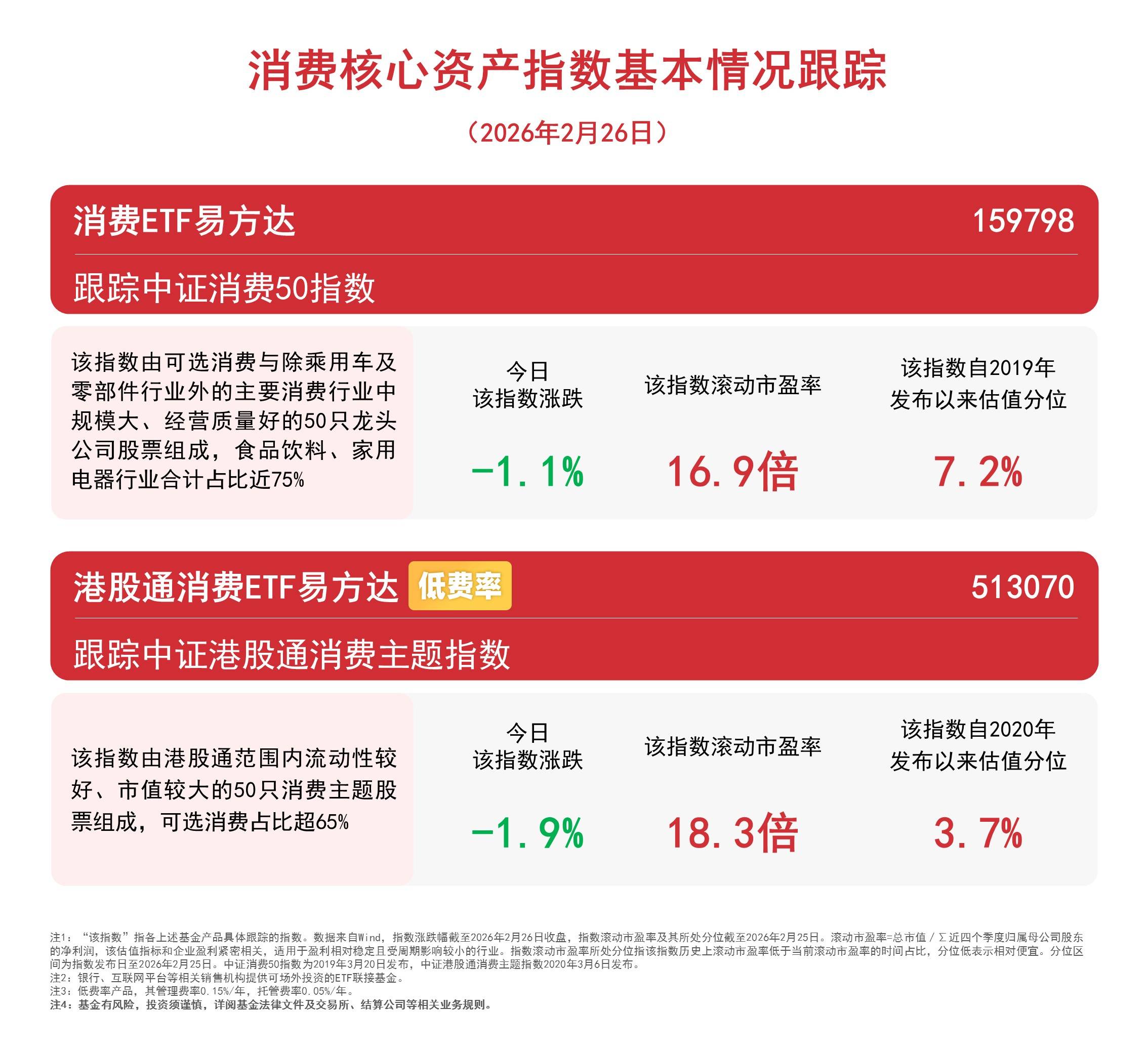
Group 1 - The core viewpoint of the article indicates a decline in the consumer indices, with the CSI Consumer 50 Index down by 1.1% and the CSI Hong Kong Stock Connect Consumer Theme Index down by 1.9% [1] - The E Fund Consumer ETF (513070) has attracted over 1.2 billion yuan in capital over the past 10 trading days, indicating strong investor interest [1] - According to CITIC Securities, the consumption performance during the Year of the Horse Spring Festival shows a mixed trend, aligning with expectations, where sectors like hotels, scenic spots, and high-end liquor exhibit better performance [1] Group 2 - The overall consumption performance is affected by a weak macroeconomic environment, suggesting that the recovery in consumer sentiment may take time [1] - Short-term investment opportunities in consumption may arise from potential fiscal stimulus policies [1]

政策暖风叠加春节催化 消费板块投资机遇凸显
Zhong Guo Zheng Quan Bao· 2026-02-13 20:23
Core Viewpoint - The upcoming 2026 Spring Festival consumption season is expected to inject strong vitality into traditional consumption while accelerating the implementation of new business formats and models, shifting the investment logic in the consumption sector from "overall recovery" to "selective structure" [1][4]. Policy Effects - The "2026 'Shopping New Spring' Special Activity Plan" was jointly issued by nine departments, covering six areas: food, accommodation, transportation, tourism, shopping, and entertainment [1]. - The plan includes various promotional activities such as New Year’s Eve dinner packages, home renovation promotions, and increased transportation capacity by civil aviation and railway departments [1][2]. - The Ministry of Commerce announced three major incentives for consumers: trade-in programs, prize invoices, and financial support, aimed at enhancing the supply and promotional activities of retail businesses [2]. Market Dynamics - The restaurant sector is experiencing a surge in demand, with many restaurants in Beijing reporting a booking rate of 90% for New Year’s Eve dinners [3]. - Various cities are creating complex consumption scenarios, such as events in Wangfujing and Nanjing Road that combine culture, food, and interactive experiences [3]. - The trade-in program is gaining traction, with an emphasis on increasing subsidies and enhancing promotional activities during the Spring Festival [3]. Investment Opportunities - Analysts suggest focusing on four main investment lines: 1. Offline retail leaders adapting to consumer trends and regaining traffic [4]. 2. Gold and jewelry brands with fundamental and valuation recovery potential [4]. 3. Domestic beauty brands excelling in high-demand niches [4]. 4. Upstream differentiated medical beauty product manufacturers benefiting from the recovery of medical beauty consumption [4]. - Long-term investment strategies should consider changes in consumer structure and focus on new products, technologies, channels, and markets [5].
消费板块震荡分化,关注港股通消费ETF易方达(513070)、消费ETF易方达(159798)等产品投资价值
Mei Ri Jing Ji Xin Wen· 2026-02-13 15:26
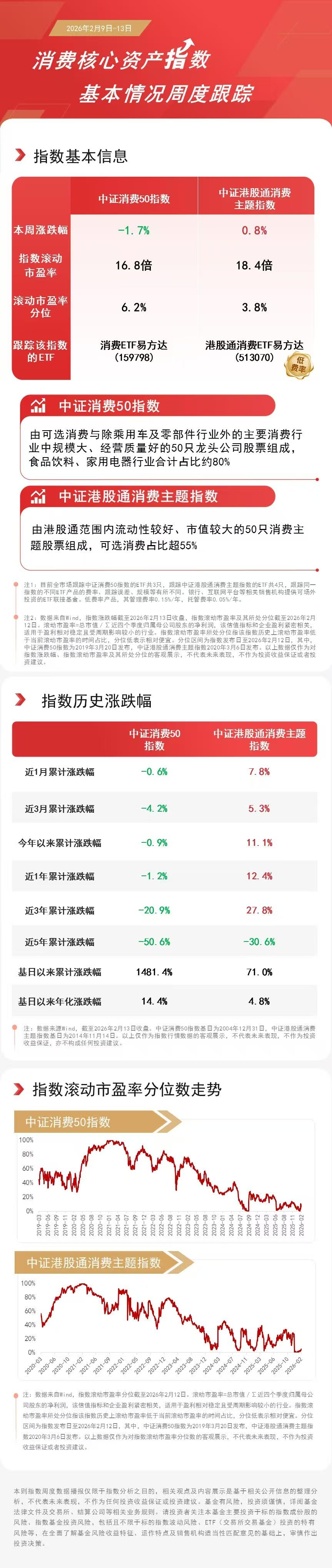
Core Viewpoint - The consumer sector in the Hong Kong stock market shows mixed performance, with the CSI Hong Kong Stock Connect Consumer Theme Index rising by 0.8% while the CSI Consumer 50 Index fell by 1.7% this week [1][3]. Group 1: Index Performance - The CSI Hong Kong Stock Connect Consumer Theme Index has a rolling price-to-earnings (P/E) ratio of 18.4 times, while the CSI Consumer 50 Index has a rolling P/E ratio of 16.8 times [3]. - The rolling P/E ratio percentile for the CSI Hong Kong Stock Connect Consumer Theme Index is at 3.8%, indicating it is relatively cheaper compared to historical values, while the CSI Consumer 50 Index is at 6.2% [3][6]. - Year-to-date performance shows the CSI Hong Kong Stock Connect Consumer Theme Index has increased by 11.1%, while the CSI Consumer 50 Index has decreased by 0.9% [7]. Group 2: ETF and Fund Flows - The Hong Kong Stock Connect Consumer ETF managed by E Fund (513070) has seen a net inflow of 750 million yuan over four consecutive trading days [1]. - There are currently three ETFs tracking the CSI Consumer 50 Index and four ETFs tracking the CSI Hong Kong Stock Connect Consumer Theme Index, with varying fee rates and tracking errors [5]. - The management fee for low-fee products is 0.15% per year, and the custody fee is 0.05% per year [5]. Group 3: Sector Composition - The food and beverage, along with home appliance sectors, account for approximately 80% of the CSI Hong Kong Stock Connect Consumer Theme Index [5]. - The index comprises 50 consumer stocks with good liquidity and large market capitalization, with discretionary consumption making up over 55% of the index [5].
段永平:今天真没买茅台
Jin Shi Shu Ju· 2026-01-29 12:44
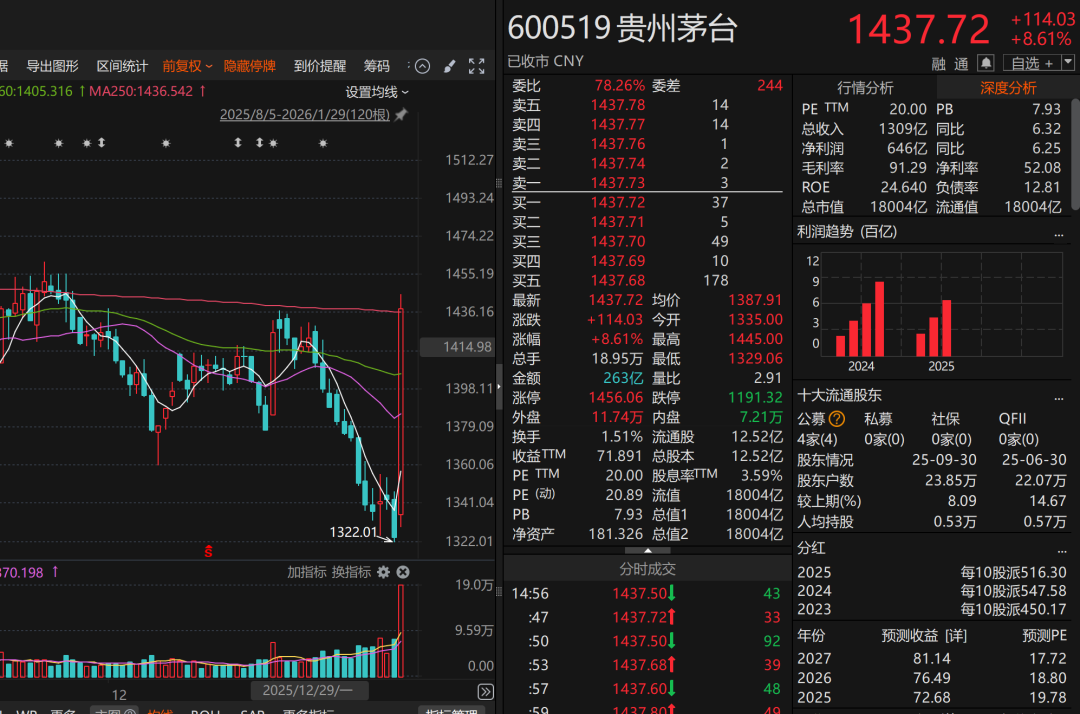
Group 1 - The core viewpoint of the news is the strong rebound of liquor stocks, particularly Kweichow Moutai, which saw its stock price rise to 1400 CNY, marking an increase of 8.61% on January 29 [1][2] - The overall performance of the consumer sector has been impressive, with multiple food and beverage ETFs rising over 7% [1][6] - Notably, the investment sentiment in the consumer sector is shifting, with fund managers recognizing the investment value despite previous downturns [8] Group 2 - Dong Yongping, a notable investor, mentioned that he did not purchase shares on the day of the price surge but had exchanged some shares of China Shenhua for Kweichow Moutai earlier [1][3] - Dong emphasized that the iMoutai platform addresses significant issues such as counterfeit products and high prices, which could unleash substantial purchasing power [4] - Fund managers are increasingly focusing on structural opportunities within the consumer sector, moving from a general optimism about industry growth to selecting outstanding companies with strong brand and product capabilities [8]

“新旧消费”龙头股,基金经理现操作分歧
券商中国· 2026-01-24 15:29
Core Viewpoint - The "technology bull" continues to lead the market in Q4 2025, while both "new consumption" and traditional consumption sectors, represented by brands like Bubble Mart and liquor companies, show weak performance throughout the year [1]. New Consumption Sector - In Q4 2025, the new consumption sector, particularly represented by Bubble Mart, experienced a significant decline, with Bubble Mart's stock dropping by 29.65% [2]. - Despite the downturn, Bubble Mart remained a key holding for 123 funds, with a total of approximately 37.587 million shares held, although it was reduced by 8.7591 million shares in the quarter [2]. - Other new consumption stocks like Mao Geping and Mixue Group also saw increased fund interest, with Mao Geping being increased by 575.93 million shares and Mixue Group by 1.0322 million shares [3]. - Analysts suggest that the new consumption sector has potential for growth due to low penetration rates, despite volatility in some companies [3]. Traditional Consumption Sector (Liquor) - The traditional consumption sector, particularly the liquor industry, has shown disappointing profit results, with many stocks experiencing declines [4]. - Major liquor companies like Kweichow Moutai, Wuliangye, and Luzhou Laojiao faced reductions in holdings by funds, with Wuliangye being reduced by approximately 15.9 million shares [5]. - Despite the overall decline, Kweichow Moutai saw an increase in holdings by over 20,000 shares in Q4, indicating continued investor confidence [5]. - Analysts believe that the liquor industry is currently in a bottoming phase, with expectations for stabilization in the future, although the bottom for prices and financial reports has yet to be seen [5].




券商资管系第3只浮动费率基金正在发行
Zheng Quan Ri Bao Wang· 2025-12-03 04:17
Group 1 - The core point of the news is the launch of the first floating fee rate fund by Caitong Asset Management, which will be open for subscription from December 3 to December 23, and it is the third floating fee rate fund issued by a brokerage asset management firm in the market [1] - The fund's management fee will be linked to the holding period and performance, ranging from 0.6% to 1.5%, with specific rates based on the annualized excess return relative to the benchmark [1] - If investors hold shares for less than one year, a management fee of 1.2% per year will be charged; for one year or more, the fee will vary based on performance, with a maximum of 1.5% for excess returns over 6% [1] Group 2 - The floating management fee model raises the requirements for fund managers' research and investment capabilities, incentivizing them to pursue more certain excess returns and share risks with investors during poor market performance [2] - The proposed fund manager, Li Xiang, has 17 years of experience in the securities industry and will focus on four key areas: technology, industrial metals, optimizing competitive landscapes, and consumer sectors at historical valuation lows [2] - Caitong Asset Management emphasizes a research-driven, value investment approach, with a comprehensive range of equity funds covering various investment strategies and themes [3]
白酒回来了!泸州老窖涨8%,山西汾酒涨6%!大消费集体爆发!千亿免税龙头也爆拉涨停!
雪球· 2025-11-10 07:57
Group 1: Market Overview - The three major indices showed mixed performance, with the Shanghai Composite Index rising by 0.53% and the Shenzhen Component Index increasing by 0.18%, while the ChiNext Index fell by 0.92% [2] - The total trading volume in the Shanghai and Shenzhen markets reached 2.17 trillion yuan, an increase of 175.4 billion yuan compared to the previous trading day, with over 3,200 stocks rising [2] Group 2: Consumer Sector Activity - The consumer sector experienced a significant rally, led by the liquor and duty-free segments, with stocks like China Duty Free Group and JiuGuiJiu hitting the daily limit, and Luzhou Laojiao rising over 8% [3][4] - Positive economic signals were released, including a 0.2% month-on-month and year-on-year increase in CPI for October, with core CPI rising by 1.2% year-on-year, marking the sixth consecutive month of growth [6] Group 3: AI Hardware Sector - The AI hardware sector saw a collective pullback, with stocks like NewEase falling by 3.94% and others like Zhongji Xuchuang dropping over 6% [8] - The launch of the open-source model Kimi K2Thinking by Moonlight Dark has raised concerns about the valuation of companies in the AI space, particularly in light of reduced training costs compared to competitors like OpenAI [10] Group 4: Chemical Sector Performance - The chemical sector remained active, particularly the phosphorus concept stocks, with Chengxing Co. hitting the daily limit and several others also experiencing significant gains [12] - Recent price increases in yellow phosphorus and lithium hexafluorophosphate, along with a tight supply situation, have contributed to the sector's performance, driven by demand from the energy storage and power battery markets [15][16]




浙商早知道-20250917
ZHESHANG SECURITIES· 2025-09-16 23:31
Market Overview - On September 16, the Shanghai Composite Index rose by 0.04%, while the CSI 300 fell by 0.21%. The STAR Market 50 increased by 1.32%, the CSI 1000 rose by 0.92%, and the ChiNext Index went up by 0.68%. The Hang Seng Index decreased by 0.03% [3][4] - The best-performing sectors on September 16 were comprehensive (+3.63%), machinery and equipment (+2.06%), computer (+2.06%), retail (+1.96%), and automotive (+1.82%). The worst-performing sectors included agriculture, forestry, animal husbandry, and fishery (-1.29%), banking (-1.15%), non-ferrous metals (-0.99%), defense and military industry (-0.5%), and food and beverage (-0.38%) [3][4] - The total trading volume for the A-share market on September 16 was 23,670.69 billion yuan, with a net outflow of 3.188 billion Hong Kong dollars from southbound funds [3][4] Key Insights Consumption Strategy - In the medium to long term, the first "systematic 'slow' bull" is expected to release a wealth effect, potentially slowly boosting consumption. Insurance funds and foreign capital entering the market are favorable for consumer blue chips, with positive signals from central Huijin increasing holdings in liquor ETFs. A top-down perspective suggests that the broad consumption sector is likely to benefit [5] - The market perceives that the wealth effect of the bull market is not significant. However, it is believed that the bull market can indirectly drive the wealth effect through a specific transmission path: A-share bull market → stabilization of second-hand housing prices in first-tier cities → stabilization of second-hand housing prices in other cities → recovery of real estate wealth effect. Investment opportunities in the consumption sector are worth noting, particularly in blue-chip leaders and emerging growth areas [5] - The driving factors include support from policies, funds, and sentiment, indicating that the first "systematic 'slow' bull" has quietly arrived, which may enhance the Sharpe ratio of the A-share market and indirectly boost consumption [5] Bond Market Insights - The current bond market adjustment differs significantly from historical bear markets, as the fundamentals, monetary policy, and curve shapes do not resemble past bear markets. Instead, it is more akin to an emotional adjustment under continuous risk preference shocks, anti-involution, and fund fee reduction [7][8] - There is a need to gradually break the mindset of a one-sided decline in yields and adapt to a fluctuating market pattern. However, based on the economic fundamentals and the core tone of moderate policy easing, a major bull-bear reversal has not yet been established [7][8] - The three core signals for a bull-to-bear transition include: 1. Policy bottom: Signs of marginal tightening in macro policies or expressions of tightening monetary policy 2. Fundamental bottom: Consistent and positive surprises in high-frequency and economic data 3. Sentiment bottom: A fragile and crowded trading structure triggered by the above two signals, leading to self-reinforcing sell-offs and deleveraging [8][9]