资本市场服务等

Search documents
北京师范大学:中国上市公司质量ESG指数报告
Sou Hu Cai Jing· 2026-01-29 10:46
Core Insights - The report titled "China Listed Company Quality/ESG Index Report No.5 (2025)" provides a comprehensive evaluation framework for the quality and ESG (Environmental, Social, and Governance) performance of listed companies in China, developed by Beijing Normal University [1][7]. Group 1: ESG Index Overview - The ESG index consists of three main dimensions: corporate governance (55% weight), social responsibility (35% weight), and environmental protection (10% weight), with a total of 132 specific indicators [1][11][12]. - The evaluation covers 5,292 A-share listed companies across the Shanghai, Shenzhen, and Beijing stock exchanges, using a relative scoring method based on the highest scores in each dimension [1][13]. Group 2: Evaluation Results - The average ESG index for non-financial companies from 2020 to 2024 shows fluctuations, with a score of 68.14 in 2024, indicating a slight decline of 0.79 from the previous year [2][18]. - State-owned enterprises consistently outperform non-state-owned enterprises, with central enterprises showing the best performance [2][20]. - The financial sector's average ESG index in 2024 is 73.76, reflecting a steady increase, particularly in corporate governance [2][42]. Group 3: Regional and Sectoral Performance - The eastern region leads in ESG performance, with Tianjin, Shanghai, and Anhui ranking as the top provinces in 2024 [2][31]. - The mining industry ranks highest in ESG performance, while the education sector ranks lowest among 17 industries evaluated [2][33]. Group 4: Policy Recommendations - The report suggests enhancing corporate governance by adopting international standards, improving board independence, and ensuring effective information disclosure and executive compensation incentives [2][17]. - It emphasizes the importance of aligning social responsibility and environmental protection efforts with industry realities while safeguarding stakeholder rights [2][17].


“十五五”金融强国建设蓝图:呼应六大内涵 锚定高质量发展
2 1 Shi Ji Jing Ji Bao Dao· 2025-10-31 17:31
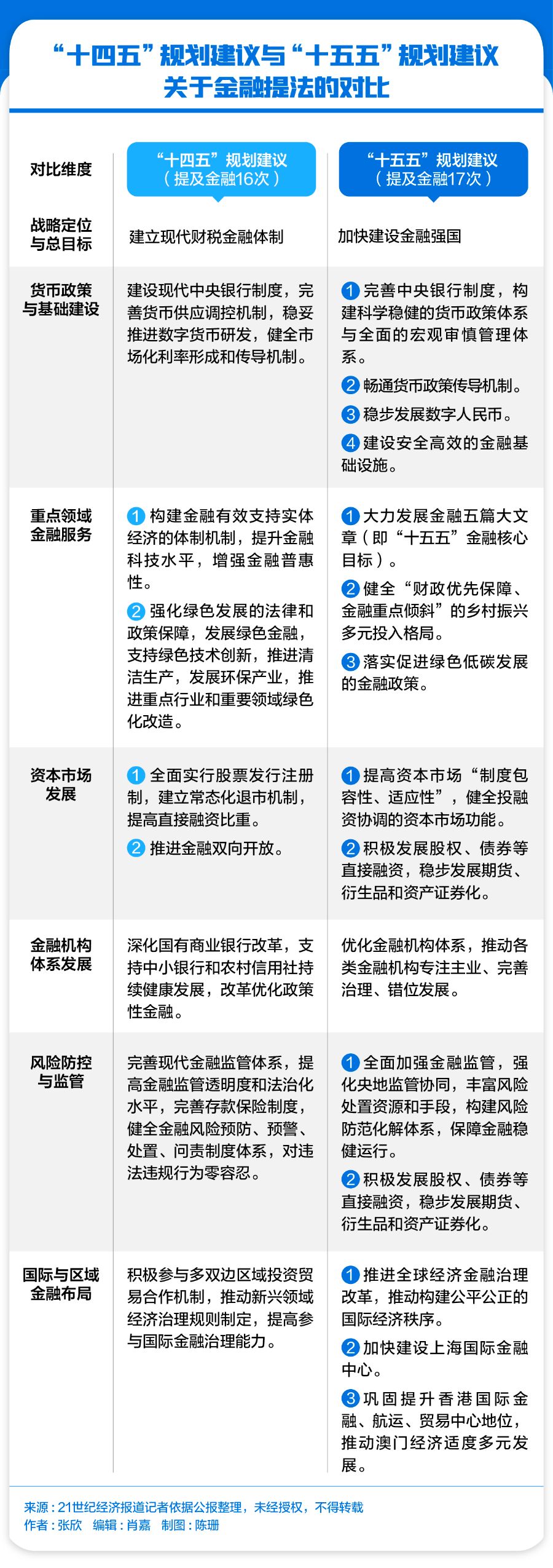
Core Insights - The "15th Five-Year Plan" emphasizes the strategic goal of accelerating the construction of a financial power, marking a significant shift from the previous focus on establishing a modern financial system to enhancing quality and global competitiveness [1][3][4] - The plan outlines six core components of a financial power, including a strong currency, a robust central bank, powerful financial institutions, an international financial center, effective financial regulation, and a skilled financial talent pool [1][2] Financial Development Strategy - The "15th Five-Year Plan" suggests a systematic upgrade of the central bank's framework, focusing on improving the monetary policy system and enhancing macro-prudential management [9][10] - Financial institutions are encouraged to specialize in their core functions and improve governance to reduce risks associated with homogeneous competition [19] Capital Market Reforms - The plan aims to enhance the inclusiveness and adaptability of the capital market, promoting direct financing through equity and bond markets while steadily developing futures, derivatives, and asset securitization [14][15] - The focus is on addressing the challenges of investment and financing coordination, which is crucial for fostering innovation and economic growth [14][15] Risk Management and Regulation - The "15th Five-Year Plan" emphasizes a systematic approach to risk prevention and resolution, particularly in key areas such as real estate, local government debt, and small financial institutions [17][18] - Strengthening the collaboration between central and local regulatory bodies is highlighted as essential for effective risk management [16][18] International Financial Center Development - The plan underscores the importance of establishing strong international financial centers, with Shanghai and Hong Kong being focal points for enhancing China's global financial influence [7][8] - The shift from being a participant to a leader in global financial governance is a key objective, aiming to shape international economic order [7] Financial Support for Real Economy - The "15th Five-Year Plan" prioritizes the development of five key financial areas: technology finance, inclusive finance, green finance, pension finance, and digital finance, aligning with national strategic goals [12][13] - These initiatives are designed to provide targeted financial support to meet the needs of the real economy and promote sustainable development [12][13]