
酒类酿造

Search documents
欧印正式签下所有协议之母级合作文件!双方联手直接叫板特朗普关税,这波重大联动引全球关注?
Sou Hu Cai Jing· 2026-02-05 02:41
Group 1 - The India-EU Free Trade Agreement, termed the "mother of all agreements," was finalized on January 27, 2026, after nearly 20 years of negotiations, covering 25% of global GDP and one-third of global trade, benefiting 2 billion people [1][3] - India will eliminate or reduce tariffs on 96.6% of goods imported from the EU, while the EU will reduce tariffs on 99.5% of goods from India, significantly impacting sectors like automotive and alcohol [1][3] - The automotive sector will see a reduction in tariffs from 110% to 10% over five years, with an annual import quota of 250,000 vehicles for the EU, which is a major advantage for European car manufacturers [1][3] Group 2 - The agreement will save the EU approximately €4 billion in tariff costs annually and is expected to double exports to India by 2032 [3] - The negotiations, which began in 2007, faced delays due to disagreements over agricultural subsidies and intellectual property, but accelerated after the U.S. imposed tariffs on Indian goods in 2025 [3][5] - The agreement strategically avoids sensitive areas such as agriculture and dairy, protecting India's key industries while allowing the EU to open markets for textiles, seafood, and jewelry [5] Group 3 - In addition to trade, India and the EU signed a security and defense partnership agreement, focusing on maritime security, defense technology cooperation, and counter-terrorism [7] - This partnership aims to balance China's influence in South Asia and reduce dependency on Chinese supply chains, particularly in critical minerals and technology [7] - Strengthening ties with the EU enhances India's role as a strategic partner in the Indo-Pacific region [7]

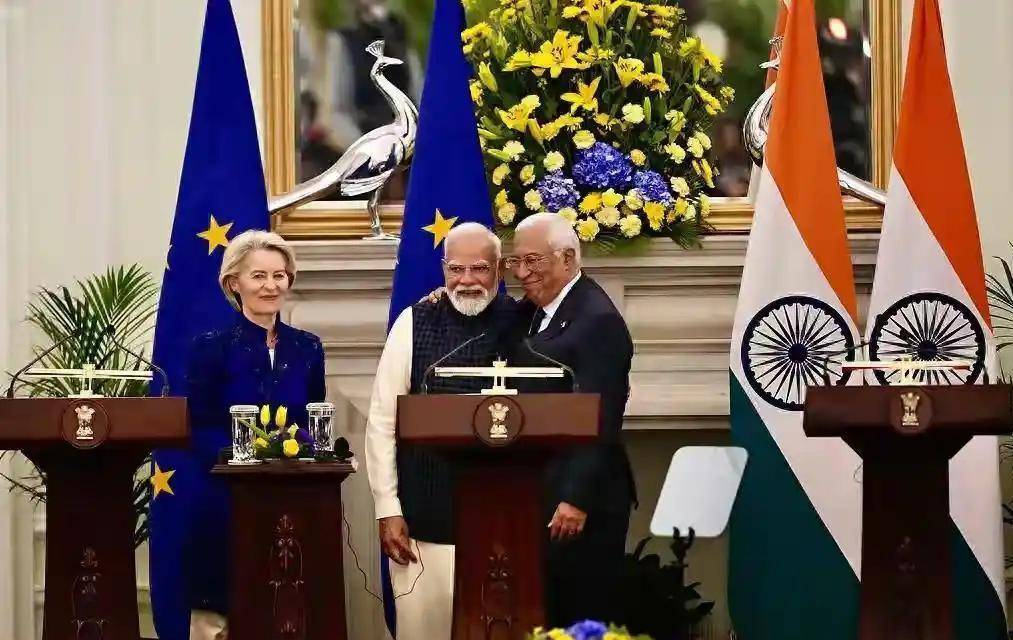
印欧敲定自贸协定:印度取消对超过90%欧盟商品的关税,提供25万辆汽车进口配额
Hua Er Jie Jian Wen· 2026-01-27 08:24
Core Insights - India and the EU have finalized a historic free trade agreement aimed at significantly reducing tariff barriers, with India committing to eliminate tariffs on over 90% of EU goods and opening up its highly protected automotive and alcoholic beverage markets [1][2] - The agreement is seen as a strategic counter to U.S. trade protectionism, especially following the imposition of punitive tariffs by the U.S. on Indian goods [1][4] - The deal is expected to create a closer economic relationship between India's 1.4 billion population and the European market, with a projected trade volume of $136.5 billion by March 2025 [6] Automotive Industry Access - A key highlight of the agreement is the unprecedented import quota for EU automotive manufacturers, allowing up to 250,000 vehicles annually, which is over six times the quota previously granted to the UK [2] - Import duties on approximately 160,000 fuel vehicles within the quota will be reduced to 10% over five years, while duties on electric vehicles will start to decrease in the tenth year [2] - The EU will reciprocate by providing up to 625,000 import quotas for Indian automotive manufacturers, and both parties will eliminate tariffs on auto parts to enhance supply chain integration [2] Broad Tariff Reductions and Sensitive Areas - The agreement encompasses a wide range of goods, with India agreeing to eliminate tariffs on over 90% of EU products, including a proposal for zero tariffs on steel products [3] - Significant reductions in tariffs on alcoholic beverages have been agreed upon, with wine tariffs set to be adjusted to 20%-30%, spirits to 40%, and beer to 50% [3] - Although agriculture remains a sensitive topic, the agreement includes provisions to lower high tariffs on EU agricultural products [3] Strategic Response to U.S. Tariff Pressures - The agreement is a crucial measure for India to address the trade pressures from the U.S., particularly after the U.S. imposed a 50% tariff on Indian goods [4] - This marks India's fourth major trade agreement following similar deals with the UK, Oman, and New Zealand [4] EU's Search for Trade Partnerships - The EU is also seeking trade partners to navigate the uncertainties in U.S.-EU relations, emphasizing a preference for "fair trade over tariffs" [5] - Prior agreements have been signed with other regions, including the Southern Common Market, Indonesia, Mexico, and Switzerland [5] Trade Scale and Future Outlook - The trade agreement is projected to create a massive market covering 2 billion people, although experts note it cannot fully replace the necessity of the India-U.S. trade agreement [6] - In 2024, India's trade surplus with the U.S. is expected to be $45.8 billion, significantly higher than the $25.8 billion surplus with the EU [6] - The agreement includes review clauses to reassess quotas based on the prosperity of the Indian automotive market and future concessions with other partners, including the U.S. [6]