AI消费电子

Search documents
帮主郑重:三大消费赛道优质标的清单,中长线闭眼盯这几类!
Sou Hu Cai Jing· 2025-12-19 00:39
Group 1: Smart Connected Vehicles - Focus on three categories: 1) Companies producing core components for autonomous driving, such as lidar and in-vehicle cameras, with leading firms investing over 10% of revenue in R&D [3] [4] - 2) Intelligent cockpit service providers, with new vehicle penetration rates exceeding 60% and accelerating growth [4] - 3) Automotive-grade chip manufacturers, particularly those involved in domestic substitution, as domestic new energy vehicle installations account for over 50% of the global total, making chip localization a necessity [4] Group 2: AI Consumer Electronics - Emphasis on "AI+" upgrade targets: 1) New product categories empowered by AI, such as smart speakers with large models and AI translation devices, with sales growth rates exceeding 30% year-on-year [4] - 2) Leading companies in the consumer electronics supply chain, especially those producing AI modules and precision manufacturing for top brands, benefiting from industry upgrades and stable overseas orders [4] - 3) Companies related to AR/VR devices, supported by policies promoting digital consumption, with leading firms already in mass production [4] Group 3: Silver Economy - Focus on "essential needs + quality": 1) Companies in elderly health management, such as those producing smart blood glucose meters and blood pressure monitors, with over 280 million people aged 60 and above driving demand for health monitoring [4] - 2) Operators of elderly care services, particularly those with chain operations and integrated medical care, benefiting from policy incentives like venue and tax benefits, with leading institutions achieving over 85% bed utilization [4] - 3) Companies involved in elderly-friendly renovations, such as leading firms in elderly appliances and smart nursing equipment, with the market for elderly-friendly renovations growing over 25% annually [4] Group 4: Investment Strategy - Long-term investment targets should focus on R&D investment, market share, and policy alignment, as these companies are positioned at the forefront of national strategy and industrial upgrades [5]


六部门联合发文促消费,开启消费市场新篇章!
Quan Jing Wang· 2025-11-28 09:03
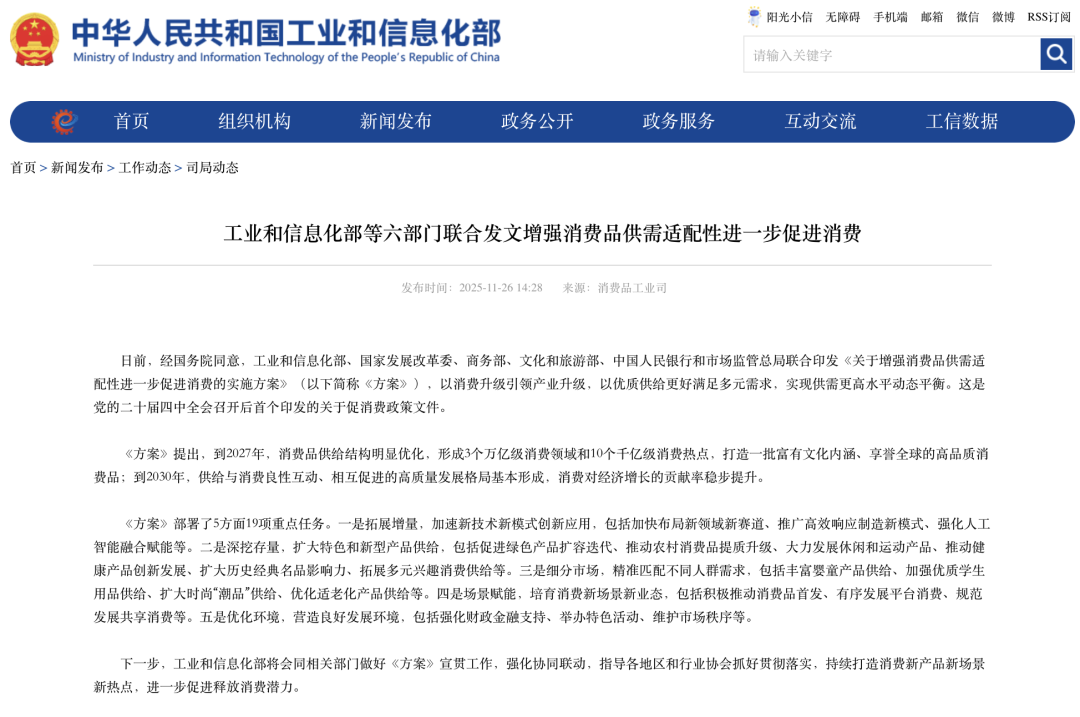
Core Viewpoint - The implementation plan aims to enhance the adaptability of consumer goods supply and demand, addressing the structural contradictions of oversupply in low-end products and insufficient supply in high-end products [2][3]. Policy Background - The current consumer market in China faces a dual challenge of low-end oversupply and high-end undersupply, necessitating a proactive approach from the supply side to align with changing consumer trends [2]. - The plan encourages enterprises to innovate and produce products that meet consumer preferences, thereby improving the quality and suitability of goods available to consumers [2]. Policy Core Goals - By 2027, the plan aims to optimize the supply structure of consumer goods, creating three trillion-level consumption sectors and ten hundred-billion-level consumption hotspots [3]. - By 2030, a high-quality development pattern characterized by positive interaction between supply and consumption is expected to be established, with a steady increase in consumption's contribution to economic growth [3][20]. Key Tasks Expanding Increment - Accelerate the application of new technologies and innovative models, promoting flexible production and user participation in design [5]. Deepening Existing Supply - Expand the supply of unique and new products, including green products, rural consumer goods, and health-related innovations [6]. Market Segmentation - Provide specific guidance for different consumer demographics, including products for children, students, and the elderly [7]. Scene Empowerment - Cultivate new consumption scenarios and business models, promoting platforms for product launches and shared consumption [8]. Environmental Optimization - Strengthen financial support for consumer goods enterprises through fiscal subsidies and specialized loans, while encouraging financial institutions to innovate consumer finance products [10]. Opportunities for Enterprises - The plan sets clear targets for three trillion-level and ten hundred-billion-level consumption hotspots, providing strategic guidance for corporate resource allocation and reducing decision-making uncertainty during transformation [11]. - The promotion of flexible manufacturing and customization is expected to enhance the efficiency and quantity of new product launches, offering a clear path for corporate upgrades [12]. New Market Spaces - The cultivation of new consumption scenarios is anticipated to open new market opportunities, particularly through the integration of AI technology in consumer products, which has shown significant growth [13]. - Innovations in the sports sector, including wearable devices and smart monitoring tools, are expanding the consumer landscape and enhancing customer engagement [13]. New Era of Consumption Market - The implementation of the plan signifies a new phase in China's consumption market, driven by dual supply and demand dynamics, which is expected to foster high-quality economic development [14].