Display Panels

Search documents
大型赛事、存储涨价等刺激,3月电视面板价格看涨
WitsView睿智显示· 2026-03-21 02:00
Core Viewpoint - In March, panel prices for TVs and laptops have increased, while laptop panel prices have stabilized after a period of decline [2]. Group 1: TV Panels - As of March, brands are preparing for upcoming promotional periods, including the World Cup and 618 sales, leading to stable demand for TV panels [4]. - Anticipated price increases for March include $1 for 32-inch, 43-inch, and 50-inch panels, $2 for 55-inch panels, and $3 for 65-inch and 75-inch panels [5]. - The demand for TV panels remains stable, and manufacturers are expected to maintain upward pricing trends due to ongoing cost pressures from storage and components [5]. Group 2: Monitor Panels - Demand for LCD monitor panels remains stable in March, although production is affected by rising storage costs and shortages of various components [6]. - Manufacturers are experiencing increased cost pressures and are likely to reflect this in price increases; for instance, the 23.8-inch FHD IPS panel is expected to rise by $0.3 to $0.4, and the 27-inch FHD IPS by $0.3 [6]. Group 3: Laptop Panels - Laptop panel demand remains steady in March, but rising storage costs and CPU shortages may lead to corrections in demand in the second quarter [7]. - Manufacturers are feeling pressure from rising costs of upstream components, which is affecting their profit margins; thus, laptop panel prices are expected to stabilize in March [7].


最新面板价格趋势(2026年3月)
TrendForce集邦· 2026-03-20 09:01
Core Viewpoint - In March 2026, the prices of television panels continued to rise, while laptop panel prices stabilized after a decline [5][11]. Group 1: Television Panel Prices - The average price of a 65-inch television panel reached $175, an increase of $3 from the previous month, representing a 1.7% rise; the lowest price was $168 and the highest was $178 [7]. - The average price of a 55-inch television panel was $126, up by $2 from the previous month, with a 1.6% increase; the lowest price was $119 and the highest was $129 [7]. - The average price of a 43-inch television panel was $66, which is $1 higher than the previous month, reflecting a 1.5% increase; the lowest price was $64 and the highest was $68 [7]. - The average price of a 32-inch television panel was $37, up by $1 from the previous month, indicating a 2.8% increase; the lowest price was $36 and the highest was $38 [7]. Group 2: Monitor Panel Prices - The average price of a 27-inch IPS monitor panel was $63.1, with a slight increase of $0.1 from the previous month, representing a 0.2% rise; the lowest price was $57.7 and the highest was $66 [9]. - The average price of a 23.8-inch IPS monitor panel was $50.4, which increased by $0.3 from the previous month, reflecting a 0.6% rise; the lowest price was $47.4 and the highest was $51.9 [9]. Group 3: Laptop Panel Prices - In March 2026, laptop panel prices remained stable after previous declines [11]. - The average price of a 17.3-inch TN panel was $37.6, with a minimum price of $37 and a maximum price of $38.9 [12]. - The average price of a 15.6-inch Value IPS panel was $39.6, with a minimum price of $37.9 and a maximum price of $41 [13]. - The average price of a 14.0-inch TN panel was $26.7, with a minimum price of $26.2 and a maximum price of $27.9 [14]. - The average price of an 11.6-inch TN panel was $24.9, with a minimum price of $24 and a maximum price of $26.3 [15].

8.6代OLED产线放量前夕,谁将率先跨入IT领域?
WitsView睿智显示· 2026-03-18 04:07
Core Viewpoint - The global IT OLED panel investment landscape is diversifying, with major players like Samsung Display, BOE, Visionox, and TCL Huaxing launching their 8.6-generation OLED production lines, indicating a competitive market environment [2][9]. Samsung Display - In 2023, Samsung Display announced an investment plan for its 8.6-generation line, utilizing traditional FMM evaporation technology and planning to incorporate Tandem OLED to extend screen lifespan, with mass production expected to start in Q2 2026, targeting Apple's new MacBook Pro [3]. BOE - BOE also employs FMM evaporation technology and Tandem OLED, announcing a total investment of 63 billion yuan for its 8.6-generation OLED production line, primarily aimed at mid-sized AMOLED panels. The line is expected to begin mass production in the second half of 2026, having achieved early activation five months ahead of schedule [4]. Visionox - Visionox has developed its own technology, ViP, which offers higher PPI and aperture rates compared to traditional FMM. The 8.6-generation OLED production line commenced construction in September 2024, with a total investment of 55 billion yuan, targeting the mid-to-large size AMOLED market across various applications. The line aims for volume production starting in Q1 2027 [5]. TCL Huaxing - TCL Huaxing is utilizing inkjet printing (IJP) technology, which simplifies the process and theoretically reduces material waste by about 30%. The 8.6-generation OLED line was officially launched in October 2025, with a total investment of approximately 29.5 billion yuan, focusing on applications in tablets, laptops, and monitors. The construction progress reached 40% by February 2026, with volume production expected in Q4 2027 [6]. Market Outlook - The FMM camp holds advantages such as stable customer relationships and extensive production experience, while the non-FMM camp is in its early development stage, facing challenges like lower yield rates and material development needs. However, there is significant market interest, suggesting potential for catching up with the FMM camp [9]. - The upcoming 8.6-generation lines from four major panel manufacturers are anticipated to reshape the IT OLED market landscape, with discussions on strategic shifts and opportunities at the 2026 New Display Industry Seminar [9].




3月手机面板行情:成本与需求双重挤压,手机面板价格延续跌势
CINNO Research· 2026-03-16 10:32
Core Viewpoint - The mobile display panel market is facing significant challenges as the effects of the Spring Festival holiday fade, with high upstream costs and cautious downstream purchasing sentiment leading to downward pressure on panel prices [2][4]. Group 1: Market Conditions - The interplay of high costs for upstream memory and raw materials with weak demand from downstream has enhanced the bargaining power of buyers, prompting panel and module manufacturers to adopt a "price for volume" strategy, resulting in continued price declines [2][4]. - The a-Si segment is experiencing shrinking brand demand, but leading manufacturers are maintaining high production rates by increasing shipments in the South China market. However, the ongoing cost pressure from rising raw material prices is making it difficult for module manufacturers to sustain long-term price reductions, indicating potential price softening for a-Si cells [4][5]. - In the LTPS segment, demand from automotive, laptops, and tablets supports high production rates, but the mobile sector is seeing a contraction in demand due to storage cost pressures. Manufacturers are adopting more competitive pricing strategies to secure new project orders, leading to continued price declines for LTPS panels in March [5]. Group 2: AMOLED Segment - The rigid AMOLED panel prices are expected to continue declining in March due to pricing strategies from major manufacturers. The flexible AMOLED panels face more severe challenges, with significant reductions in procurement volumes from terminal brands due to rising storage prices, leading to underutilization of production lines [5]. - To fill capacity gaps and maintain customer shares, panel manufacturers are offering discounts in negotiations, resulting in intensified price competition. The prices of flexible AMOLED panels are projected to remain on a downward trend, with a potential price drop of over 20% in the second half of the year [5]. - CINNO Research forecasts that prices for a-Si modules and LTPS panels will continue to decline in March and April 2026, with flexible AMOLED panel prices also expected to remain in a downward channel [5].

8.6代线产能爬坡,5代线及以下产能占比将降至4.7%
WitsView睿智显示· 2026-03-13 09:55
Core Viewpoint - The article discusses the ongoing transformation in the display panel industry, highlighting the shift from older generation production lines to newer, more efficient technologies, particularly in the context of LCD and OLED markets. Group 1: LCD Panel Industry Trends - Due to technological upgrades and increased production cost pressures, Taiwanese panel manufacturers are gradually shutting down older generation production lines while focusing on emerging businesses [4]. - The global LCD capacity share of 8.6-generation lines is expected to rise to 26% by 2026, indicating a concentration towards higher generation lines [4]. - Innolux has announced the disposal of certain module factories in Tainan Science Park, with Fab 5 expected to cease production by Q2 2026 [5]. - The global market share for Innolux and AUO is projected to decline to 9.1% and 9.2% respectively by 2026, as they continue to close older facilities [5]. - The share of 5th generation and below in the overall LCD market is anticipated to drop to 4.7% by 2026, a decrease of 0.5 percentage points [5]. - The 8.6-generation lines are expected to see an increase in capacity share by 1.4 percentage points, driven by production optimizations and new lines coming online [5]. - The ongoing ramp-up of several 8.6-generation lines is likely to increase competitive pressure on older generation lines, leading to a faster exit of these lines from the market over the next two to three years [5]. Group 2: OLED Industry Insights - The article outlines a schedule for an OLED industry event, featuring discussions on technological innovations and market competition, indicating a focus on advancements in OLED technology [8].

研报 | 高世代产线压境,8.6代线产能爬坡挤压市场格局,小世代LCD产线面临加速收敛压力
TrendForce集邦· 2026-03-13 08:04
Industry Insights - The core viewpoint of the article highlights the ongoing transition in the panel industry, with Taiwanese manufacturers gradually shutting down small-generation production lines while focusing on emerging businesses due to technological upgrades and competitive production costs [2][3] - The global LCD capacity share of 8.6-generation lines is expected to rise to 26% by 2026, indicating a structural shift towards higher-generation lines [2] Company Developments - Innolux has announced the disposal of certain module factories in the Tainan Science Park, with plans to cease production at Fab 5 by Q2 2026. Previously, Innolux closed Fab 4 and sold it to TSMC [2] - AUO is also in the process of closing its Singapore L4B and Taoyuan L5A factories between 2023 and 2025, leading to a projected global LCD market capacity share of 9.1% for Innolux and 9.2% for AUO by 2026 [2] Market Trends - The capacity share of 5th generation and below in the overall LCD market is expected to decline to 4.7% by 2026, a decrease of 0.5 percentage points year-on-year [3] - In contrast, the 8.6-generation lines are anticipated to increase their capacity share by 1.4 percentage points, driven by production optimizations and new lines entering mass production [3] - The ongoing ramp-up of several 8.6-generation lines, including Tianma TM19 and Laibo Phase 1, is expected to enhance competitiveness, putting additional pressure on weaker 5th and 6th generation lines [3]

3月电视面板行情: 短期供需博弈加剧, 面板价格呈结构性分化走势
CINNO Research· 2026-03-10 10:30
Core Viewpoint - The overall price of LCD TV panels has shown an upward trend due to the recovery of domestic and international demand and tight supply conditions in February. The demand is expected to remain supported in March due to pre-stock for the 618 promotion, although supply is becoming more relaxed, leading to a forecast of slight price increases for small and medium-sized panels while larger panels may stabilize in price [3]. Group 1: Price Dynamics - In February, the average prices for various sizes of LCD TV panels were as follows: 32" at $34.0, 43" at $66.0, 50" at $89.0, 55" at $113.0, 65" at $167.0, 75" at $220.0, 85" at $288.0, and 98"/100" at $425.0. In March, prices are expected to increase slightly, with 32" rising to $34.5, 43" to $67.0, 50" to $90.0, 55" to $114.0, and 65" to $168.0, while 75", 85", and 98"/100" remain stable at $220.0, $288.0, and $425.0 respectively [4][6]. Group 2: Market Conditions - The mobile panel market is entering a traditional off-season by January 2026, with brands reducing shipment targets to manage cost pressures, leading to a significant decline in overall demand for mobile panels [5]. - The a-Si panel market is experiencing increased competition due to reduced demand and the release of new production lines, which is likely to result in a continued downward trend in a-Si module prices [5]. - In February, despite some production cuts due to the Spring Festival, the overall capacity utilization rate remained relatively stable at 83.4%, with a year-on-year decrease of about 3.5 percentage points. The G10.5 production line saw a more significant decline, contributing to a tightening effect on supply and supporting a moderate price increase [5].

面板价格观察 | 3月电视与显示器面板涨幅明确,笔电面板跌势收敛
TrendForce集邦· 2026-03-06 06:16
Core Viewpoint - TrendForce predicts that TV panel and monitor panel prices will rise in March 2026, while some laptop panel prices are expected to decline [3][6]. Group 1: TV Panel Price Trends - Demand for TVs remains stable, with North American retailers agreeing to increase prices for small to medium-sized TVs starting in Q2, boosting confidence in panel procurement [3]. - Price increases for various TV panel sizes are forecasted: 32-inch, 43-inch, and 50-inch panels are expected to rise by $1; 55-inch panels by $2; and 65-inch and 75-inch panels by $3 [3]. Group 2: Monitor Panel Price Trends - The demand for MNT panels remains stable, and with the ongoing increase in TV panel prices, manufacturers are more confident in raising monitor panel prices [4]. - Specific price increases for monitor panels include a $0.3 rise for the 23.8-inch FHD IPS panel due to tight supply, a $0.1 increase for the 23.8-inch FHD VA panel, and a $0.2 increase for the 27-inch FHD IPS panel [5]. Group 3: Laptop Panel Price Trends - Despite stable demand in March, panel manufacturers are showing signs of price concessions, with some discounts potentially moving off the table [6]. - The price trend for laptop panels indicates that TN models are expected to remain stable, while IPS models are forecasted to decrease by $0.1 [6].

CINNO Research:春节控产影响下 2月电视面板价格预计维持上涨
Zhi Tong Cai Jing· 2026-02-24 11:00
Core Viewpoint - The demand for TV panels is expected to remain strong in February due to international sports events and domestic subsidy policies, leading to a moderate price increase for most panel sizes [1][3]. Demand Side Summary - In January, the demand was bolstered by the World Cup and the continuation of the "trade-in" subsidy policy, resulting in a strong consumer market [3]. - Prices for mainstream panel sizes (32" to 85") showed an upward trend, while prices for ultra-large panels (98"/100") continued to decline, although the rate of decline has narrowed [3]. - In February, some brands are preemptively stocking up for new product launches, contributing to sustained demand and price increases for mainstream panel sizes [3]. Supply Side Summary - Panel manufacturers increased production line utilization rates in January to meet concentrated order deliveries, with an average utilization rate of 86.4% for high-generation lines [4]. - Due to the Spring Festival holiday, some production lines implemented production controls, leading to a projected decrease in average utilization rates to below 80% in February and a 10.3% decline in panel shipments [4]. - The overall price of LCD TV panels is expected to rise in February, with mainstream sizes projected to increase by $1, while ultra-large panel prices are expected to stabilize at $425 [4].
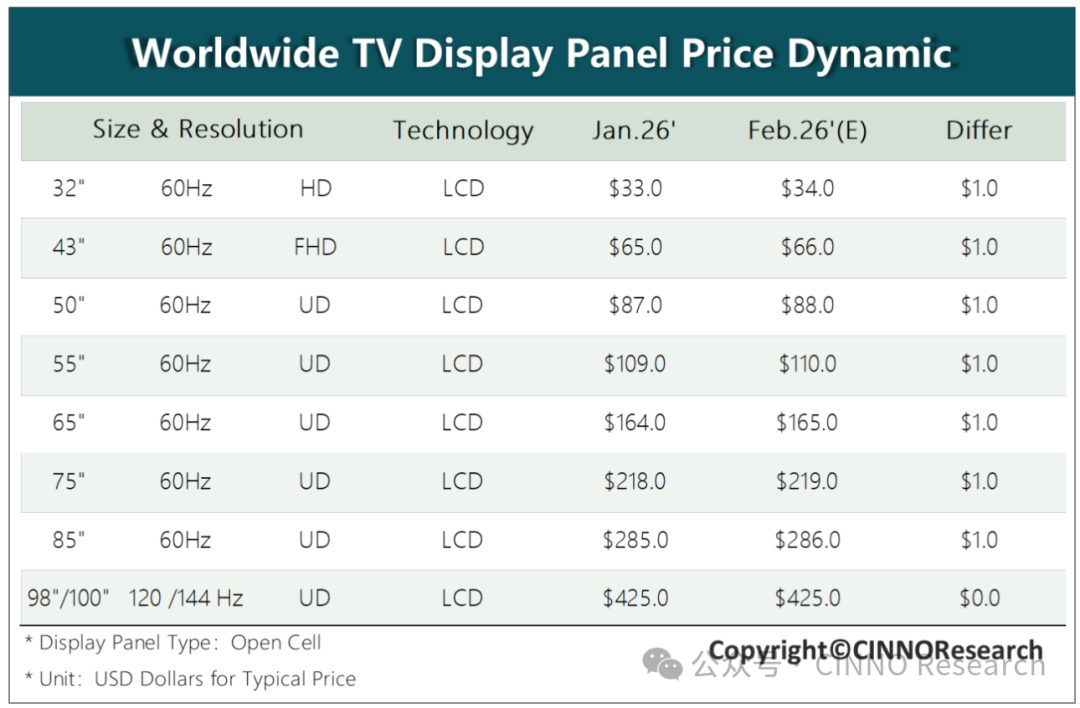
2月电视面板行情: 春节控产影响下,面板价格预计维持上涨
CINNO Research· 2026-02-24 10:31
Core Viewpoint - The TV panel market is experiencing a short-term demand recovery driven by international sports events and domestic subsidy policies, leading to a moderate price increase for most panel sizes in February, despite a decline in ultra-large panel prices [2][4]. Group 1: Demand Analysis - In January, the demand for TV panels was supported by preparations for international sports events like the World Cup and the continuation of domestic "trade-in" subsidy policies, resulting in a strong consumer market [5]. - Prices for mainstream panel sizes from 32" to 85" showed an upward trend, while ultra-large panel prices continued to decline, although the rate of decline has narrowed significantly [5]. - In February, some brands are preemptively stocking up for new product launches, contributing to sustained demand and price increases for mainstream panel sizes [5]. Group 2: Supply Analysis - Panel manufacturers increased production line utilization rates to meet the concentrated order deliveries, with the global average utilization rate reaching 86.4% in January [6]. - However, due to the Chinese New Year holiday, some production lines implemented production controls, leading to a forecasted decrease in average utilization rates to below 80% in February, with a projected 10.3% decline in panel shipments [7]. - The price forecast for February indicates a general increase of $1 for mainstream panel sizes, while ultra-large panel prices are expected to stabilize at $425 [7].