Exchange Traded Funds (ETF)

Search documents
2025登顶亚洲 中国ETF市场的“奇点之年”
Sou Hu Cai Jing· 2026-02-11 03:22
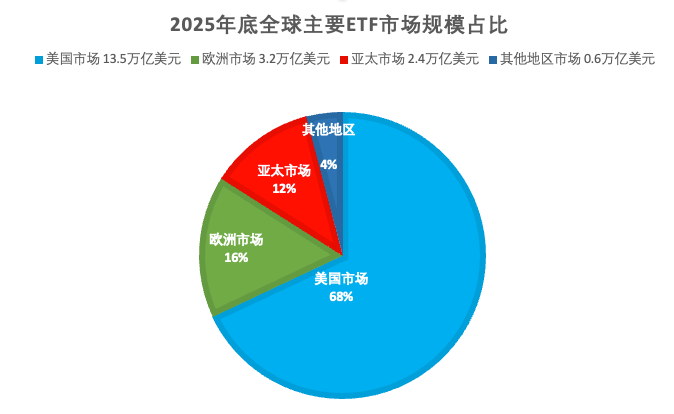
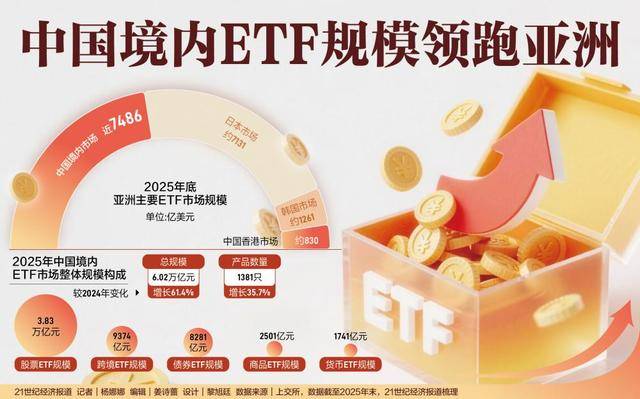
Core Insights - In 2025, China's ETF market reached a historic milestone, surpassing 6 trillion yuan, making it the largest in Asia, overtaking Japan [1][2][4] - The growth was driven by significant net inflows, particularly in bond ETFs, and a shift towards institutional investors dominating the market [2][5][6] Market Growth - By the end of 2025, the total size of China's ETF market was 6.02 trillion yuan, with the Shanghai Stock Exchange (SSE) contributing approximately 4.22 trillion yuan and the Shenzhen Stock Exchange (SZSE) about 1.79 trillion yuan [1][5] - The SSE ranked first in Asia and third globally in terms of trading volume, with a total turnover of 61 trillion yuan, while the SZSE saw a 189% year-on-year increase in trading volume, reaching 23.17 trillion yuan [1][5] Investor Dynamics - The net inflow into the domestic ETF market exceeded 1.16 trillion yuan in 2025, with bond ETFs leading the way with a net inflow of 552.7 billion yuan [2][6] - Institutional ownership of ETFs increased significantly, with the SSE's institutional holdings rising to 65% and the SZSE's to 58%, indicating a shift towards a more institutionally driven market [2][16] Product Innovation - The ETF market saw a transformation from broad-based products to more targeted offerings, including thematic ETFs focused on sectors like artificial intelligence and robotics [10][11] - Bond ETFs experienced explosive growth, with their total size increasing from 173.9 billion yuan at the end of 2024 to 829 billion yuan by the end of 2025, marking a 376% increase [12][13] Regulatory and Structural Developments - The regulatory framework for ETFs was enhanced, focusing on risk management and investor protection, with new guidelines introduced to improve market efficiency [16][17] - The market's infrastructure was upgraded to support increased liquidity and trading efficiency, including the introduction of T+0 trading for bond ETFs [17][18] Future Outlook - The Chinese ETF market is expected to continue evolving towards a more refined ecosystem, focusing on attracting long-term capital and enhancing investor experience [19][20] - The emphasis will shift from merely providing a wide range of products to creating a sustainable and competitive environment that fosters innovation and growth in the ETF space [19][20]

2025登顶亚洲,中国ETF市场的“奇点之年”
2 1 Shi Ji Jing Ji Bao Dao· 2026-02-10 13:16
Core Insights - In 2025, China's ETF market reached a historic milestone, surpassing 6 trillion yuan, making it the largest in Asia, overtaking Japan [1][7][13] - The growth was driven by significant net inflows, particularly in bond ETFs, and a shift towards institutional investors dominating the market [2][12][28] Market Growth - By the end of 2025, the total size of the ETF market in China was 6.02 trillion yuan, with the Shanghai Stock Exchange (SSE) contributing approximately 4.22 trillion yuan and the Shenzhen Stock Exchange (SZSE) about 1.79 trillion yuan [1][8] - The SSE recorded a trading volume of 61 trillion yuan, ranking first in Asia and third globally, while the SZSE's trading volume grew by 189% to 23.17 trillion yuan [11][12] Investor Dynamics - The net inflow into the domestic ETF market exceeded 1.16 trillion yuan, with bond ETFs leading at 552.7 billion yuan [2][12] - Institutional ownership of ETFs increased significantly, with the SSE reaching 65% and the SZSE 58%, indicating a shift towards a more institutional-driven market [2][28] Product Innovation - The ETF market saw a transformation from broad-based products to more targeted offerings, including thematic ETFs focused on technology and innovation [15][16] - Bond ETFs experienced explosive growth, with their total size increasing from 173.9 billion yuan to 829 billion yuan, marking a 376% increase [18][20] Market Structure - By the end of 2025, the structure of the ETF market included 1,381 products, with stock ETFs making up 63.6% of the total size, followed by cross-border ETFs at 15.6% and bond ETFs at 13.8% [7][8] - The market's evolution reflects a growing demand for diversified investment strategies and a focus on long-term asset allocation [2][12] Regulatory and Institutional Framework - The regulatory environment has evolved to support the rapid growth of the ETF market, with new rules and mechanisms introduced to enhance liquidity and investor protection [29][30] - The market is transitioning towards a more institutionalized structure, with a focus on long-term capital and risk management [28][29] Future Outlook - The future of the ETF market in China is expected to focus on building a sustainable ecosystem that attracts long-term capital, emphasizing product innovation and regulatory balance [33]