
创业板ETF

Search documents
金融期权周报-20260330
Guo Tou Qi Huo· 2026-03-30 13:53
Group 1: Market Overview - The market showed a volatile recovery trend last week. Most indices opened lower on Monday and gradually recovered, but still ended the week with losses. The ChiNext Index led the decline, with a weekly drop of 1.67%. The non - bank financial and computer sectors were weak, with weekly declines of about 3.98% and 3.43% respectively, while the non - ferrous metals sector was prominent, with a weekly gain of 2.78% [1] - The market focus remained on the geopolitical situation. The geopolitical situation was still tense, and the uncertainty in the Strait of Hormuz supported high - level volatile energy prices. Overseas, the US dollar index continued to fluctuate strongly, and the US March PMI indicators were divided, leading to a further decline in market expectations for the Fed to cut interest rates. Domestically, the RMB exchange rate remained in a strong - oscillating pattern [1] Group 2: Options Market - In the options market last week, the implied volatility (IV) of various financial options rebounded. The IV of the STAR 50 options (IV = 29%) and ChiNext ETF options (IV = 24%) rose above the median of the past year. The IV of 50 and 300 options was in the range of 15% - 17%, and that of CSI 500 and CSI 1000 options was in the range of 25% - 28%. The PCR of most financial options was in the range of 60% - 80%, slightly lower than the previous week [2] Group 3: Strategy Outlook - The market may continue the volatile pattern, and the implied volatility of financial options will continue to rise. It is advisable to hold indices with relatively reasonable valuations, such as the SSE 50 and CSI 300, and consider selling out - of - the - money put options on the corresponding indices. For the STAR 50 Index, which has large recent fluctuations and high static valuations, if holding the underlying assets, one can consider buying out - of - the - money put options or selling out - of - the - money call options. If there are substantial spot gains, one can consider taking profits on the spot and keeping a small amount of long - term call options. The CSI 1000 - 2606 index futures basis has converged, and one can consider rolling over to the 2609 contract with a higher basis to form a covered call strategy [3] Group 4: Market Data - The report provides detailed data on various financial options, including the closing price, price change, IV, ΔIV (daily), historical quantile, IV median in the past year, option trading volume, and PCR of multiple underlying assets such as the SSE 50ETF, SSE 50 Index, CSI 300ETF, CSI 500ETF, CSI 1000 Index, ChiNext ETF, STAR 50ETF, and Shenzhen 100ETF [5] - It also presents data on the price, price change, IV of different months, and related quantiles of various underlying assets over different time periods, as well as information on IV term structure, intraday IV trends, skew index, smile curve, and the relationship between IV and trading volume [7][10][15]
50ETF价格、隐波近三年走势,50ETF价格、隐波近一年走势,不同月份平值IV日内走势,ATM IV期限结构:50ETF价格、隐波走势分析
Guo Tou Qi Huo· 2026-03-30 12:46
Report Industry Investment Rating - Not provided in the given content Core Viewpoints - Not provided in the given content Summary by Related Catalogs 50ETF - The current month contract has 16 days until expiration. From March 26 - 30, 2026, the underlying price fluctuated, with a -1.13% decline on March 26, a 0.41% increase on March 27, and a -0.14% decline on March 30. The current month IV and next month IV also showed corresponding changes [1]. - The skew index on March 30, 2026, was 124.95 [2]. 300ETF (Shanghai) - The current month contract has 16 days until expiration. From March 25 - 30, 2026, the underlying price fluctuated, with a 1.45% increase on March 25, a -1.23% decline on March 26, and a 0.45% increase on March 27. The current month IV and next month IV also changed accordingly [4]. - The skew index on March 25, 2026, was 132.26 [6]. 300ETF (Shenzhen) - The current month contract has 16 days until expiration. From March 26 - 30, 2026, the underlying price fluctuated, with a -1.22% decline on March 26, a 0.51% increase on March 27, and a -0.19% decline on March 30. The current month IV and next month IV also changed [9]. - The skew index on March 26, 2026, was 128.29 [16]. CSI 500ETF (Shanghai) - The current month contract has 16 days until expiration. From March 26 - 30, 2026, the underlying price fluctuated, with a 0.63% increase on March 26, a -0.29% decline on March 27, and a 1.53% increase on March 30. The current month IV and next month IV also changed [18]. - The skew index on March 30, 2026, was 129.52 [19]. CSI 500ETF (Shenzhen) - The current month contract has 16 days until expiration. From March 26 - 30, 2026, the underlying price fluctuated, with a -1.70% decline on March 26, a 1.27% increase on March 27, and a 0.42% increase on March 30. The current month IV and next month IV also changed [21]. - The skew index on March 30, 2026, was 128.12 [23]. ChiNext ETF - The current month contract has 16 days until expiration. From March 26 - 30, 2026, the underlying price fluctuated, with a -1.33% decline on March 26, a 0.92% increase on March 27, and a -0.88% decline on March 30. The current month IV and next month IV also changed [24]. - The skew index on March 30, 2026, was 106.93 [26]. Shenzhen 100ETF - The current month contract has 16 days until expiration. From March 26 - 30, 2026, the underlying price fluctuated, with a -1.40% decline on March 26, a 0.76% increase on March 27, and a -0.61% decline on March 30. The current month IV and next month IV also changed [28]. - The skew index on March 30, 2026, was 132.23 [31]. Science and Technology Innovation 50ETF - The current month contract has 16 days until expiration. From March 26 - 30, 2026, the underlying price fluctuated, with a -2.02% decline on March 26, a 0.96% increase on March 27, and a -0.80% decline on March 30. The current month IV and next month IV also changed [36]. - The skew index on March 30, 2026, was 131.42 [39]. STAR 50ETF - The current month contract has 16 days until expiration. From March 26 - 30, 2026, the underlying price fluctuated, with a -2.01% decline on March 26, a 0.99% increase on March 27, and a -0.83% decline on March 30. The current month IV and next month IV also changed [42]. - The skew index on March 30, 2026, was 117.45 [43]. 300 Index - The current month contract has 13 days until expiration. From March 26 - 30, 2026, the underlying price fluctuated, with a -1.32% decline on March 26, a 0.56% increase on March 27, and a -0.24% decline on March 30. The current month IV and next month IV also changed [45]. - The skew index on March 30, 2026, was 117.93 [47]. 1000 Index - The current month contract has 13 days until expiration. From March 26 - 30, 2026, the underlying price fluctuated, with a -1.44% decline on March 26, a 1.40% increase on March 27, and a 0.28% increase on March 30. The current month IV and next month IV also changed [50]. - The skew index on March 30, 2026, was 138.43 [54]. SSE 50 Index - The current month contract has 13 days until expiration. From March 26 - 30, 2026, the underlying price fluctuated, with a -1.22% decline on March 26, a 0.45% increase on March 27, and a -0.14% decline on March 30. The current month IV and next month IV also changed [55]. - The skew index on March 30, 2026, was 127.79 [56].
50ETF当月合约距离到期还剩5天:50ETF价格、隐波相关数据及走势分析
Guo Tou Qi Huo· 2026-03-18 13:03
1. Report Industry Investment Rating There is no information about the report industry investment rating in the provided content. 2. Report's Core View There is no clear core view presented in the provided content. The report mainly provides a large amount of data on various financial products' prices, price changes, implied volatility (IV), and related statistics. 3. Summary by Related Catalogs 3.1 50ETF - **Price and IV Data**: From March 16 - 18, 2026, the 50ETF price was 3.028, 3.039, and 3.035 respectively, with corresponding price changes of -0.23%, 0.36%, and -0.13%. The corresponding monthly IVs were 14.45%, 15.58%, and 14.44%, and the next - month IVs were 14.71%, 14.79%, and 14.29% [1]. - **IV Quantiles**: The monthly IV quantiles in the past 1 - year were 47.70%, 64.40%, and 47.30%, and in the past 2 - year were 49.80%, 63.10%, and 49.20%. The next - month IV quantiles in the past 1 - year were 46.40%, 47.20%, and 40.90%, and in the past 2 - year were 47.70%, 49.40%, and 41.40% [1]. - **Skew Index**: The skew index of the main contract month was 106.41 today, 112.32 yesterday, 107.13 two days ago, 117.10 three days ago, and 107.20 four days ago [2]. 3.2 Shanghai 300ETF - **Price and IV Data**: From March 13 - 18, 2026, the Shanghai 300ETF price and price changes, monthly IV, and next - month IV are provided. For example, on March 16, the price was 4.680 with a 0.06% increase, monthly IV of 16.09%, and next - month IV of 15.74% [5]. - **IV Quantiles**: The monthly IV quantiles in the past 1 - year and 2 - year, as well as the next - month IV quantiles in the past 1 - year and 2 - year, are presented [5]. - **Skew Index**: The skew index of the main contract month today is 108.94, and other historical data is also provided [8]. 3.3 Shenzhen 300ETF - **Price and IV Data**: From March 16 - 18, 2026, the Shenzhen 300ETF price and price changes, monthly IV, and next - month IV are shown. For example, on March 16, the price was 4.879 with a 0.06% increase, monthly IV of 14.83%, and next - month IV of 15.28% [10]. - **IV Quantiles**: The monthly IV quantiles in the past 1 - year and 2 - year, and the next - month IV quantiles in the past 1 - year and 2 - year are given [10]. - **Skew Index**: The skew index of the main contract month today is 112.17, and historical data is also available [13]. 3.4 Shanghai CSI 500ETF - **Price and IV Data**: From March 16 - 18, 2026, the Shanghai CSI 500ETF price and price changes, monthly IV, and next - month IV are provided. For example, on March 16, the price was 8.259 with a - 1.98% decrease, monthly IV of 22.08%, and next - month IV of 23.14% [16]. - **IV Quantiles**: The monthly IV quantiles in the past 1 - year and 2 - year, and the next - month IV quantiles in the past 1 - year and 2 - year are presented [16]. - **Skew Index**: The skew index of the main contract month today is 114.79, and historical data is also provided [18]. 3.5 Shenzhen CSI 500ETF - **Price and IV Data**: From March 16 - 18, 2026, the Shenzhen CSI 500ETF price and price changes, monthly IV, and next - month IV are shown. For example, on March 16, the price was 3.282 with a - 0.76% decrease, monthly IV of 22.10%, and next - month IV of 23.22% [19]. - **IV Quantiles**: The monthly IV quantiles in the past 1 - year and 2 - year, and the next - month IV quantiles in the past 1 - year and 2 - year are given [19]. - **Skew Index**: The skew index of the main contract month today is 130.43, and historical data is also available [21]. 3.6 ChiNext ETF - **Price and IV Data**: From March 16 - 18, 2026, the ChiNext ETF price and price changes, monthly IV, and next - month IV are provided. For example, on March 16, the price was 3.349 with a 1.48% increase, monthly IV of 23.45%, and next - month IV of 24.47% [22]. - **IV Quantiles**: The monthly IV quantiles in the past 1 - year and 2 - year, and the next - month IV quantiles in the past 1 - year and 2 - year are presented [22]. - **Skew Index**: The skew index of the main contract month today is 125.46, and historical data is also provided [24]. 3.7 Shenzhen 100ETF - **Price and IV Data**: From March 16 - 18, 2026, the Shenzhen 100ETF price and price changes, monthly IV, and next - month IV are shown. For example, on March 16, the price was 3.541 with a 0.45% increase, monthly IV of 19.59%, and next - month IV of 19.96% [25]. - **IV Quantiles**: The monthly IV quantiles in the past 1 - year and 2 - year, and the next - month IV quantiles in the past 1 - year and 2 - year are given [25]. - **Skew Index**: The skew index of the main contract month today is 117.33, and historical data is also available [28]. 3.8 Science and Technology Innovation 50ETF - **Price and IV Data**: From March 16 - 18, 2026, the Science and Technology Innovation 50ETF price and price changes, monthly IV, and next - month IV are provided. For example, on March 16, the price was 1.458 with a 0.55% increase, monthly IV of 27.48%, and next - month IV of 27.40% [32]. - **IV Quantiles**: The monthly IV quantiles in the past 1 - year and 2 - year, and the next - month IV quantiles in the past 1 - year and 2 - year are presented [32]. - **Skew Index**: The skew index of the main contract month today is 102.71, and historical data is also provided [35]. 3.9 STAR 50ETF - **Price and IV Data**: From March 16 - 18, 2026, the STAR 50ETF price and price changes, monthly IV, and next - month IV are shown. For example, on March 16, the price was 1.413 with a 0.50% increase, monthly IV of 27.35%, and next - month IV of 27.09% [38]. - **IV Quantiles**: The monthly IV quantiles in the past 1 - year and 2 - year, and the next - month IV quantiles in the past 1 - year and 2 - year are given [38]. - **Skew Index**: The skew index of the main contract month today is 101.18, and historical data is also available [40]. 3.10 300 Index - **Price and IV Data**: From March 16 - 18, 2026, the 300 Index price and price changes, monthly IV, and next - month IV are provided. For example, on March 16, the price was 4671.559 with a 0.05% increase, monthly IV of 13.76%, and next - month IV of 14.72% [45]. - **IV Quantiles**: The monthly IV quantiles in the past 1 - year and 2 - year, and the next - month IV quantiles in the past 1 - year and 2 - year are presented [45]. - **Skew Index**: The skew index of the main contract month today is 127.74, and historical data is also provided [47]. 3.11 1000 Index - **Price and IV Data**: From March 16 - 18, 2026, the 1000 Index price and price changes, monthly IV, and next - month IV are shown. For example, on March 16, the price was 8211.352 with a - 0.04% decrease, monthly IV of 19.38%, and next - month IV of 22.86% [50]. - **IV Quantiles**: The monthly IV quantiles in the past 1 - year and 2 - year, and the next - month IV quantiles in the past 1 - year and 2 - year are given [50]. - **Skew Index**: The skew index of the main contract month today is 112.02, and historical data is also available [54]. 3.12 Shanghai 50 Index - **Price and IV Data**: From March 16 - 18, 2026, the Shanghai 50 Index price and price changes, monthly IV, and next - month IV are provided. For example, on March 16, the price was 2954.089 with a - 0.09% decrease, monthly IV of 14.79%, and next - month IV of 59.09% [55]. - **IV Quantiles**: The monthly IV quantiles in the past 1 - year and 2 - year, and the next - month IV quantiles in the past 1 - year and 2 - year are presented [55]. - **Skew Index**: The skew index of the main contract month today is 98.95, and historical data is also provided [57].
投资者微观行为洞察手册3月第2期:地缘波动之下:全球外资流出美国,南水大幅买入港股
GUOTAI HAITONG SECURITIES· 2026-03-17 15:04
Market Pricing Status - The market transaction activity has slightly decreased, while the profit effect has increased, with the average daily trading volume for the entire A-share market dropping to 2.5 trillion yuan and the proportion of stocks rising to 34.9% [5][9][10] - The trading concentration has risen, with 10 industries having turnover rates above 90%, including oil and petrochemicals, and coal [5][19] A-Share Liquidity Tracking - Financing funds have seen a slight inflow, while ETF funds have experienced a small outflow, with public equity funds' new issuance increasing to 22.62 billion yuan [5][29] - Private equity confidence index has decreased by 0.1% compared to February, while the overall position has marginally increased [5][36] - Foreign capital has exited the A-share market, with a net outflow of 1.035 billion USD [5][41] - The IPO fundraising for the current period is 290 million yuan, with a private placement scale of 1.15 billion yuan [5][29] A-Share Industry Allocation Tracking - Foreign capital has generally exited various primary industries, with electronics and power equipment seeing the largest outflows of 160.4 million USD and 91.7 million USD respectively [5][40] - Financing funds have seen net inflows in power equipment (+6.05 billion yuan) and basic chemicals (+4.07 billion yuan), while outflows were noted in non-ferrous metals (-4.04 billion yuan) and defense industry (-1.22 billion yuan) [5][29] - ETF funds have shown a net outflow in sectors like oil and petrochemicals (-4.15 billion yuan) and pharmaceuticals (-2.15 billion yuan), while public utilities saw a net inflow of 2.61 billion yuan [5][29] Hong Kong Stock Market and Global Fund Flow - Significant inflow of southbound funds, with net purchases rising to 52.44 billion yuan, marking the 96th percentile since 2022 [5][29] - Global foreign capital has marginally flowed into Japan and South Korea, with inflows of 1.57 billion USD and 2.57 billion USD respectively [5][41]
当月合约距离到期还剩17天:50ETF
Guo Tou Qi Huo· 2026-03-02 12:59
1. Report Industry Investment Rating - No relevant information provided 2. Core Viewpoints of the Report - No clear overall core viewpoints presented, but detailed data on various financial products are provided 3. Summary by Related Contents 3.1 50ETF - From February 26 to March 2, 2026, the 50ETF price fluctuated slightly, with a -0.61% decline on February 26, a 0.26% increase on February 27, and a 0.06% increase on March 2 [1] - The current month's IV was 12.57% on February 26, 12.03% on February 27, and 12.60% on March 2; the next month's IV was 13.31%, 13.14%, and 13.57% respectively [1] - The current month's IV quantiles in the past 1 - year and 2 - year were 14.20% - 15.90% and 17.70% - 18.80% respectively; the next month's IV quantiles in the past 1 - year and 2 - year were 23.30% - 28.60% and 25.40% - 30.70% respectively [1] - The skew index of the main contract was 107.16 today, 97.77 yesterday, 100.43 two days ago, 100.67 three days ago, and 100.00 four days ago [3] 3.2 Shanghai 300ETF - From February 25 to February 27, 2026, the Shanghai 300ETF price decreased first and then increased slightly, with a 0.72% increase on February 25, a -0.32% decline on February 26, and a -0.21% decline on February 27 [4] - The current month's IV was 12.55% on February 25, 12.22% on February 26, and 12.69% on February 27; the next month's IV was 13.64%, 13.54%, and 13.76% respectively [4] - The current month's IV quantiles in the past 1 - year and 2 - year were 0.40% - 7.50% and 4.40% - 9.20% respectively; the next month's IV quantiles in the past 1 - year and 2 - year were 6.70% - 17.50% and 5.90% - 15.80% respectively [4] - The skew index of the main contract was 112.50 today, 100.07 yesterday, 104.51 two days ago, 103.33 three days ago, and 100.00 four days ago [6] 3.3 Shenzhen 300ETF - From February 26 to March 2, 2026, the Shenzhen 300ETF price decreased first and then increased, with a -0.28% decline on February 26, a -0.24% decline on February 27, and a 0.24% increase on March 2 [7] - The current month's IV was 12.86% on February 26, 12.57% on February 27, and 12.97% on March 2; the next month's IV was 13.73%, 13.65%, and 13.67% respectively [7] - The current month's IV quantiles in the past 1 - year and 2 - year were 4.80% - 12.20% and 7.50% - 13.40% respectively; the next month's IV quantiles in the past 1 - year and 2 - year were 14.00% - 15.30% and 17.80% - 19.10% respectively [7] - The skew index of the main contract was 107.05 today, 98.76 yesterday, 100.82 two days ago, 102.14 three days ago, and 74.20 four days ago [10] 3.4 Shanghai CSI 500ETF - From February 26 to March 2, 2026, the Shanghai CSI 500ETF price increased, with a 1.90% increase on February 26, a 1.57% increase on February 27, and a 1.19% increase on March 2 [12] - The current month's IV was 20.69% on February 26, 20.22% on February 27, and 20.37% on March 2; the next month's IV was 21.01%, 20.91%, and 21.20% respectively [12] - The current month's IV quantiles in the past 1 - year and 2 - year were 66.90% - 71.40% and 55.60% - 59.70% respectively; the next month's IV quantiles in the past 1 - year and 2 - year were 66.50% - 68.30% and 59.90% - 62.00% respectively [12] - The skew index of the main contract was 110.69 today, 109.76 yesterday, 116.18 two days ago, 105.53 three days ago, and 100.00 four days ago [15] 3.5 Shenzhen CSI 500ETF - From February 26 to March 2, 2026, the Shenzhen CSI 500ETF price increased slightly, with a 0.29% increase on February 26, a 1.20% increase on February 27, and a 0.03% increase on March 2 [18] - The current month's IV was 20.97% on February 26, 20.57% on February 27, and 20.33% on March 2; the next month's IV was 21.25%, 21.19%, and 21.19% respectively [18] - The current month's IV quantiles in the past 1 - year and 2 - year were 65.70% - 70.20% and 56.00% - 63.20% respectively; the next month's IV quantiles in the past 1 - year and 2 - year were 64.50% - 65.60% and 59.10% - 59.30% respectively [18] - The skew index of the main contract was 113.04 today, 114.78 yesterday, 105.89 two days ago, 100.00 three days ago, and 100.00 four days ago [20] 3.6 GEM ETF - From February 26 to March 2, 2026, the GEM ETF price decreased, with a -0.24% decline on February 26, a -1.05% decline on February 27, and a -0.58% decline on March 2 [21] - The current month's IV was 20.49% on February 26, 20.07% on February 27, and 20.43% on March 2; the next month's IV was 22.61%, 22.20%, and 22.00% respectively [21] - The current month's IV quantiles in the past 1 - year and 2 - year were 11.80% - 26.20% and 12.20% - 32.80% respectively; the next month's IV quantiles in the past 1 - year and 2 - year were 15.50% - 30.00% and 15.90% - 32.80% respectively [21] - The skew index of the main contract was 99.44 today, 100.00 yesterday, 108.81 two days ago, 100.45 three days ago, and 102.04 four days ago [23] 3.7 Shenzhen 100ETF - From February 26 to March 2, 2026, the Shenzhen 100ETF price decreased first and then remained stable, with a 0.09% increase on February 26, a -0.99% decline on February 27, and a -0.03% decline on March 2 [25] - The current month's IV was 16.49% on February 26, 15.91% on February 27, and 16.48% on March 2; the next month's IV was 17.70%, 17.84%, and 17.74% respectively [25] - The current month's IV quantiles in the past 1 - year and 2 - year were 13.80% - 22.00% and 11.60% - 20.20% respectively; the next month's IV quantiles in the past 1 - year and 2 - year were 28.80% - 30.50% and 31.50% - 33.40% respectively [25] - The skew index of the main contract was 109.68 today, 101.21 yesterday, 104.39 two days ago, 102.56 three days ago, and 100.00 four days ago [28] 3.8 Science and Technology Innovation 50ETF - From February 26 to March 2, 2026, the Science and Technology Innovation 50ETF price increased first and then decreased, with a 0.77% increase on February 26, a 0.13% increase on February 27, and a -1.40% decline on March 2 [34] - The current month's IV was 24.86% on February 26, 24.26% on February 27, and 24.13% on March 2; the next month's IV was 25.50%, 24.72%, and 24.19% respectively [34] - The current month's IV quantiles in the past 1 - year and 2 - year were 22.70% - 39.10% and 25.30% - 34.70% respectively; the next month's IV quantiles in the past 1 - year and 2 - year were 24.40% - 31.10% and 25.70% - 31.10% respectively [34] - The skew index of the main contract was 96.92 today, 87.73 yesterday, 92.93 two days ago, 101.59 three days ago, and 109.50 four days ago [36] 3.9 STAR 50ETF - From February 26 to March 2, 2026, the STAR 50ETF price increased first and then decreased, with a 0.86% increase on February 26, a 0.20% increase on February 27, and a -1.51% decline on March 2 [39] - The current month's IV was 24.13% on February 26, 23.36% on February 27, and 24.55% on March 2; the next month's IV was 25.91%, 24.97%, and 24.84% respectively [39] - The current month's IV quantiles in the past 1 - year and 2 - year were 23.90% - 37.20% and 30.20% - 36.40% respectively; the next month's IV quantiles in the past 1 - year and 2 - year were 27.30% - 41.30% and 28.40% - 41.30% respectively [39] - The skew index of the main contract was 106.85 today, 97.60 yesterday, 99.58 two days ago, 99.63 three days ago, and 100.00 four days ago [40] 3.10 300 Index - From February 26 to March 2, 2026, the 300 Index price decreased first and then increased, with a -0.19% decline on February 26, a -0.34% decline on February 27, and a 0.38% increase on March 2 [42] - The current month's IV was 12.33% on February 26, 12.57% on February 27, and 12.40% on March 2; the next month's IV was 13.65%, 13.49%, and 13.52% respectively [42] - The current month's IV quantiles in the past 1 - year and 2 - year were 14.60% - 17.50% and 11.00% - 13.20% respectively; the next month's IV quantiles in the past 1 - year and 2 - year were 8.90% - 10.60% and 11.60% - 13.90% respectively [42] - The skew index of the main contract was 116.87 today, 107.83 yesterday, 99.03 two days ago, 103.02 three days ago, and 101.03 four days ago [44] 3.11 1000 Index - From February 26 to March 2, 2026, the 1000 Index price increased first and then decreased, with a 0.76% increase on February 26, a 0.83% increase on February 27, and a -0.98% decline on March 2 [47] - The current month's IV was 20.80% on February 26, 20.73% on February 27, and 20.34% on March 2; the next month's IV was 21.62%, 21.68%, and 21.54% respectively [47] - The current month's IV quantiles in the past 1 - year and 2 - year were 28.40% - 53.00% and 28.40% - 31.90% respectively; the next month's IV quantiles in the past 1 - year and 2 - year were 48.90% - 51.40% and 29.60% - 49.70% respectively [47] - The skew index of the main contract was 118.99 today, 108.08 yesterday, 114.41 two days ago, 112.69 three days ago, and 116.12 four days ago [51] 3.12 Shanghai 50 Index - From February 26 to March 2, 2026, the Shanghai 50 Index price increased slightly, with a -0.65% decline on February 26, a 0.14% increase on February 27, and a 0.23% increase on March 2 [53] - The current month's IV was 13.04% on February 26, 12.95% on February 27, and 13.25% on March 2; the next month's IV was 62.01%, 64.95%, and 65.31% respectively [53] - The current month's IV quantiles in the past 1 - year and 2 - year were 20.40% - 26.50% and 22.20% - 25.30% respectively; the next month's IV quantiles in the past 1 - year and 2 - year were 78.30% - 93.80% and 29.70% - 93.80% respectively [5
“落袋为安”?14亿,跑了
Zhong Guo Ji Jin Bao· 2026-02-26 04:17
Group 1 - On February 25, the A-share market saw all three major indices rise, but the stock ETF market experienced a net outflow of approximately 1.4 billion yuan [1] - As of February 25, the total scale of 1,344 stock ETFs in the market reached 4.18 trillion yuan, with a reduction of 503 million fund shares, resulting in a net outflow of about 1.48 billion yuan [2] - The Hong Kong stock market ETFs led in net inflows, totaling 1.881 billion yuan, with the CSI 500 Index ETF seeing the highest inflow of 1.678 billion yuan [2] Group 2 - On February 25, 32 ETFs had net inflows exceeding 100 million yuan, with the CSI 500 ETF leading at 1.424 billion yuan, followed by the Electric Grid Equipment ETF and A500 ETF with inflows of 1.059 billion yuan and 618 million yuan respectively [2] - E Fund's ETFs continued to attract net inflows, with the Hang Seng Technology ETF receiving 270 million yuan, the SSE 50 ETF 229 million yuan, and the Artificial Intelligence ETF 203 million yuan [2] - The Electric Grid Equipment ETF and Hang Seng Internet ETF from Huaxia Fund saw significant net inflows of 1.059 billion yuan and 603 million yuan respectively, with their latest scales at 20.465 billion yuan and 37.213 billion yuan [3] Group 3 - The ChiNext Index ETF experienced the largest net outflow on February 25, amounting to 1.946 billion yuan [4] - ICBC Credit Suisse Fund remains optimistic about the A-share market in the medium term, citing that total demand adjustments are nearing equilibrium and supply-side adjustments will enhance confidence in capital return rates [4]
从“国家队”重仓ETF的规模变化,看稳市资金的入场与离场
Xin Lang Cai Jing· 2026-02-25 06:50
Core Insights - Recent significant increases in trading volumes and decreases in on-market shares of major broad-based index ETFs have raised market concerns about the potential exit of Central Huijin Investment from these funds [3][21] - Central Huijin's holdings in the four major CSI 300 ETFs exceeded 80% by the end of 2025, indicating a dominant position in these funds [3][21] ETF Holdings and Changes - The total shares of the four major CSI 300 ETFs have shown substantial growth, primarily driven by the increase in shares held by Central Huijin, while shares held by other investors have decreased [4][22] - For example, in the Huatai-PineBridge CSI 300 ETF, Central Huijin's holdings increased from 62.47 million shares at the end of 2023 to 735.13 million shares by the end of 2025, while other holders' shares dropped from 311.97 million to 153.17 million [5][23] - Similar trends were observed in the other three major ETFs, with Central Huijin's shareholding increasing significantly while other investors' shares decreased [5][23] Trading Volume and Market Impact - Between January 14 and February 2, 2026, the trading volume of the four major CSI 300 ETFs surged, accompanied by a significant reduction in circulating shares, suggesting a potential reduction in Central Huijin's holdings during this period [6][24] - The net outflow of funds from these ETFs during this period has offset previous inflows, indicating a strategic exit by Central Huijin [10][28] Financial Estimates and Performance - Estimates suggest that Central Huijin's total investment cost was approximately 651.6 billion yuan, with an estimated exit amount of 602.1 billion yuan, resulting in a profit margin of about 78.77% [12][29] - The financial performance of Central Huijin indicates a successful exit strategy, maintaining a significant portion of its ETF holdings for future market stabilization [11][28] Market Comparisons and Historical Context - The exit strategy of Central Huijin aligns with international practices observed in markets like Hong Kong and South Korea, where stabilization funds have successfully exited during normalized market conditions [16]


56亿,加仓!
Zhong Guo Ji Jin Bao· 2026-02-25 05:48
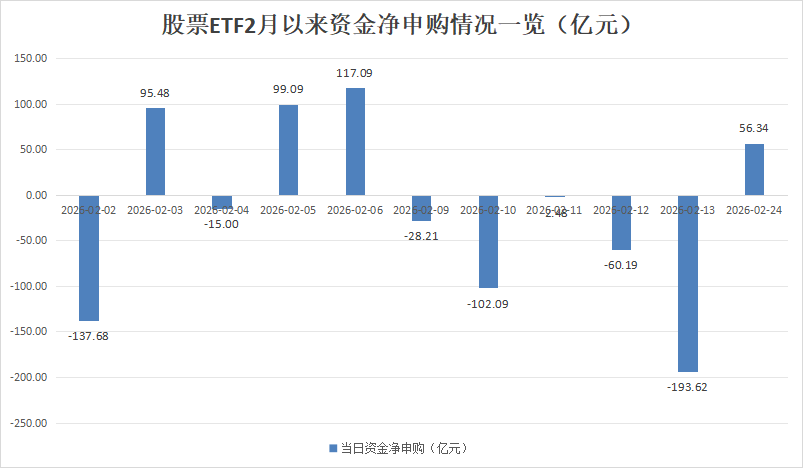
Group 1 - The stock ETF market experienced a significant inflow of 56.34 billion yuan on the first trading day of the Year of the Horse, reversing the trend of outflows seen in the previous five trading days [1][2] - The A-share market opened higher and closed with the Shanghai Composite Index up 0.87%, stabilizing above 4100 points, while the market turnover slightly increased to 2.18 trillion yuan [2] - The inflow was primarily driven by strong performance in the Hong Kong stock sector, with several ETFs tracking the Hong Kong market seeing substantial inflows [1][4] Group 2 - The largest inflows were observed in Hong Kong market ETFs, totaling 84.72 billion yuan, and thematic industry ETFs, which saw inflows of 25.79 billion yuan, while broad-based ETFs experienced outflows of 50.11 billion yuan [4] - ETFs tracking the Hang Seng Technology Index led the inflows with 46.59 billion yuan, while those tracking the CSI A500 Index saw outflows of 17.18 billion yuan [4] - Major fund companies like E Fund and Huaxia Fund reported significant inflows in their ETFs, with E Fund's total ETF scale reaching 659.7 billion yuan, increasing by 4.88 billion yuan on February 24 [4][5] Group 3 - Specific ETFs such as the Huaxia Hang Seng Technology Index ETF and the E Fund's China Internet ETF saw inflows of 16.53 billion yuan and 13.75 billion yuan, respectively [5][6] - The performance of the robotics sector was highlighted, with the Huaxia Robotics ETF also receiving over 4 billion yuan in inflows, reflecting a growing interest in the domestic robotics industry [7] - The market sentiment around the Hang Seng Technology Index is optimistic, with analysts noting the potential for growth driven by advancements in AI and technology [6][7]
利润增幅跑输规模,降费潮下华夏基金ETF“一哥”位次承压
Sou Hu Cai Jing· 2026-02-12 06:41
Core Insights - The article highlights the competitive landscape of the ETF market, focusing on the performance and challenges faced by China Asset Management Co., Ltd. (华夏基金) as it navigates fee reductions and market pressures [2][4]. Group 1: Financial Performance - In 2025, 华夏基金 reported operating revenue of 9.626 billion yuan, a year-on-year increase of 19.86%, and a net profit of 2.396 billion yuan, with an increase of 11.03% [3]. - The total assets of 华夏基金 reached 222.46 billion yuan, with total liabilities of 71.51 billion yuan, and the management asset scale surpassed 3 trillion yuan, reaching 3.014484 trillion yuan, a growth of 22% compared to the previous year [3]. - The growth in management scale over three years was significant, with an increase of nearly 1.2 trillion yuan, from 1.823564 trillion yuan in 2023 to 2.464531 trillion yuan in 2024, and then to 3.014484 trillion yuan in 2025 [3]. Group 2: Market Position and Competition - 华夏基金 maintains its position as the leading ETF provider with an ETF management scale of 892.67 billion yuan, accounting for 42% of its total managed public products, and a growth of 35.55% in 2025 [4][8]. - However, competitors like 易方达基金 are closing the gap, with an ETF management scale of 794.91 billion yuan, representing a growth of 32.08% [4][8]. - The reliance on ETF products is increasing for 华夏基金, which faces significant pressure from the ongoing fee reduction trend in the industry, as many competitors have lowered their management fees to the minimum level of 0.15% [4][6]. Group 3: Fee Structure and Market Dynamics - The ETF market is experiencing a fee reduction trend, with 27.2% of the 1,400 existing ETFs having management fees at the lowest tier of 0.15% [6]. - Among the top fund management companies, 华夏基金 has a lower proportion of ETFs with the minimum management fee, with only 27.5% of its ETFs at this rate, compared to 52.9% for 易方达基金 [8]. - The competitive landscape indicates that while fee rates are not the sole factor in attracting investors, they are increasingly significant in a low-interest-rate environment, impacting the profitability of fund management companies [8].

2月11日持仓过节的资金在买入哪些ETF?
Mei Ri Jing Ji Xin Wen· 2026-02-12 02:10
Group 1 - The Shanghai Composite Index experienced a seven-day rise, but trading volume continued to shrink, leading to a significant "seesaw" effect in capital allocation and accelerated sector rotation [1] - Ahead of the Spring Festival holiday, funds are divided into two camps: one showing cautious sentiment favoring dividend and free cash flow ETFs, while the other is positioning for a rebound after the holiday [1] - Major ETFs that received significant net subscriptions from external funds include the ChiNext ETF and the CSI 1000 ETF, with industry-specific ETFs like satellite, robotics, AI, semiconductor equipment, and chemical ETFs also seeing strong inflows [1] Group 2 - According to Wang Bo from Huaxia Fund, the reduction in trading volume before the holiday is normal, and there is a general optimistic expectation for the February market, although a short-term recovery in market sentiment will take time [2] - The investment strategy suggested includes maintaining a balanced allocation across technology, cyclical, and consumer sectors through broad-based ETFs like the Hu-Shen 300 ETF [2] - The recent increase in January PPI by 0.4% month-on-month has catalyzed price increases in the chemical sector, while positive developments in robotics and AI models are also emerging [1][2]