《时隙之旅》

Search documents
360前高管实名“开炮”,称“帮做假账几十亿”!周鸿祎紧急发声→
Guo Ji Jin Rong Bao· 2025-12-16 13:45
Core Viewpoint - Recent allegations by Yu Hong against Zhou Hongyi and 360 Group regarding financial fraud have sparked significant controversy, with 360 Group firmly denying these claims and asserting its commitment to compliance and transparency [2][4]. Company Background - Yu Hong is a notable figure in the Chinese gaming industry, having founded Quyou Technology in 2008, which achieved significant revenue growth and aimed for an IPO before being acquired by 360 Group [4]. - 360 Group, founded by Zhou Hongyi in 2005, went public on the New York Stock Exchange in 2011, was privatized in 2016, and later re-entered the market through a restructuring in 2017 [4]. Financial Performance - In 2024, 360 Group reported revenues of 7.948 billion yuan, a decline of 12.23% from 9.055 billion yuan in the previous year, with a net loss of 1.094 billion yuan compared to a loss of 492 million yuan in 2023 [5]. - The company's main revenue streams include internet advertising and services, smart hardware, internet value-added services (including gaming), and security services, with internet advertising being the largest contributor at 4.166 billion yuan, down 7.85% year-on-year [5][7]. Business Segment Analysis - The internet value-added services segment was the only one to see revenue growth, achieving 1.379 billion yuan, a 25.51% increase, while the gaming segment within this category saw a decline to 893 million yuan, down approximately 7.1% from the previous year [7][8]. - The smart hardware segment experienced a significant revenue drop of 35.44%, totaling 1.014 billion yuan, while security and other services also faced a decline of 27.06% [7]. Market Position and Challenges - 360's gaming revenue is primarily reliant on PC and agency-operated games, with titles like "World of Tanks" and "World of Warships" contributing stable income [8]. - The company has struggled to regain a foothold in the mobile gaming market, with recent self-developed titles failing to perform well, exemplified by the rapid discontinuation of the game "Shenling Meinv" just three months post-launch [8].


连续两款游戏上线仅三个月就下架,这家互联网大厂的游戏业务怎么了?
3 6 Ke· 2025-11-19 00:13
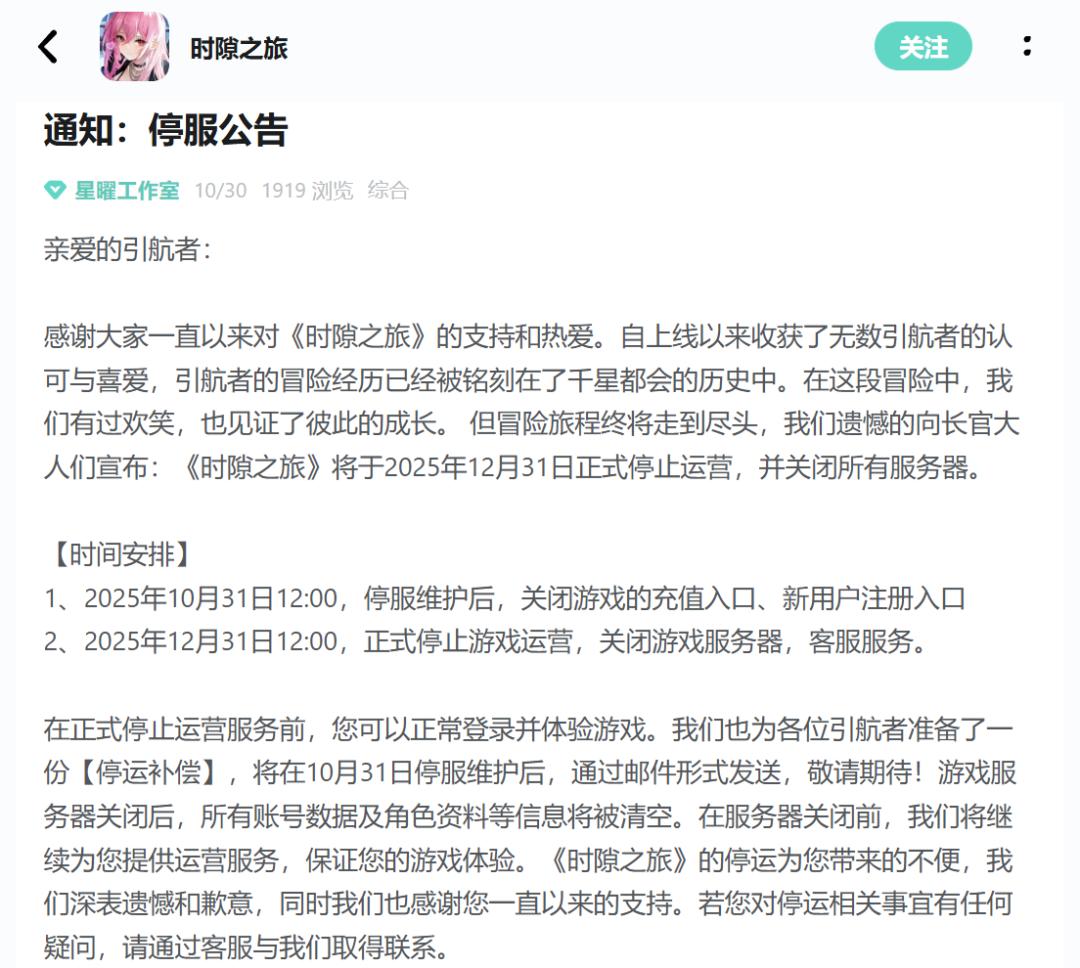
Core Viewpoint - The recent announcement of the shutdown of the game "Time-Space Journey" just three months after its launch highlights the ongoing struggles of the company in the gaming industry, particularly in the mobile sector, despite previous efforts to revitalize its game development and publishing business [1][2][5]. Company Overview - The game "Time-Space Journey" was developed by the company's subsidiary, Xingyao Studio, and published by 360, which has not seen significant success in the gaming sector for several years [2][5]. - The company has been attempting to re-enter the gaming market since 2018, establishing a self-developed brand "360 Game Art" and setting up multiple divisions across major cities to enhance its game development capabilities [5][11]. Market Challenges - The company has faced challenges in the mobile gaming market, losing its competitive edge since 2014 and struggling to adapt to the evolving landscape dominated by other major players [8][11]. - Despite having a substantial user base, the company has not been able to leverage this advantage effectively, with its gaming revenue experiencing a gradual decline in recent years [7][8]. Game Development and Performance - The company has shifted its focus to mobile games, particularly in the Southeast Asian market, where it has seen some success with titles like "Destiny Girl," which performed relatively well in Indonesia's iOS top charts [11][17]. - However, recent titles, including "Time-Space Journey," have not achieved expected performance, with the game failing to maintain a strong ranking shortly after its release [2][24]. Strategic Shifts - The company has attempted to incorporate AI tools into its gaming operations, resulting in a 50% increase in user payment performance and a 200% increase in material production [17][24]. - Despite these efforts, the company has struggled to produce standout titles, with several games underperforming and being removed from the market shortly after launch [24][26]. Future Prospects - The company is exploring new opportunities in the PC gaming market, leveraging its existing user base and aiming to capitalize on the growing interest in PC gaming [32][33]. - The company has also been focusing on developing lighter, more casual games, which may align better with current market trends and user preferences [26][32].