《明日之后》

Search documents
AI 进了游戏公司,但还没开始改变游戏丨GDC 现场大讨论
晚点LatePost· 2026-03-29 14:25
Core Viewpoint - The gaming industry is facing significant challenges due to rising development costs, the impact of AI, and changing player preferences, leading to a potential crisis in traditional game production models [6][10][25]. Group 1: AI's Impact on the Gaming Industry - The introduction of generative AI in game development has sparked both excitement and anxiety among industry professionals, with many expressing concerns about its potential negative effects [5][25]. - A significant portion of game developers (52%) believe that generative AI is having a negative impact on the industry, a notable increase from previous years [25]. - AI is currently being utilized primarily for optimizing specific content production processes, rather than fundamentally changing the traditional game development workflow [11][12]. Group 2: Financial Challenges in Game Development - Investment in the gaming industry has decreased significantly, with funding to game studios dropping by 85% compared to the peak in 2021 [6]. - The cost of developing large-scale games has risen dramatically, with some projects requiring thousands of employees and budgets exceeding hundreds of millions of dollars, while game prices have not increased proportionately [6][10]. - The gaming industry's operating profits have been declining at a compound annual rate of approximately 7% since 2021, falling below pre-pandemic levels [6]. Group 3: Changing Player Preferences - New generations of players are increasingly gravitating towards user-generated content (UGC) platforms like Roblox and Minecraft, which have seen significant increases in playtime [8][9]. - Traditional game genres, such as battle royale and shooting games, are experiencing declines in player engagement, indicating a shift in player interests [8][9]. - The future of the gaming industry may hinge on whether players who grew up with UGC platforms will transition to traditional AAA games or remain within alternative entertainment ecosystems [9]. Group 4: AI Integration in Game Development - AI is being integrated into various stages of game production, with companies like Tencent using it to streamline processes such as 3D model generation and animation [16][18]. - The use of AI has led to significant reductions in production time for certain tasks, such as global illumination calculations, which can now be completed in minutes instead of days [15][16]. - Despite the advancements, the gaming industry still relies heavily on human creativity and oversight, with AI serving as a tool to enhance rather than replace human input [25][28]. Group 5: Future Directions and Concerns - The development of AI technologies like Google DeepMind's Genie 3 is still in its early stages, with many foundational issues yet to be resolved before they can be fully integrated into game development [23][24]. - Industry leaders emphasize the importance of maintaining human creativity in game design, arguing that AI should augment rather than dictate artistic direction [30][31]. - The consensus among industry professionals is that while AI can improve efficiency, the core of game development remains rooted in human creativity and collaboration [43].





网易集团执行副总裁丁迎峰宣布退休,后续担任公司顾问
3 6 Ke· 2025-12-27 03:04
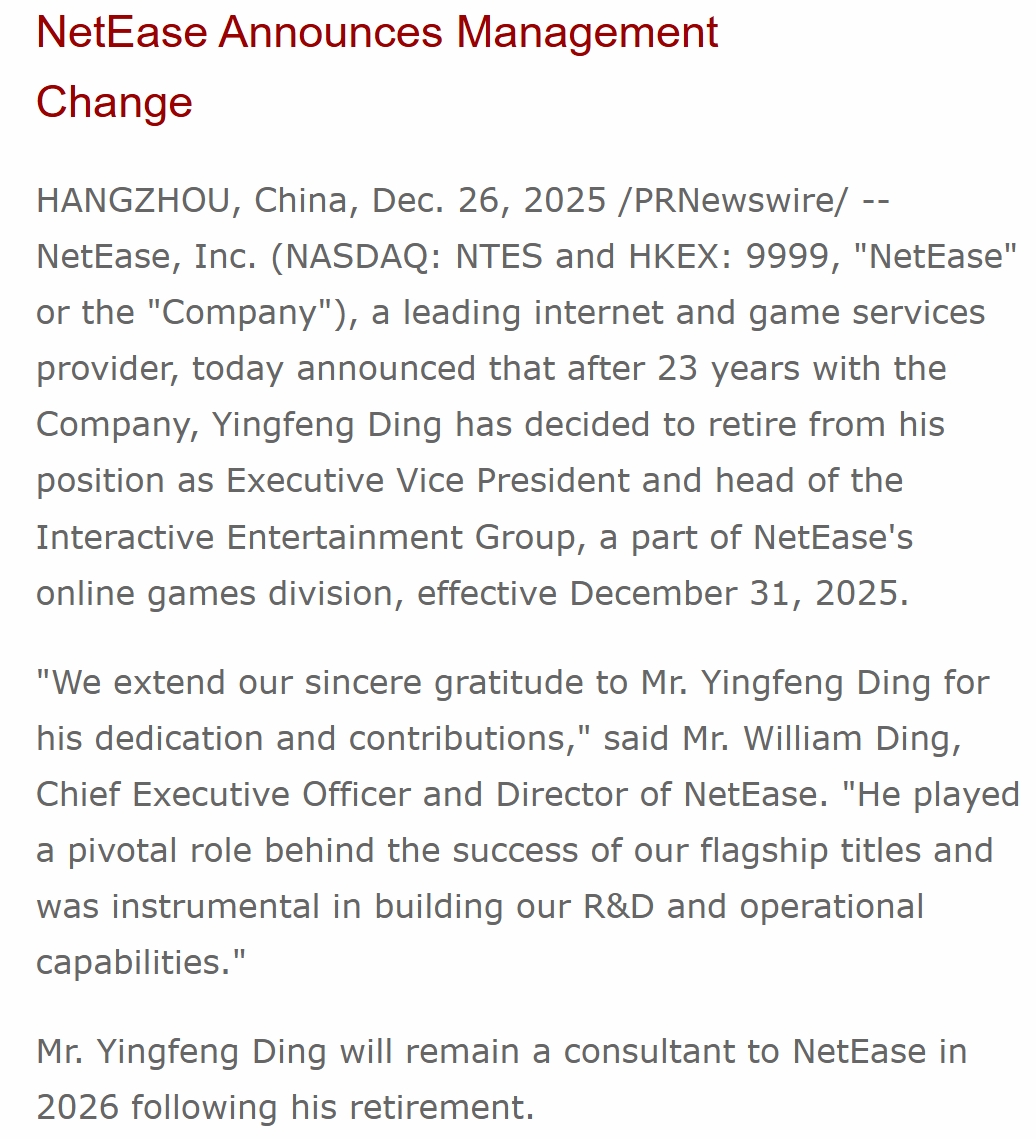
Core Insights - NetEase Group announced the retirement of Ding Yingfeng, Executive Vice President and head of the Interactive Entertainment Division, effective December 31, 2025, after which he will continue as a company advisor [1][7] - CEO Ding Lei expressed gratitude for Ding Yingfeng's contributions, particularly in the success of flagship games and the development of the company's R&D and operational capabilities [1] Group 1: Career and Contributions - Ding Yingfeng entered the gaming industry in 1998 and joined NetEase in 2002, contributing to the design and development of several iconic products, including the first self-developed large-scale online game, "Dahua Xiyou Online" [2] - Under his leadership, "Dream of the West Journey," launched in 2003, has operated for over 22 years by the end of 2025, making it one of the longest-running and highest-grossing product series in NetEase's gaming history [2] Group 2: Business Performance - In the third quarter of 2025, NetEase reported a net revenue of RMB 28.4 billion, with net income from games and related value-added services reaching RMB 23.3 billion, an 11.8% increase compared to the same period in 2024, accounting for 82% of total revenue [5] - The growth was primarily driven by the launch of new games such as "Yanyun Sixteen Sounds" and "Broken Land," as well as the stable income from existing products like the "Dream of the West Journey" series and "Egg Party" [5] Group 3: Organizational Changes - Following Ding Yingfeng's retirement, his responsibilities will be taken over by the current management team of the Interactive Entertainment Division, although specific successors have not been disclosed [7] - The impact of this leadership change on NetEase's long-term strategy and product line planning for the gaming business will gradually become evident in 2026 and beyond [7]

多款知名游戏下架OPPO渠道
Di Yi Cai Jing· 2025-11-05 10:35
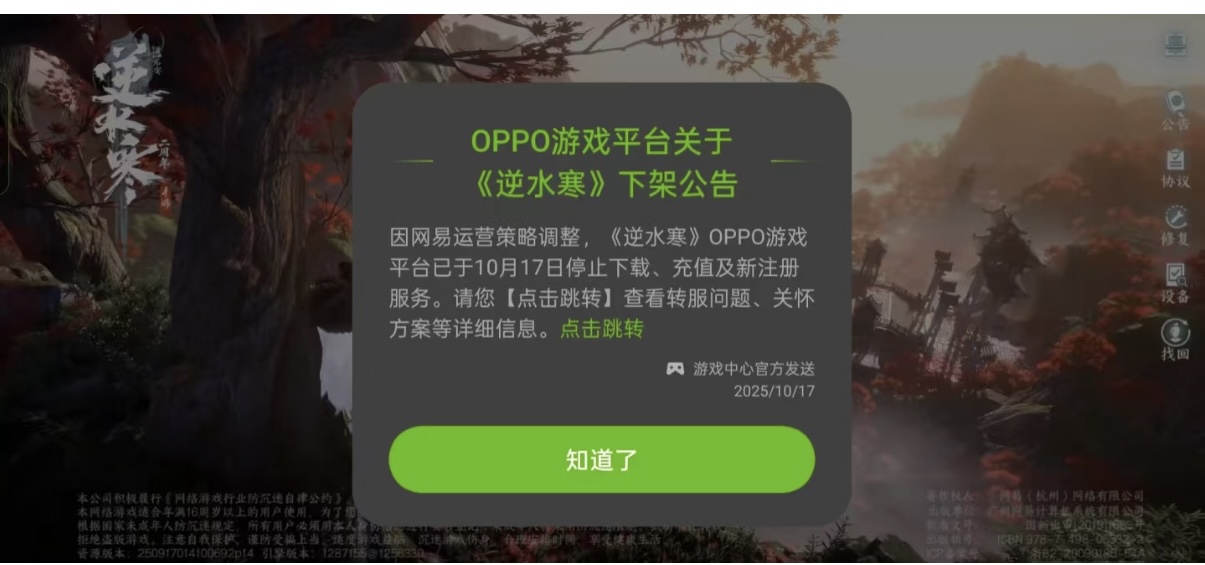
Core Viewpoint - The recent trend of multiple NetEase games ceasing operations on OPPO's platform reflects a broader shift in the gaming industry, driven by high channel fees and changing market dynamics [2][3][4]. Group 1: Game Cessation on OPPO - Several NetEase games, including "逆水寒" (Nirvana in Fire), have stopped operations on OPPO's platform due to "operational strategy adjustments" by NetEase [2][3]. - This trend is not new; multiple titles have previously announced their exit from OPPO, including "阴阳师:妖怪屋" (Onmyoji: Yokai House) and "梦幻西游" (Fantasy Westward Journey) [3][4]. - Analysts suggest that more prominent titles from NetEase may also follow suit, indicating a significant shift in the gaming landscape [3][4]. Group 2: Industry Dynamics - The gaming industry is witnessing a decline in the relevance of Android channels, with companies increasingly opting to withdraw from these platforms due to high revenue-sharing demands [4][5]. - The "hardcore alliance" formed by major players like Tencent has also contributed to this shift, as it established a 50/50 revenue-sharing model that is now being challenged [4][5]. - The contribution of channels to user acquisition is diminishing, while the revenue-sharing ratios remain high, leading to increased tension between game developers and platform providers [5][6]. Group 3: Strategic Shifts - Companies like NetEase and Tencent are confident in their games' appeal, believing that withdrawing from channel servers will not significantly impact user retention and may even enhance user migration to official servers [6]. - The industry is moving towards a model where high-quality games attract users directly, reducing reliance on traditional channel distribution methods [5][6].
多款游戏下架OPPO渠道,厂商与渠道的博弈进入深水区
Di Yi Cai Jing· 2025-11-05 09:55
Core Viewpoint - The era of channel-based revenue collection is coming to an end, as major game developers like NetEase are increasingly withdrawing their games from OPPO's channel services due to operational strategy adjustments and high revenue-sharing costs [1][4][5]. Group 1: Game Industry Trends - Multiple NetEase games have announced the cessation of their OPPO channel services, including popular titles like "Onmyoji: Yokai House" and "Reverse Water Cold," indicating a broader trend in the gaming industry [1][3]. - Analysts suggest that the withdrawal from channel services is driven by the rising costs associated with Android channels, which have become unsustainable for game developers [3][4]. - The gaming industry is witnessing a shift where developers are moving away from reliance on app store channels for user acquisition, as the contribution of these channels to new user growth diminishes while revenue-sharing ratios remain high [4][5]. Group 2: Developer Strategies - Game developers, including NetEase and Tencent, are confident in their games' appeal and are willing to withdraw from channel services, believing it will not significantly impact user retention [5]. - The trend of high-quality games attracting users through direct downloads rather than through channels is becoming more prevalent, allowing developers to bypass traditional revenue-sharing models [5]. - The "hardcore alliance" formed by major companies like Tencent has led to significant changes in how games are distributed on Android platforms, with developers seeking more favorable terms [4].