《阴阳师:百闻牌》

Search documents
2025年二游:理想主义者的冲锋
3 6 Ke· 2025-12-02 08:03
Core Insights - The 二次元 (2D) gaming industry is experiencing a significant downturn, with a noticeable gap emerging in 2025 as the market matures and competition intensifies [1][4][36] - Despite the overall growth of the gaming industry, the 二次元 mobile market saw a decline in actual sales revenue by 8% year-on-year in the first half of 2025 [4] - The success of past titles like 《阴阳师》 and 《原神》 has led to an influx of developers, but many new projects struggle to sustain operations, with a third of 二次元 games ceasing operations last year [3][4] Market Trends - The 二次元 gaming market is characterized by a lack of new standout products, with players primarily discussing established titles that have maintained long-term operations [6][36] - The emotional connection between players and characters is crucial, as seen in marketing strategies that emphasize character-driven experiences [9][12] - The rise of related cultural events, such as conventions, indicates a growing interest in the 二次元 culture, which supports the gaming market [12][14] Challenges and Opportunities - The market is becoming increasingly difficult for new entrants, as players are less willing to pay for games that do not meet high creative and quality standards [36][38] - Successful products often require a strong creative vision and a commitment to quality, as exemplified by titles like 《明日方舟:终末地》 and 《Varsapura》 [25][30] - Developers must innovate in gameplay and aesthetics to stand out in a saturated market, as traditional models of success are no longer effective [36][39] Future Outlook - The 二次元 gaming sector is expected to remain a focal point in 2026, with anticipation surrounding new products that could potentially revitalize the market [45][47] - The industry's idealistic nature continues to drive developers to pursue high-quality, emotionally resonant games, despite the challenges [20][45]


月度版号发放创新高;《阴阳师:百闻牌》停更丨游戏周报
2 1 Shi Ji Jing Ji Bao Dao· 2025-12-01 09:41
Industry Dynamics - In November, a total of 178 domestic game licenses and 6 imported game licenses were approved, marking a new high in recent years [1][2] - The domestic game market revenue reached 31.36 billion yuan in October, with a year-on-year growth of 7.83% [1][3] - The PC game market saw a significant increase, growing by 29.39% year-on-year, driven by titles like "Delta Force" and "Yanyun Sixteen Sounds" [3] Company Updates - Guo Weiwei resigned as CEO of Xishanju, continuing as Chief Producer, while Zou Tao, CEO of Kingsoft, will act as interim CEO [1][4] - Xindong Network provided a loan of 40 million USD (approximately 290 million yuan) to support the acquisition of Arc Games and Cryptic Studios by Project Golden Arc [1][5] - ByteDance is in negotiations with Saudi Savvy Game Group to sell its subsidiary Mutong, with a potential valuation of 2 billion USD for the core asset "Mobile Legends: Bang Bang" [1][6] - NetEase announced that its card game "Onmyoji: Banshu Card" will stop new content updates after January 1, 2026, due to operational strategy adjustments [1][7] - Perfect World’s actual controller, Chi Yufeng, plans to reduce his stake by selling up to 3297.95 million shares, representing 1.7% of the total share capital [1][8] Overseas Insights - Research firm Alinea Analytics predicts that Valve's revenue from its Steam platform will reach approximately 16.2 billion USD in 2025, with total revenue potentially exceeding 17 billion USD when including hardware and first-party game sales [1][9]


儒意景秀旗下《FC足球梦剧场》首次亮相;《阴阳师:百闻牌》停止新内容开发|游戏早参
Mei Ri Jing Ji Xin Wen· 2025-11-30 23:22
Group 1 - The core point of the article is the introduction of the football strategy game "FC Football Dream Theater" by Ru Yi Jing Xiu, marking a new exploration in mobile sports gaming [1] - The game allows players to experience the process of creating a football club and competing for continental championships, as well as the promotion and relegation system of real professional leagues [1] - This launch reflects the trend of game developers deeply exploring niche markets and is expected to enrich Ru Yi Jing Xiu's product matrix, positively impacting the company's long-term value [1] Group 2 - NetEase announced that "Onmyoji: Hundred Tales" will stop new content development after January 1, 2026, while keeping the servers operational [2] - The game, part of the "Onmyoji" IP, reached a peak position of 12th on the iOS game revenue chart after its launch in December 2019 [2] - This decision indicates the intense competition in the CCG sector, prompting NetEase to concentrate resources on more promising projects, testing the derivative capabilities of the "Onmyoji" IP [2] Group 3 - The release date for the game "Taiwu Scroll: Sky Curtain Heart Curtain" has been postponed to April 2026, as announced by the developer Fangluozhou Studio [3] - The delay is attributed to the team's desire to invest more time in system testing, experience optimization, content refinement, and final checks on the English version [3] - This postponement, while delaying the product launch, demonstrates the development team's commitment to quality and respect for player experience, which can enhance the long-term value and reputation of the core IP [3]
触乐本周行业大事:11月184款版号下发,字节或有意出售沐瞳,腾讯完成对育碧子公司战略投资
Sou Hu Cai Jing· 2025-11-29 07:16
Group 1: Game Approval and Market Trends - In November, the National Press and Publication Administration approved a total of 184 games, bringing the total number of game licenses issued in 2025 to 1,624, with 1,532 being domestic and 92 being imported [1][4] - The number of domestic game licenses approved each month has consistently exceeded 110 over the past year, indicating a stable growth trend compared to last year [4] - Notable games approved this month include Tencent's "No Man's Land," Bilibili's "Shining! Lume," and Perfect World's "Dream New Zhu Xian: Light Enjoy" [1] Group 2: ByteDance and Savvy Games Group Negotiations - ByteDance is reportedly in talks with Saudi Savvy Games Group to sell its gaming subsidiary, Mouton, with negotiations still ongoing and no final agreement reached [5] - Mouton's flagship game, "Mobile Legends: Bang Bang," has over 1.5 billion downloads globally and is considered a core asset of ByteDance's gaming business [5] - There are concerns regarding Savvy's financial situation, which may impact the negotiations, as the Saudi Public Investment Fund is facing funding shortages [7] Group 3: Tencent's Strategic Investments - Tencent has completed a strategic investment of €11.6 billion (approximately 900 million RMB) in Ubisoft's subsidiary, Vantage Studios, acquiring a 26.32% economic interest while Ubisoft retains control [8][10] - Vantage Studios will focus on major Ubisoft IPs like "Assassin's Creed," "Far Cry," and "Rainbow Six," aiming to develop them into evergreen brands with annual revenues of €1 billion [8] Group 4: Game Releases and Updates - Tencent's Level Infinite has secured global publishing rights for the upcoming cross-platform game "Project Spirits" developed by Shift Up, indicating Tencent's deepening involvement in game development [11][13] - Bilibili's game "Yao Guang Lu: Chaos Princess" will cease online operations on December 8, 2025, after a short lifespan, reflecting challenges in sustaining player engagement [16][18] - NetEase's collectible card game "Onmyoji: The Card Game" will stop new content updates after January 1, 2026, although servers will remain operational [19][21] Group 5: Acquisitions and Market Expansion - Nintendo plans to acquire 80% of Bandai Namco Studios Singapore by April 1, 2026, to enhance its game development capabilities [22][24] - The Chinese Embassy in Belarus praised NetEase's "Yanyun Sixteen Sounds," highlighting the increasing success of Chinese ARPGs in international markets [25][28] - Kaien Network's investment in the AI game "EVE" is set for a second test, with plans for a Q1 2026 launch, showcasing the industry's focus on AI-driven gaming experiences [29][31]


多款知名游戏下架OPPO渠道
Di Yi Cai Jing· 2025-11-05 10:35
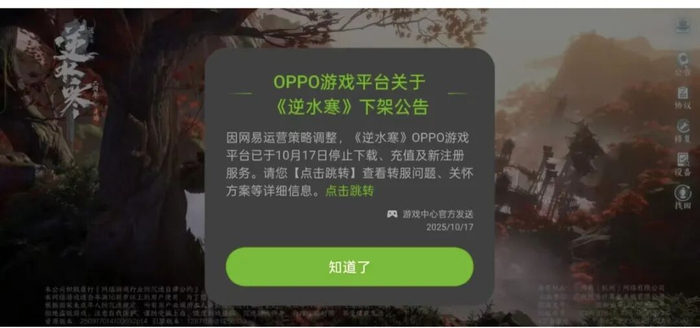
Core Viewpoint - The recent trend of multiple NetEase games ceasing operations on OPPO's platform reflects a broader shift in the gaming industry, driven by high channel fees and changing market dynamics [2][3][4]. Group 1: Game Cessation on OPPO - Several NetEase games, including "逆水寒" (Nirvana in Fire), have stopped operations on OPPO's platform due to "operational strategy adjustments" by NetEase [2][3]. - This trend is not new; multiple titles have previously announced their exit from OPPO, including "阴阳师:妖怪屋" (Onmyoji: Yokai House) and "梦幻西游" (Fantasy Westward Journey) [3][4]. - Analysts suggest that more prominent titles from NetEase may also follow suit, indicating a significant shift in the gaming landscape [3][4]. Group 2: Industry Dynamics - The gaming industry is witnessing a decline in the relevance of Android channels, with companies increasingly opting to withdraw from these platforms due to high revenue-sharing demands [4][5]. - The "hardcore alliance" formed by major players like Tencent has also contributed to this shift, as it established a 50/50 revenue-sharing model that is now being challenged [4][5]. - The contribution of channels to user acquisition is diminishing, while the revenue-sharing ratios remain high, leading to increased tension between game developers and platform providers [5][6]. Group 3: Strategic Shifts - Companies like NetEase and Tencent are confident in their games' appeal, believing that withdrawing from channel servers will not significantly impact user retention and may even enhance user migration to official servers [6]. - The industry is moving towards a model where high-quality games attract users directly, reducing reliance on traditional channel distribution methods [5][6].
多款游戏下架OPPO渠道,厂商与渠道的博弈进入深水区
Di Yi Cai Jing· 2025-11-05 09:55
Core Viewpoint - The era of channel-based revenue collection is coming to an end, as major game developers like NetEase are increasingly withdrawing their games from OPPO's channel services due to operational strategy adjustments and high revenue-sharing costs [1][4][5]. Group 1: Game Industry Trends - Multiple NetEase games have announced the cessation of their OPPO channel services, including popular titles like "Onmyoji: Yokai House" and "Reverse Water Cold," indicating a broader trend in the gaming industry [1][3]. - Analysts suggest that the withdrawal from channel services is driven by the rising costs associated with Android channels, which have become unsustainable for game developers [3][4]. - The gaming industry is witnessing a shift where developers are moving away from reliance on app store channels for user acquisition, as the contribution of these channels to new user growth diminishes while revenue-sharing ratios remain high [4][5]. Group 2: Developer Strategies - Game developers, including NetEase and Tencent, are confident in their games' appeal and are willing to withdraw from channel services, believing it will not significantly impact user retention [5]. - The trend of high-quality games attracting users through direct downloads rather than through channels is becoming more prevalent, allowing developers to bypass traditional revenue-sharing models [5]. - The "hardcore alliance" formed by major companies like Tencent has led to significant changes in how games are distributed on Android platforms, with developers seeking more favorable terms [4].