
上海银行AI手机银行

Search documents
2025深圳香蜜湖金融年会召开 擘画智能金融新蓝图
Zheng Quan Shi Bao· 2025-12-21 09:16
Core Insights - The 2025 Shenzhen Xiangmi Lake Financial Annual Conference focused on promoting a virtuous cycle of technology, industry, and finance in the Guangdong-Hong Kong-Macao Greater Bay Area, emphasizing the theme of making finance smarter and more humane [1][3] Report Overview - The "Xiangmi Lake Intelligent Finance Development Report (2025)" was released, led by former China Securities Regulatory Commission Chairman Xiao Gang, featuring contributions from over 30 experts. The report includes six chapters: technology, application, special topics, exploration, Hong Kong-Macao, and governance, providing a comprehensive view of China's intelligent finance development [3][4] Technological Developments - The report highlights significant achievements in the financial system's support for artificial intelligence (AI) and related technologies, while also addressing challenges such as the rapid depreciation of existing technologies and the impact on traditional valuation systems [3][4] Financial Support System - Xiao Gang proposed a financial support system tailored for AI development, which includes enhancing product adaptability, increasing early-stage investment, improving risk management capabilities, and enhancing post-investment services [4] AI Industry Landscape - As of November 1, 2025, China has registered 611 generative AI services, with 306 applications or functions documented. However, the AI sector faces challenges such as governance difficulties, a shortage of skilled professionals, weak intellectual property protection, and funding issues for startups [5] Application Trends - The report identifies five key trends in intelligent finance applications for 2025, including the expansion of complex financial business scenarios, reduced reasoning costs, automation of financial services, breakthroughs in multi-modal capabilities, and the role of AI models in supporting financial development [6] Data Governance Transformation - The transition from traditional data governance to intelligent governance is emphasized, with a focus on adapting to the increasing volume of heterogeneous real-time data. The need for a new governance framework that prioritizes value creation over cost is highlighted [7] Regulatory Framework - The Hong Kong-Macao section of the report discusses the importance of a regulatory framework that balances innovation and safety, with a focus on using AI for risk management rather than front-end services [8] Global Governance and Opportunities - The governance chapter outlines the need for a balanced approach to innovation and regulation, with specific recommendations for small and medium-sized financial institutions to enhance their AI capabilities through collaboration and resource allocation [10] Industry Consensus - The conference concluded with a call for collaboration among government, industry, academia, and research sectors to address challenges in intelligent finance development, aiming to transition China from a "financial power" to a "financial stronghold" [11]


上海银行AI手机银行:“可触可感”,颠覆性交互重构金融体验
Cai Jing Wang· 2025-11-27 02:55
Core Insights - The integration of AI technology in the banking sector has shifted from exploration to a critical path for future competitiveness, exemplified by Shanghai Bank's launch of AI mobile banking services that enhance customer interaction and service delivery [1][4]. Group 1: AI Mobile Banking Features - Shanghai Bank's AI mobile banking introduces a "dialogue-as-a-service" model, allowing users to perform over ten high-frequency services such as fund transfers and retirement fund management through voice or text input, significantly improving user experience [2][3]. - The AI system utilizes a voice model to recognize customer intent and provides personalized financial advice based on various data points, enhancing wealth management services [2][3]. Group 2: User Experience and Engagement - The AI mobile banking service proactively identifies customer needs by analyzing historical behavior and preferences, offering timely notifications and support in local dialects to bridge communication gaps [3]. - The bank has established over 300 "Beautiful Life Studios" in collaboration with communities to extend online services to offline activities, addressing the comprehensive needs of elderly customers [3]. Group 3: Operational Efficiency and Performance - The implementation of AI technology has led to a 10% increase in business transaction conversion rates, reduced reliance on human customer service, and improved online problem-solving capabilities [5][6]. - Shanghai Bank's digital transformation strategy includes building a robust AI infrastructure, enhancing computational resources, and deploying various AI models to improve operational efficiency across multiple business functions [4][6]. Group 4: Future Directions - The bank plans to deepen its digital transformation by enhancing the language user interface (LUI) and expanding AI applications beyond financial services to include government, healthcare, and education, aiming to position the AI mobile banking as a comprehensive financial advisor for customers [6].


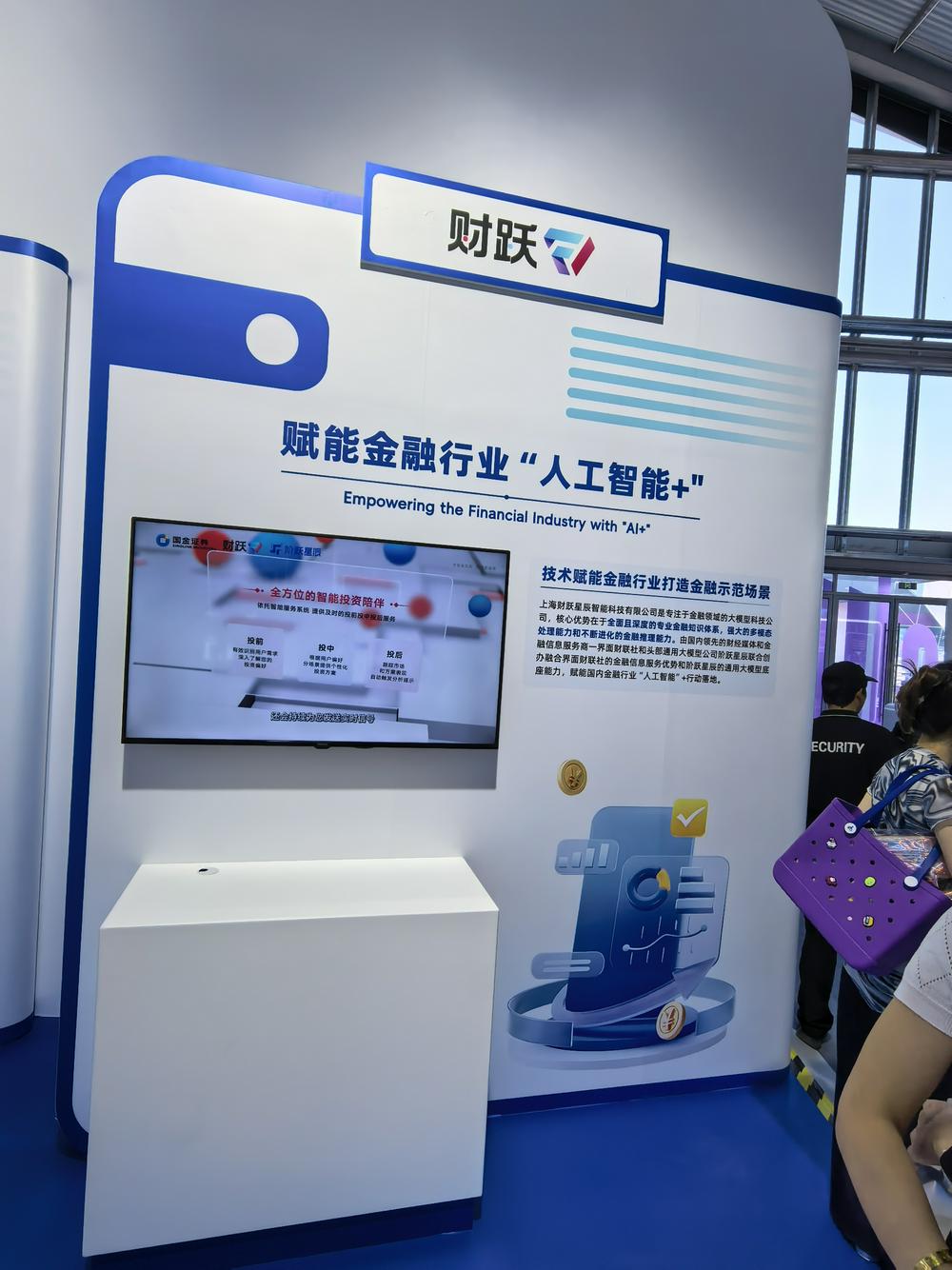
财跃星辰携四大成果亮相外滩大会,以AI创新重塑金融科技新图景
Xin Lang Cai Jing· 2025-09-11 12:45
Core Viewpoint - The "2025 Inclusion·Bund Conference" in Shanghai focuses on "reshaping innovative growth" and showcases advancements in financial AI technology, emphasizing the role of Shanghai in global financial innovation [1] Group 1: Financial AI Innovations - The conference highlighted four major financial AI achievements from Caiyue Xingchen, showcasing its breakthroughs in intelligent financial services [3] - The AI Xiaocaishen Pro product, known for its exceptional financial research capabilities, can generate professional financial reports in just half an hour, integrating exclusive data and analysis tools [3] - AI Xiaocaishen Pro ranked first in China and among the top three globally in the FinResearchBench evaluation for financial research report writing [3] Group 2: Collaborative Models - The Junhong Lingxi model, developed in collaboration with Guotai Junan, is the first multimodal large model with a scale of over 100 billion parameters, capable of processing text, images, and voice data [4] - This model enhances data perception and intelligent analysis, providing precise and efficient support in complex financial scenarios, thus creating a new paradigm in smart finance [4] Group 3: Inclusive Financial Services - The Shanghai Bank AI Mobile Banking, developed with Shanghai Bank, successfully addresses dialect recognition and synthesis, offering a seamless financial service experience for local elderly populations [5] - The Guojin AI Investment Advisory, created with Guojin Securities, merges strategy and service to lower the barriers for professional investment, making personalized advisory services accessible to a broader audience [5] - Caiyue Xingchen's innovations reflect the integration of cutting-edge technology with industry practices, contributing to the development of Shanghai as a global financial technology center [5]
数字金融|上海银行AI手机银行亮相人工智能大会:让金融服务“可感可触”
Quan Jing Wang· 2025-08-13 05:51
Core Insights - The 2025 World Artificial Intelligence Conference in Shanghai showcased Shanghai Bank's innovative AI mobile banking platform, emphasizing its "dialogue as service" model and user-friendly design aimed at enhancing customer experience [1][2]. Group 1: Service Innovation - Shanghai Bank's AI mobile banking redefines banking service entry by utilizing a "dialogue as service" approach, allowing users to interact through text or voice for various banking needs without navigating complex menus [1]. - The AI system can quickly analyze user data to recommend financial products, providing a seamless experience comparable to consulting a professional bank advisor [1]. Group 2: Human-Centric Design - The AI mobile banking platform incorporates "smart prediction" and "age-friendly design," demonstrating a commitment to user-centric service by anticipating customer needs based on historical behavior and preferences [2]. - Shanghai Bank collaborates with communities to create over 300 "Beautiful Life Studios," addressing the needs of elderly customers through both online and offline services, thereby lowering financial barriers for senior citizens [2]. Group 3: Technological Foundation - The implementation of the AI mobile banking service is based on a "technology-first, data-driven, business-integrated" approach, utilizing a layered architecture and modular design for its core technology [3]. - The platform has shown significant improvements in service efficiency, including a 10% increase in business transaction conversion rates and enhanced online problem resolution capabilities [3]. Group 4: Future Directions - Shanghai Bank aims to further explore AI innovations in financial scenarios, focusing on refining large models with regulatory and product knowledge to mitigate inaccuracies [4]. - The bank plans to evolve its mobile banking from a "functional tool" to an "intelligent partner," integrating AI with various life services beyond finance [5].
金改前沿|WAIC会场直击:“AI+金融”会碰撞出哪些火花?
Xin Hua Cai Jing· 2025-07-28 13:08
Core Insights - The integration of AI in financial services is redefining the industry, moving from tools to an ecosystem of innovative applications [1][2][5] Group 1: AI Innovations in Financial Services - AI-driven personalized asset allocation and real-time financial product interpretation are emerging trends showcased at the WAIC 2025 [1] - New terms like "embodied" and "Agent" are gaining traction in the AI+finance space, with applications such as the "Xiao Jiao" robot from Bank of Communications providing various customer services [2] - Shanghai Bank's AI mobile banking app features a "dialogue as service" model, allowing users to interact through natural language, significantly enhancing user experience [3] Group 2: Operational Efficiency and Collaboration - Digital employees are transforming financial service collaboration, with firms like CITIC Securities deploying multiple digital assistants to enhance operational efficiency [3][4] - AI is seen as a "cognitive lever" that reduces coordination costs and drives transformation in financial institutions, facilitating a shift from process automation to data-driven decision-making [4] Group 3: Challenges in AI Implementation - Despite rapid AI application penetration in finance, challenges such as high computational costs, technical barriers for smaller institutions, and regulatory compliance remain significant [5] - The gap between general AI models and specialized financial applications highlights the need for industry-specific knowledge and compliance [5] - Questions arise regarding how to leverage AI for financial supply-side reform and ensure that AI technology translates into effective service capabilities [5][6] Group 4: Future Directions and Perspectives - Industry leaders emphasize the importance of integrating AI into business practices, focusing on how to effectively utilize AI rather than whether to adopt it [6] - The call for a collaborative approach between technology and application sectors is crucial for advancing AI in finance [6]
上海银行AI手机银行亮相人工智能大会:让金融服务“可感可触”
Quan Jing Wang· 2025-07-28 01:59
Core Viewpoint - The 2025 World Artificial Intelligence Conference in Shanghai showcased Shanghai Bank's innovative AI mobile banking, emphasizing a "dialogue as service" model that enhances user experience and accessibility for elderly customers [1][2][3]. Group 1: AI Mobile Banking Features - Shanghai Bank's AI mobile banking redefines service entry by utilizing a "dialogue as service" approach, allowing users to interact through text or voice without navigating complex menus [2]. - The AI system can quickly respond to user inquiries and perform transactions, covering over ten high-frequency services such as fund transfers, investment advice, and pension management [2]. - The AI's ability to analyze user data enables it to provide tailored financial product recommendations and professional insights, mimicking the experience of consulting with a bank advisor [2]. Group 2: Human-Centric Design - The AI mobile banking platform incorporates "smart prediction" and "elderly-friendly design," showcasing a commitment to user-centric service [3]. - The system proactively identifies user needs based on historical behavior and context, offering timely notifications and support for elderly users, including language preferences [3]. - Shanghai Bank collaborates with communities to create over 300 "Beautiful Life Studios," extending online services to offline activities that cater to the elderly's diverse needs [3]. Group 3: Technological Foundation and Performance - The implementation of AI mobile banking is based on a "technology-first, data-driven, business-integrated" approach, utilizing a layered architecture and modular design [4]. - The platform has demonstrated significant performance improvements, including a 10% increase in transaction conversion rates and enhanced online problem resolution capabilities [4]. - The design for elderly users and the development of a comprehensive pension service ecosystem have increased engagement among older customers, reinforcing the inclusivity and security of financial services [4]. Group 4: Future Directions - Shanghai Bank aims to deepen its AI capabilities by enhancing large model training in specific financial areas and establishing a feedback loop for continuous improvement [5]. - The bank plans to evolve its mobile banking from a "functional tool" to an "intelligent partner," integrating AI with various life scenarios beyond finance [6]. - Future developments will focus on creating a comprehensive service that positions the AI mobile banking as a personal financial advisor for customers [6].