丝绸家纺

Search documents
党建引领促帮扶 丝绸消费进机关——人保寿险北京市分公司举办“东绸西固”消费帮扶专场活动
Sou Hu Cai Jing· 2026-02-13 08:23
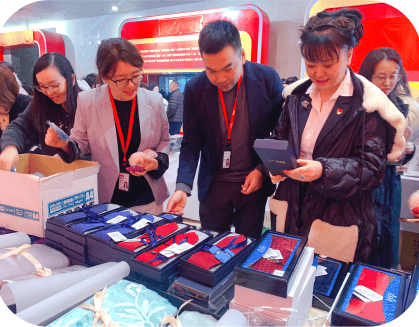
Core Viewpoint - The event "Party Building Leads to Assistance, Silk Consumption in Government Agencies" aims to integrate consumption stimulation with social welfare, rural revitalization, and the development of the private economy, showcasing the responsibility of state-owned enterprises in releasing domestic demand potential [1][4]. Group 1: Event Overview - The event was organized by the Party Branch of the Beijing Branch of People’s Insurance Company of China (PICC) in collaboration with the China National Textile Industry Federation, focusing on the theme of "East Silk West Solid" [1][3]. - It took place on January 20 and 22 at the PICC workplace and the headquarters building, respectively [1]. Group 2: Implementation and Activities - The event emphasized party leadership, led by Secretary Zhu Xiaokun, and involved close cooperation with the China Textile Federation and assisting enterprises to accurately assess employee consumption needs [3]. - A variety of products were showcased, including new Chinese-style clothing, charitable woven goods, silk home textiles, standard down jackets, and specialty agricultural products, utilizing a model of "purchase instead of donation" to effectively implement assistance tasks [3]. Group 3: Outcomes and Future Plans - The event created a vibrant atmosphere, attracting employees from the headquarters and leasing units, indicating strong interest in the showcased products [3]. - It established a solid communication bridge between PICC Beijing Branch and the China National Textile Industry Federation, reaching a consensus on resource sharing and government-enterprise services [3][4]. - Moving forward, PICC Beijing Branch plans to continue promoting consumption assistance work under the guidance of party building, deepening government-enterprise collaboration, and innovating assistance models to support rural revitalization and the private economy [4].

让更多苏品苏货“跨”入全球市场
Su Zhou Ri Bao· 2025-12-08 01:01
Core Insights - The article highlights the efforts of Suzhou's cross-border e-commerce industry to facilitate the global expansion of local products through a comprehensive ecosystem that includes platform integration and product exportation [1][6]. Group 1: Company Initiatives - Suzhou Cross-Border E-commerce Industry Company aims to build a complete ecosystem for cross-border e-commerce, facilitating platform integration and product exportation [1]. - The company has established a cross-border e-commerce service team that actively visits various enterprises to educate them on policies and operational models [2][3]. - The team has visited 67 companies across various sectors, sharing effective practices related to cross-border e-commerce services and policies [3]. Group 2: Platform Development - The cross-border e-commerce selection center, operational since June, has gathered over 770 quality products from 151 Suzhou enterprises, providing a one-stop selection service for overseas buyers [4]. - The center has launched an online sales function, allowing local products to be showcased and sold directly to global buyers [4]. Group 3: Resource Integration - The company has organized multiple events to connect local enterprises with international platforms, including Amazon and various trade fairs [6]. - A total of 27 business training sessions have been conducted, covering 1,300 participants, to support talent development in the cross-border e-commerce sector [6]. Group 4: Compliance and Support - The online comprehensive service platform operated by the company handles essential functions such as customs registration and data declaration, ensuring compliance for cross-border operations [7]. - As of now, 1,964 companies have registered on the platform, with plans to serve over 360 enterprises by 2025 [7].
【投资视角】启示2025:中国丝绸行业投融资及兼并重组分析(附投融资事件和兼并重组等)
Qian Zhan Wang· 2025-07-16 03:15
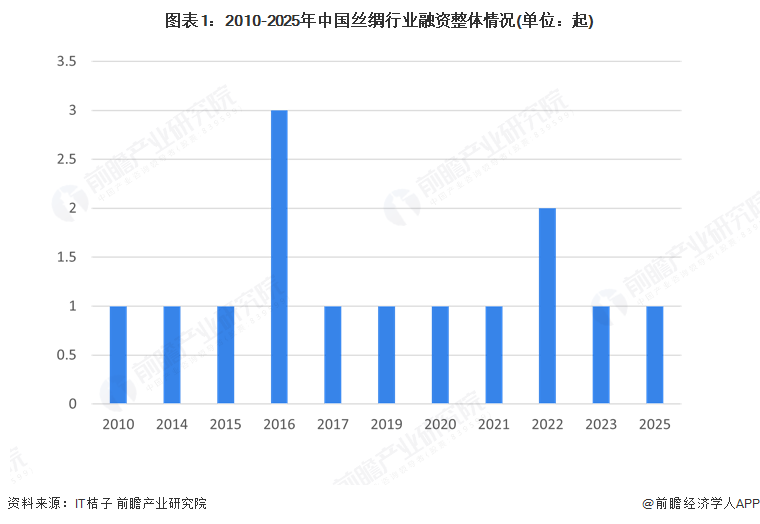
Group 1 - The core viewpoint of the article highlights the low investment and financing activity in the domestic silk industry in recent years, with a notable exception in 2016 due to the Hangzhou G20 Summit, which saw three financing events [1] - Since 2010, the silk industry has experienced a lack of financing, with only one financing event occurring in 2025, indicating potential for growth and development in the sector [1] - The financing events in the silk industry are primarily concentrated in Zhejiang and Jiangsu provinces, which have a rich history in silk production and a developed capital market [8] Group 2 - The average single financing amount in the silk sector is around tens of millions, with seed round financing exceeding 20 million RMB and angel round financing in the millions [2] - The majority of financing events are focused on companies that are already listed, reflecting a preference for established firms in the silk industry [7] - Key investment areas within the silk industry include clothing and other silk products, with a total of 14 financing events categorized into six main types, including upstream silk, home textiles, and fashion [10][16] Group 3 - The investment entities in the silk industry are evenly split between capital organizations and industrial enterprises, with notable investors including Taiheng Investment and Liangjiang Venture Capital [16] - Recent mergers and acquisitions in the silk industry are primarily horizontal, aimed at expanding scale and enhancing technological capabilities, involving both traditional silk companies and tech-driven firms [18] - Specific acquisition examples include Wan Shili's acquisition of Baoyang New Materials to enhance business strength and Anuoqi's acquisition of Colorful Jump to improve product application services [19]