个人汽车贷款

Search documents
图说资产证券化产品:REITs支持政策加码激活民间投资,ABS一二市场均有所降温
Zhong Cheng Xin Guo Ji· 2025-12-18 09:32
Report Summary 1. Industry Investment Rating - No investment rating information is provided in the report. 2. Core Viewpoints - The State Council supports private investment projects to issue infrastructure REITs to broaden the financing channels for private enterprises. The "Measures" put forward 13 measures to stimulate private investment vitality and development, focusing on direct financing through equity and REITs [2][3]. - The average issuance costs of policy - backed mortgage loans and REIT - like products are relatively high, while those of personal auto loans are relatively low [5]. - In October 2025, the issuance of ABS decreased due to holiday factors, and the secondary stratification ratio of non - performing loan products remained high [6]. - The trading activity of ABS products in the secondary market declined, with significant differences in trading activity among different products [22]. 3. Summary by Directory 3.1 REITs Policy Support - The "Measures" encourage private capital to participate in infrastructure projects and support the listing of high - tech enterprises and the issuance of infrastructure REITs by private investment projects to expand financing sources [2][3]. - The NDRC will promote the expansion of infrastructure REITs to new fields. Currently, private investment projects in infrastructure REITs have less than 20% in quantity and scale, indicating significant development potential [4]. 3.2 Market Issuance Situation - **Overall Market**: In October 2025, 164 asset - securitized products were issued, with a total scale of 181.083 billion yuan, a 33% decrease from the previous period. Non - performing loan products had a high secondary stratification ratio [6]. - **Bank - to - Bank Market**: 10 products were issued, with a scale of 34.343 billion yuan. The average issuance cost of non - performing loan products was the highest, while that of personal auto loans and micro - enterprise loans was relatively low [10][11]. - **Trading Association ABN**: 49 products were issued, with a scale of 51.653 billion yuan, a 23% decrease from the previous month. The coupon rates of priority products with disclosed credit ratings ranged from 1.65% to 3.60% [17]. - **Exchange ABS**: 105 products were issued, with a scale of 95.087 billion yuan, a 42% decrease from the previous month. The credit ratings of priority products included AAAsf and AA + sf, and the coupon rates ranged from 1.65% to 3.95% [18]. 3.3 Secondary Market Situation - **Bank - to - Bank Market**: The trading volume was 1.1445 billion yuan, with a significant decline in trading activity. Personal auto loan products had the highest trading volume [23]. - **Trading Association ABN**: The trading volume was 4.6139 billion yuan, a further decrease. Small - scale loans and enterprise accounts receivable were relatively actively traded [26]. - **Exchange ABS**: The trading volume was 8.1 billion yuan, a decrease from the previous month. The Shanghai and Shenzhen Stock Exchanges had trading volumes of 6.3879 billion yuan and 1.7121 billion yuan respectively [27].
消费贷“国补”落地,多方响应激发消费市场活力
Huan Qiu Wang· 2025-09-19 03:23
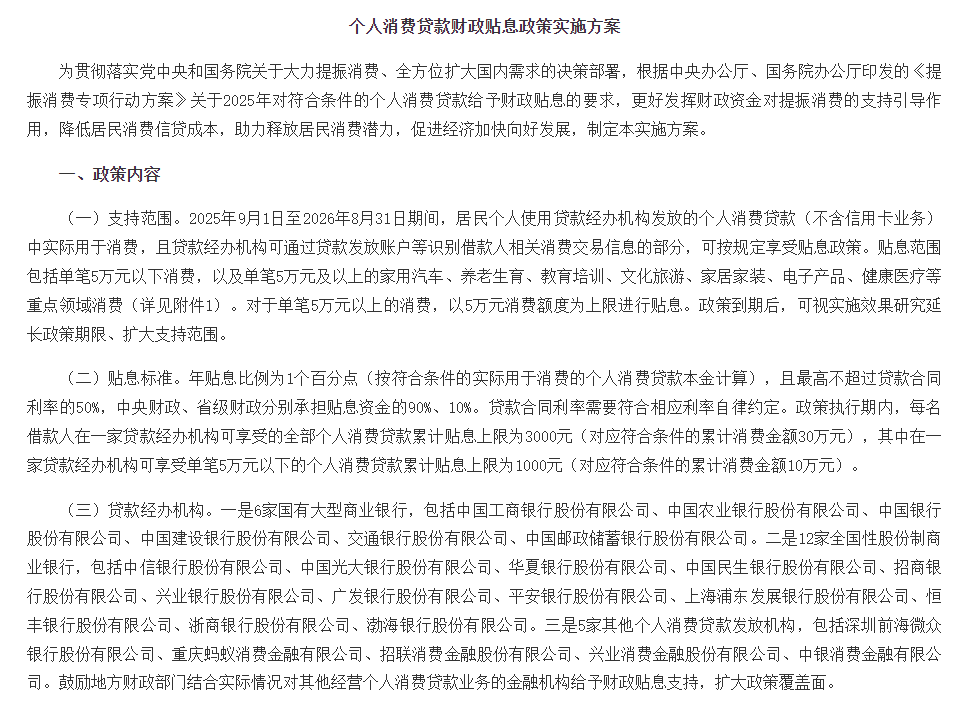
Group 1 - The personal consumption loan interest subsidy policy was officially implemented on September 1, with a cumulative subsidy cap of 3000 yuan and a maximum subsidy of 1000 yuan for individual loans below 50,000 yuan [1][2] - The policy aims to lower credit costs, stimulate consumer willingness, and guide consumption direction, which is expected to positively impact short-term consumption and expand domestic demand [1][9] - Banks are expanding the types of subsidized loan products, including various personal loans and consumer finance options [3] Group 2 - Financial technology platforms and e-commerce companies are actively responding to the subsidy policy, allowing users to enjoy subsidies directly through their platforms [5][7] - The digital operation of the entire process from application to subsidy redemption is more efficient on these platforms compared to traditional banks, which rely on manual approval [8] - The increase in personal consumption loan issuance by commercial banks in the first half of the year indicates a growing focus on consumer lending, with significant growth rates reported by several banks [8][9]


贴息“红包”福利来了!使用攻略速看!
Sou Hu Cai Jing· 2025-09-01 12:42
Core Viewpoint - The Chinese government has introduced a subsidy program for personal consumption loans, effective from September 1, 2025, to August 31, 2026, providing a 1% annual interest subsidy for loans used for consumption purposes [5][9]. Group 1: Policy Implementation - The subsidy program is the first of its kind from the central government aimed at personal consumption loans, with a subsidy rate of 1%, which is approximately one-third of the current interest rates for personal consumption loans [5]. - The subsidy applies to loans used for genuine consumption, including daily expenses under 50,000 yuan and larger purchases such as home appliances, vehicles, and education [5][9]. - Each borrower can receive a maximum subsidy of 3,000 yuan from the government [5]. Group 2: Bank Preparedness - Multiple banks have prepared to implement the subsidy program, optimizing processes and ensuring that funds are directed towards consumer spending [4][8]. - Major commercial banks and consumer finance companies have completed system developments and are conducting final tests to launch the subsidy feature by September 1 [8]. - Banks are actively promoting the subsidy to consumers, collaborating with retailers to raise awareness [7][8]. Group 3: Consumer Experience - Banks will directly deduct the subsidy from the interest charged to eligible borrowers, enhancing customer satisfaction [6]. - Consumers can apply for loans and check their subsidy amounts through mobile banking apps [9]. - The program aims to simplify the loan application process and improve the overall customer experience [8][10].