
中亚班列

Search documents
西安、郑州超过成都、重庆,中欧班列格局何以生变
Di Yi Cai Jing· 2026-01-20 13:46
Core Insights - The operational landscape of the China-Europe Railway Express is shifting, with Xi'an and Zhengzhou surpassing Chengdu and Chongqing in terms of train operations, reflecting a diversification trend in China's foreign trade [1][2]. Group 1: Operational Changes - In 2025, Xi'an is projected to operate 6,037 trains, a 21.1% increase year-on-year, with a total cargo weight of 6.96 million tons, up 23.7% [1]. - Zhengzhou is expected to operate a total of 3,417 trains, surpassing both Chengdu and Chongqing, although it does not exceed the combined volume of the Chengdu-Chongqing line [5][9]. - The competition between Xi'an and the Chengdu-Chongqing region has intensified, with Xi'an's growth leading to a new operational dynamic [4][8]. Group 2: Trade Trends - The shift in rankings from Chengdu and Chongqing to Xi'an and Zhengzhou is indicative of a broader trend towards diversification in trade routes, particularly towards Central Asia [9][10]. - In 2025, the total number of trains operating in the Central Asia direction is expected to reach 14,254, a 19.6% increase, while the Europe direction will see a modest growth of 3.2% [9]. - The trade volume between China and Central Asia is projected to reach $106.3 billion in 2025, marking a 12% increase and reflecting a significant growth trend in this region [10].
中欧班列全年开行首超2万列 “南通道”同比增速超两成
Xin Lang Cai Jing· 2026-01-17 09:29
Core Insights - The China-Europe (Asia) Railway Express is projected to operate 34,000 trains and send 3.17 million TEUs in 2025, representing year-on-year growth of 9.8% and 7.6% respectively, with over 20,000 trains for the first time [2] - The "South Corridor" of the China-Europe Railway Express is experiencing rapid development, with 456 trains expected to operate in 2025, marking a 21% increase, making it the fastest-growing corridor [3] - The total number of China-Europe Railway Express trains has surpassed 120,000, with a total cargo value exceeding $490 billion, covering 128 cities in China and reaching 26 European countries and over 100 cities in 11 Asian countries [4] Group 1: Operational Data - In 2025, the Alashankou port is expected to have the highest number of trains, with 6,622 trains, followed by Manzhouli and Erenhot with 4,867 and 4,690 trains respectively [2] - The Erenhot port has the fastest growth rate among the six major ports, with a year-on-year increase of 23.4% [2] - The total number of routes at the Erenhot railway port has increased to 74, connecting to over 70 hub stations in more than 10 countries [2] Group 2: Corridor Development - The "South Corridor," also known as the "Middle Corridor," connects China to Europe without passing through Russia, significantly shortening transport routes [3] - The Middle Corridor includes 4,256 kilometers of rail and 508 kilometers of shipping routes, enhancing logistics efficiency [3] - The cargo volume of the Middle Corridor grew by 63% in the first 11 months of 2024, reaching 4.1 million tons, with container transport increasing by 2.6 times [4] Group 3: Container Transport Performance - In 2025, the Central Asia Railway Express is expected to operate 8,864 trains, reflecting a year-on-year growth of 32.9% [5] - The total container volume for the year is projected to reach 9.025 million TEUs, accounting for 21.7% of the total railway volume [5] - The multi-modal transport business has also seen significant growth, with rail-water transport completing 5.14 million TEUs, representing 29.6% of the total [5]

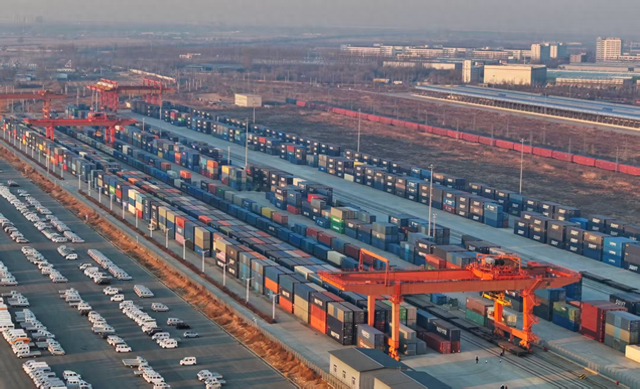
铁路货运蹄疾步稳,谱写物流现代化新篇
Zhong Guo Jing Ji Wang· 2025-10-27 09:07
Core Insights - The railway freight sector in China has shown stable growth, with a total cargo volume of 3.03 billion tons in the first three quarters of the year, reflecting a year-on-year increase of 3.4% [1] - The transformation of railways from traditional transport to modern logistics service providers is highlighted, emphasizing the importance of rail freight as an economic indicator [1][2] - The integration of various transport modes, such as rail, road, and water, is being actively promoted to enhance logistics efficiency and reduce costs [3] Group 1 - The railway freight volume is seen as a "barometer" of economic performance, with significant contributions to energy supply and food security through efficient transportation of key materials [1][3] - The shift from "station-to-station" to "door-to-door" services marks a significant change in the railway's operational model, improving supply chain stability for modern manufacturing [2] - The development of inland ports and the establishment of multimodal transport channels have been successful, with Guangdong building 37 inland ports to enhance logistics connectivity [2] Group 2 - The "One Order" rail-water intermodal transport model has been innovated, significantly reducing transportation time by 5 to 7 days and lowering logistics costs by approximately 20% compared to traditional methods [2] - The growth of international logistics corridors, such as the China-Europe Railway Express and the China-Laos Railway, is enhancing China's global trade and infrastructure connectivity [2] - The modernization of railway freight is reshaping China's economic landscape, providing robust support for domestic and international circulation [3]
今年前三季度江苏省中亚班列累计开行1089列
Zhong Guo Xin Wen Wang· 2025-10-14 11:59
Core Insights - In the first three quarters of this year, Jiangsu Province's international freight trains have operated steadily, with a total of 1,789 trains launched, including 1,089 Central Asia trains, marking an 8% year-on-year increase [1][1][1] - The total cargo transported reached 89,382 TEUs, placing the total number of trains among the top in China [1][1][1] - The transit trains accounted for 616 trains, carrying 50,491 TEUs, making the scale of transit trains the largest in China [1][1][1] Summary by Category Train Operations - Jiangsu Province has focused on developing a diversified transportation network, introducing new routes for the "China-Kyrgyzstan-Uzbekistan" rail-road international intermodal trains from Xuzhou and Nantong, which have achieved regular operations [1][1][1] - A total of 2,812 TEUs of "China-Kyrgyzstan-Uzbekistan" rail-road international intermodal trains were dispatched in the first three quarters, representing a 65% year-on-year increase, leading the Yangtze River Delta region in dispatch volume [1][1][1] Economic Impact - The opening of these train services has significantly enhanced the export capacity of Xuzhou, Nantong, and surrounding areas, while greatly reducing transportation costs for local enterprises to Central Asia [1][1][1]
成都国际班列公司:已切换三条通道应对中欧班列中断
Di Yi Cai Jing· 2025-09-22 07:57
Core Viewpoint - Poland's interruption of the China-Europe Railway Express has garnered significant attention, prompting domestic operators to implement emergency measures [1] Group 1: China-Europe Railway Express Operations - The China-Europe Railway Express began operations in 2011 and has developed four main routes over the past decade, including the East, North, Central, and South corridors [1] - The most frequently used route is the Central corridor through Poland, but following the outbreak of the Russia-Ukraine conflict, Chinese railway companies have been actively expanding the South corridor [1] - On July 9, 2023, the Chengdu International Railway Port and Chongqing Tuanjie Village Central Station launched regular South corridor express trains [1] Group 2: Chengdu's Connectivity Initiatives - Chengdu operates three connecting corridors, with the South corridor utilizing a "rail-sea-rail" model, starting from Chengdu International Railway Port, passing through Kazakhstan, Azerbaijan, and Turkey, before reaching various locations in Europe [5] - Chengdu is also expanding the North corridor, which circumvents the conflict in Poland by using sea transport from Russia to Germany and Poland [5] - The city is leveraging the Rongou rail-sea intermodal corridor to offer direct rail transport from Chengdu to various ports in China, facilitating maritime shipping to Europe [5] Group 3: Future Projections - According to China National Railway Group, the China-Europe Railway Express is projected to operate 19,000 trains and send 2.07 million TEUs in 2024, representing year-on-year growth of 10% and 9% respectively [5] - The Central Asia Railway Express is expected to operate 12,000 trains and send 880,000 TEUs, with year-on-year growth of 10% and 12% respectively [5] - The Western Land-Sea New Corridor is anticipated to send 960,000 TEUs, reflecting an 11% increase year-on-year [5]
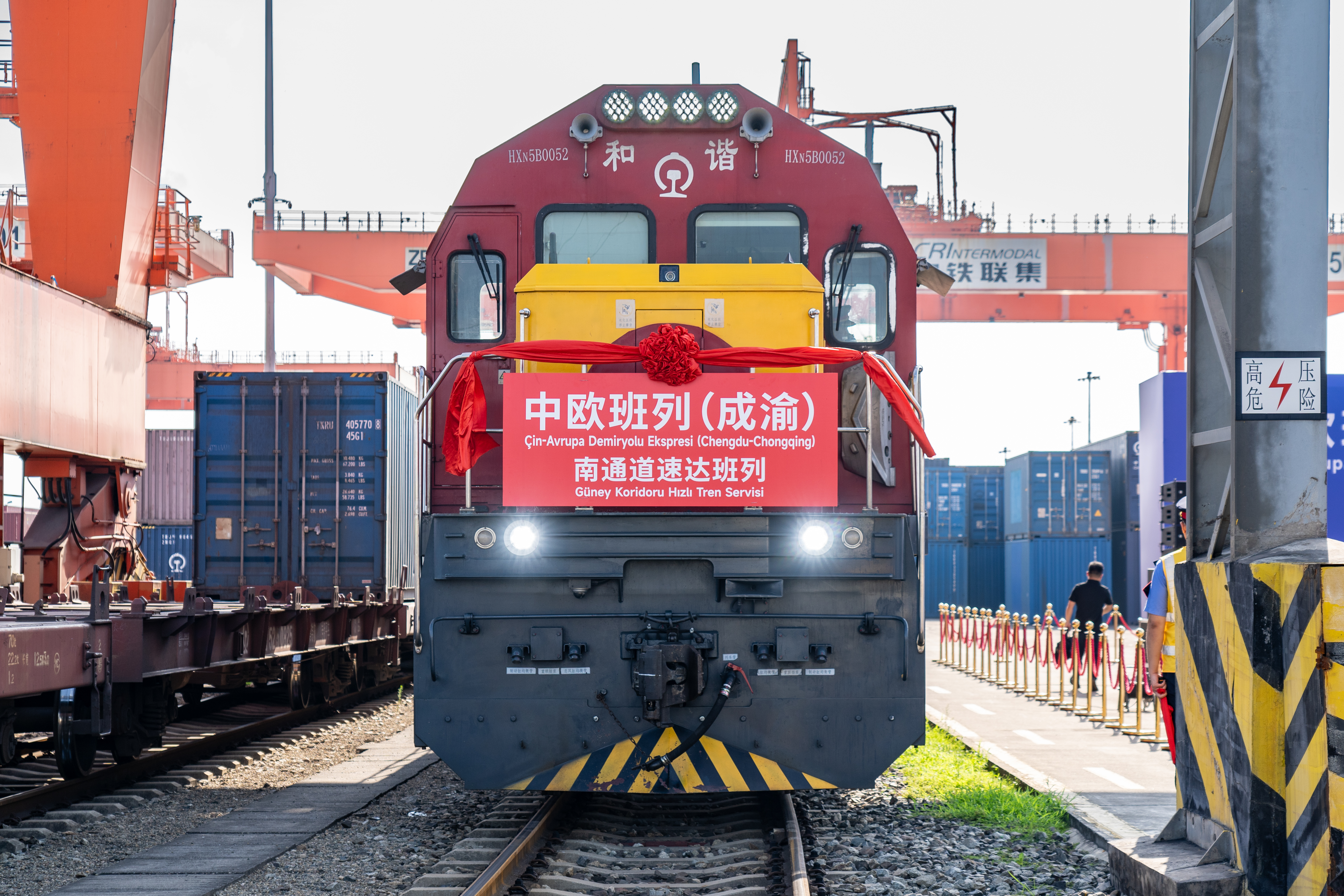
前8月中亚班列发送货物增长超三成 运输能力和效率持续提升
Ren Min Ri Bao· 2025-09-12 21:59
Core Insights - The China-Europe freight trains have achieved a record high in the first eight months, with 9,626 trains operated and 751,000 TEUs sent, representing year-on-year increases of 22.7% and 31.1% respectively [1] Group 1: Operational Performance - The cumulative number of China-Central Asia freight trains has exceeded 69,000, with over 5.19 million TEUs sent as of August 31 [1] - The opening of new transport corridors, such as the China-Laos Railway and the Trans-Caspian Transport Corridor, has expanded the coverage of the China-Central Asia freight trains to over 100 cities in 11 Asian countries and 128 cities in 28 provincial-level regions in China [1] Group 2: Cargo Diversification - The types of goods transported have diversified from mainly second-hand vehicles to include 22 major categories such as new energy vehicles, photovoltaic products, and machinery [1] - Goods from Central Asia, including cotton yarn, antimony concentrate, and barley, as well as tropical fruits and fertilizers from Southeast Asia, are entering the Chinese market [1] - Chinese manufactured goods, including new energy vehicles, photovoltaic components, electronic products, and daily necessities, are increasingly reaching various Asian countries and regions [1] Group 3: Efficiency Improvements - The transportation time for freight trains from Lianyungang, China, to Almaty, Kazakhstan, has been reduced from over 10 days in 2014 to 6 days currently [1] - The upcoming launch of the "cross-border e-commerce special train" in 2024 will enable shipments from Yiwu, Zhejiang, to Tashkent, Uzbekistan, in just 10 days, at a cost 80% lower than air freight [1]
今年以来苏州中亚班列发运量同比增长超三成
Xin Hua Ri Bao· 2025-09-01 21:58
Core Insights - The Shanghai Cooperation Organization (SCO) member states' summit highlighted the increasing trade cooperation among member countries, exemplified by the significant growth in the Central Asia freight train service originating from Suzhou [1] Group 1: Trade and Logistics - The Central Asia freight train service has seen a year-on-year increase of over 30% in shipment volume, indicating a robust demand for logistics connecting China with SCO member states [1] - From January to July this year, the Suzhou Central Asia freight train operated 77 trains and transported 3,965 containers, reflecting a nearly 35% increase compared to the previous year [1] - Approximately 85% of the goods exported via the Central Asia freight train are destined for Kazakhstan, while 9% are headed to Uzbekistan, showcasing the primary trade routes [1] Group 2: Goods and Sources - The main goods transported include home appliances, elevator parts, pesticides, chemical products, and auto parts, with nearly 50% of the cargo sourced locally from Suzhou [1] - The remaining goods primarily come from the Yangtze River Delta region, indicating a strong regional supply chain supporting the freight service [1]
物流运行稳中有进 物流总额保持增长——透视前7个月我国物流发展
Xin Hua She· 2025-08-31 09:53
Core Insights - The logistics sector in China has shown steady growth in the first seven months of the year, with a total social logistics volume of 201.9 trillion yuan, reflecting a year-on-year increase of 5.2% [1] - The logistics demand in high-tech manufacturing, digital intelligence, and green low-carbon sectors has become a significant driver for logistics demand upgrades [2] - International logistics has emerged as a new growth point, with substantial increases in cross-border transportation and e-commerce logistics [3] Group 1: Overall Logistics Performance - The total social logistics volume for January to July reached 201.9 trillion yuan, with a year-on-year growth of 5.2%, and July's logistics volume grew by 4.9% [1] - The logistics revenue for the logistics industry was 8.2 trillion yuan, marking a year-on-year increase of 4.9% [2] - The business volume index for July was 50.5, indicating continued expansion, while the new orders index was 52.5, suggesting improved business conditions [2] Group 2: Sector-Specific Growth - Industrial product logistics volume increased by 5.7%, with logistics demand across 35 industries growing, covering over 85% of sectors [1] - High-tech manufacturing logistics demand grew by 9.3%, with logistics for products like simulation chips and 3D printing equipment exceeding 20% growth [2] - The logistics volume for new energy products, including electric vehicles and lithium-ion batteries, also saw growth rates around 20% [2] Group 3: Regional Dynamics - The logistics demand in the central and western regions of China is gaining momentum, with business volume indices of 52.3 and 50.9, respectively, surpassing the national average [2] - The eastern region maintained a steady growth index of 50.3, indicating a coordinated regional development pattern [2] Group 4: International Logistics and E-commerce - The number of China-Europe freight trains reached 8,526, a year-on-year increase of 23.2%, while international air cargo transport volume grew by 21.5% [3] - E-commerce logistics, particularly in rural areas, showed strong growth, with indices of 130.9 and 131.5 for overall and rural e-commerce logistics, respectively [3] Group 5: Future Outlook - The logistics sector is expected to continue its steady growth trajectory, supported by stable and flexible policies that create a conducive environment for logistics operations [4]