中国海外互联网ETF

Search documents
全球资本瞄准中国资产 境内ETF出海引“活水”
Shang Hai Zheng Quan Bao· 2026-02-02 18:45
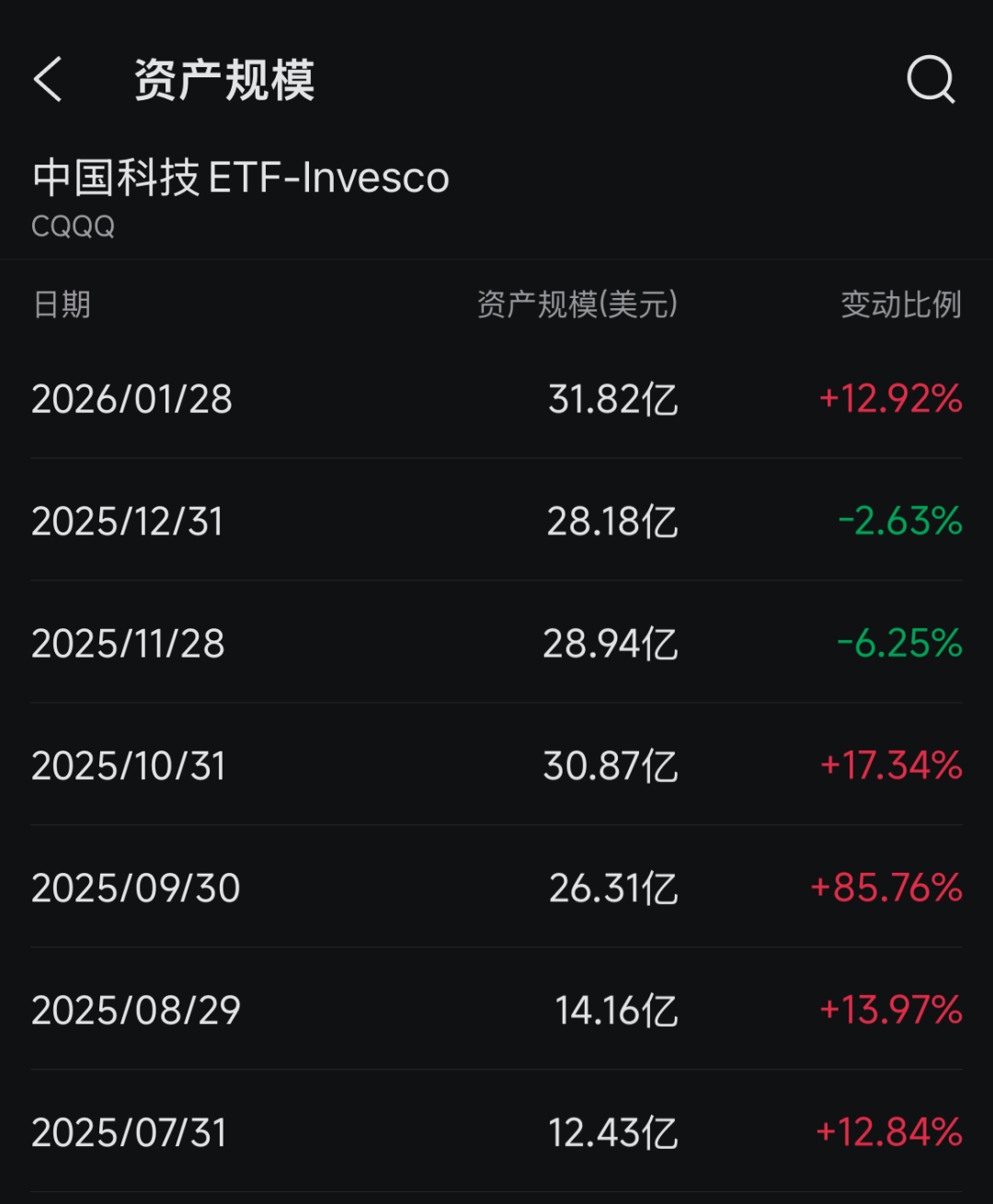
Core Viewpoint - The article highlights the increasing interest of global funds in Chinese assets, with domestic ETFs actively expanding internationally through various exchanges, providing richer investment tools for global investors [1][2]. Group 1: Domestic ETFs Going International - Domestic ETFs have been expanding internationally, with significant milestones including the listing of the first cross-border ETFs on the Hong Kong Stock Exchange and the Singapore Exchange [2]. - Notable ETFs that have gone international include the Southern Eastern Huatai-PB China Solar Industry ETF, the Southern Eastern Huatai-PB Shanghai Dividend ETF, and the Southern Eastern Huatai-PB CSI A500 ETF [2]. - The trend reflects a shift from single-market listings to multi-exchange listings and from traditional broad-based ETFs to smart beta and thematic indices, indicating growing international investor interest in China's structural investment opportunities [3]. Group 2: Inflow of Foreign Capital into Chinese Assets - Recent data shows a continuous net inflow of both active and passive foreign capital into Chinese assets, with active foreign capital accelerating [4]. - As of January 28, active foreign capital has seen three consecutive weeks of inflow, while passive foreign capital also maintains a net inflow [4]. - Several China-themed ETFs listed in the U.S. have shown significant growth, particularly in the technology sector, with the Invesco China Technology ETF's assets increasing from $2.818 billion to $3.161 billion, a growth of 12.17% [4]. Group 3: Positive Outlook from International Asset Management Firms - Major international asset management firms, including Franklin Templeton and Invesco, have released optimistic investment outlooks for 2026, citing attractive valuations in Chinese stocks and potential for market growth [6]. - The outlook emphasizes the vibrancy and breakthrough progress in key areas such as technology innovation and industrial upgrades, which are expected to support market performance [6]. - Analysts suggest that the A-share market's overall valuation has rebounded from low levels, with no signs of overheating, indicating a favorable environment for growth opportunities [6][7]. Group 4: Key Investment Areas - Key sectors identified for investment opportunities include consumer electronics, lithium battery supply chains, the financial sector, and emerging sub-sectors related to domestic demand expansion [7]. - The consumer electronics sector is expected to remain in a major innovation cycle, while the lithium battery market is projected to grow due to favorable policies supporting electric vehicle demand [7].



图解1月ETF涨跌幅、资金流
Ge Long Hui· 2026-02-01 09:04
Group 1 - In January 2026, the A-share ETF market showed a clear divergence, with over 200 billion yuan flowing into industry-themed ETFs such as non-ferrous metals, gold, chemicals, and satellite, while core broad-based ETFs like CSI 300 and CSI 1000 experienced a net outflow exceeding 1 trillion yuan [1][6] - The Shanghai Composite Index rose by 3.76% in January, reaching above the 4100-point mark, while the Sci-Tech 50 Index saw an increase of over 12% [2] - Significant gains were observed in various ETFs, with semiconductor and gold stock ETFs rising over 40%, and mining and non-ferrous metal ETFs increasing by over 20% [2][3] Group 2 - In January, the banking ETF fell by over 6%, along with declines in the automotive and battery ETFs [4] - On January 28, a notable increase in ETF trading volume was recorded, with the Huatai-PineBridge CSI 300 ETF exceeding 40 billion yuan in trading volume, marking the highest since 2015 for the SSE 50 ETF [5] - Over 1 trillion yuan was withdrawn from broad-based ETFs in January, with significant outflows from the CSI 300, CSI 1000, and SSE 50 ETFs, while industry-themed ETFs saw net inflows exceeding 10 billion yuan [6] Group 3 - In January, there was a substantial inflow of overseas funds into Chinese stock assets, with a net inflow of 16.659 billion USD into mainland Chinese stock funds, according to Goldman Sachs [7]
海外资金 大幅加仓中国资产
Shang Hai Zheng Quan Bao· 2026-01-29 23:22
Group 1 - Significant inflow of overseas funds into Chinese assets has been observed since the beginning of 2026, particularly favoring technology-related assets [2][7] - In the month leading up to January 14, global funds saw a net inflow of $105.52 billion into stock funds, with Chinese mainland stock funds receiving a net inflow of $16.66 billion [2] - The Invesco China Technology ETF's asset size reached $3.182 billion as of January 28, 2026, marking a nearly 13% increase from $2.818 billion at the end of 2025 [4][5] Group 2 - The KraneShares CSI China Internet ETF's asset size was $8.699 billion as of January 27, 2026, reflecting an 8.51% increase from $8.017 billion at the end of 2025 [5] - The Rayliant ChinaAMC Transformative China Tech ETF saw its size grow to $18.1726 million as of January 27, 2026, a nearly 30% increase from $13.984 million at the end of 2025 [6] - Major asset management firms like Franklin Templeton, Invesco, and Morgan Asset Management express optimism about the Chinese stock market's valuation and potential for further upward movement in 2026 [7][8] Group 3 - Key investment opportunities identified for 2026 include the consumer electronics sector, lithium battery supply chain, financial sector, and emerging fields related to domestic demand expansion [8] - The consumer electronics sector is expected to remain in a major innovation cycle, with leading companies' valuations at historically low levels [8] - The lithium battery industry is anticipated to see growth in demand due to favorable policies supporting the domestic electric vehicle market [8]

持续“吸金” 科技方向ETF规模大增
Shang Hai Zheng Quan Bao· 2026-01-13 18:34
Core Viewpoint - The Chinese technology sector has seen significant capital inflow in 2026, driven by strong performance in various technology-related ETFs and positive market sentiment towards the long-term growth potential of the sector [1][2][4]. Group 1: ETF Inflows - Several technology-focused ETFs have attracted substantial net inflows this year, with the Yongying Satellite ETF leading at 4.79 billion yuan, followed by the Guotai Semiconductor Equipment ETF at 3.014 billion yuan and the Fuguo Satellite ETF at 2.824 billion yuan [1][2]. - Other ETFs, including the Fuguo Hong Kong Internet ETF and Huatai-PB Hang Seng Technology ETF, have also seen significant inflows, with amounts exceeding 1 billion yuan [1][2]. Group 2: Market Performance - The performance of technology indices has been strong, with the Shenwan Computer and Shenwan Electronics indices rising by 14.13% and 5.7% respectively, while the Hang Seng Technology Index increased by 6.41% [2]. - In the U.S. market, Alibaba and Baidu stocks have outperformed the Nasdaq index, rising by 13.46% and 16.53% respectively, compared to the Nasdaq's 2.12% increase [2]. Group 3: Growth Potential - Foreign institutions express confidence in the long-term growth logic of the Chinese technology sector, highlighting the potential for continued market performance in 2026 [4]. - Key sub-sectors such as robotics, autonomous driving, and commercial aerospace are expected to experience significant growth, driven by technological advancements and increasing policy support [5][6]. Group 4: AI and Emerging Technologies - The integration of AI across various industries is anticipated to be a transformative process over the next 3 to 5 years, with core companies in the AI sector currently valued reasonably without entering bubble territory [5]. - Specific applications of AI, such as smart glasses and autonomous driving, are identified as having high growth potential, with ongoing technological breakthroughs and market expansion [6].
外资开年频频加仓中国资产
Shang Hai Zheng Quan Bao· 2026-01-10 06:36
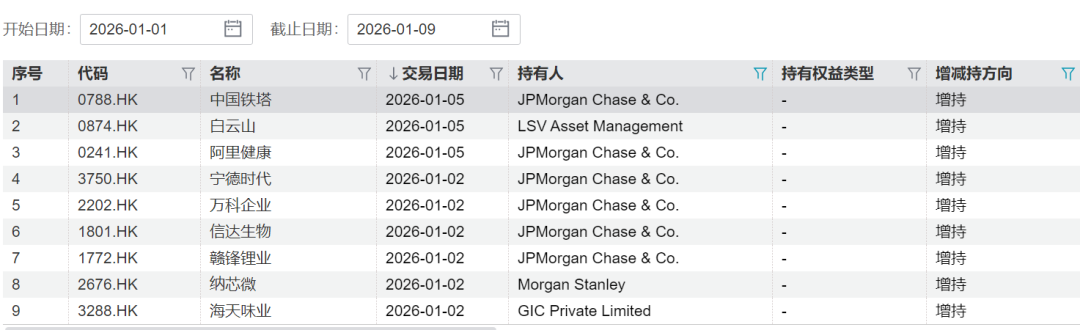
Group 1: Foreign Investment Trends - Foreign institutions are increasingly enthusiastic about allocating assets in China, reflecting expectations of economic stabilization and the attractiveness of undervalued Hong Kong stocks [2][9] - In the first trading days of 2026, JPMorgan Chase significantly increased its holdings in several Hong Kong-listed companies across various sectors, including new energy and biomedicine [1][4][8] Group 2: Specific Investments by JPMorgan - JPMorgan Chase invested over 700 million HKD to increase its stakes in multiple Hong Kong stocks, including approximately 793,478 shares of Ningde Times at an average price of 514.76 HKD per share, totaling around 408 million HKD [4][6] - The bank also acquired shares in other companies such as Sinopharm and Ganfeng Lithium, with notable investments including 317.3 million shares of Sinopharm at an average price of 78.45 HKD, amounting to about 249 million HKD [6] Group 3: Broader Market Sentiment - The trend of foreign capital inflow into Chinese technology ETFs has been strong, with funds like Invesco's China Technology ETF seeing a 6.53% increase in assets to 3 billion USD since the end of 2025 [12][14] - Analysts believe that the long-term growth logic of China's technology sector remains solid, with expectations for continued performance in 2026, particularly in AI and advanced manufacturing [15][16] Group 4: Future Outlook - The outlook for 2026 suggests that foreign capital will continue to actively invest in China's advanced industries, with a focus on sectors like biomedicine and new energy, which have shown strong appeal to foreign investors [8][10] - Predictions indicate that the MSCI China Index and the CSI 300 Index could rise by 20% and 12% respectively in 2026, driven by accelerated corporate earnings growth [10]
中国资产,大爆发!美联储,降息大消息!
Sou Hu Cai Jing· 2025-12-06 05:08
Core Viewpoint - Chinese assets have shown a strong rebound, with significant gains in various indices and stocks, indicating renewed interest from global investors in the Chinese market [1][2]. Group 1: Market Performance - The Nasdaq Golden Dragon Index rose by 1.29%, and the three-times leveraged FTSE China ETF surged over 4%, reversing a week-long decline [1][2]. - Popular Chinese concept stocks experienced substantial increases, with Dingdong Maicai rising over 10% and Baidu increasing nearly 6% [1][2]. - Multiple foreign institutions have released optimistic reports on Chinese assets, with Morgan Stanley redefining the Chinese stock market as a "growth market" [2]. Group 2: Economic Outlook - Morgan Stanley set a target for the CSI 300 Index at 4840 points by December 2026, suggesting a forward P/E ratio for the MSCI China Index in the range of 12 to 13 times [2]. - JPMorgan's Rajiv Batra noted that the Chinese stock market is in the early stages of recovery, with attractive valuations and relatively low holding levels [2][3]. - Various institutions, including OECD and Goldman Sachs, have raised their GDP growth forecasts for China, with Goldman Sachs adjusting its 2025 forecast from 4.9% to 5.0% [3]. Group 3: Federal Reserve's Interest Rate Expectations - The U.S. core PCE price index for September rose by 0.2% month-on-month and 2.8% year-on-year, aligning with expectations and reinforcing the likelihood of a rate cut by the Federal Reserve [4][5]. - The probability of a 25 basis point rate cut in December has risen to 87.2%, with expectations for further cuts in early 2026 [5][6].



估值优势与AI前景驱动 外资巨头三季度加仓中国资产
Shang Hai Zheng Quan Bao· 2025-11-18 18:42
Core Viewpoint - Major Wall Street investment institutions have significantly increased their allocation to Chinese assets, particularly in the technology sector, as indicated by the latest 13F filings from the U.S. [1][2] Group 1: Investment Trends - In Q3, major financial institutions such as Bank of America, UBS, and Morgan Stanley have substantially increased their holdings in the China Overseas Internet ETF (KWEB), with share increases of 215.89%, 35.29%, and 24.76% respectively [1] - Soros Fund Management increased its holdings in KWEB from 290,000 shares to 2.4 million shares, a growth of over 700% [2] - Jain Global LLC, founded by Bobby Jain, increased its KWEB holdings by over 850% in Q3 [2] Group 2: Performance of Key Stocks - The top two holdings in the China Overseas Internet ETF are Tencent and Alibaba, each accounting for over 10% of the portfolio [2] - The total size of the China Overseas Internet ETF grew from $6.373 billion at the end of the first half to $9.793 billion by the end of Q3 [2] - Alibaba saw significant increases in holdings from UBS, Fidelity, and Goldman Sachs, with increases of 51.05%, 30.83%, and 8.16% respectively [2] Group 3: Market Sentiment and Future Outlook - Analysts believe that Alibaba's investments in artificial intelligence have not yet been fully reflected in its stock price, and confidence in its AI prospects has begun to rise [3] - UBS's China equity strategy head noted that despite recent adjustments in global AI stocks potentially impacting Chinese tech stocks, several factors may mitigate this effect, including lower correlation with other emerging markets [3] - Invesco's senior fund manager expressed optimism about the long-term performance of Chinese assets, citing ongoing technological innovations as a key growth driver [3]

“华尔街抄底王”Q3大举加仓惠而浦 清仓英特尔、甲骨文
Xin Lang Cai Jing· 2025-11-14 06:25
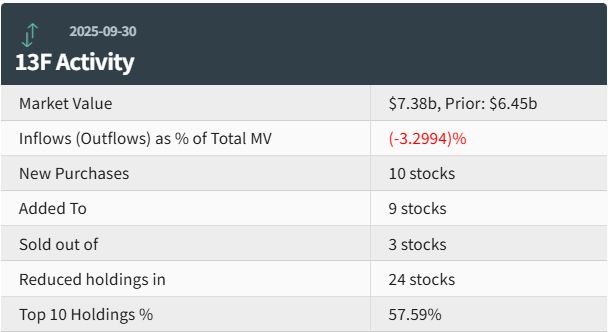
Core Insights - Appaloosa LP, led by David Tepper, reported a total market value of $7.38 billion for its U.S. stock holdings as of September 30, 2025, reflecting a 14% increase from the previous quarter's $6.45 billion [1][2] - The firm added 10 new stocks, increased holdings in 9 stocks, reduced holdings in 24 stocks, and completely sold out of 3 stocks, with the top 10 holdings accounting for 57.59% of the total market value [1][2] Holdings Summary - Alibaba (BABA.US) is the largest holding with 6.45 million shares valued at approximately $1.15 billion, representing 15.61% of the portfolio, down 8.73% from the previous quarter [2][3] - Amazon (AMZN.US) ranks second with 2.5 million shares valued at about $550 million, making up 7.43% of the portfolio, a decrease of 7.41% in share count [2][3] - Whirlpool (WHR.US) is the third largest holding with 5.5 million shares valued at around $430 million, a significant increase of 1966.95% in share count [3][5] - Nvidia (NVDA.US) is fourth with 1.9 million shares valued at approximately $354 million, an increase of 8.57% in share count [3][5] - Google (GOOG.US) is fifth with about 1.39 million shares valued at around $337 million, down 7.50% in share count [3][5] Significant Transactions - Appaloosa significantly increased its holdings in the KraneShares CSI China Internet ETF (KWEB.US), Qualcomm (QCOM.US), and Baidu (BIDU.US) [5] - The firm completely sold out of Intel (INTC.US), Oracle (ORCL.US), and Beike (BEKE.US) [5] - The top five purchases by percentage change in the portfolio included Whirlpool, AMD, KWEB, Qualcomm, and Fiserv (FISV.US) [6][7] - The top five sales by largest value included UnitedHealth (UNH.US), Intel, Vistra Energy (VST.US), Amazon, and Meta (META.US) [6][7]


“华尔街抄底王”Q3大举加仓惠而浦(WHR.US) 清仓英特尔(INTC.US)、甲骨文(ORCL.US)
智通财经网· 2025-11-14 02:38
Core Insights - Appaloosa LP, led by David Tepper, reported a total market value of $7.38 billion for its U.S. stock holdings as of September 30, 2025, reflecting a 14% increase from the previous quarter's $6.45 billion [1][2] Holdings Summary - Appaloosa added 10 new stocks, increased holdings in 9 stocks, reduced holdings in 24 stocks, and completely sold out of 3 stocks [1][2] - The top 10 holdings accounted for 57.59% of the total market value [2] Top Holdings - Alibaba (BABA.US) is the largest holding with 6.45 million shares valued at approximately $1.15 billion, representing 15.61% of the portfolio, down 8.73% from the previous quarter [3][4] - Amazon (AMZN.US) is the second largest holding with 2.5 million shares valued at about $550 million, accounting for 7.43% of the portfolio, down 7.41% [3][4] - Whirlpool (WHR.US) ranks third with 5.5 million shares valued at approximately $432 million, making up 5.85% of the portfolio, with a significant increase in holdings by 1966.95% [3][4] - Nvidia (NVDA.US) is the fourth largest holding with 1.9 million shares valued at around $354 million, representing 4.80% of the portfolio, up 8.57% [3][4] - Google (GOOG.US) is the fifth largest holding with approximately 1.39 million shares valued at about $337 million, accounting for 4.58% of the portfolio, down 7.50% [3][4] Significant Transactions - Appaloosa significantly increased its stake in the KraneShares CSI China Internet ETF (KWEB.US), Qualcomm (QCOM.US), and Baidu (BIDU.US) [4] - The firm completely sold out of Intel (INTC.US), Oracle (ORCL.US), and Beike (BEKE.US) [5] - The top five purchases by percentage change in the portfolio included Whirlpool, AMD (AMD.US), KWEB, Qualcomm, and Fiserv (FISV.US) [6][7] - The top five sales by largest value included UnitedHealth (UNH.US), Intel, Vistra Energy (VST.US), Amazon, and Meta (META.US) [6][7]
深夜!中国资产,集体爆发!
券商中国· 2025-09-17 14:48
Core Viewpoint - Chinese assets have collectively surged, driven by strong performances in the U.S. and Hong Kong markets, with significant inflows from foreign investors [2][3]. Group 1: Performance of Chinese Assets - After the U.S. market opened on September 17, the Nasdaq Golden Dragon China Index rose by 2.4%, and various ETFs focused on Chinese stocks saw increases of over 5% [3]. - Notable Chinese stocks such as Baidu experienced a surge of over 7%, with its H-shares rising more than 15% [3]. - The Hang Seng Tech Index increased by 4.22%, reaching its highest level since December 2021, while the Hang Seng Index rose by 1.78% [3]. Group 2: Market Dynamics - Goldman Sachs indicated that the recent surge in Hong Kong stocks was driven by foreign capital, with net purchases from southbound funds amounting to approximately 9.441 billion HKD [3]. - The overall U.S. market showed mixed results, with the Dow Jones up by 0.47% and the Nasdaq down by 0.35% [4]. Group 3: Investor Sentiment - A recent Bank of America survey revealed that 28% of global fund managers are bullish on stocks, the highest level since February [5]. - The survey indicated that nearly half of the respondents expect the Federal Reserve to cut rates at least four times in the next 12 months [5]. Group 4: Federal Reserve Outlook - The Federal Reserve is expected to announce a 25 basis point rate cut, with a 96% probability according to market tools [6]. - Goldman Sachs forecasts that the Fed will implement three consecutive rate cuts of 25 basis points in September, October, and December [7].