
中性原子量子计算机

Search documents
克服运行中原子损耗限制,能自行修复的量子计算机问世
Huan Qiu Wang Zi Xun· 2025-12-23 01:30
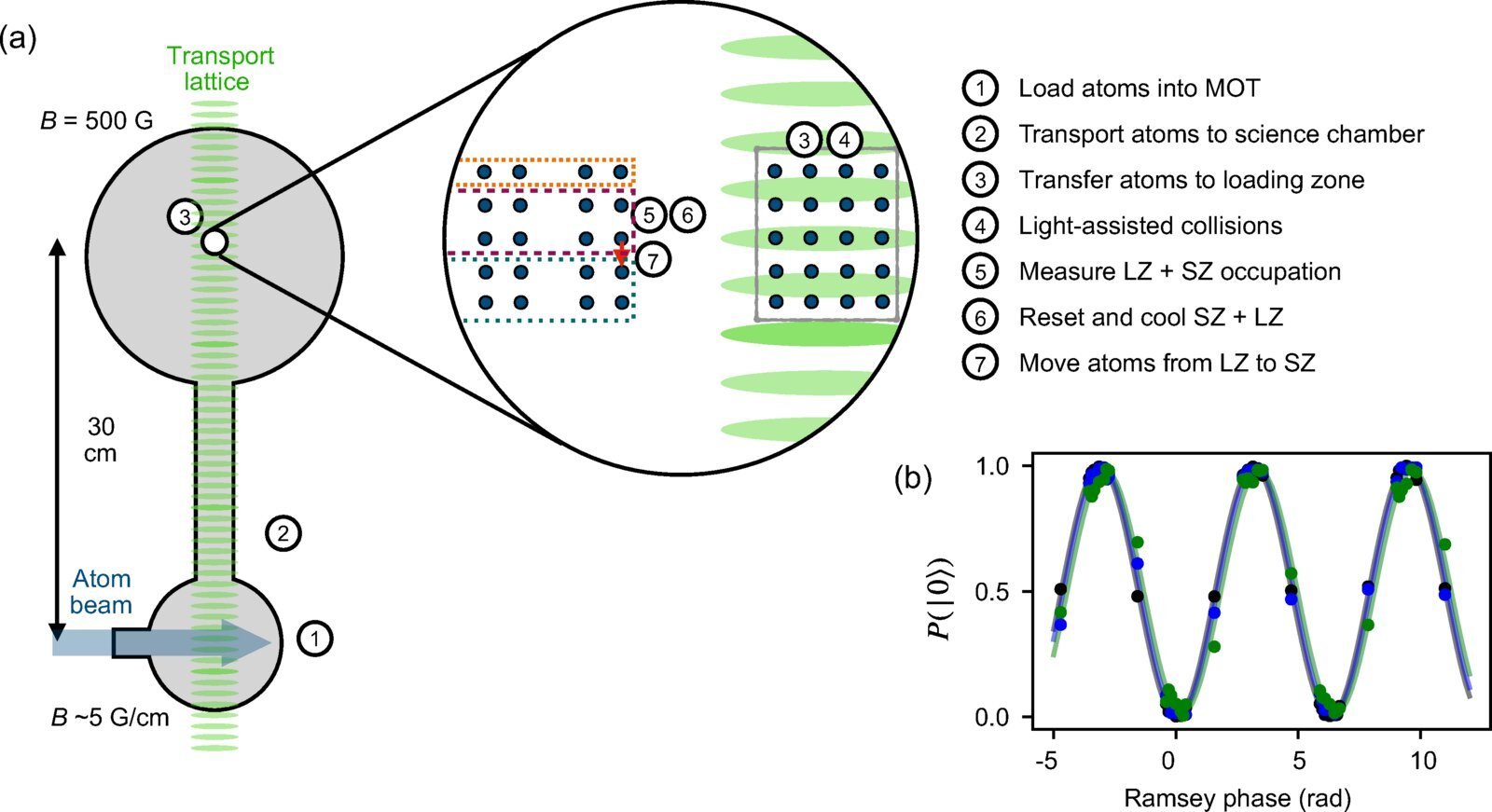
为解决这一问题,研究团队想出了"分区管理"的办法。他们把原子分成5个不同的功能区:寄存区用于存放量子比特,交互区进行计算,测量区用于利用辅 助原子检查误差,储备区则放着备用原子,加载区负责从外部补充新原子。 这样一来,就好比把工厂的生产线分成几个独立车间,即便某个车间出现故障,其他车间仍能照常运转,不会让整个生产停摆。当"工厂"发现某个原子"跑 掉"时,会立即从储备区调出备用原子,放到空缺位置,并将其重置为最低能量状态,使其马上投入运算。同时,完成检查任务的辅助原子也可以被回收, 经过重置后重复使用,实现"边运行边修复"。 为了验证这一机制,研究团队让量子计算机运行了一个重复代码,并连续进行了41轮自检。每轮中,系统都能像替换损坏零件一样,及时补上丢失的原子, 而数据运行不受影响。研究人员表示,如果没有自我修复功能,系统在几轮运算后就会"耗光原子",无法继续工作。 这项研究表明,中性原子量子处理器在电路运行中可像"回收零件"一样,重新初始化并重复使用辅助原子,这样在量子比特寿命有限的条件下,量子电路也 能连续运转。 来源:科技日报 科技日报记者 张佳欣 就像传统计算机一样,量子计算机也会"出故障"。在运行过程 ...

克服运行中原子损耗限制 能自行修复的量子计算机问世
Ke Ji Ri Bao· 2025-12-23 00:56
这样一来,就好比把工厂的生产线分成几个独立车间,即便某个车间出现故障,其他车间仍能照常运 转,不会让整个生产停摆。当"工厂"发现某个原子"跑掉"时,会立即从储备区调出备用原子,放到空缺 位置,并将其重置为最低能量状态,使其马上投入运算。同时,完成检查任务的辅助原子也可以被回 收,经过重置后重复使用,实现"边运行边修复"。 为了验证这一机制,研究团队让量子计算机运行了一个重复代码,并连续进行了41轮自检。每轮中,系 统都能像替换损坏零件一样,及时补上丢失的原子,而数据运行不受影响。研究人员表示,如果没有自 我修复功能,系统在几轮运算后就会"耗光原子",无法继续工作。 这项研究表明,中性原子量子处理器在电路运行中可像"回收零件"一样,重新初始化并重复使用辅助原 子,这样在量子比特寿命有限的条件下,量子电路也能连续运转。 就像传统计算机一样,量子计算机也会"出故障"。在运行过程中,它们有时会丢失用于计算的原子,这 可能会让计算直接中断。不过,据最新一期《物理评论X》杂志报道,美国量子计算机制造商"原子计 算"展示了一种在运行中能自行修复的中性原子量子计算机,克服了原子损耗的关键难题,为开发可持 续运行的量子计算机奠 ...
雷鸟,又融了一轮 | 融中投融资周报
Sou Hu Cai Jing· 2025-11-08 02:47
Group 1: Investment Highlights - Thunderbird Innovation completed a record financing round in the AI+AR glasses sector, led by CITIC Jinshi, with funds aimed at accelerating technology development and ecosystem construction [2] - Time Technology raised 300 million RMB in a B++ round, marking its second financing round in 2025, and signed a procurement agreement for 350 eVTOL aircraft worth 1 billion USD with Autocraft [2] - Sensing Intelligence, focused on "robot perception," completed a Pre-A round financing with undisclosed amounts, aimed at enhancing technology development and market expansion [3] Group 2: Company Developments - Hongyi Technology, targeting AI+industrial digitalization, aims to provide comprehensive solutions for small and medium-sized manufacturers, with significant funding directed towards reducing AI usage barriers [4] - Suzhou Xinshi Nuo Semiconductor Equipment Co., Ltd. announced a strategic financing round to enhance R&D and market expansion in the semiconductor automation sector [5] - MatriQ, specializing in neutral atom quantum computing, completed a seed round financing to advance core technology development and industrial application [6] Group 3: Robotics and AI Integration - Alsaik, an intelligent pneumatic company, completed a multi-million Pre-A round financing to enhance product development and market positioning [7] - Simple AI, a company in the embodied intelligent robotics sector, raised 200 million RMB through consecutive seed rounds to support commercialization efforts [8] - The establishment of the Henan Electric Equipment Fund, with a scale of 300 million RMB, aims to invest in new electric equipment manufacturing, enhancing local industry development [9] Group 4: International Collaboration - A partnership between Binhai New Area and Yida Capital at the Future Investment Initiative Conference aims to strengthen cross-border capital and industry cooperation, with an initial agreement of 80 million USD [10] - A strategic action plan in Shandong focuses on advancing the robotics industry, aiming for significant technological breakthroughs and the establishment of innovation platforms by 2028 [11]
十五五重点科技方向之 - 量子通信产业
2025-10-23 15:20
Summary of Quantum Computing Industry Conference Call Industry Overview - The conference call focused on the **quantum computing industry**, discussing various technological routes and advancements in quantum computing, including superconducting, ion trap, neutral atom, and photonic technologies [1][2][3]. Key Points and Arguments Technological Routes - **Superconducting Technology**: - Leading in engineering progress but requires improvement in yield rates. Companies like Benyuan and IBM can produce over 100 to thousands of qubits [1][3][4]. - **Ion Trap Technology**: - High fidelity with single and two-qubit logic gates achieving 99.99%. Companies like Beijing Huayi and Anhui Yao are actively developing this technology [3][10]. - **Neutral Atom Technology**: - Significant progress in trapping a large number of qubits, with reports of up to 6,100 qubits. Wuhan Zhongke Kuyuan is a notable player in this field [1][11]. - **Photonic Technology**: - Simple construction but requires a large number of auxiliary qubits for error correction. Companies like Shanghai Turing and Beijing Bosi are making strides in this area [1][12]. Quantum Supremacy - "Quantum supremacy" refers to quantum computers outperforming classical computers in specific tasks. Google's achievement using 53 qubits to solve a random circuit sampling problem in 200 seconds, compared to classical computers taking thousands of years, exemplifies this [1][6][22]. Current State and Future Prospects - Quantum computing is currently in a medium noise stage, with commercial applications beginning to emerge. Full-scale practical applications are expected in 8 to 10 years, although advancements from companies like Google and IONQ may shorten this timeline [2][18][19]. Challenges in Quantum Computing - **Superconducting Quantum Computers**: - Face challenges such as the complexity of internal layouts due to increased qubit numbers and difficulties in interconnecting multiple devices [9]. - **Ion Trap Systems**: - Require high precision in laser control and face engineering challenges in trapping more ions [10]. - **Neutral Atom Systems**: - Still in the early stages with limited startups, but potential for growth as research progresses [11]. - **Photonic Systems**: - Need significant auxiliary qubits for error correction, complicating their practical application [12]. Important but Overlooked Content - The Chinese quantum computing industry has room for improvement compared to international counterparts, particularly in measurement and control systems, stability of dilution refrigerators, and integration of quantum chips [2][13][14]. - The government is providing substantial support for quantum technology development, with funding for national laboratories and regional initiatives [20][21]. - Companies like Hefei's data center have begun purchasing quantum computers for research and development, indicating a growing interest in practical applications [19]. Conclusion - The quantum computing industry is rapidly evolving, with various companies making significant advancements across different technological routes. However, challenges remain in terms of engineering, integration, and commercial viability. The support from government and academic institutions is crucial for the continued growth and success of this industry.
“AI+”推动量子计算迈向“万原子时代”
Ke Ji Ri Bao· 2025-10-08 23:32
近日,由上海量子科学研究中心(合肥实验室上海研究基地)、上海人工智能实验室、中国科学技术大 学等单位研究人员组成的联合团队,通过人工智能(AI)和量子计算的跨界融合,成功构建了世界规 模最大的无缺陷二维和三维原子阵列,以2024个原子规模刷新了该领域的世界纪录。相关论文日前发表 于国际期刊《物理评论快报》。 正因如此,世界各国围绕量子计算原型机的研制展开激烈角逐。在并行推进的超导、离子阱、光量子等 多种技术路线中,中性原子量子体系因具有高扩展性、高保真度、高并行性等优势,在过去十年中迅速 脱颖而出,成为极具潜力的量子计算和量子模拟平台。但受困于技术,中性原子阵列的规模始终止步于 数百个原子,如何将其扩充至数千甚至数万个原子规模,成为通往通用量子计算机道路上首先要解决的 问题。 算力限制是科学技术发展面临的最大挑战之一,没有足够的算力就无法有效进行大规模数据处理和复杂 算法运算。量子计算机被视为破解算力瓶颈的"终极武器",其有能力在瞬间破解传统计算机需数千年才 能完成的难题。 原子阵列面临规模化瓶颈 可扩展的量子比特系统是实现量子计算和量子模拟的基石,量子比特越多,计算能力越强。对于超导与 光量子等其他体系结构 ...