
超导量子计算机

Search documents
国盾量子(688027):量子计算业务显著放量,量超融合打开AI算力新范式
NORTHEAST SECURITIES· 2026-03-25 08:45
Investment Rating - The report maintains a "Buy" rating for the company, indicating a positive outlook for the stock's performance over the next six months [6]. Core Insights - The company achieved a revenue of 310 million yuan in 2025, representing a year-on-year growth of 22.53%. The quantum computing business saw significant growth, with a year-on-year increase of 111.82%, driven by project deliveries [2][4]. - The company successfully turned a profit in 2025, with a net profit attributable to shareholders of 5.39 million yuan, although the adjusted net profit was negative at -43.55 million yuan due to high R&D expenses [2][4]. - The company is positioned as a rare provider of complete quantum computing solutions, focusing on key areas of the superconducting route and has made significant technological advancements, including the "Zu Chongzhi 3" superconducting quantum computer achieving a scale of 105 qubits [3][4]. - The national policy framework emphasizes the importance of quantum technology as a new economic growth point, which is expected to benefit the company through increased demand for quantum computing infrastructure and services [4]. Financial Summary - The company forecasts revenues of 588 million yuan, 1.104 billion yuan, and 1.989 billion yuan for 2026, 2027, and 2028, respectively, with net profits projected to reach 39 million yuan, 84 million yuan, and 262 million yuan in the same years [5][4]. - The gross margin is expected to improve, with projections of 51.4% in 2025 and 53.0% by 2028, indicating a positive trend in profitability [5][4]. - The company’s total assets are projected to grow from 3.626 billion yuan in 2025 to 4.698 billion yuan by 2028, reflecting a strong growth trajectory [5].

量子科技-在不确定性中超越未来
2026-02-24 14:16
Quantum Technology Industry Conference Summary Industry Overview - The quantum technology industry in China is categorized into three main directions: quantum communication, quantum computing, and precision measurement. Quantum communication has a head start but faces bandwidth limitations. Quantum computing has the largest market potential, with superconducting technology being relatively mature. The precision measurement sector is also seeing active advancements from various companies [1][5]. Key Insights and Arguments - China has elevated quantum technology to a strategic level, achieving significant research outcomes but lagging behind the U.S. in commercialization. In the first three quarters of 2025, U.S. quantum companies raised over $4 billion, while China's financing was less than one-tenth of that, indicating a need for improved public investment and social financing efficiency [1][4]. - The quantum technology industry is expected to experience a compound annual growth rate (CAGR) of 70% to 80% from 2025 to 2035. The year 2026 is anticipated to be pivotal, with several quantum companies preparing for IPOs, driven by market demand and policy support [2]. - China is actively participating in the global quantum technology competition, aiming to catch up with the U.S. and Europe. Companies like Quantum Tech and GuoDun are leading in quantum communication and computing, respectively, with significant advancements in their product offerings [3][15]. Market Potential and Financial Projections - The global market for dilution refrigerants, crucial for superconducting quantum computing, is currently around $500 million. If superconducting quantum computing is widely adopted, this market could grow to a multi-billion dollar scale by 2030, with China potentially capturing 25% to 30% of the market share [8]. - The superconducting chip and measurement control system market is projected to approach $10 billion by 2030, highlighting the financial opportunities within the quantum computing sector [9]. Challenges in Commercialization - The industry faces challenges such as stable support, controllable manipulation, and measurable readout conditions. Different physical pathways are still in parallel development, with no clear winner among the various technology routes [6][7]. Leading Companies and Innovations - Key players in the superconducting route include GuoDun, Benyuan, and Liangxuan, with Benyuan preparing for an IPO. In the ion trap route, companies like Hualing and Hefei University of Science and Technology are advancing their research [14]. - GuoDun has become a core supplier of dilution refrigerants, achieving a market share of 31% and generating revenue of 70 million yuan in the first half of 2025, with an expected net profit exceeding 50 million yuan for the year [7][17]. Future Directions and Investment Opportunities - Emerging markets worth attention include precision instruments and testing equipment, as well as optical instruments and laser devices. Companies like Puyuan Precision and Yongxin Optics are positioned to play critical roles in supporting superconducting qubit development [21]. - GuoDun is also engaging in strategic investments, such as indirect investments in startups focusing on encryption technology applications in government and finance sectors [20]. Conclusion - The quantum technology industry in China is poised for significant growth, driven by strategic government support, advancements in technology, and increasing market demand. However, challenges remain in achieving commercialization and competing on a global scale. Continued investment and innovation will be crucial for the industry's future success [12][13].
连续三年聚焦新质生产力 合肥“新春第一会”召开
Xin Lang Cai Jing· 2026-02-24 09:05
Group 1 - The core theme of Hefei's "New Spring First Meeting" is "technological innovation leading the development of new quality productivity," marking the third consecutive year this theme has been emphasized [5][7] - The meeting serves as a strategic signal for the city's focus on high-quality development and the importance of new quality productivity in the context of the 14th Five-Year Plan [4][12] - Hefei aims to leverage its technological advantages to transition from quantitative accumulation to qualitative leaps in productivity, aligning with national strategies for innovation and economic development [13][14] Group 2 - Hefei has made significant strides in technological innovation, ranking 12th globally among research cities and 39th in technology clusters, indicating its growing influence in the global innovation landscape [16] - The city has seen a substantial increase in research and development intensity, with a total industrial output value exceeding 1.4 trillion yuan, and new industries accounting for 60.4% of this output [16][18] - The overall goal is to establish Hefei as a source of technological innovation and a hub for emerging industries, aiming for new advantages and breakthroughs in these areas [18]


人工智能产业亮点纷呈
Xin Hua Wang· 2026-01-21 23:41
Core Insights - The Chinese industrial economy is projected to achieve a year-on-year growth of 5.9% in industrial added value by 2025, with manufacturing's contribution to GDP remaining stable and maintaining its position as the world's largest manufacturing sector for 16 consecutive years [1] Group 1: AI Industry Development - The global AI technology is accelerating innovation and integration across various sectors, with China's AI industry showing significant vitality and innovation since the 14th Five-Year Plan [2] - High-quality innovative results are emerging, including advancements in perovskite materials, permanent magnet materials, and power batteries, with technologies like quantum computing and brain-computer interfaces expanding into new fields [2] Group 2: Competitive Industries - Key industries such as integrated circuits and electronic materials have seen substantial growth, with added value increasing by 26.7% and 23.9% respectively, while industrial robot production rose by 28% [3] - New energy vehicle sales reached 16.49 million units, marking a year-on-year increase of 28.2% [3] Group 3: Smart and Green Transformation - The initiative aims to create "Chinese models" of smart manufacturing, with 15 pilot factories showcasing high efficiency and quality, achieving an average production efficiency increase of 29% and a reduction in defect rates by 47% [4] - AI has penetrated over 70% of operations in these pilot factories, leading to the development of over 6,000 vertical models and the application of more than 1,700 key smart manufacturing equipment and industrial software [4] Group 4: Digital Economy Integration - By the end of 2025, China's digital industry revenue is expected to reach approximately 38.3 trillion yuan, with profits of 3.1 trillion yuan, reflecting growth rates of 39.5% and 48.4% compared to the end of the 13th Five-Year Plan [6] - The industrial internet has achieved comprehensive coverage, with over 100 high-level 5G factories leading globally, resulting in a 25% increase in average capacity and a 21% improvement in product quality [7] Group 5: Consumer Goods Industry - The consumer goods industry is projected to grow by 3.7% by 2025, accounting for 26.1% of total industrial output, with efforts focused on expanding domestic demand and optimizing supply [8] - Initiatives to enhance product quality and brand strategy are underway, including the launch of 93 consumer brands and 43 regional brands, aimed at boosting domestic consumption [8] Group 6: Industry Upgrading Foundations - Implementation of digital transformation plans for various sectors, including textiles and food, is being prioritized to strengthen the consumer goods industry's unique clusters [9]
人工智能产业亮点纷呈(权威发布)
Ren Min Wang· 2026-01-21 22:32
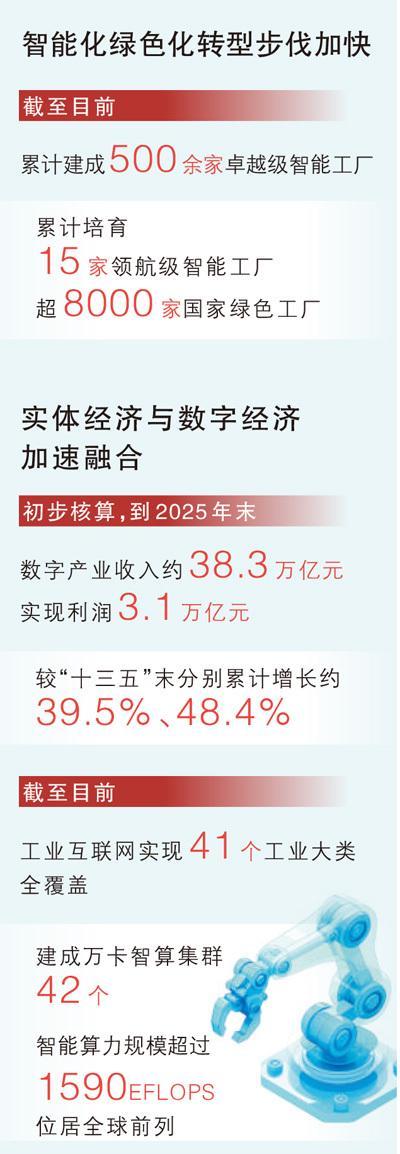
Group 1: Industrial Transformation and Growth - As of now, over 500 exemplary smart factories have been established, with 15 leading smart factories cultivated and more than 8,000 national green factories built [1] - By the end of 2025, the digital industry revenue is expected to reach approximately 38.3 trillion yuan, with profits of 3.1 trillion yuan, representing cumulative growth of about 39.5% and 48.4% compared to the end of the 13th Five-Year Plan [6] - The industrial internet has achieved full coverage across 41 industrial categories, with the establishment of 42 smart computing clusters [1] Group 2: High-Quality Development and Innovation - By 2025, the added value of large-scale industrial enterprises is projected to grow by 5.9% year-on-year, with the manufacturing sector's contribution to GDP remaining stable [2] - New production capabilities are leading to high-quality development, with significant advancements in materials and technologies such as perovskite materials, permanent magnet materials, and power batteries [2] - The production efficiency of leading factories has improved by an average of 29%, and the defect rate of products has decreased by 47% [4] Group 3: Market Expansion and Consumer Goods - The consumer goods industry is expected to see a 3.7% year-on-year increase in added value by 2025, accounting for 26.1% of total industrial output [8] - A series of promotional activities have been organized to enhance the supply of quality products, including the release of 35 bio-manufacturing products and 1,321 innovative textile products [8][9] - The strategy to enhance brand development is being implemented, with the selection of 93 national consumer brands and 43 regional brands to stimulate domestic consumption [8]
“含新量”不断提升 工信部发布一批新兴产业发展成果
Xin Lang Cai Jing· 2026-01-21 02:15
Core Insights - The press conference held by the State Council Information Office highlighted the achievements in industrial and information technology development by 2025, showcasing a surge of high-innovation results transitioning from laboratory ideas to market-ready products [1][2] Group 1: Technological Advancements - Advanced technologies such as perovskite materials, permanent magnet materials, and power batteries are now at an internationally advanced level [2] - New technologies in networking, high-speed communication, advanced computing, emerging software, and blockchain are accelerating their iterations [2] - Prototypes based on new quantum technologies, including atomic clocks and magnetometers, have been successfully developed [2] Group 2: Quantum Computing and Brain-Machine Interfaces - Superconducting quantum computers and optical quantum computers have achieved quantum superiority, capable of surpassing any classical computer on specific problems [2] - Brain-machine interface technology is rapidly expanding from the medical field into education and industrial sectors [2]
制造业高质量发展重点任务扎实推进
中汽协会数据· 2026-01-12 07:05
Core Viewpoint - The article emphasizes the significant progress in the digital transformation of the manufacturing industry in China, highlighting the government's strategic initiatives and the establishment of a comprehensive framework to support this transformation by 2025 [4][18]. Group 1: Digital Transformation Framework - The State Council issued a digital transformation action plan for the manufacturing industry, aiming for full coverage of digital upgrades in key industrial enterprises by 2027 and completion of a round of digital transformation by 2030 [4]. - A universal evaluation index system for the digital transformation of the manufacturing industry has been established, categorizing transformation levels into five grades (L1-L5) [6]. - A comprehensive information service platform for manufacturing digital transformation has been launched, providing assessment diagnostics, policy documents, and industry evaluations, with connectivity established across 15 provinces [9]. Group 2: Industry-Specific Policies - Implementation plans for digital transformation have been issued for 14 key industries, specifying transformation goals, typical scenarios, and solutions [12]. - The establishment of 62 digital transformation promotion centers has been initiated, covering 25 provinces and 14 key industries, focusing on specialized services [15]. Group 3: Progress and Achievements - As of December 31, 2025, 248,000 industrial enterprises have registered on the digital transformation platform, representing 47.1% of all industrial enterprises, with 89.6% of these enterprises having initiated digital upgrades [18]. - The penetration rate of digital production equipment among industrial enterprises reached 57.7% [18]. - Industrial technology renovation investments in 26 cities averaged a growth rate of 7.3%, exceeding the national average by 6.8 percentage points, with total investments surpassing 760 billion [21]. Group 4: Green and Intelligent Manufacturing - The average penetration rate of digital R&D design tools among industrial enterprises reached 86.7%, with the CNC rate for key production processes averaging 71.1% [23]. - The energy consumption per unit of industrial added value has decreased to 1.4 tons of standard coal per 10,000 yuan [23]. Group 5: Collaborative Innovation and New Models - The article highlights the establishment of 1,724 national-level technology innovation carriers and nearly 3,000 public service platforms, with an average R&D investment intensity of 4.64% within clusters [43]. - The integration of new technologies such as 5G, AI, and big data into manufacturing processes has led to the establishment of 238 leading and excellent smart factories [47][48]. Group 6: High-tech Industry Development - By 2025, national high-tech zones are expected to maintain a positive growth trend, with industrial output value reaching 27.4 trillion yuan, a year-on-year increase of 2.8% [72]. - High-tech zones have gathered 70% of national manufacturing innovation centers and 80% of key laboratories, contributing significantly to original innovations and high-tech industry clusters [76][78].

合肥量超融合计算中心上线运行
Xin Lang Cai Jing· 2026-01-07 17:12
Core Viewpoint - The Hefei Super Fusion Computing Center has officially launched, providing diverse quantum computing services globally, marking a significant advancement in China's quantum computing capabilities [1] Group 1: Infrastructure and Technology - The Hefei Super Fusion Computing Center is built on the Hefei Advanced Computing Center's supercomputer, featuring 2 superconducting quantum computers with over 180 qubits and 1 ion trap quantum computer with 12 qubits [1] - The center has developed a "super fusion system" that includes both underlying operating systems and upper software systems, making it the first localized deployment in China supporting multiple technological routes [1] Group 2: Applications and Future Prospects - The quantum center has already achieved scenario validation in multiple fields and aims to deepen application exploration and accelerate breakthroughs in practical scenarios [1] - The center's capabilities include high-speed interconnection with multiple quantum computers, indicating a new practical stage in China's super fusion computing field [1] Group 3: Development and Innovation - The superconducting quantum computer deployed at the center has a scale and performance that meet international advanced levels, with measurement and control systems and low-temperature devices developed independently by the company [1] - The superconducting quantum computer has a capacity of 200 qubits, showcasing significant technological advancements in the sector [1]
合肥量超融合计算中心正式上线运行
Ke Ji Ri Bao· 2026-01-07 00:41
Core Insights - Hefei Data Asset Operation Company has launched the Hefei Quantum Fusion Computing Center, providing diverse quantum computing services globally [1] - The center utilizes the "Chao Lake Moon" supercomputer and includes two 180+ qubit superconducting quantum computers and one 12 qubit ion trap quantum computer, marking a significant advancement in localized quantum computing deployment in China [1] - The quantum fusion system integrates quantum and classical computing, enhancing problem-solving efficiency for complex issues [1] Group 1 - The Hefei Quantum Fusion Computing Center is the first localized platform in China supporting multiple technological routes in quantum computing [1] - The center has established high-speed interconnections with multiple quantum computers, indicating a new practical phase in quantum fusion computing in China [1] - The center aims to deepen application exploration and accelerate breakthroughs in practical scenarios, having already conducted scene verification in various fields [1] Group 2 - The superconducting quantum computer deployed by Keda Guandun Quantum Technology Co., Ltd. at the center has a scale and performance that meet international advanced standards [2] - The center provides quantum computing services to institutions such as the University of Science and Technology of China and the Chinese Academy of Sciences, supporting cutting-edge research in areas like new energy and materials [2] - The collaboration has led to significant progress in several frontier research projects, demonstrating the center's impact on scientific advancements [2]
1月7日早餐 | 美股存储股爆发
Xuan Gu Bao· 2026-01-07 00:04
Market Performance - The three major US stock indices continued to rise, with the S&P 500 and Dow Jones reaching all-time highs, up 0.62% and 0.99% respectively, while the Nasdaq increased by 0.65% [1] - Amazon's stock rose over 3%, while Tesla fell more than 4% [1] - Micron Technology raised its third-quarter revenue guidance, leading to a 10% increase in its stock price, while Nvidia experienced two consecutive declines [1] Semiconductor and AI Sector - Nvidia's CEO Jensen Huang expressed optimism about AI systems driving storage demand, resulting in a nearly 28% surge in SanDisk's stock [1] - Intel launched the world's first 1.8nm AI PC chip, enhancing edge AI computing power to 180 TOPS, marking a breakthrough in performance and efficiency [4] - AMD introduced the MI440X at CES, targeting the enterprise AI data center market, positioning itself against Nvidia [5] Commodities and Metals - Nickel prices surged over 10% on the London Metal Exchange, marking the largest intraday increase since 2022, reaching $18,545 per ton, with a cumulative rise of over 20% in the past two weeks [9] - The Shanghai Futures Exchange saw nickel prices rise by 8%, closing at 147,720 yuan per ton [9] - Gold and silver prices also saw significant increases, with gold reaching a one-week high and silver rising over 6% [2] Domestic Developments - The Ministry of Commerce announced strengthened export controls on dual-use items to Japan, with reports indicating a tightening of rare earth export license reviews to Japan [6] - The National Data Bureau plans to introduce over 30 national standards in the data sector by 2026 [7] - The Henan Provincial Department of Culture and Tourism is seeking public opinion on a plan to build a modern cultural tourism industry system, aiming to create 20 new consumption scenarios [7] Investment Strategies - According to a report by Founder Securities, the average daily trading volume in the domestic market has rebounded to around 2.8 trillion yuan, indicating a renewed consensus among institutions on Chinese assets [8] - The report highlights that the fifth round of US-China negotiations has reduced external disturbances, contributing to a bullish sentiment in the market, with the Shanghai Composite Index achieving a 13-day consecutive rise [8] Logistics and Recycling - The Ministry of Commerce is promoting the construction of green, intelligent, and specialized sorting centers, aiming to enhance the recycling industry [10] - The market for sorting center construction is experiencing a golden development period driven by demand in e-commerce logistics and recycling sectors, with projections indicating a global market size exceeding $20 billion by 2030 [10] Cross-Border Payment - The recent national foreign exchange management meeting emphasized deepening foreign exchange facilitation reforms and supporting the development of cross-border e-commerce [11][13] - The cross-border payment sector is expected to transition from a "funds channel" to a "digital trade hub," with significant growth anticipated [13]

