丰田卡罗拉概念车

Search documents
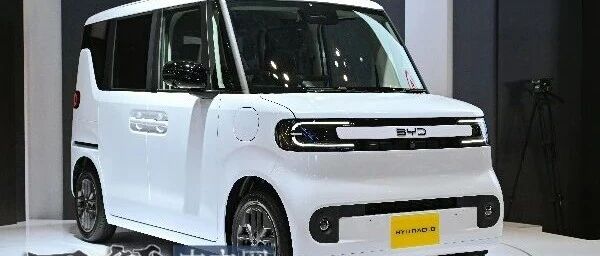
比亚迪携轻型EV吹响日本价格战号角
36氪· 2025-11-07 13:07
Core Viewpoint - The article discusses the introduction of lightweight electric vehicles (EVs) by BYD and Suzuki in Japan, highlighting the competitive pricing strategy and the potential for increased EV adoption in a market where EV penetration is currently low [5][12][14]. Group 1: Market Context - Lightweight vehicles account for 40% of new car sales in Japan, making them a strategic focus for EV manufacturers [5][7]. - Japan has the lowest EV penetration among developed countries, with only 1-2% of new car sales being EVs, compared to around 20% in other markets [12][14]. - The average retail price of lightweight vehicles in Japan is approximately 1.63 million yen (about 75,800 RMB) as of 2024 [12]. Group 2: Competitive Landscape - BYD's lightweight EV "RACCO" is priced below 2 million yen (approximately 93,000 RMB), aiming to leverage cost advantages from its integrated production process [4][12]. - Suzuki is also developing its lightweight EV "Vision e-Sky," targeting mass production by 2026, although it has stated it will not engage in price competition [12][13]. - The introduction of competitive pricing strategies by both BYD and Suzuki is seen as essential for increasing EV adoption in Japan, where high prices and inadequate charging infrastructure have hindered growth [12][14]. Group 3: Future Outlook - BYD plans to launch the "RACCO" in the summer of 2026, with features tailored to Japanese consumers, including spacious luggage space and compliance with local charging standards [7][11]. - The lightweight EV segment is expected to drive the growth of EV sales in Japan, with models like Nissan's lightweight EV "Sakura" already capturing significant market share [13]. - The article indicates that if EV prices can be aligned with those of traditional combustion engine vehicles, the adoption rate is likely to accelerate [12].



比亚迪携轻型EV吹响日本价格战号角
日经中文网· 2025-11-03 03:01
Core Insights - BYD has launched a lightweight electric vehicle (EV) named "RACCO" specifically designed for the Japanese market, priced below 2 million yen (approximately 93,000 RMB) [1][3][5] - Lightweight vehicles, a unique standard in Japan, account for 40% of new car sales, making them a strategic focus for EV manufacturers [1][6] - The introduction of lightweight EVs aims to boost the adoption of electric vehicles in Japan, which currently has the lowest EV penetration rate among developed countries [8][9] Group 1: Market Context - The Japanese market for lightweight vehicles is characterized by specific regulations, including size restrictions (width under 1.48 meters, length under 3.4 meters, height under 2 meters) and lower tax burdens compared to standard vehicles [6] - The average retail price for lightweight vehicles in Japan is projected to be 1.63 million yen (approximately 75,800 RMB) in 2024, highlighting the competitive pricing strategy of BYD [8] - The current EV market in Japan has a low penetration rate of only 1-2% of new car sales, significantly lower than the approximately 20% in overseas markets [9] Group 2: Competitive Landscape - BYD's pricing strategy, combined with government subsidies, positions its lightweight EVs competitively against traditional combustion engine vehicles, potentially accelerating EV adoption [8][12] - Competitors like Suzuki are also entering the lightweight EV market, with plans to launch their own models by 2026, indicating a growing interest in this segment [9] - The overall EV market in China is experiencing intense price competition due to government subsidies, leading to a decrease in average prices for EVs [10][12]
一场东京车展,看清日系车所有底牌
汽车商业评论· 2025-10-30 23:08
Core Viewpoint - The Japan Mobility Show 2025 showcases a stark contrast between Japanese automakers, who present ambitious electric vehicle (EV) strategies, and international brands, which appear less innovative and engaged in the current automotive transformation [5][6][9]. Group 1: Japanese Automakers' Strategies - Honda introduced two cost-effective electric concept cars, aiming for a full electric lineup by 2040, with the 0 Alpha targeting the Japanese and Indian markets [12][15]. - Toyota's Corolla concept car breaks traditional perceptions, offering hybrid, electric, and gasoline options, reflecting its "multi-path strategy" to adapt to diverse global energy conditions [19][22]. - Toyota plans to elevate its Century model to an independent luxury brand, with a new coupe version enhancing its prestigious image [25][29]. Group 2: International Brands' Participation - The participation of international brands like BMW and Mercedes-Benz was limited, lacking significant innovations compared to their Japanese counterparts [7][8]. - Subaru unveiled two STI concept cars, focusing on performance, while Nissan aims to revitalize its brand with the new Elgrand MPV, featuring a hybrid e-Power system [34][41]. Group 3: Future Mobility Concepts - The show emphasizes a broader vision of mobility, with Lexus presenting a solar-powered catamaran and a compact electric vehicle designed for urban environments [47][52]. - Honda showcased its ambitions beyond traditional vehicles, including a rocket for space exploration and an advanced electric wheelchair [60][64]. - Mazda's X-Coupe concept car highlights innovative fuel technology using microalgae, despite current efficiency challenges [67][70].


只有一家中国车企参展的世界级车展,有多魔幻?
3 6 Ke· 2025-10-29 23:33
Core Insights - The Tokyo Mobility Show, held in late October 2023, showcases the evolving landscape of the Japanese automotive market, emphasizing a shift towards mobility solutions beyond traditional vehicles [1][12] - Chinese automaker BYD made a significant impact by launching the first electric K-Car specifically designed for the Japanese market, marking a historic moment in the Tokyo auto show [9][10] Group 1: Overview of the Tokyo Mobility Show - The event is characterized as a "mobility show" rather than a traditional "auto show," highlighting a broader focus on various modes of transportation [1][3] - Japanese automakers prominently featured K-Cars, which hold nearly 40% market share in Japan, indicating their cultural significance [5][17] - The show had a lower international presence compared to previous years, with fewer European manufacturers participating [11][12] Group 2: Chinese Automaker BYD's Strategy - BYD's launch of the electric K-Car Racco represents a strategic entry into Japan's automotive market, targeting local consumers with a product that directly competes with established Japanese brands [15][19] - The Racco features advanced technology, including a blade battery, and aims to challenge the slow electric transition of Japanese competitors [17][19] - BYD's presence at the show signifies a shift in market dynamics, with Chinese brands increasingly challenging traditional Japanese dominance [13][15] Group 3: Japanese Automakers' Response - Japanese automakers, including Toyota, Honda, and Nissan, showcased a mix of innovative concepts and traditional models, indicating a dual approach of maintaining heritage while embracing new technologies [26][40] - Toyota introduced several groundbreaking models, including a new generation Corolla concept and the FJ Land Cruiser, reflecting a commitment to innovation [27][29] - Honda and Nissan also presented new electric models, emphasizing their strategies to enhance their electric vehicle lineups and adapt to market changes [40][49] Group 4: Future Mobility Trends - The show highlighted advancements in battery technology, with Toyota showcasing solid-state batteries that promise rapid charging and extended range [90][92] - Japanese automakers are exploring diverse mobility solutions, including air and sea transportation, indicating a broader vision for future mobility [94][97] - The overall sentiment at the show reflects Japan's cautious yet determined approach to transitioning towards electric and smart mobility solutions [98]