乘用车辅助驾驶系统

Search documents
争夺智驾第一梯队:轻舟智航的“双面榜单”
第一财经· 2026-02-09 09:41
Core Viewpoint - The article discusses the competitive landscape of the intelligent driving sector, highlighting the market share rankings of various companies and the emergence of QCraft as a significant player in the NOA (Navigation on Autopilot) market, while questioning the validity of these rankings due to differing methodologies and market segments [3][4][7]. Market Share Rankings - According to a report by Gaogong Intelligent Automotive Research Institute, Huawei leads the market with over 41% share, followed by QCraft with over 21%, Momenta with over 16%, and Zhuoyue Technology with over 5% [5]. - The rankings reveal a disparity in market positioning, as QCraft is not listed among the top players in the high-end market segment (vehicles priced above 300,000 yuan), where Huawei dominates with nearly 70% market share [6][7]. QCraft's Rise and Challenges - QCraft, founded in 2019 by former Waymo employees, has gained prominence by becoming the core supplier for Li Auto's AD Pro version, significantly boosting its system deployment to over 1 million units [9]. - However, reliance on a single major client, Li Auto, poses risks, as many automakers are increasingly developing their own autonomous driving solutions, with 14 out of the top 20 brands in NOA deliveries having self-developed systems [9][10]. Market Dynamics and Competition - QCraft is actively seeking to diversify its client base by partnering with other automakers like Chery and Geely, but these companies are also building their own autonomous driving systems, which could limit QCraft's market opportunities [10][11]. - The intelligent driving market is becoming increasingly competitive, with major players like Huawei and Horizon aiming to make advanced driving features available in lower-priced vehicles, creating a "red ocean" of competition [12][14]. Future Outlook - QCraft aims to promote high-level autonomous driving in vehicles priced around 100,000 yuan, with the belief that "driving equality" will be achieved as urban NOA becomes a standard feature [13]. - The competition is not just about market share but also about cost control, iteration efficiency, and deployment speed, which are essential for survival in a market where automakers are developing their own technologies [14].

争夺智驾第一梯队:轻舟智航的“双面榜单”
Di Yi Cai Jing· 2026-02-09 06:44
Core Viewpoint - The competition in the intelligent driving sector is intensifying, with various organizations releasing differing market share rankings for Navigation on Autopilot (NOA) systems, leading to confusion about the leading players in the industry [1][2]. Group 1: Market Share Rankings - Huawei leads the NOA market with over 41% market share, followed by QCraft (Lightyear) with over 21%, Momenta with over 16%, and Zhuoyue Technology with over 5% [2]. - Lightyear's rise to second place has prompted increased visibility and promotional efforts from the company, which recently announced that its passenger car assistance system has surpassed 1 million units in deployment [2]. - Contrarily, in the high-end market segment (vehicles priced above 300,000 yuan), Lightyear does not appear in the rankings, with Huawei holding nearly 70% of the market share [2][3]. Group 2: Competitive Landscape - The rankings highlight the dynamic and complex nature of the intelligent driving market, with no consensus on whether the structure is "one strong and many strong" or "two strong and many strong" [3]. - Lightyear's absence from certain reports indicates the distinction between overall market share and high-value market segments [3]. Group 3: Strategic Partnerships and Risks - Lightyear's market position is closely tied to its partnership with Li Auto, which has significantly boosted its system deployment [4]. - The company transitioned from focusing on L4 autonomous minibuses to L2+ production systems in 2022, capitalizing on the growth of Li Auto's sales [4]. - However, reliance on a single major client poses risks, as many automakers are developing their own autonomous driving solutions [4][5]. Group 4: Industry Trends and Challenges - Lightyear is actively seeking to diversify its client base by engaging with other automakers like Chery and Geely, who are also building their own intelligent driving systems [5][6]. - The intelligent driving sector is becoming increasingly competitive, with major players like Huawei and Horizon aiming to make advanced driving features available in lower-priced vehicles [7]. - The current landscape suggests that merely ranking companies is insufficient; firms must establish core barriers in cost control, iteration efficiency, and deployment speed to secure a place in the top tier of the market [8].
轻舟智航CEO于骞:智驾市场会留存4-5家企业|36氪专访
3 6 Ke· 2026-01-26 05:57
Core Insights - The autonomous driving industry is at a critical transition point, with a shift towards mass production and lower vehicle price segments while also pursuing advanced levels of automation like L3 and L4 [3][4] - The company, Lightyear, has survived previous industry eliminations by making strategic decisions that balance dependence and independence in partnerships with automakers and chip manufacturers [4][5] Company Strategy - Lightyear has transitioned from focusing on L4 capabilities to delivering L2 mass production software, becoming one of the first companies to relieve itself of the "technical burden" associated with L4 [3][4] - The company maintains a close yet independent relationship with automakers and chip manufacturers, allowing it to adapt to various platforms while developing its own algorithms and simulation tools [4][30] Market Position - Lightyear's passenger vehicle assistance systems have surpassed one million units in deployment, with expectations to exceed 50 models by 2026, nearly all featuring urban NOA capabilities [5][6] - The autonomous driving market is expected to retain 4-5 leading companies, similar to the engine or battery industries, rather than consolidating into a monopoly [6][37] Product Development - Lightyear plans to expand its L2 product offerings and increase investments in L4 technologies, including applications in unmanned logistics [6][44] - The company has outlined a product matrix with three tiers: Air, Pro, and Max, targeting various market segments and price points [9][12] Technological Focus - The company emphasizes an end-to-end solution that optimizes resource use for better user experience, avoiding unnecessary complexity in models and hardware [8][23] - Lightyear is exploring advanced technologies like VLA and world models, focusing on enhancing model generalization and virtual training capabilities [12][14] Industry Trends - The penetration rate of autonomous driving is currently below 5% but is projected to rise to 50% in the coming years, driven by the electrification of vehicles [35] - The trend of integrating autonomous driving features into lower-priced vehicles is expected to continue, making advanced safety and convenience features accessible to a broader audience [36]
轻舟智航:L2与L4本质上技术同源
Jing Ji Guan Cha Wang· 2026-01-25 08:22
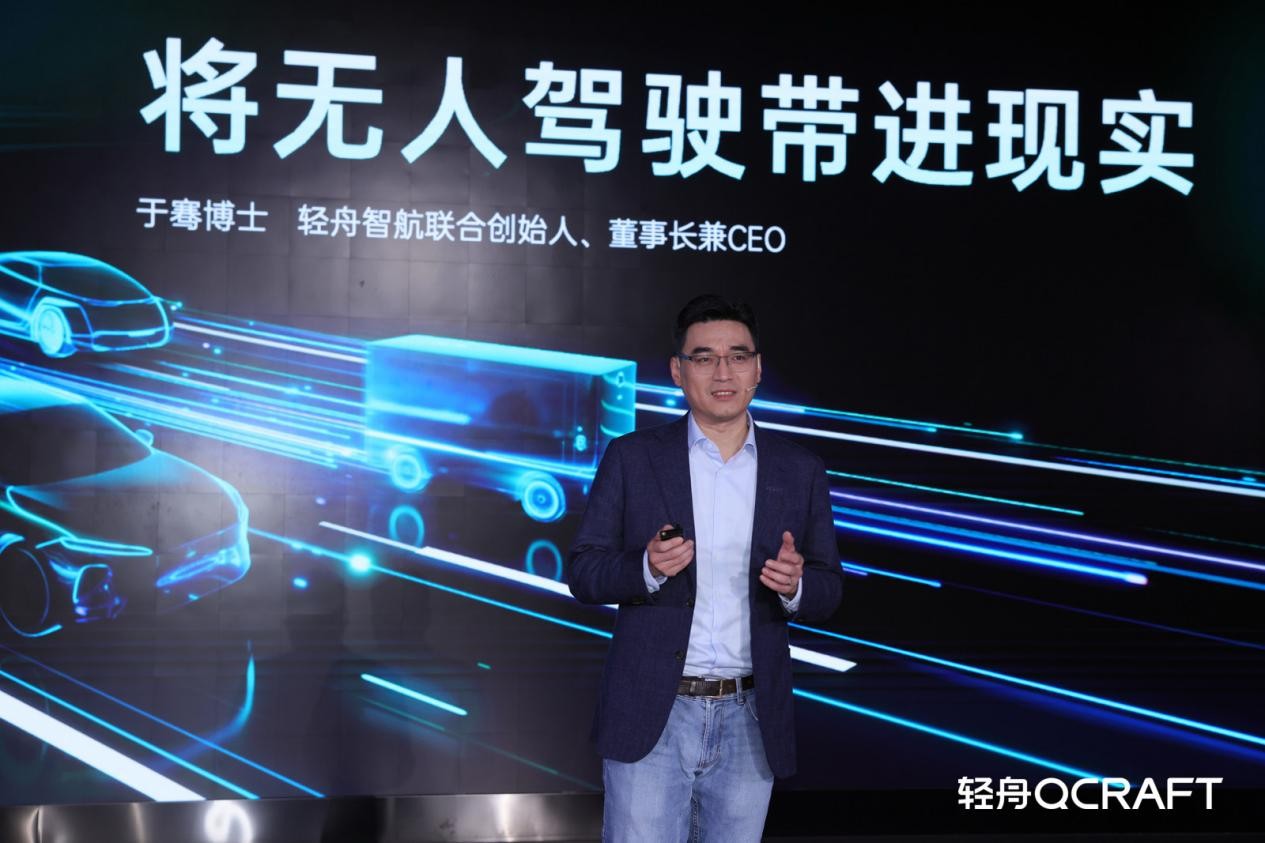
Core Insights - QCraftDAY2026 event showcased QCraft's next-generation autonomous driving technology and future development plans, marking the mass production of the first city NOA solution based on Horizon's 6M chip [2] - The company aims to expand its partnerships, targeting over 50 new vehicle models equipped with city NOA by 2026 and plans to achieve 3 million units of intelligent driving systems by 2027 [2] Technology Developments - QCraft introduced the "VLA+ World Model" unified architecture, which enhances decision-making, remote takeover, and human-machine interaction through language capabilities [2] - The company emphasized that L2, L3, and L4 technologies share the same AI model foundation, with a focus on safety, comfort, and predictability [3][4] Product Offerings - QCraft launched the "QCraft Chengfeng 2.0" driver assistance solution, creating a three-tier product matrix: Chengfeng AIR for highway NOA, Chengfeng PRO for urban NOA, and Chengfeng MAX integrating VLA and world model technologies [2] - The "Robo-X" autonomous driving open platform was unveiled, aiming to become the "Android of the autonomous driving field," providing comprehensive tools for Robobus, Robovan, and Robotaxi [4] Market Strategy - The company is expanding its business from passenger vehicles to more L4 commercial scenarios, establishing a dual-line layout of passenger vehicle intelligent driving and commercial vehicle automation [4] - QCraft plans to initiate small-scale operations of Robotaxi in 2026, with a broader deployment expected in 2027, while acknowledging potential delays in China compared to the U.S. due to various factors [5]
轻舟已过万重山!轻舟智航驶入量产达100万台,轻舟智航于骞:自动驾驶要干20年
Huan Qiu Wang Zi Xun· 2026-01-24 04:11
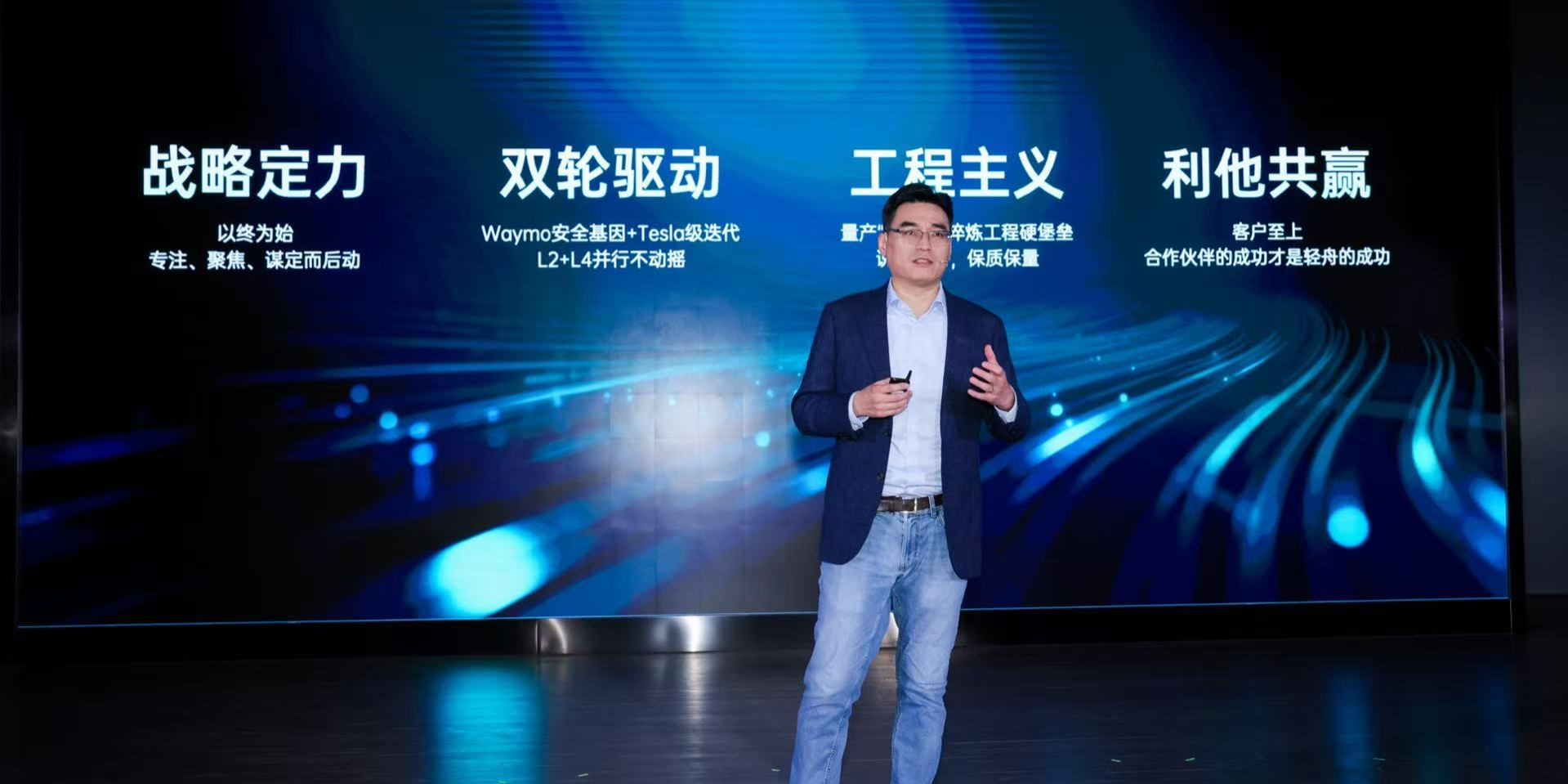
Core Insights - The era of transitioning from assisted driving to autonomous driving has begun, with 2026 marking the start of a new golden decade for autonomous driving and the "super intelligent" era [1][3] - QCraft, co-founded by Dr. Yu Qian, has successfully crossed the production milestone of 1 million units for its assisted driving systems, indicating a new phase of large-scale implementation [3][5] Group 1: Company Developments - QCraft has achieved a significant milestone with over 1 million units of its assisted driving system deployed, marking a new starting point for the company [5] - The company has established partnerships with nearly 10 automotive manufacturers, aiding in the mass production of 23 vehicle models, with expectations to exceed 50 new models in 2026, all featuring urban NOA capabilities [7] - QCraft's user base has accumulated over 2.5 billion kilometers of assisted driving mileage, with nearly 100 million uses of smart parking assistance [7] Group 2: Technological Innovations - QCraft has introduced the industry's first "safety explainable" end-to-end large model, addressing safety concerns associated with the "black box" nature of end-to-end systems [11] - The company has developed a unified architecture called "VLA+ World Model," which enhances the ability of assisted driving systems to handle complex real-world scenarios [13] - QCraft's technology allows for the use of a single journey 6M chip to achieve urban NOA, demonstrating a commitment to providing affordable and effective intelligent driving solutions [8] Group 3: Future Plans - QCraft has outlined a product evolution roadmap from advanced assisted driving to large-scale operations of autonomous driving from 2025 to 2027 [14] - The company aims to enter the L4 unmanned logistics market, collaborating with automotive manufacturers to create a new paradigm of "production equals operation" [16] - QCraft is accelerating its international expansion, establishing offices in cities like Beijing, Suzhou, and Munich, and targeting markets in Europe, East Asia, the Middle East, and Singapore [19]