
九章四号

Search documents
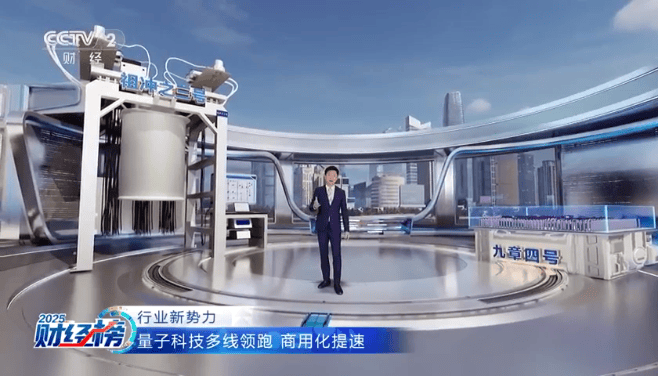
2025量子科技多线领跑 AI赋能千行百业
Sou Hu Cai Jing· 2025-12-31 16:23
Group 1: Quantum Technology - In 2025, China's quantum technology commercialization is accelerating, showcasing vast application prospects [3] - China's "Zuchongzhi 3" superconducting quantum computer is reportedly 10 trillion times faster than the world's fastest supercomputer for specific tasks, while "Jiuzhang 4" can solve problems in microseconds that would take supercomputers 10^42 years [3] - Over 30 countries have released quantum strategy plans with total investments exceeding $35 billion, and the number of related companies has surpassed 800, with financing exceeding $14.5 billion in the past decade [3] Group 2: Artificial Intelligence - AI has evolved from a reactive model to a proactive service model, enabling autonomous operations in factories and personalized services in daily life [5] - The AI industry in China is projected to exceed 1.2 trillion yuan by 2025 and is expected to surpass 1.8 trillion yuan by 2028, with over 15% of work decisions globally anticipated to be made by AI agents by 2028 [5] Group 3: Smart Glasses - Smart glasses are emerging as the next mainstream interactive terminal, with significant advancements in battery life, optical display, and integration with AI models [7] - In the first half of the year, over 2.4 million smart glasses with camera functions were shipped globally, with China capturing a 35.5% market share, leading the world [7] - The Chinese smart glasses market is expected to grow at a compound annual growth rate of 55.6% from 2024 to 2029, the highest globally [7] Group 4: New Energy Storage - New energy storage technologies are ensuring the stability and affordability of green electricity, acting as "super charging stations" for cities [9] - By the end of September, China's new energy storage capacity reached 103 million kilowatts, accounting for over 40% of the global total, making it the world leader [9] Group 5: Innovative Pharmaceuticals - China's innovative pharmaceuticals are advancing in research, application, and international expansion, with a focus on cancer and rare diseases [11] - The number of innovative drugs in development accounts for approximately 30% of the global total, with a record number of approvals and 50 innovative drugs included in the national medical insurance directory [11] - Total licensing agreements for innovative drugs have surpassed $100 billion, demonstrating China's capability in original technology and global recognition [11]

“我们可能只领先中国几纳秒,这是真正的竞赛”
Guan Cha Zhe Wang· 2025-12-03 23:42
Core Insights - The global competition in quantum computing is intensifying, with China rapidly closing the gap with the United States, potentially leading to a situation where the U.S. may only be ahead by "a few nanoseconds" [1][2] - John Martinis, a prominent figure in quantum computing, emphasizes the competitiveness of China's advancements in the field, indicating that Western researchers are concerned about the genuine race between the two nations [1][2] Investment and Strategic Focus - The U.S. government, while currently focused on artificial intelligence, is beginning to shift its attention towards the challenges posed by quantum computing [2] - China has strategically prioritized quantum technology development since the "13th Five-Year Plan" (2016-2020) and has included it in the "14th Five-Year Plan" (2021-2025) as one of the seven key areas for technological advancement [5] Technological Advancements - China's latest generation of optical quantum computer, Jiuzhang 4, has achieved control over 3,050 photons, significantly outperforming traditional computers in specific tasks [5] - The potential applications of quantum computing span various fields, including medicine, finance, artificial intelligence, and military, with implications for existing encryption systems [4] Funding and Investment Disparities - China leads the world in public funding for quantum technology, with an investment of $15.3 billion, which is eight times that of the U.S. government's investment of $1.9 billion and double that of the European Union's total investment of $7.2 billion [5] - A report by LexisNexis suggests that China could surpass the U.S. in quantum computing patents as early as 2027, indicating a significant shift in technological capabilities [5][6] Future Outlook - Experts predict that Chinese research institutions will play a crucial role in the development of quantum technologies in the coming years, similar to the technological transformations seen in the electric vehicle sector [6]

大国科学家|他给学生挨个发信息回国 共创中国量子梦之队
Yang Shi Xin Wen Ke Hu Duan· 2025-06-03 09:18
Core Insights - The article highlights the achievements of Pan Jianwei, a leading figure in China's quantum technology, who has spearheaded significant advancements in the field, including the development of quantum satellites and secure communication systems [1][6]. Group 1: Achievements in Quantum Technology - Pan Jianwei's team is developing the world's first medium-high orbit quantum satellite, which can establish quantum key distribution between distant locations, enhancing national information security [1]. - The successful launch of the world's first quantum science experimental satellite, "Mozi," in 2016 marked China's leadership in global quantum communication research [4]. - The completion of the quantum "Beijing-Shanghai Line" provides unconditional security for financial and governmental communications, establishing a "shield" for information security [6]. Group 2: Educational and Research Contributions - Pan Jianwei returned to China after studying in Europe, motivated to establish a world-class laboratory in quantum optics and information, reflecting a commitment to national scientific advancement [2][3]. - The return of overseas students, inspired by Pan Jianwei, contributed to the establishment of a robust quantum technology research environment in China [4][3]. - The focus on nurturing innovative talent is seen as essential for maintaining competitive advantage in the quantum technology sector [6][7]. Group 3: Future Directions - The team is currently working on the "Jiuzhang 4" and "Zuchongzhi 4" quantum computing prototypes, with plans to launch multiple quantum micro-nano satellites for practical applications [6]. - The ambition is to elevate China's quantum technology to compete with the United States and Europe, contributing to national technological self-reliance [7].