云端AI推理芯片

Search documents
“国产AI芯片六小龙”竞速 上海助推“中国算力”破局
Shang Hai Zheng Quan Bao· 2026-02-12 17:42
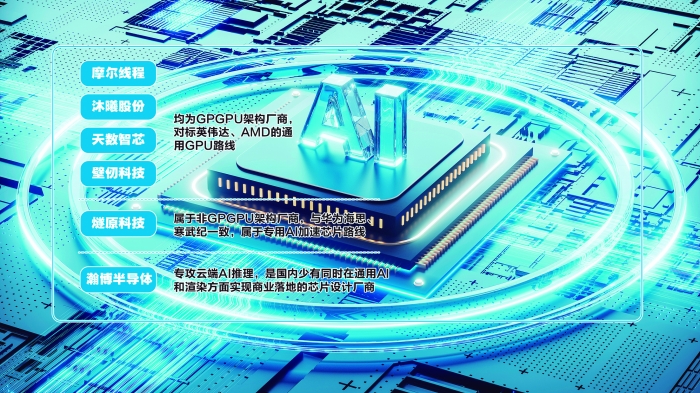
Core Viewpoint - The article highlights the rapid development and competitive landscape of domestic AI chip companies in China, particularly focusing on the six emerging players in Shanghai, which are poised for significant growth and innovation in the AI sector [2][10]. Group 1: Company Developments - Hanbo Semiconductor has completed its guidance for an IPO on the Sci-Tech Innovation Board and is progressing steadily towards its public offering [2]. - Suiruan Technology's IPO application has been accepted, indicating a growing interest in AI chip companies [2]. - The six domestic AI chip companies, including Hanbo Semiconductor, are collectively referred to as the "Six Little Dragons," with a strong emphasis on technological advancements and product development [2][4]. Group 2: Market Position and Strategy - The "Six Little Dragons" are primarily cloud-based AI chip manufacturers, with five of them focusing on GPGPU architecture to compete with global giants like NVIDIA and AMD [2][4]. - Hanbo Semiconductor specializes in cloud AI inference and has achieved commercial success in both general AI and rendering applications, positioning itself as a leader in the domestic market [3][4]. - The companies are actively updating their technology and product lines, with significant launches such as the new GPU brand by Muxi Co., which aims to enhance scientific research capabilities [3][4]. Group 3: Financial Performance and Projections - Muxi Co. anticipates a revenue of 1.6 billion to 1.7 billion yuan in 2025, reflecting a year-on-year growth of 115.32% to 128.78% [9]. - Moer Thread expects a revenue of 1.45 billion to 1.52 billion yuan in 2025, with a projected year-on-year increase of 230.70% to 246.67% [9]. - The domestic general GPU market share is expected to rise from 8.3% in 2022 to over 50% by 2029, indicating a structural transformation in the market [10]. Group 4: Government and Investment Support - Shanghai has been proactive in nurturing the AI chip industry through financial support and favorable policies, positioning itself as a leader in the integrated circuit sector [5][7]. - The Shanghai Sci-Tech Innovation Fund has been involved in early-stage investments in companies like Muxi, demonstrating strong government backing for local tech firms [6]. - Hanbo Semiconductor has received significant investments from local state-owned enterprises, benefiting from various policy supports aimed at fostering high-quality development in the tech sector [7].

“国产AI芯片六小龙”竞速 上海赚大了
Shang Hai Zheng Quan Bao· 2026-02-07 02:57
Core Viewpoint - The domestic AI chip unicorn, Hanbo Semiconductor, has completed its guidance for the Sci-Tech Innovation Board IPO, alongside Suiyuan Technology, marking a significant moment for the AI chip sector in China as it gathers six notable companies in the capital market, showcasing the rapid development of artificial intelligence [1] Group 1: Company Developments - Hanbo Semiconductor is advancing its IPO process and is recognized for its commercial success in both general AI and rendering applications, leading in the domestic data center AI and edge computing sectors [3][5] - Suiyuan Technology has developed four generations of cloud AI chips and aims to raise 6 billion yuan for the R&D and industrialization of its fifth and sixth-generation products [5] - The "Six Little Dragons" of AI chips, including companies like Moer Thread and Muxi, are focusing on technological advancements and product updates, with Muxi launching a new GPU product line [2][3][4] Group 2: Market Trends - The domestic general GPU market share is expected to rise from 8.3% in 2022 to 17.4% in 2024, with projections indicating it could exceed 50% by 2029 [13] - The AI chip market is experiencing structural changes, with companies transitioning from relying on external support to achieving self-sustained growth [13] - The upcoming IPOs of these companies are anticipated to strengthen the trend of domestic AI chip localization, providing a stable financial foundation and increasing market recognition [12] Group 3: Government Support and Investment - Shanghai has positioned itself as a leader in the integrated circuit industry, ranking first in China and fourth globally, and is actively supporting local AI chip companies through funding and policy initiatives [7][8][10] - Significant investments have been made by Shanghai's state-owned enterprises in companies like Wallen Technology and Suiyuan Technology, facilitating their growth and technological advancements [9][10]
RISC-V架构AI芯片公司进迭时空再获数亿元融资,新一代RISC-V AI芯片即将发布|硬氪首发
3 6 Ke· 2026-01-15 07:35
Financing Information - The company "Jin Die Shi Kong" has completed a Series B financing round, raising several hundred million RMB [1] - Investors include China Internet Investment Fund, Agricultural Bank AIC, Beijing AI Industry Investment Fund, and others, with existing shareholders continuing to invest [1] - The funds will be used for breakthroughs in RISC-V general AI computing power and the development of various AI-related products [1] Company Overview - Established in November 2021 and based in Hangzhou, the company focuses on self-developed full-stack core technologies, including high-performance RISC-V CPU cores and AI cores [2] - The company aims to promote the RISC-V + AI + Triton/Tilelang intelligent computing ecosystem [2] Market Potential - The global RISC-V computing chip market is estimated to be around 318 billion RMB in the short to medium term [3] - The long-term outlook suggests significant growth in humanoid robots, cloud AI chips, and AI computing markets, potentially reaching a trillion-dollar market [3] Company Performance - The company has delivered three generations of RISC-V CPU cores, with the latest generation exceeding 16 points/GHz in SPECINT2006 performance [4] - The first generation of terminal RISC-V AI CPU chip K1 has achieved a shipment volume of 150,000 units, making it the highest volume RISC-V high-performance chip in China [4] - The second generation terminal RISC-V AI chip K3 is set to be released soon [4] Team Background - The founder, Chen Zhijian, has a PhD from Zhejiang University and has been involved in domestic processor research since 2006 [5] - The core team includes members from well-known companies like Alibaba, Huawei, and Allwinner Technology, with over 80% of the team being R&D personnel [5] Product Development and Business Goals - The company plans to release a new chip generation annually, aiming for a 4-8 times increase in CPU and AI computing power with each iteration [10] - The second generation edge-side chip K3 is expected to be launched in January 2026, with a third generation cloud chip planned for the second half of 2026 [10] - The company targets exponential revenue growth, aiming to triple its revenue each year [10] Investor Perspectives - Investors view RISC-V as a key opportunity for the next generation of computing architecture and a significant choice for domestic CPU development [11] - The company is recognized for its strong full-stack technology capabilities and its potential to become a benchmark enterprise in the RISC-V and AI sectors [11]
上海又要冲出一个百亿IPO
3 6 Ke· 2025-08-05 07:09
Core Insights - Hanbo Semiconductor has signed a listing guidance agreement with CITIC Securities, officially aiming for an IPO on the A-share Sci-Tech Innovation Board [1] - The domestic GPU sector is experiencing intense competition, with several companies, including Moore Threads and Muxi, also pursuing IPOs [1] - The current GPU IPO wave is driven by technological maturity, rational capital focus, and an awakening ecosystem, marking a significant shift from the previous AI chip boom in 2018 [1] Company Overview - Hanbo Semiconductor, established six years ago, has achieved a valuation of 10.5 billion yuan after six rounds of financing [2] - The company is led by two former AMD leaders, Qian Jun and Zhang Lei, who aim to challenge NVIDIA's market dominance [3][4] - Hanbo's unique approach involves developing cloud AI inference chips based on domain-specific architecture (DSA), rather than replicating traditional GPU architectures [4] Financial Performance - Hanbo has completed six financing rounds totaling over 2.5 billion yuan, attracting investments from major players like Alibaba and Kuaishou [9] - The company has a strong R&D team of over 500 members, with 80% being technical experts, indicating a significant investment in talent [6] - Despite the rapid growth in revenue for some GPU companies, including Moore Threads and Muxi, most remain unprofitable due to high R&D costs [6][11] Market Dynamics - The Chinese AI chip market is projected to reach 1.34 trillion yuan by 2029, with GPUs expected to account for 77.3% of this market [11] - Recent changes in international regulations regarding AI chip exports to China have created strategic opportunities for domestic manufacturers like Hanbo [11] - The competitive landscape is intensifying, with many startups vying for market share, leading to a survival-of-the-fittest scenario [6][7]
上海又要冲出一个百亿IPO
投中网· 2025-08-05 06:37
Core Viewpoint - The Chinese GPU industry is experiencing a significant boom, with multiple companies preparing for IPOs, indicating a shift towards a more mature and competitive market [2][3][11]. Group 1: Industry Dynamics - Several domestic GPU companies, including Hanbo Semiconductor, Moer Technology, and Muxi, are actively pursuing IPOs, with Hanbo aiming for a valuation of 105 billion yuan after six rounds of financing [3][4][15]. - The current wave of IPOs is reminiscent of the 2018 AI chip startup boom, but the current market is characterized by technological maturity, rational capital focus, and an awakening ecosystem [3][11]. - The GPU market is projected to grow significantly, with the AI chip market expected to reach 1.34 trillion yuan by 2029, and GPUs accounting for 77.3% of that market [18]. Group 2: Company Profiles - Hanbo Semiconductor, founded by former AMD leaders, has developed a differentiated technology path focusing on domain-specific architecture (DSA) for cloud AI inference chips, rather than replicating existing GPU architectures [6][9]. - The company has achieved significant milestones, including the successful mass production of its second-generation GPU chip SG100 in 2023, and serves high-growth markets such as cloud gaming and industrial simulation [9][11]. - Hanbo's R&D team consists of over 500 members, with 80% being technical experts, and the company has invested heavily in R&D, indicating a commitment to innovation despite current losses [11][12][16]. Group 3: Financial Landscape - The financial health of emerging GPU companies is under scrutiny, with many reporting substantial losses despite revenue growth; for instance, Moer Technology's revenue is projected to grow from 0.46 billion yuan in 2022 to 4.38 billion yuan in 2024, reflecting a compound annual growth rate of 208.44% [11][12]. - The competitive landscape is intensifying, with over a hundred companies in the GPU sector, leading to a survival of the fittest scenario as firms race to secure funding and market share [12][13]. - The trend of rapid financing and IPOs is driven by the need for capital to sustain R&D efforts, with companies incurring significant financial advisory fees in the process [17][18].