AI训练芯片

Search documents
Meta扩大内部AI训练芯片的研发力度 力求减少对英伟达和AMD的依赖
Xin Lang Cai Jing· 2026-03-05 14:58
Core Insights - Meta Platforms is seeking to expand its custom chip development efforts to support artificial intelligence model training [1][2] - The company has already utilized self-developed chips for tasks such as content rating and recommendations, with plans to extend these efforts to more complex AI models [1][2] Group 1 - The CFO, Susan Li, indicated that some workloads at Meta have highly customized characteristics, making in-house chip production a viable option [1][2] - Custom chips may enhance the performance of AI systems executing tailored recommendations and other large computational tasks [1][2] - This initiative aims to reduce Meta's reliance on third-party chip suppliers like NVIDIA and AMD, who are currently the largest players in the AI hardware industry [1][2] Group 2 - Meta has reportedly begun testing its first internally manufactured AI training chip in early 2025 [1][2] - The company initially planned to expand generative AI workloads into more areas by 2026, but encountered issues with certain complex chip designs [1][2] - This move is part of a broader trend among large tech companies to reduce AI infrastructure costs and gain better control over performance through in-house chip development [1][2]


“国产AI芯片六小龙”竞速 上海助推“中国算力”破局
Shang Hai Zheng Quan Bao· 2026-02-12 17:42
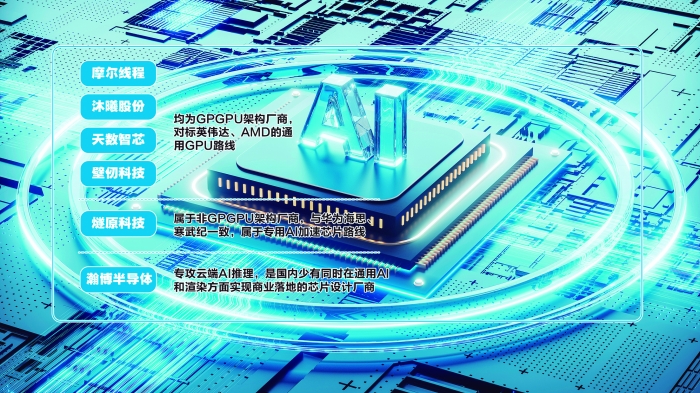
Core Viewpoint - The article highlights the rapid development and competitive landscape of domestic AI chip companies in China, particularly focusing on the six emerging players in Shanghai, which are poised for significant growth and innovation in the AI sector [2][10]. Group 1: Company Developments - Hanbo Semiconductor has completed its guidance for an IPO on the Sci-Tech Innovation Board and is progressing steadily towards its public offering [2]. - Suiruan Technology's IPO application has been accepted, indicating a growing interest in AI chip companies [2]. - The six domestic AI chip companies, including Hanbo Semiconductor, are collectively referred to as the "Six Little Dragons," with a strong emphasis on technological advancements and product development [2][4]. Group 2: Market Position and Strategy - The "Six Little Dragons" are primarily cloud-based AI chip manufacturers, with five of them focusing on GPGPU architecture to compete with global giants like NVIDIA and AMD [2][4]. - Hanbo Semiconductor specializes in cloud AI inference and has achieved commercial success in both general AI and rendering applications, positioning itself as a leader in the domestic market [3][4]. - The companies are actively updating their technology and product lines, with significant launches such as the new GPU brand by Muxi Co., which aims to enhance scientific research capabilities [3][4]. Group 3: Financial Performance and Projections - Muxi Co. anticipates a revenue of 1.6 billion to 1.7 billion yuan in 2025, reflecting a year-on-year growth of 115.32% to 128.78% [9]. - Moer Thread expects a revenue of 1.45 billion to 1.52 billion yuan in 2025, with a projected year-on-year increase of 230.70% to 246.67% [9]. - The domestic general GPU market share is expected to rise from 8.3% in 2022 to over 50% by 2029, indicating a structural transformation in the market [10]. Group 4: Government and Investment Support - Shanghai has been proactive in nurturing the AI chip industry through financial support and favorable policies, positioning itself as a leader in the integrated circuit sector [5][7]. - The Shanghai Sci-Tech Innovation Fund has been involved in early-stage investments in companies like Muxi, demonstrating strong government backing for local tech firms [6]. - Hanbo Semiconductor has received significant investments from local state-owned enterprises, benefiting from various policy supports aimed at fostering high-quality development in the tech sector [7].

深圳两会代表委员建言 积极抢占人工智能产业科技制高点
Zhong Guo Zheng Quan Bao· 2026-02-11 22:24
Group 1 - Shenzhen aims to become a global leader in the artificial intelligence industry, with a target of over 10% growth in the AI industry cluster's added value by 2026 [1] - The city has over 2,600 AI enterprises and expects core AI industry revenue to reach approximately 220 billion by 2025, maintaining its position in the top tier nationally [2] - Shenzhen is focusing on building a comprehensive AI ecosystem, including a national AI college and a venture capital fund of 50.45 billion aimed at emerging fields like AI [3] Group 2 - The city is pushing for high-level applications of AI across various industries, having opened nearly 200 "city + AI" application scenarios, particularly in urban governance and public services [5] - Challenges remain, such as insufficient data integration and the need for enhanced core technology autonomy, which require a more robust AI ecosystem [6] - Recommendations include fostering deep integration of AI with high-end manufacturing and smart cities, and implementing regulatory innovations to accelerate the transition of high-potential applications from labs to market [6]
积极抢占人工智能产业科技制高点
Zhong Guo Zheng Quan Bao· 2026-02-11 20:23
Core Insights - Shenzhen aims to become a global leader in the artificial intelligence (AI) industry, with a target of over 10% growth in AI industry cluster value added by 2026 [1] - The city has over 2,600 AI enterprises and anticipates core AI industry revenue of approximately 220 billion yuan by 2025, maintaining its position among the top tier in the country [2] Industry Developments - Shenzhen has made significant breakthroughs in AI, including advancements in foundational computing power and the commercialization of edge AI chips [2] - The National Supercomputing Center in Shenzhen is set to achieve the world's top computing performance by December 2025, with a projected 16,000P computing cluster by October 2023 [2] - The city has issued its first batch of AI vouchers to reduce the cost of computing power for AI entities [2] Talent and Funding - The establishment of the National AI Academy in Shenzhen has selected 114 dual-appointed professors, with the first cohort of 237 students expected by September 2025 [3] - A venture capital fund of 50.45 billion yuan will be launched in December 2025, focusing on AI and other emerging sectors [3] Strategic Goals - Shenzhen aims to enhance its AI supply chain advantages and become a leader in autonomous computing technology and innovative smart terminal solutions [3] - The city is focused on three key areas: AI inference chips, AI-native hardware, and AI business models, to lead the fourth industrial revolution [4] Challenges and Recommendations - Despite progress, challenges remain in data integration, core technology autonomy, and cross-system collaboration [5] - Recommendations include strengthening high-level AI applications across all sectors, promoting vertical integration, and implementing regulatory innovations to facilitate AI development [5][6]

“国产AI芯片六小龙”竞速 上海赚大了
Shang Hai Zheng Quan Bao· 2026-02-07 02:57
Core Viewpoint - The domestic AI chip unicorn, Hanbo Semiconductor, has completed its guidance for the Sci-Tech Innovation Board IPO, alongside Suiyuan Technology, marking a significant moment for the AI chip sector in China as it gathers six notable companies in the capital market, showcasing the rapid development of artificial intelligence [1] Group 1: Company Developments - Hanbo Semiconductor is advancing its IPO process and is recognized for its commercial success in both general AI and rendering applications, leading in the domestic data center AI and edge computing sectors [3][5] - Suiyuan Technology has developed four generations of cloud AI chips and aims to raise 6 billion yuan for the R&D and industrialization of its fifth and sixth-generation products [5] - The "Six Little Dragons" of AI chips, including companies like Moer Thread and Muxi, are focusing on technological advancements and product updates, with Muxi launching a new GPU product line [2][3][4] Group 2: Market Trends - The domestic general GPU market share is expected to rise from 8.3% in 2022 to 17.4% in 2024, with projections indicating it could exceed 50% by 2029 [13] - The AI chip market is experiencing structural changes, with companies transitioning from relying on external support to achieving self-sustained growth [13] - The upcoming IPOs of these companies are anticipated to strengthen the trend of domestic AI chip localization, providing a stable financial foundation and increasing market recognition [12] Group 3: Government Support and Investment - Shanghai has positioned itself as a leader in the integrated circuit industry, ranking first in China and fourth globally, and is actively supporting local AI chip companies through funding and policy initiatives [7][8][10] - Significant investments have been made by Shanghai's state-owned enterprises in companies like Wallen Technology and Suiyuan Technology, facilitating their growth and technological advancements [9][10]
4个月股价涨幅超700%,这只牛股被查
Jing Ji Guan Cha Wang· 2026-01-12 08:54
Core Viewpoint - Tianpu Co., Ltd. experienced a dramatic stock price surge of 718.39% from late August 2025 to December 2025, despite no performance growth, asset injections, or business transformation announcements, leading to a dynamic P/E ratio exceeding 898 times [2][3] Group 1: Stock Price Movement - From August 23, 2025, Tianpu's stock price rose from approximately 27 CNY per share to 218.02 CNY per share by December 30, 2025, marking a cumulative increase of 718.39% [5] - The company issued 11 announcements regarding abnormal stock trading fluctuations during this period, with 2 instances triggering severe abnormal fluctuation standards [5] Group 2: Regulatory Investigation - On January 9, 2026, the China Securities Regulatory Commission (CSRC) initiated an investigation into Tianpu Co., citing significant omissions in the company's announcements related to abnormal stock trading [3][4] - The CSRC's investigation highlights concerns regarding information disclosure deficiencies, which impact not only Tianpu but also broader issues of effective communication and regulatory response mechanisms in the A-share market [3] Group 3: Company Background and Ownership Changes - Tianpu Co., Ltd. primarily operates in the automotive rubber hose and fluid pipeline system sector, with a reported net profit of 33.066 million CNY for the entire year of 2024, indicating a long-standing position as a low-valuation, low-volatility traditional manufacturing entity [3] - The stock price surge was largely attributed to market speculation surrounding its new controlling shareholder, Zhonghao Xinying, an AI chip company, despite Tianpu's clarifications that it had not engaged in AI-related business or planned any technology, personnel, or asset injections [4]


从汽车橡胶到AI芯片 天普股份718%涨幅引来监管铁拳
Jing Ji Guan Cha Wang· 2026-01-11 06:56
Core Viewpoint - The China Securities Regulatory Commission (CSRC) has initiated an investigation into Ningbo Tianpu Rubber Technology Co., Ltd. (Tianpu Co., 605255.SH) due to significant omissions in announcements related to abnormal stock trading fluctuations, marking a critical regulatory response to the company's stock price volatility since August 2025 [1][2]. Group 1: Company Background and Stock Performance - Tianpu Co. specializes in automotive rubber hoses and fluid pipeline systems, with a projected net profit of only 33.07 million yuan for the entire year of 2024, indicating its status as a low-valuation, low-volatility traditional manufacturing entity [1]. - Since late August 2025, the company's stock price surged dramatically by 718.39% to 218.02 yuan per share by December 30, 2025, despite no performance growth, asset injections, or business transformation announcements [1][3]. - The stock price increase was largely driven by market speculation regarding its new controlling shareholder, AI chip company Zhonghao Xinying, despite the company clarifying that it had not engaged in AI-related business or plans for asset injection [2][3]. Group 2: Regulatory Investigation and Market Reaction - The CSRC's investigation is focused on the compliance of information disclosure during the period of abnormal stock price fluctuations, specifically addressing whether the company fulfilled its obligations to disclose information accurately and completely [6]. - The company issued multiple announcements regarding stock trading anomalies and risk warnings, yet these did not align with the market's expectations, leading to a disconnect between official communications and investor sentiment [3][6]. - The investigation highlights the regulatory challenges in the A-share market regarding the integration of concepts and the need for clearer disclosure obligations when significant shareholder changes occur in companies linked to hot market trends [6]. Group 3: Implications for the Industry - The case illustrates a broader issue of "expectation arbitrage" driven by information asymmetry, where the new controlling party leveraged market enthusiasm for AI to influence stock prices without substantive business changes [5][6]. - The CSRC's actions may prompt a reevaluation of existing regulations, particularly concerning the disclosure of potential market misinterpretations and the effectiveness of current acquisition regulations in protecting shareholder interests [6]. - The outcome of the Tianpu Co. investigation could set a precedent for future cases involving similar circumstances in the A-share market, emphasizing the need for a balance between encouraging industry integration and preventing speculative bubbles [6].
瀚博半导体:争做全球AI推理芯片的领导者
Xin Lang Cai Jing· 2026-01-04 12:25
Core Viewpoint - Nvidia plans to acquire core technology assets from AI chip startup Groq for approximately $20 billion, signaling a shift in focus from "training" to "inference" in AI computing, as real-time, low-cost, and deployable inference capabilities become the new competitive focus in the industry [1][9]. Group 1: Nvidia's Acquisition and Market Shift - Nvidia's acquisition of Groq is seen as a clear signal that the focus of AI computing is shifting towards inference capabilities [1][9]. - The move is expected to help Nvidia cover a broader range of AI inference and real-time workloads [1][9]. Group 2: Insights from Hanbo Semiconductor - Hanbo Semiconductor was founded in 2018 with the insight that cloud AI inference would have greater explosive potential than AI training chips [4][10]. - The CEO of Hanbo, Qian Jun, emphasizes the vast and untapped market potential for cloud AI inference and rendering in the era of AGI [4][12]. Group 3: Hanbo's Product Development and Market Position - Hanbo has launched two series of AI inference and rendering chips, SV and SG, achieving commercial success with major internet companies and operators in China [4][12]. - The SV series chips can achieve data throughput speeds twice that of general-purpose GPUs while requiring lower bandwidth, and they are among the few products in China that natively support FP8 large model inference [6][14]. Group 4: Strategic Focus and Future Outlook - Hanbo focuses on specific applications, such as video processing and AI acceleration, to create value through hardware and software collaboration [5][13]. - The company aims to become a global leader in AI inference chips, with a prediction that 2027 will be a key year for the large-scale replacement of domestic AI inference chips [8][16].

三星、海力士毛利率超台积电!
国芯网· 2025-12-23 04:49
Core Viewpoint - The semiconductor industry is experiencing a shift in profit margins, with Samsung and SK Hynix's storage division expected to surpass TSMC's margins for the first time in seven years, indicating a significant change in the industry's profit focus driven by AI demand [2][4]. Group 1: Profit Margins and Market Dynamics - Samsung and SK Hynix's gross margins for the fourth quarter are estimated to be between 63% and 67%, exceeding TSMC's 60% [2]. - The shift in profit margins highlights the growing importance of storage chips in the AI industry, which are becoming critical for AI inference capabilities [4]. Group 2: Market Growth and Demand - The storage market is projected to reach $444 billion next year, driven by increasing demand for AI inference [4]. - As AI applications expand, the demand for storage chips is expected to rise, enhancing their market position and demand scale [4]. - AI inference will also drive upgrades in storage architecture, accelerating the replacement of traditional hard drives with SSDs, thus providing new growth momentum for the storage industry [4].

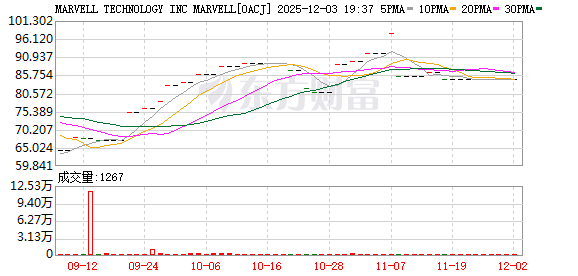
这家公司财报公布后股价激增
Guo Ji Jin Rong Bao· 2025-12-03 11:36
Core Viewpoint - Marvell Technology has shown strong financial performance in Q3, with revenue and adjusted earnings exceeding market expectations, indicating a positive outlook for the company's AI-related business growth [2][4]. Financial Performance - Marvell reported Q3 revenue of $2.075 billion, slightly above market expectations of $2.069 billion, representing a year-over-year growth of 37% [2]. - Adjusted earnings per share were $0.76, surpassing analyst expectations of $0.74 [2]. - For Q4, Marvell anticipates revenue of $2 billion, with a fluctuation range of ±5%, aligning with the median forecast from analysts [3]. Business Segments - The data center business, which constitutes a significant portion of Marvell's total sales, generated $1.52 billion in revenue, a 38% year-over-year increase, slightly exceeding Wall Street's expectation of $1.51 billion [4]. - Marvell expects data center revenue growth to exceed 25% in FY2027, significantly higher than the general analyst forecast of 16% [4]. Market Sentiment - Following the earnings report, Marvell's stock price rose by 8.7% in after-hours trading, reversing earlier declines [4]. - Year-to-date, Marvell's stock has seen a decline of over 15%, attributed to previous earnings reports not meeting high market expectations [4]. Analyst Ratings - Marvell currently holds a composite rating of 96 (out of 99), indicating strong performance among growth stocks [5]. - Morgan Stanley analyst Joseph Moore noted that market expectations for Marvell's AI training chips have been recalibrated after previous overestimations [5]. - UBS analyst Timothy Arcuri has a "buy" rating on Marvell with a target price of $110, suggesting that clients are diversifying their technology roadmaps [5]. Strategic Moves - Marvell has not mentioned its recent acquisition of Celestial AI in the earnings report, which is valued at $3.25 billion, including $1 billion in cash and $2.25 billion in Marvell stock [6]. - Celestial AI's technology aims to overcome the limitations of traditional copper wiring, providing better bandwidth, lower latency, and improved energy efficiency, which are critical for modern AI infrastructure [6].