亚马逊Prime服务

Search documents
对外松绑、对内加压:特朗普政府对科技巨头为何持“双标”态度
第一财经· 2025-09-05 07:27
Core Viewpoint - The Trump administration is exerting pressure on other countries to relax regulations on American tech companies while maintaining a strong antitrust stance domestically against these giants [2][4]. Group 1: Antitrust Actions - A U.S. federal judge recently rejected the Department of Justice's request to break up Google's search business, but the DOJ plans to continue pursuing this case, indicating its historical significance [2][3]. - The DOJ and FTC have been actively identifying and proposing the removal of regulatory barriers that hinder competition, with a focus on various industries including technology [4][6]. - The Trump administration's antitrust enforcement is expected to continue, with a focus on labor market issues and stricter scrutiny of the tech sector [6][9]. Group 2: Regulatory Contradictions - The Trump administration's tough enforcement against tech giants contrasts with its broader policy of regulatory relaxation across multiple sectors [4][5]. - The administration has sought exemptions for U.S. multinational companies from international digital regulations, particularly criticizing the EU's Digital Services Act for its perceived restrictions on free speech [4][5]. Group 3: Tech Companies' Responses - Many tech leaders have shown support for Trump, hoping to benefit from regulatory rollbacks and government backing against foreign scrutiny [8]. - Despite showing a cooperative stance, major tech companies like Apple and Google are still facing significant antitrust lawsuits, indicating ongoing challenges in the regulatory landscape [9].



本周重磅日程:7月9日“对等关税”大限
Hua Er Jie Jian Wen· 2025-07-06 04:00
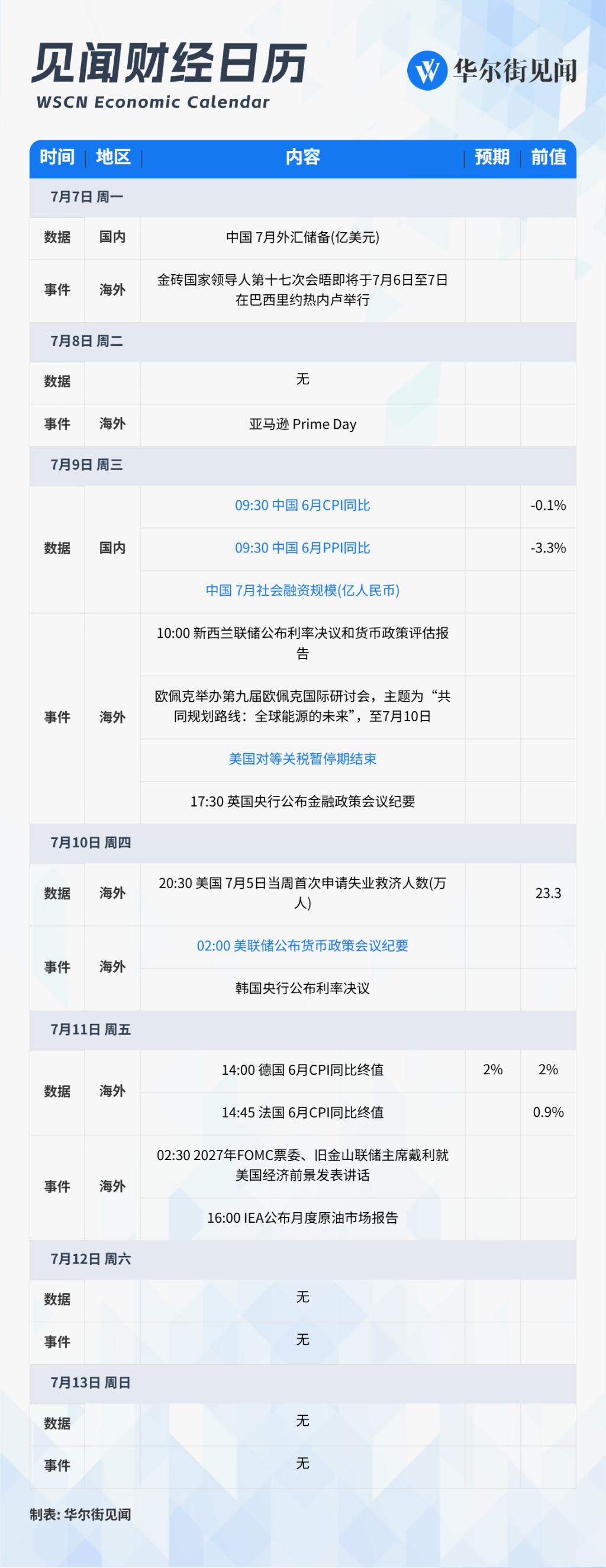
Group 1: Economic Events and Data Releases - The week of July 7-13 will feature significant economic events, including the end of the U.S. "reciprocal tariffs" suspension, the BRICS summit in Brazil, and the release of China's June CPI, PPI, and social financing data [3][4][6][8][10][11]. - The BRICS summit will take place from July 6-7 in Rio de Janeiro, focusing on enhancing cooperation among emerging markets and developing countries [8]. - The U.S. will announce new tariffs ranging from 10% to 70% starting August 1, following the expiration of the negotiation period with several countries [6][7]. Group 2: U.S. Economic Indicators - The U.S. non-farm payroll data for June showed an increase of 147,000 jobs, surpassing the expected increase of 106,000, with the unemployment rate dropping from 4.24% to 4.12% [9]. - Market expectations indicate a low probability of interest rate cuts in July, with a 75% chance of a cut in September, as the labor market remains robust [9]. Group 3: China Economic Data - China's June CPI showed a year-on-year decline of 0.1%, with urban prices stable and rural prices down by 0.4% [10]. - The PPI for June decreased by 3.3% year-on-year, indicating ongoing deflationary pressures in the industrial sector [10][11]. - Social financing data for May indicated an increase of 2.29 trillion yuan, with new RMB loans amounting to 620 billion yuan [11]. Group 4: International Economic Reports - The IEA will release its monthly oil market report on July 11, with OPEC+ expected to agree on increasing oil production by approximately 550,000 barrels per day in August [12]. - Germany's June CPI unexpectedly fell to 2%, reaching the European Central Bank's target for the first time in nearly a year, while France's CPI was reported at 0.9% [13]. - The Bank of England maintained its policy rate at 4.25%, with a notable division among policymakers regarding future rate cuts [14].