
人工智能气象预报模型

Search documents
观云识天,护航国计民生
Zhong Zheng Wang· 2025-12-05 06:17
Core Insights - Meteorological services have become a crucial support for meeting public expectations and promoting economic and social development during the 14th Five-Year Plan period [1] Group 1: Technological Advancements - The global first achievement of meteorological satellite with a regional resolution of 250 meters for continuous imaging every minute [3] - Fengyun-3G satellite is China's first and the world's third low-inclination orbit precipitation measurement satellite [3] - Fengyun-3E satellite is the only civil polar meteorological satellite conducting observations during dawn and dusk [3] - High-level self-reliance and strength achieved through equipment and technology like Fengyun satellites, Beidou sounding, and weather radars [7] Group 2: Forecasting Accuracy - The monitoring rate for hazardous weather has increased to 83% [10] - The lead time for severe convective weather warnings has been advanced by 13% [10] - Regional heavy rain, high temperature, and cold wave events can be forecasted 3 to 7 days in advance, while national significant weather events can be predicted 15 days ahead [10] - Climate anomaly events can be forecasted 6 months in advance, and climate annual outlook products can be released 1 year ahead [10] - The accuracy of rain forecasts has improved by 10% compared to the 13th Five-Year Plan period [12] Group 3: Economic Impact - Economic losses due to meteorological disasters have decreased by an average of 0.12 percentage points of GDP during the 14th Five-Year Plan [14] - Artificial rainfall and snow operations have cumulatively increased precipitation by approximately 1,677 million tons [14] - Winter wheat dry hot wind warnings have contributed to an increase in grain production by 8.3 billion jin [15] Group 4: Public Services and Applications - The life meteorological service index has expanded to over 70 types, covering various aspects of daily life [21] - Meteorological services now encompass over 70 major categories of the national economy [13] - A seamless and comprehensive intelligent digital meteorological forecasting system has been established, with spatial resolution down to 5 kilometers globally and 1 kilometer nationally [12] - 17 industries have achieved the integration and rapid release of 82 types of warning information, with alerts delivered to emergency responders within 1 minute [18] - Meteorological data products have been shared with nearly 130 million users across 21 industries in 153 countries and regions [25]

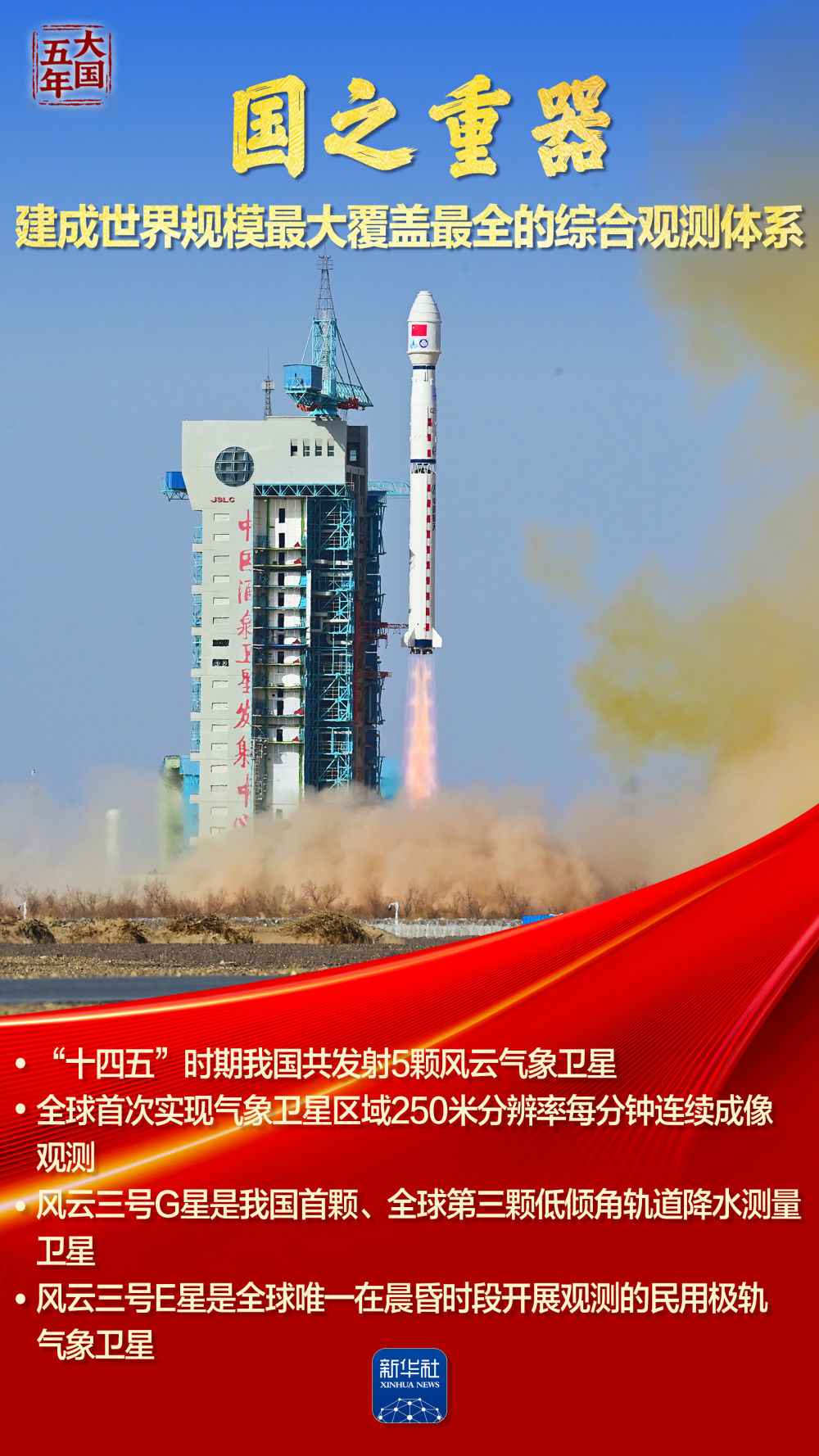
大国五年|观云识天,护航国计民生
Zhong Zheng Wang· 2025-12-05 06:15
Core Viewpoint - Meteorological services have become a crucial support for meeting public expectations and promoting economic and social development during the 14th Five-Year Plan period, enhancing safety and empowering various industries. Group 1: Technological Advancements - The global first achievement of meteorological satellite regional imaging with a resolution of 250 meters every minute [3] - The Fengyun-3G satellite is China's first and the world's third low-inclination orbit precipitation measurement satellite [3] - The Fengyun-3E satellite is the only civil polar meteorological satellite conducting observations during dawn and dusk [3] - High-level self-reliance and strength achieved through equipment and technology like Fengyun satellites, Beidou sounding, and weather radars [7] Group 2: Forecasting Accuracy - The monitoring rate for hazardous weather has increased to 83% [10] - Severe convective weather warning time has been advanced by 13% [10] - Regional heavy rain, high temperature, and cold wave processes can be forecasted 3 to 7 days in advance [10] - National significant weather processes can be predicted 15 days ahead, and global climate anomalies can be forecasted 6 months in advance [10] - Climate annual outlook products can be released 1 year in advance [10] Group 3: Service Expansion - The life meteorological service index has increased to over 70 types, covering various aspects of daily life [21] - Refined meteorological services encompass clothing, food, housing, transportation, tourism, shopping, and entertainment, covering over 50,000 scenic spots nationwide [21] - Health meteorological warning products for high temperatures and pollen allergies are popular among the public [21] Group 4: Economic Impact - Economic losses due to meteorological disasters have decreased by an average of 0.12 percentage points of GDP during the 14th Five-Year Plan [14] - Artificial rainfall and snow operations have cumulatively increased precipitation by approximately 1,677 million tons [14] - Early warnings for winter wheat dry hot wind have contributed to an increase in grain production by 8.3 billion jin [15] - Traffic accident numbers on optimized routes have decreased by 51% year-on-year due to the "three-party" warning linkage mechanism [15] Group 5: Data Sharing and AI Integration - A seamless, comprehensive intelligent digital meteorological forecasting business system has been established, with spatial resolution refined to 5 kilometers globally and 1 kilometer nationally [12] - The meteorological data sharing initiative has provided over 100 types of meteorological data products to nearly 1.3 million users across 21 industries in China and 153 countries and regions globally [25] - The Chinese Meteorological Administration has developed an AI meteorological application plan for 2023-2030, leading to breakthroughs in AI forecasting models [23]
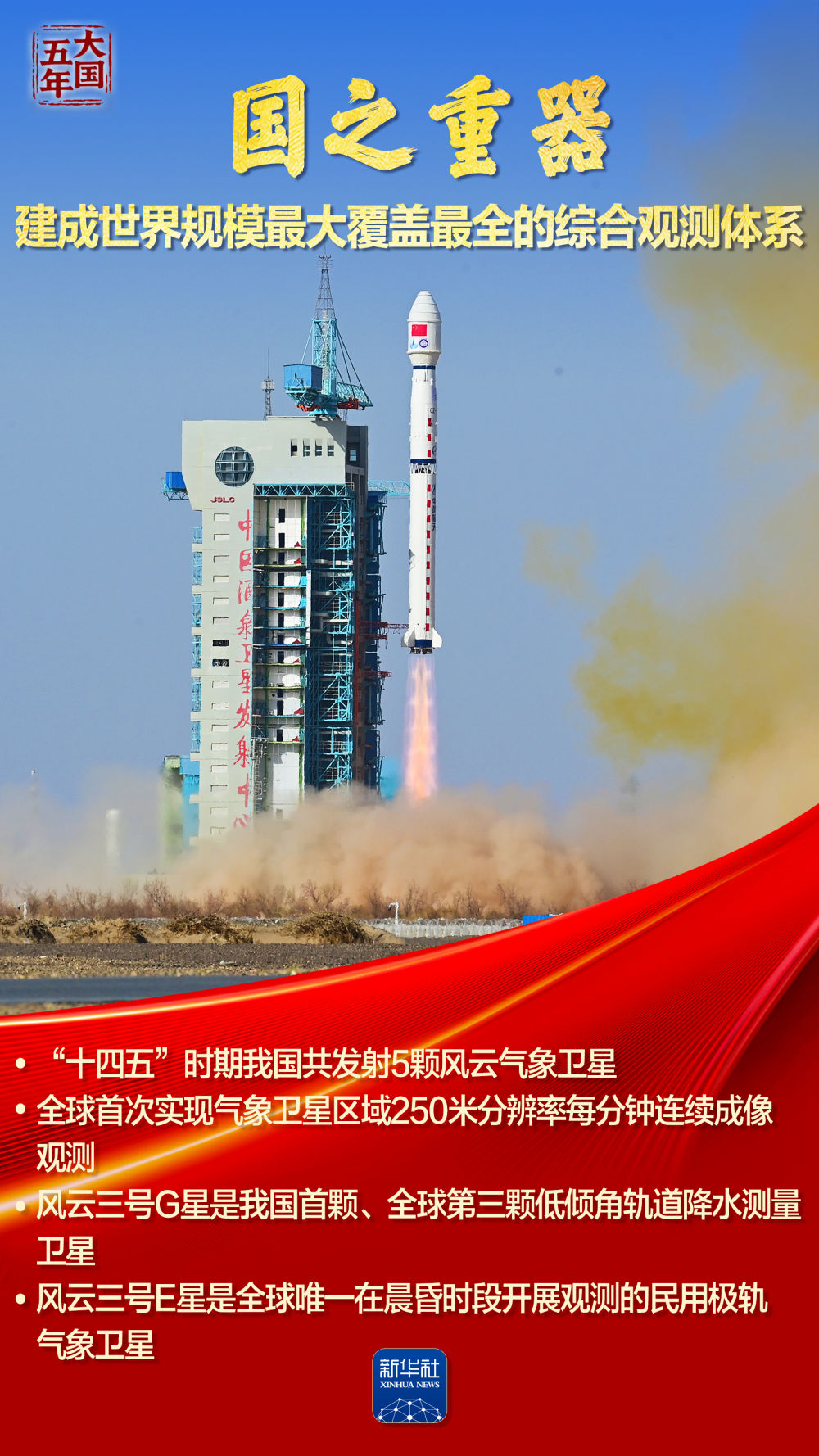
气象赋能千行百业服务国计民生 2024年全国气象高质量发展指数较2020年提升18.35%
Jing Ji Ri Bao· 2025-10-11 22:11
Core Viewpoint - The Chinese Meteorological Administration aims to modernize meteorological capabilities and services during the 14th Five-Year Plan period, with a projected 18.35% increase in the national meteorological high-quality development index by 2024 compared to 2020 [1] Group 1: Meteorological Services and Economic Impact - Meteorological services cover over 70 major industries, integrating digital meteorology into urban management platforms [2] - Economic losses from meteorological disasters have decreased by an average of 0.12 percentage points of GDP during the 14th Five-Year Plan period [1] - Artificial rainfall operations have increased precipitation by approximately 167.7 billion tons, while hail prevention efforts have reduced economic losses by about 60.3 billion yuan [1] Group 2: Agricultural and Energy Support - Collaborative efforts with agricultural departments have led to agricultural meteorological disaster risk warnings, contributing to an increase in grain production by 8.3 billion jin [2] - Meteorological services support the entire energy supply chain, aiding over 2,000 new energy stations in optimizing wind and solar resource utilization [2] Group 3: Technological Advancements - The meteorological modernization includes a comprehensive observation system with 9 meteorological satellites, 842 weather radars, and over 90,000 ground observation stations, achieving an 83% monitoring rate for severe weather [4] - The development of AI meteorological forecasting models in collaboration with universities and companies has led to significant breakthroughs in meteorological services [3] Group 4: Public Engagement and Health Services - Customized meteorological services will be enhanced through big data and AI, allowing for personalized weather information based on user preferences [3] - Health-related meteorological warning products, such as those for high temperatures and pollen allergies, have gained popularity among the public [2]