
风云三号G星

Search documents
观云识天,护航国计民生
Zhong Zheng Wang· 2025-12-05 06:17
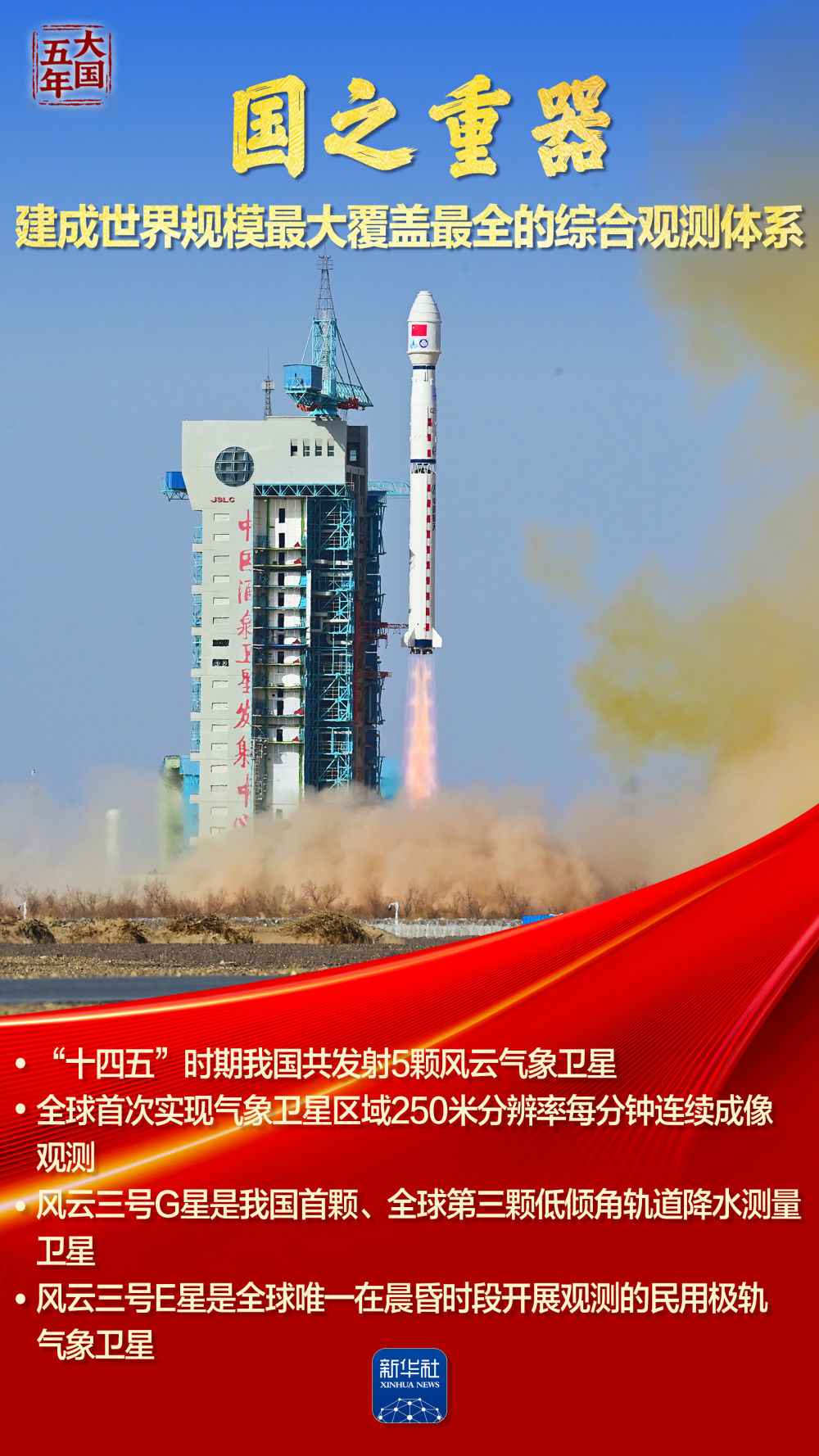
Core Insights - Meteorological services have become a crucial support for meeting public expectations and promoting economic and social development during the 14th Five-Year Plan period [1] Group 1: Technological Advancements - The global first achievement of meteorological satellite with a regional resolution of 250 meters for continuous imaging every minute [3] - Fengyun-3G satellite is China's first and the world's third low-inclination orbit precipitation measurement satellite [3] - Fengyun-3E satellite is the only civil polar meteorological satellite conducting observations during dawn and dusk [3] - High-level self-reliance and strength achieved through equipment and technology like Fengyun satellites, Beidou sounding, and weather radars [7] Group 2: Forecasting Accuracy - The monitoring rate for hazardous weather has increased to 83% [10] - The lead time for severe convective weather warnings has been advanced by 13% [10] - Regional heavy rain, high temperature, and cold wave events can be forecasted 3 to 7 days in advance, while national significant weather events can be predicted 15 days ahead [10] - Climate anomaly events can be forecasted 6 months in advance, and climate annual outlook products can be released 1 year ahead [10] - The accuracy of rain forecasts has improved by 10% compared to the 13th Five-Year Plan period [12] Group 3: Economic Impact - Economic losses due to meteorological disasters have decreased by an average of 0.12 percentage points of GDP during the 14th Five-Year Plan [14] - Artificial rainfall and snow operations have cumulatively increased precipitation by approximately 1,677 million tons [14] - Winter wheat dry hot wind warnings have contributed to an increase in grain production by 8.3 billion jin [15] Group 4: Public Services and Applications - The life meteorological service index has expanded to over 70 types, covering various aspects of daily life [21] - Meteorological services now encompass over 70 major categories of the national economy [13] - A seamless and comprehensive intelligent digital meteorological forecasting system has been established, with spatial resolution down to 5 kilometers globally and 1 kilometer nationally [12] - 17 industries have achieved the integration and rapid release of 82 types of warning information, with alerts delivered to emergency responders within 1 minute [18] - Meteorological data products have been shared with nearly 130 million users across 21 industries in 153 countries and regions [25]

风云气象卫星:“天穹之眼”如何照亮美好生活
Ren Min Wang· 2025-11-22 01:41
Core Insights - The news highlights the significant advancements of China's Fengyun meteorological satellites, which now serve 133 countries and regions, showcasing China's transformation from a follower to a leader in meteorological technology [1] Group 1: Technological Advancements in Agriculture - The Fengyun satellite system enables real-time monitoring of crop conditions, allowing farmers to make informed decisions regarding irrigation and fertilization, thus transitioning traditional agriculture to smart agriculture [2] - The use of satellite-guided precision fertilization has reduced chemical fertilizer usage in Northeast China, while remote sensing has improved irrigation efficiency in arid regions [2] Group 2: Disaster Prevention and Response - The Fengyun-4 satellite has improved the monitoring and identification of severe weather events, reducing the time for disaster warnings to as little as 5 minutes and enhancing severe weather alerts by 40 minutes [3] - The satellite's rapid imaging capabilities allow for real-time emergency responses, playing a crucial role in disaster management and reporting [3] Group 3: Ecological Monitoring and Protection - Fengyun satellites serve as "space sentinels" for ecological protection, providing data for environmental assessments and monitoring changes in ecological conditions [4] - The satellite data supports initiatives like ecological red lines and tracking carbon neutrality goals, contributing to sustainable development [4] Group 4: Enhancing Public Services - The Fengyun-3 G satellite's precipitation measurement radar fills a gap in precipitation detection, providing accessible agricultural weather information to rural farmers and aiding livestock herders and fishermen [5] - These services exemplify the satellite's role in bridging the gap between advanced technology and everyday life, enhancing public welfare [5] Group 5: Space Weather Monitoring - Fengyun satellites also monitor space weather, providing critical data for major space missions and enhancing the safety of satellite navigation and aerospace operations [6] - The upcoming launch of the world's first space weather AI model, "Fengyu," is expected to significantly improve forecasting accuracy [6] Group 6: Global Contribution and Future Outlook - China is transitioning from a "follower" to a "contributor" in global meteorological governance, sharing Fengyun satellite data through the World Meteorological Organization [7] - The Fengyun-2 H satellite and Fengyun-4 A satellite are pivotal in providing meteorological support for regional and international initiatives, with a high satisfaction rate among international users [7] - Future developments in the next generation of Fengyun satellites are anticipated to further enhance China's capabilities in meteorological services and global cooperation [7]