
人工耳蜗系统

Search documents
财达证券每日市场观察-20260114
Caida Securities· 2026-01-14 01:49
Market Overview - The market experienced a decline on January 13, with the Shanghai Composite Index falling by 0.64%, the Shenzhen Component Index dropping by 1.37%, and the ChiNext Index decreasing by 1.96% [2] - The total trading volume reached 3.7 trillion yuan, an increase of approximately 60 billion yuan compared to the previous trading day [1] Sector Performance - Most sectors saw declines, with notable exceptions in oil, pharmaceuticals, and non-ferrous metals, while aerospace, electronics, communications, and computers faced the largest drops [1] - The aerospace sector's significant adjustment was influenced by multiple companies announcing share reductions, although this adjustment is not seen as severe compared to previous gains [1] Investment Opportunities - Despite the downturn in the aerospace sector, the overall market did not exhibit panic, with over 90 companies experiencing declines of 10% or more, primarily from the aerospace sector [1] - There is potential for short-term investment in other technology sectors, such as innovative pharmaceuticals and AI applications, as recent large-scale business development transactions in domestic innovative pharmaceutical companies indicate a high level of activity in this area [1] Policy Developments - The Ministry of Civil Affairs is working on measures to promote the silver economy, focusing on elderly care services, rehabilitation aids, and age-friendly products, aiming to optimize industry layout and attract social capital [3][5] - The Ministry of Industry and Information Technology has released an action plan for the high-quality development of industrial internet platforms, targeting the establishment of over 450 influential platforms by 2028 [4] Fund Dynamics - The first domestic fund management company has surpassed 1 trillion yuan in ETF assets, marking a significant milestone in the Chinese ETF market [10] - As of January 12, the total trading volume of ETFs reached 465.79 billion yuan, with stock ETFs accounting for 256.06 billion yuan of this total [12]
八部门发文促银发经济发展 14项举措培育养老服务经营主体
Shang Hai Zheng Quan Bao· 2026-01-13 23:34
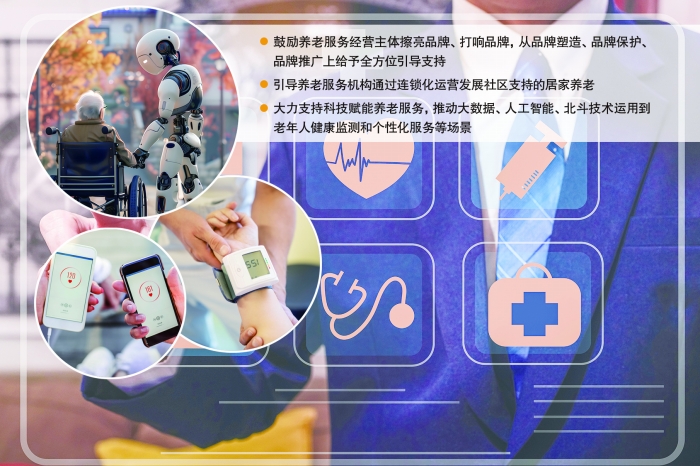
Core Viewpoint - The Ministry of Civil Affairs and seven other departments have jointly issued measures to cultivate the elderly care service sector and promote the silver economy, focusing on brand development and technological empowerment [1][2]. Group 1: Policy Measures - The measures include 14 specific initiatives aimed at optimizing the development environment for elderly care services and stimulating operational vitality [1]. - There is a strong emphasis on brand building, with support for brand creation, protection, and promotion to foster well-known brands in the elderly care sector [1]. - The measures aim to enhance market supply and demand matching by optimizing the supply of elderly care services and age-friendly products, encouraging community-supported home care through chain operations [1]. Group 2: Technological Empowerment - The measures advocate for the integration of big data, artificial intelligence, and Beidou technology in health monitoring and personalized services for the elderly [2]. - There is encouragement for the development of elderly care robots and smart devices, with a focus on improving the service experience for older adults [2]. - The initiative aims to transition the elderly care service system from traditional care to a more intelligent and quality-enhanced model, addressing labor shortages and improving service efficiency [2][3]. Group 3: Industry Development Focus - The Ministry of Industry and Information Technology plans to focus on key areas such as elderly care robots, smart footwear, and easy-to-swallow foods, enhancing product development [3]. - There will be a collaborative effort between production and application enterprises to advance core technology and product development in elderly care [3]. - The Ministry of Commerce will work on five key areas, including the development of home care services for the elderly and creating platforms for supply and demand matching in elderly care [3].
八部门发文促银发经济发展 14项举措培育养老服务经营主体 鼓励养老服务机器人产业发展
Shang Hai Zheng Quan Bao· 2026-01-13 18:34
Core Insights - The Ministry of Civil Affairs and seven other departments have jointly issued measures to cultivate the elderly care service sector and promote the silver economy, focusing on brand development and technological innovation [2][3][4] Group 1: Policy Measures - The measures include 14 specific initiatives aimed at enhancing the operational vitality of elderly care service providers and promoting structural reforms in supply [2] - Emphasis is placed on brand building, with support for brand creation, protection, and promotion to foster well-known brands in the elderly care sector [2] Group 2: Market Optimization - The measures aim to optimize the supply of elderly care services and age-friendly products, encouraging community-based home care through chain operations [3] - Support is provided for e-commerce platforms and large supermarkets to enhance the connection between supply and demand in elderly care services [3] Group 3: Technological Empowerment - The initiative promotes the integration of big data, artificial intelligence, and other technologies into elderly health monitoring and personalized services [3][4] - Development of elderly care robots and smart devices is encouraged, with a focus on improving the service experience for the elderly [3][4] Group 4: Industry Development - The Ministry of Industry and Information Technology will focus on the deep integration of new information technologies with elderly care services, addressing the pain points of elderly living [4] - Key areas for development include elderly care robots, age-friendly clothing, and easy-to-swallow food products [4] Group 5: Business Development - The Ministry of Commerce will focus on five areas, including the development of home care services for the elderly and creating platforms for supply-demand matching in elderly care [5] - Efforts will be made to create new consumption scenarios for elderly care and foster an open cooperative environment [5]


事关银发经济 八部门联合发布
Shang Hai Zheng Quan Bao· 2026-01-13 05:08
Core Viewpoint - The Ministry of Civil Affairs introduced measures to cultivate the elderly care service sector and promote the silver economy through systematic policy support aimed at enhancing the operational vitality of service providers and advancing structural reforms in supply-side elderly care [1][3]. Group 1: Key Measures - The measures include 14 specific initiatives across five areas, focusing on brand development, market supply-demand matching, technological empowerment, environmental optimization, and increased support for resources [3][4]. - Encouragement for elderly care service providers to enhance brand recognition and protection, providing clear policy pathways for developing well-known brands and leading enterprises in the sector [3]. - Promotion of market-oriented supply-demand matching by optimizing elderly care services and products, facilitating community-based home care through chain operations, and enhancing online and offline service accessibility [3]. Group 2: Technological Empowerment - Strong support for integrating technology into elderly care services, including the use of big data, artificial intelligence, and robotics to improve health monitoring and personalized services for the elderly [3][6]. - Focus on the development and application of humanoid robots and health monitoring devices in various settings such as homes and care institutions, transitioning from mechanical care to precise service delivery [6][7]. Group 3: Environmental Optimization - Creation of a fair competitive environment and establishment of a standard certification system to monitor and evaluate the implementation of standards for silver products and services, while combating illegal activities against the elderly [3][4]. - Improvement of administrative services to attract social investment in elderly care, including the implementation of a unified online service for licenses across regions to reduce operational costs for service providers [4]. Group 4: Market Development - The Ministry of Commerce aims to enhance the supply of quality elderly care services by developing home care services, creating platforms for supply-demand matching, and promoting new consumption scenarios for the elderly [7]. - Plans to accelerate the development of new business models and pilot programs for consumption, while encouraging e-commerce platforms to enrich the supply of elderly-friendly products and services [7].
小伙听力损失18年重获新“声”
Xin Lang Cai Jing· 2025-12-31 16:58
Core Viewpoint - The successful cochlear implant surgery for a young man suffering from severe hearing loss highlights advancements in medical technology and the impact of national healthcare policies in reducing patient costs, making treatment more accessible for families with hearing disabilities [1][2]. Group 1: Medical Procedure and Technology - The young patient, referred to as Xiao Jie, underwent cochlear implant surgery after 18 years of severe hearing loss due to "large vestibular aqueduct syndrome" [1]. - The surgery was performed by a specialized team at Haikou People's Hospital, utilizing the MED-EL cochlear implant system, which was chosen to effectively restore hearing [1]. - The surgical procedure involved a minimally invasive approach, ensuring the protection of critical structures such as the facial nerve and inner ear, resulting in an ideal electrode placement [1]. Group 2: Cost and Accessibility - The introduction of national procurement for cochlear implants and new healthcare policies in Hainan has significantly reduced the out-of-pocket expenses for patients, bringing costs down to between 20,000 to 35,000 yuan [1]. - This financial relief allows more families with hearing disabilities to access necessary treatments, thereby enhancing their quality of life [1]. Group 3: Post-Surgery Recovery - The patient is recovering well and experienced his first device activation three weeks post-surgery, marking a significant milestone in his journey to regain hearing [2]. - Medical staff will provide comprehensive auditory and speech rehabilitation guidance to assist the patient in adapting to the new auditory environment [2].