
以太币ETF

Search documents
Crypto ETFs Enter Maturity Phase as IRS and SEC Actions Drive Rapid Expansion of Products
Yahoo Finance· 2025-11-19 14:49
Core Insights - The digital asset market has evolved significantly, transitioning from a speculative trading class to a recognized investment class, with ETFs now holding a substantial share of bitcoin's market cap [3] Group 1: Market Dynamics - The discussion at the ETP Forum highlighted the changing landscape of crypto ETFs, emphasizing the operational adjustments necessary to accommodate rapid product expansion [2] - The IRS's recent guidance has enabled funds to stake assets like ether and solana without risking their tax status, allowing for predictable yield generation [4] - The SEC's introduction of generic listing standards has streamlined the approval process for crypto ETFs, leading to the emergence of new products such as Solana, litecoin, and hedera ETFs [5] Group 2: Regulatory Changes - The IRS ruling has created a pathway for funds to earn and distribute staking rewards, integrating on-chain economics into the regulated financial environment [4] - The SEC's new standards rely on surveillance agreements and volume data, providing regulators with the confidence to detect market manipulation [5] - The wave of ETF approvals has necessitated firms to enhance their internal processes, particularly in terms of quarterly reporting and managing tax events [6]
花旗:比特币的本轮调整,在“四年大周期”尾声,政府关门加剧了流动性冲击
美股IPO· 2025-11-07 04:32
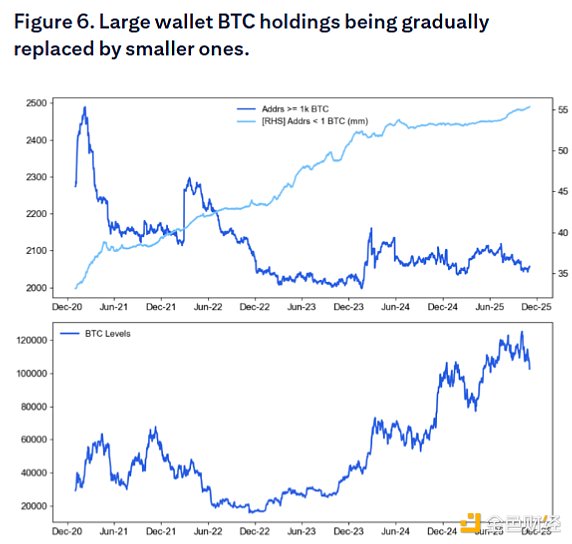
Core Insights - The report from Citigroup indicates that the recent liquidation event on October 10 may have negatively impacted investor risk appetite, with a noticeable slowdown in the inflow of funds into U.S. spot ETFs over the past few weeks [1][20] - On-chain indicators show that Bitcoin whales are gradually reducing their holdings, while smaller retail wallets are increasing their holdings, reflecting a shift in market dynamics [1][6] - The current price of Bitcoin has fallen below the 200-day moving average, which may further suppress demand [1][17] Group 1: Bitcoin's Four-Year Cycle - Bitcoin's four-year cycle theory is based on its halving mechanism, which reduces the block reward for miners approximately every four years, creating predictable supply shocks that historically lead to price increases [2] - Historical patterns show that Bitcoin typically reaches a cyclical peak about 18 months after each halving, followed by a bear market adjustment [3] - Some research institutions suggest that the Bitcoin market may be evolving beyond the traditional four-year cycle due to increased institutional participation and the introduction of spot ETFs, leading to a more mature market structure [3] Group 2: Current Market Adjustments - Bitcoin has experienced a significant price drop of approximately 20% since its historical high in early October, coinciding with the tail end of the four-year cycle [4] - On-chain data indicates that whales have sold a total of 147,000 Bitcoins, valued at around $16 billion, since August, while the number of addresses holding over 1,000 Bitcoins is decreasing [7] - The current market structure is shifting from a "whales selling to retail" model to "old whales transferring assets to new long-term holders," such as institutions and ETFs, which may lead to a more prolonged but milder price adjustment [10] Group 3: Liquidity Crisis and Government Shutdown - The liquidity crisis triggered by the U.S. government shutdown has exacerbated the depth and duration of Bitcoin's price adjustment [11] - The Treasury General Account (TGA) balance has surged to over $1 trillion, pulling significant liquidity from the market, which has a direct impact on Bitcoin as a risk asset [12][13] - The increase in TGA balance is attributed to a combination of factors, including the government shutdown and ongoing debt issuance, leading to a tightening of market liquidity [16] Group 4: Future Outlook - The potential reopening of the U.S. government could release significant liquidity back into the market, which may trigger a large-scale buying spree for risk assets, including Bitcoin [19][21] - Analysts predict that once the government reopens, the release of pent-up liquidity could act as a catalyst for a strong rebound in Bitcoin and other liquidity-sensitive assets [21]

比特币本轮调整:在“四年大周期”尾声 政府关门加剧了流动性冲击
Hua Er Jie Jian Wen· 2025-11-07 03:17
Core Viewpoint - The cryptocurrency market, particularly Bitcoin, is undergoing a significant adjustment, with prices dropping approximately 20% since early October, influenced by a liquidity crisis stemming from the U.S. government shutdown [1] Group 1: Bitcoin's Four-Year Cycle - Bitcoin's four-year cycle is based on its halving mechanism, which reduces block rewards approximately every four years, leading to predictable supply shocks and historical price increases [2] - Historical patterns show that Bitcoin typically reaches a peak about 18 months after halving, followed by a bear market; the next halving is expected in April 2024 [2] - Some research suggests that Bitcoin may be moving away from traditional four-year cycles due to increased institutional investment and the introduction of spot ETFs, indicating a more mature market structure [2][3] Group 2: Supply Dynamics and Market Behavior - The impact of the upcoming 2024 halving on supply is expected to be weaker than in previous cycles, with the annual issuance rate dropping from approximately 1.7% to 0.85%, as most Bitcoin has already been mined [3] - Market pricing is becoming more reliant on capital inflow structures, particularly from institutional and long-term holders, rather than new supply changes [3] Group 3: Whale Selling and Market Trends - Recent data indicates that Bitcoin "whales" are reducing their holdings, while smaller retail wallets are increasing, aligning with typical behavior at the end of a market cycle [4] - Since August, whales have sold a total of 147,000 Bitcoins, valued at around $16 billion, with a decline in addresses holding over 1,000 Bitcoins [5] - The current selling pattern reflects a shift from whales selling to retail investors to a transfer of assets from old whales to new long-term holders, such as institutions and ETFs [9] Group 4: Liquidity Crisis and Market Impact - The U.S. government shutdown has led to a liquidity crisis, with the Treasury General Account (TGA) balance rising sharply, withdrawing significant liquidity from the market [10] - The TGA balance has increased from approximately $300 billion to $1 trillion, pulling over $700 billion in liquidity from the market, which has negatively impacted Bitcoin as a risk asset [12] - The tightening liquidity environment has resulted in increased overnight repo rates and a decline in bank reserves, further stressing market conditions [12][13] Group 5: Future Outlook and Potential Recovery - The potential reopening of the U.S. government could release significant liquidity back into the market, which may lead to a surge in demand for risk assets, including Bitcoin [20] - Analysts predict that once the government reopens, the release of pent-up liquidity could act as a catalyst for a strong rebound in Bitcoin and other sensitive assets [20] - Current trading prices for Bitcoin have fallen below the 200-day moving average, which may further suppress demand, highlighting the importance of technical indicators in investment strategies [21]
加密货币ETF迎来分水岭:美国首只狗狗币ETF获批上市
Hua Er Jie Jian Wen· 2025-09-18 13:36
Group 1 - The SEC has approved the first meme coin-based ETF, Rex-Osprey Dogecoin ETF, marking a significant shift in cryptocurrency regulation under the leadership of Paul Atkins [1][2] - The approval of the Dogecoin ETF follows a 75-day regulatory review period, contrasting sharply with the previous administration's strict stance on cryptocurrencies [1] - Rex Financial and Osprey Funds are also launching the first XRP ETF and have applied for a $TRUMP ETF, with management fees of 1.5% for Dogecoin and 0.75% for XRP [1] Group 2 - The SEC's new simplified listing standards for cryptocurrency ETFs are expected to lead to a wave of new products tracking digital currencies next month [2] - Bitcoin and Ethereum ETFs have attracted over $175 billion in funds, with major asset management firms like BlackRock and Fidelity leading the market [2] - Analysts express concerns that the approval of meme coins could mislead investors into perceiving these assets as having economic value, unlike Bitcoin and Ethereum which have decentralized finance use cases [2] Group 3 - Eric Trump suggests that the growing demand for cryptocurrencies could attract global investment into the U.S., potentially "saving the dollar" [3] - Concerns about the U.S. dollar's status as a global reserve currency have been heightened due to trade wars and rising national debt [3] - The Trump family's cryptocurrency investments include Truth Social Bitcoin ETF and two meme coins, indicating a strategic interest in the digital asset space [3] Group 4 - Eric Trump defends the MELANIA and TRUMP meme coins as merely "entertainment," highlighting the trend of betting on celebrities and brands through digital currencies [4]
百亿大挪移!沉睡七年“比特币巨鲸”苏醒:狂抛比特币、扫货以太币
Xin Lang Cai Jing· 2025-08-26 06:25
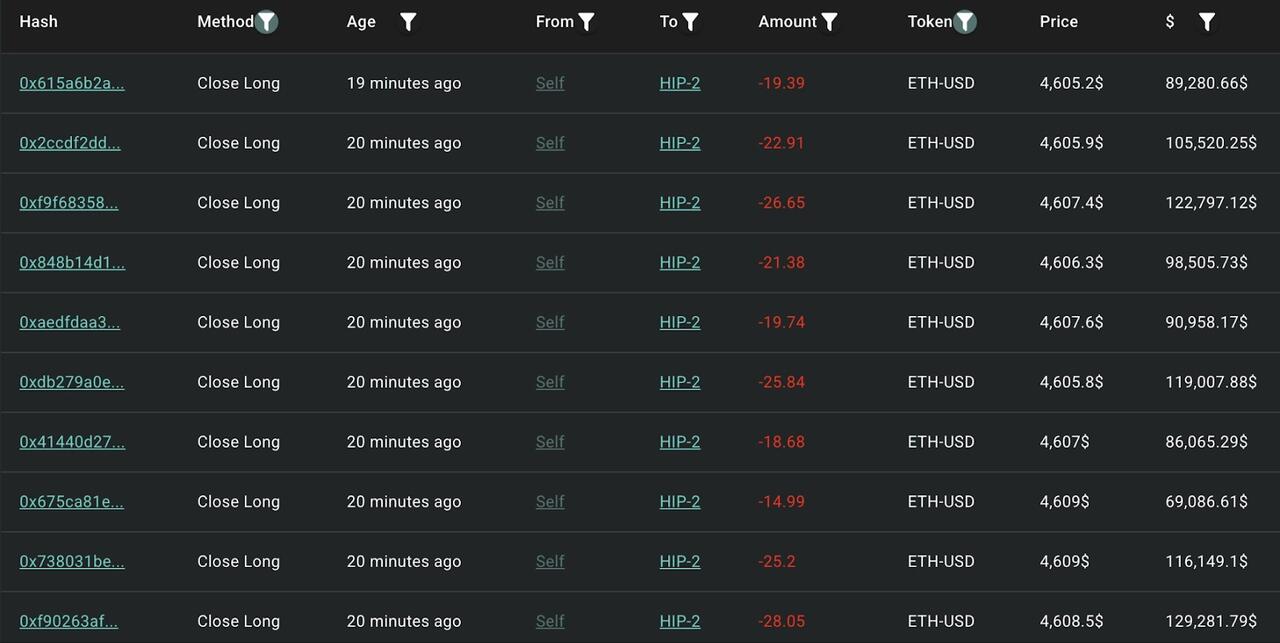
Core Insights - The divergence in performance between Bitcoin and Ethereum is attributed to large holders reallocating their investments from Bitcoin to Ethereum [1][3] - A significant Bitcoin whale, with a wallet valued over $11 billion, sold 22,769 Bitcoins worth $2.59 billion and converted the funds into 472,920 Ethereum [1] - Over the past month, Ethereum's price increased by nearly 25%, while Bitcoin's price decreased by 5.3% [3] Market Dynamics - The whale's actions, including closing a $450 million long position in Ethereum perpetual contracts and locking in a profit of $33 million, indicate a strategic shift towards Ethereum [2][3] - Analysts suggest that the movement of funds by these whales contributed to Bitcoin's recent decline to $112,000 [5] - The CEO of Bitget predicts Bitcoin may lack momentum in the coming weeks, potentially leading to increased investment in Ethereum, with price targets for Ethereum set between $4,600 and $5,200 [7] Trading Trends - There has been a notable increase in demand for Ethereum among large investors, as evidenced by trading volumes where Ethereum ETFs have matched or exceeded Bitcoin's trading volume [7] - The recent dovish comments from the Federal Reserve Chairman have been identified as a key catalyst for boosting risk appetite among cryptocurrency investors [7]
比特币波动趋缓显“蓝筹化”,投机资金转向以太坊
智通财经网· 2025-08-22 13:17
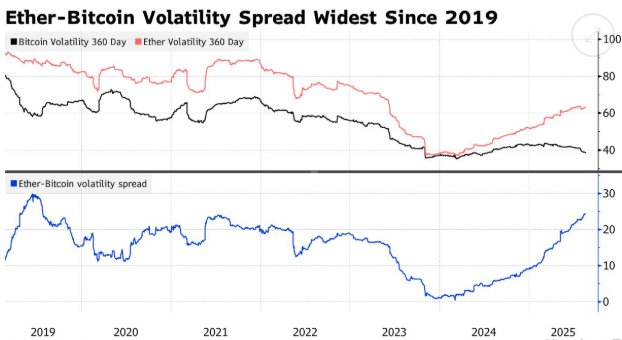
Group 1 - Bitcoin assets are showing signs of maturity, with volatility decreasing from over 200% a decade ago to nearly 38% now, comparable to blue-chip stocks like Starbucks and Goldman Sachs [1] - Institutional investors are increasingly viewing Bitcoin as a long-term hold, while Ethereum is becoming the preferred asset for traders seeking greater volatility [3][6] - As of August, investors have poured $2.5 billion into Ethereum ETFs, while Bitcoin-related products experienced a net outflow of $1.3 billion [6] Group 2 - The current trading activity is primarily focused on Bitcoin and Ethereum, with Ethereum's options holdings reaching $5.5 billion, accounting for 40% of the total on the Deribit platform [3] - Market dynamics indicate that Bitcoin is stabilizing as a mainstream asset, while Ethereum is attracting risk-seeking traders, leading to a potential divergence in the performance of other cryptocurrencies [8] - Analysts suggest that the market is in a transitional phase, with Bitcoin providing stable support and Ethereum remaining in a volatile zone [6][8]
稳定币热度居高不下 基金子公司积极尝鲜
Zhong Guo Zheng Quan Bao· 2025-07-03 20:27
Group 1 - The regulatory framework for stablecoins is becoming clearer, with the Hong Kong Legislative Council passing the Stablecoin Bill, effective from August 1, establishing a licensing system and 1:1 high liquidity asset reserves as core components [2][3] - Cathay Financial International has received approval from the Hong Kong Securities and Futures Commission to upgrade its existing securities trading license to provide virtual asset trading services, allowing direct trading of Bitcoin and stablecoins on its platform [2][3] - The global issuance scale of stablecoins has exceeded $235 billion as of May 2025, indicating significant market growth [2] Group 2 - Several public fund subsidiaries in Hong Kong are actively preparing for the stablecoin ecosystem, participating in sandbox projects led by the Hong Kong government, including stablecoin issuance, payment, asset integration, and fund subscription and redemption [3][4] - Huaxia Fund (Hong Kong) has been involved in multiple sandbox projects and is collaborating with major financial institutions to test end-to-end processes for tokenized fund transactions and cash management solutions [3][4] - The introduction of stablecoin applications in fund management could lead to a noticeable increase in fund management scale, as stated by Huaxia Fund's digital asset management head [4] Group 3 - In April 2024, six virtual asset spot ETFs were officially listed in the Hong Kong market, with major fund companies like Bosera Fund and Huaxia Fund launching Bitcoin and Ethereum ETFs that allow direct investment in these cryptocurrencies [5][6] - Huaxia Fund (Hong Kong) has been proactive in the digital asset space, launching Asia's first spot crypto asset ETFs and a tokenized currency fund, aiming to expand its tokenized fund product series [6][7] - Fund companies are rapidly building teams to capture talent in the virtual asset sector, with job postings for product managers requiring experience in virtual assets, fintech, and blockchain [7] Group 4 - Huaxia Fund (Hong Kong) has established a digital asset department to manage the lifecycle of virtual asset products and is focused on integrating traditional financial products with virtual assets and stablecoins [7] - The company plans to continue launching more tokenized fund products and explore the use of digital currencies for settlement to enhance transaction efficiency in the digital financial ecosystem in Hong Kong [7]