体育赛事观赏

Search documents
21社论丨大力发展体育赛事,激发消费潜力
21世纪经济报道· 2025-11-21 00:28
Core Insights - The article highlights the significant growth in sports consumption in China, driven by events like the 15th National Games, which has generated 1.84 billion yuan in market development revenue as of November 16 [1] - Sports consumption is becoming a vital part of residents' lives, contributing to economic stability and growth, with retail sales of sports and entertainment products increasing by 22.2% year-on-year in the first half of the year [1][2] - The shift from product consumption to service and experience consumption in sports is creating vast market opportunities, particularly as disposable income rises and health awareness increases among residents [2][3] Group 1: Sports Consumption Trends - Sports consumption is categorized into three types: tangible, participatory, and spectator consumption, with a notable shift towards participatory and spectator experiences as income levels rise [2] - The demand for sports events is expected to stimulate related sectors such as transportation, accommodation, and dining, enhancing overall economic activity [3] Group 2: Development of Sports Events - There is a need to enhance the quality of sports events in China, particularly in popular sports like football and basketball, to attract more audiences and convert potential demand into actual consumption [3] - The existing infrastructure for sports venues is substantial, with 4.842 million sports facilities covering approximately 4.23 billion square meters, indicating a strong foundation for developing sports events [3] - The successful hosting of the 15th National Games is expected to boost confidence and motivation for further development in sports event consumption in China [3]

体育+消费大有空间
Ren Min Ri Bao· 2025-11-20 01:05
Core Insights - The article emphasizes the importance of enhancing "new supply" in the sports industry, promoting the integration of sports with other sectors to create high-quality event IPs and comprehensive consumption scenarios [1][3] - The growth of sports consumption is driven by a resonance between supply and demand, evolving from traditional physical goods to a diverse landscape that includes services and experiences [2][3] Group 1: Sports Consumption Trends - Sports consumption has shifted from focusing primarily on physical goods like apparel and equipment to a more diverse model that includes event viewing, fitness training, and outdoor experiences [2] - In the first half of the year, sales of sports entertainment products in designated units increased by 22.2%, with key events in regions like Fujian and Sichuan generating an average consumption of over 30 million yuan per event [2] - The online consumption in outdoor sports exceeded 300 billion yuan last year, and the consumption in ski resorts during the 2024-2025 winter season is projected to reach 78.613 billion yuan [2] Group 2: Policy and Development Initiatives - The State Council's recent policy aims for the sports industry to exceed 7 trillion yuan by 2030, focusing on cultivating world-class sports enterprises and events [3] - The article advocates for enhancing the quality of supply, enriching consumption scenarios, and deepening the integration of sports with tourism, ecology, and technology [3] - Recommendations include optimizing the consumption environment, promoting the opening of more venues to the public, and encouraging local governments to implement sports consumption vouchers and discounts to stimulate demand [3]
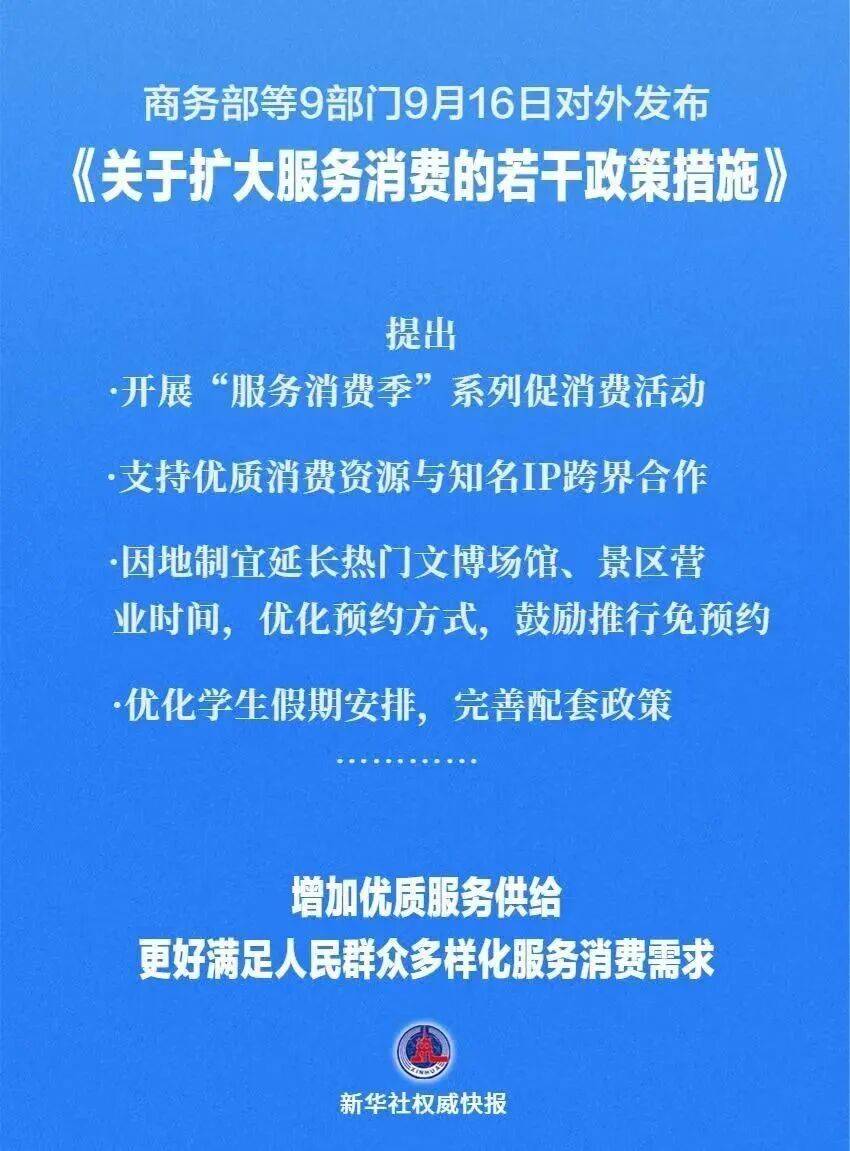
扩大服务消费!商务部等9部门发文
Sou Hu Cai Jing· 2025-09-17 02:16
Core Viewpoint - The Ministry of Commerce and nine other departments released policies on September 16 to expand service consumption through 19 measures across five areas [3] Group 1: Service Consumption Enhancement - Implementation of a quality improvement action for service consumption, continuing to deepen the "Buy in China" brand, and launching a series of promotional activities for "Service Consumption Season" [4] - Development of pilot cities for new business formats, models, and scenarios in consumption [4] - Promotion of the "first release economy" and support for innovative and diverse service consumption scenarios, including collaborations between quality consumption resources and well-known IPs [4] Group 2: Opening Up the Service Sector - Expansion of high-level openness in the service industry, with orderly opening in internet, culture, telecommunications, medical, and educational sectors [4] - Inclusion of more service consumption areas in the "Encouraged Foreign Investment Industry Catalog" to provide differentiated service supply [4] Group 3: Optimizing Consumer Experience - Extension of operating hours for popular cultural and tourist venues, optimization of reservation methods, and encouragement of no-reservation policies [4] - Support for the introduction of high-quality foreign sports events and local mass sports events, aiming to create well-known boutique events and professional leagues [4] Group 4: Educational Policy Adjustments - Optimization of student holiday arrangements while maintaining the total number of holiday days and teaching hours, encouraging local adaptations based on climate and production schedules [5] - Exploration of setting up spring and autumn breaks in primary and secondary schools, with a corresponding reduction in winter and summer vacation durations to increase service consumption time for tourism [5]