健身休闲服务

Search documents
大力发展体育赛事,激发消费潜力
2 1 Shi Ji Jing Ji Bao Dao· 2025-11-20 22:31
Core Insights - The market development revenue for the 15th National Games has reached 1.84 billion yuan as of November 16, indicating a significant economic impact from the event [1] - The "Sports+" model is effectively converting event traffic into tangible consumer spending and economic growth, particularly in the Guangdong-Hong Kong-Macao Greater Bay Area [1] - Sports consumption is becoming a vital part of residents' daily lives in China, contributing to domestic demand and overall consumption, which is crucial for economic stability and growth [1] Consumption Trends - Sports consumption is categorized into three main types: tangible goods, participatory experiences, and spectator events, with a shift from purchasing goods to services and experiences [2] - The retail sales of sports and entertainment products in China increased by 22.2% year-on-year in the first half of the year, highlighting the rapid growth of sports consumption [1][2] - The increasing disposable income and health awareness among residents are driving the growth of sports consumption, with a notable rise in participatory and spectator activities [2] Market Development - There is a need to enhance the quality of sports events in China, particularly in popular sports like football and basketball, to attract more participants and spectators [3] - The country has a solid foundation for developing various sports events, with approximately 4.842 million sports venues covering around 4.23 billion square meters by the end of 2024 [3] - The successful hosting of the 15th National Games has generated interest and participation from sports enthusiasts, fostering new consumption models and boosting confidence in the development of sports event consumption in China [3]
趋势研判!2025年中国体育服务行业产业链、产业规模、行业政策、重点企业及发展路径分析:产业规模将达2.78万亿元,行业升级驱动体育产业高质量发展 [图]
Chan Ye Xin Xi Wang· 2025-07-07 01:31
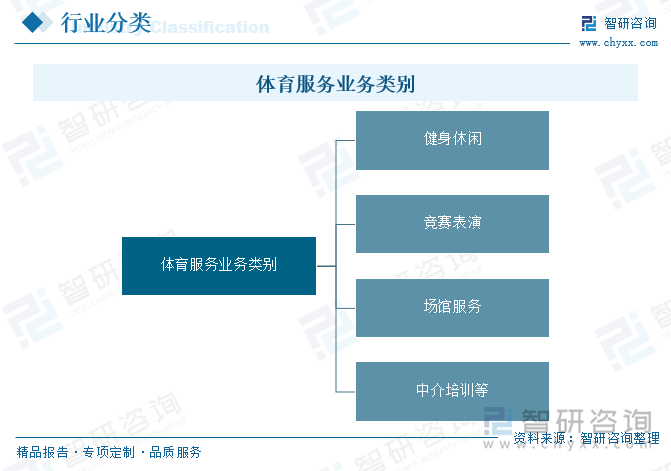
Core Insights - The sports service industry is a crucial part of the sports sector, providing non-material products related to sports through specialized and market-oriented methods [1][3][4] - In 2023, China's sports industry reached a total scale of 3.67 trillion yuan, with the sports service sector accounting for 2.11 trillion yuan, or 57.30% of the total [1][4][7] - The sports service industry is expected to grow significantly, with projections of 2.61 trillion yuan in 2024 (67.02% of the total) and 2.78 trillion yuan in 2025 (68% of the total) [1][7][25] Industry Definition and Business Categories - The sports service industry encompasses a wide range of activities, including fitness and leisure, competition performances, venue services, and intermediary training [3][4] - It aims to meet diverse needs such as health, entertainment, competition, and education [3][4] Current Development Status - The sports service industry has seen rapid growth, with a reported revenue increase of 24.1% year-on-year in the first three quarters of 2024 [7] - The industry is becoming increasingly important within the broader sports sector, reflecting rising consumer spending power [4][7] Industry Chain Structure - The industry chain includes upstream suppliers of sports equipment and venue construction, midstream service providers, and downstream consumers such as event attendees and fitness enthusiasts [9][11] Competitive Landscape - The sports service industry features a diverse competitive landscape with numerous players, including state-owned, private, and foreign enterprises [18] - Key companies include Lisheng Sports, Zhongti Industry, Feifan Lingyue, and Amer Sports, which hold significant market positions [18][20] Development Environment and Policies - National policies promoting sports and fitness have significantly boosted the growth of the sports service industry [15][17] - Recent policies focus on enhancing consumer engagement and supporting high-quality sports events and activities [15][17] Future Development Path - The sports service industry is expected to contribute to high-quality economic development and improved living standards, while also adapting to new market demands and technological advancements [25] - The integration of emerging technologies like AI and virtual reality is anticipated to transform the industry, offering personalized sports products and services [25]