
光伏太阳能

Search documents
外媒惊叹:这方面,中国4年“增出一个美国”!
Xin Lang Cai Jing· 2026-01-31 17:26
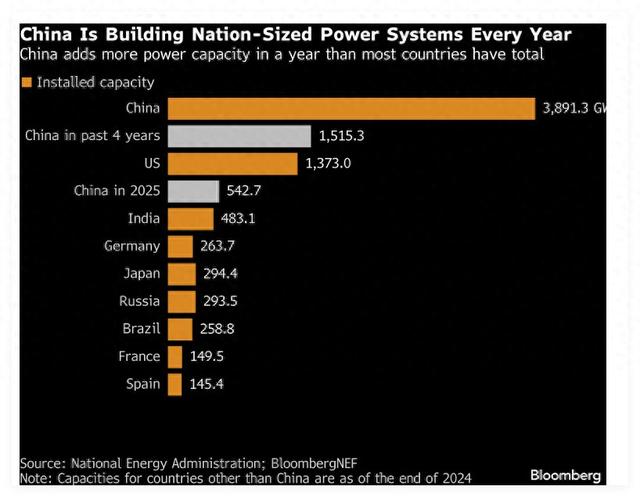
Core Insights - China's electricity consumption is projected to exceed 10 trillion kilowatt-hours by 2025, which is more than double that of the United States and greater than the total consumption of the EU, Russia, India, and Japan combined [1] Group 1: Power Generation Capacity - By the end of 2025, China's total installed power generation capacity is expected to reach 3.89 billion kilowatts, with an annual increase of 543 million kilowatts in 2025 alone [1] - The new installed capacity of 543 million kilowatts in 2025 surpasses India's total installed capacity as of the end of 2024, and also exceeds the cumulative capacities of Germany and Japan during the same period [1] - From 2022 to 2025, China is projected to add a total of 1.515 billion kilowatts of new power generation capacity, which is greater than the total installed capacity of the United States by the end of 2024 [1] Group 2: Renewable Energy Focus - A significant portion of the new installed capacity in recent years has come from renewable energy sources such as solar and wind power, indicating a strong shift towards green energy [1] Group 3: Implications for Technology - The rapid development of China's electricity infrastructure is seen as a critical factor in supporting advancements in artificial intelligence, emphasizing the relationship between computing power and electricity supply [1]
中国全年用电量是美国两倍还多
Xin Lang Cai Jing· 2026-01-28 16:49
Core Insights - China's electricity consumption has surpassed 10 trillion kilowatt-hours annually, more than double that of the United States and greater than the total consumption of the EU, Russia, India, and Japan combined [1] - By the end of 2025, China's cumulative installed power generation capacity is projected to reach 3.89 billion kilowatts, with an additional 543 million kilowatts added in that year alone, exceeding the total installed capacity of India, Germany, and Japan [3][6] - From 2022 to 2025, China is expected to add a total of 1.515 billion kilowatts of installed capacity, surpassing the total installed capacity of the United States by the end of 2024 [6] - China's cumulative installed capacity by 2025 will be nearly three times that of the United States by the end of 2024 [7] Factors Influencing Growth - The significant increase in China's installed capacity is attributed to a reduction in reliance on energy imports, with solar and wind energy making up a substantial portion of new capacity [8] - China aims to establish a solid foundation for the energy-intensive artificial intelligence and robotics industries, positioning itself for future global competition [8] - In contrast, the United States has experienced a slowdown in new installed capacity since reaching peak electricity demand decades ago, leading to a potential bottleneck in meeting the energy needs of rapidly developing technologies like artificial intelligence [8]

市场抢跑,新一轮上涨行情启动?
Sou Hu Cai Jing· 2025-09-17 10:21
Core Viewpoint - The A-share and Hong Kong stock markets experienced a strong rally, driven by the technology growth sector, with significant gains in the ChiNext Index and the Hang Seng Technology Index, indicating a positive market sentiment ahead of anticipated Federal Reserve interest rate cuts [1][2]. Market Performance - A-share market continued its upward trend, with the ChiNext Index breaking through 3100 points, closing up 1.95% at 3147.35 points. The Shanghai Composite Index rose 0.37% to 3876.34 points, while the Shenzhen Component increased by 1.16% to 13215.46 points. The total market turnover reached 2.4 trillion yuan, an increase of 359 billion yuan from the previous trading day [2]. - In the Hong Kong market, the Hang Seng Index rose 1.78% to 26908.39 points, and the Hang Seng Technology Index surged 4.22% to 6334.24 points, with significant inflows from southbound funds totaling 9.441 billion HKD [2]. Industry Highlights and Driving Logic - The A-share market saw a dual drive from high-end manufacturing and technology sectors, with the new energy industry chain experiencing a broad rally. The power equipment sector led with a 2.55% increase, while the automotive sector rose 2.05%, supported by better-than-expected new energy vehicle export data [3]. - In the Hong Kong market, technology and education sectors saw significant gains, with the Sapphire Index soaring 7.45% and the online education index rising 6.66%, driven by improved policy expectations [3]. Underperforming Sectors and Driving Logic - In the A-share market, consumer and cyclical sectors showed weak performance, with the agriculture, forestry, animal husbandry, and fishery sector declining by 1.02% due to falling pork prices. The retail and social services sectors also faced declines of 0.98% and 0.86%, respectively, due to weak consumption data [4]. - In the Hong Kong market, the precious metals and healthcare sectors faced significant declines, with the precious metals index dropping 2.20% amid concerns over overbought conditions in gold [4]. Investment Strategy Recommendations - The market exhibited a structural characteristic of "growth dominance, value consolidation," with a focus on technology and high-end manufacturing in the medium to long term. The A-share market is advised to focus on "new energy + hard technology" dual lines, particularly in the lithium battery and semiconductor sectors [5][6]. - For the Hong Kong market, a strategy focusing on "technology leaders + policy beneficiaries" is recommended, particularly in AI chips and cloud computing sectors, which still have upward potential [5][6].
光伏太阳能概念股走强 大全新能源(DQ.US)涨超7%
Zhi Tong Cai Jing· 2025-08-15 16:15
Group 1 - The solar energy sector in the US saw significant stock gains, with companies like Sunrun, Daqo New Energy, and Canadian Solar rising over 7% [1] - The upcoming tax guidance from the US Treasury poses a threat to the financial viability of numerous clean energy projects across the country [1] - The core controversy revolves around changes in the eligibility criteria for clean energy tax credits, which may increase the threshold for developers to qualify for tax subsidies [1] Group 2 - The new regulations, if implemented, could lead to many projects that rely on tax credits for profitability losing their eligibility, potentially resulting in project cancellations [1] - The Trump administration's recent executive order mandates the Treasury Department to significantly raise the qualification standards for tax credits [1] - Developers may be required to provide more evidence of construction progress to meet the new criteria [1]
