
光储直柔技术

Search documents
锚定“双碳”目标 专家详解差异化推进逻辑
Xin Lang Cai Jing· 2025-12-31 15:54
Core Viewpoint - The article emphasizes the importance of differentiated strategies for achieving China's dual carbon goals, highlighting the need for tailored approaches based on regional and industry-specific characteristics [1][3]. Group 1: Regional Strategies - The eastern regions should lead in technological innovation and green service industries, while resource-rich areas like Northwest China should focus on local renewable energy consumption and zero-carbon manufacturing [2]. - Urban areas need to concentrate on energy system transformation and synergistic effects among transportation, buildings, and networks, whereas rural areas are emerging as new focal points for the dual carbon strategy [2]. - Shanxi Province is implementing a comprehensive approach from rural to urban areas, with pilot projects for near-zero carbon emission communities, involving an investment of nearly 300 million yuan across multiple initiatives [2]. Group 2: Industry Strategies - Traditional high-energy-consuming industries require differentiated management and the use of transition financial tools to support orderly transformation [3]. - Emerging industries should be encouraged to integrate deeply into the green low-carbon industrial chain and enhance carbon technology innovation while engaging with carbon markets for dual incentives [3]. - The carbon trading market is expanding from the power sector to include high-energy industries like steel and cement, with a shift towards integrated systems for renewable energy development [3]. Group 3: Overall Coordination - Achieving the dual carbon goals necessitates respecting regional and industry differences while enhancing overall coordination to avoid fragmented progress [3]. - The core reasons for regional differences include development stages, resource endowments, and strategic positioning, while industry differences stem from emission baselines, technology maturity, and transition costs [3]. - The future of China's dual carbon efforts will focus on precise measures to enhance transformation effectiveness, with tighter regional collaboration expected under the guidance of the 14th and 15th Five-Year Plans [3].
上半年绿证交易翻倍;新型储能装机全球占比超40%
2 1 Shi Ji Jing Ji Bao Dao· 2025-08-04 13:34
Carbon Neutrality Policy - In the first half of the year, the issuance of green certificates in China reached 1.371 billion, with 0.958 billion being tradable, marking a year-on-year increase of 149% [4] - The trading volume of green certificates doubled, totaling 348 million, with a year-on-year growth of 118% [4] - The average price of green certificates increased significantly, reaching 6.5 yuan per certificate in June, a 440% rise from the lowest price earlier in the year [4] New Energy Storage Development - By the end of 2024, China's new energy storage capacity reached 73.76 million kilowatts, accounting for over 40% of the global total [6] - The new energy storage technology landscape is diverse, supporting the construction of a new power system [6] - The report on new energy storage development aims to guide industry growth and support the dual carbon strategy [6] Environmental Regulation - The new regulations aim to balance effective enforcement with reduced interference for businesses, promoting a more efficient inspection process [7] - The core of the new notification is to streamline administrative checks and reduce redundancy, thereby alleviating the burden on enterprises [7] Local Initiatives - Beijing's Chaoyang District is developing "one microgram" green blocks, utilizing "light-storage-direct-flexible" technology to enhance energy efficiency by 5%-10% [8] - The project includes the installation of over 100 lightweight flexible solar panels, achieving 100% self-consumption of solar energy [8] Corporate Practices - The Beijing Green Exchange reported a cumulative transaction volume of 2.398985 million tons of greenhouse gas voluntary reduction, with a total transaction value of approximately 202.55 million yuan [9] - The exchange plans to expand its services to include green bonds and other green financial tools to support the voluntary carbon market [9] - The launch of China's first 180°C high-temperature heat pump laboratory by Nuotong Technology fills a gap in the ultra-high temperature heat pump system research [9]

从“油烟之痛”到City Walk宝藏路线,北京朝阳街区焕绿
2 1 Shi Ji Jing Ji Bao Dao· 2025-07-30 14:28
Core Viewpoint - The article highlights the transformation of Chaoyang District in Beijing through the "One Microgram" initiative, focusing on air pollution control and the development of eco-friendly urban spaces, which has led to increased foot traffic and enhanced local economies [1][2][4]. Group 1: Environmental Initiatives - Chaoyang District has introduced the "Street and Township Air Pollution Prevention Standardization Work Plan" to address air pollution across nine major areas, marking the beginning of a standardized approach to environmental governance [2]. - The "One Microgram Demonstration Street" initiative will launch in 2024, expanding the focus from air pollution to comprehensive ecological environment management [2]. - The district's ecological governance includes the development of an "Ecological Brain" platform for real-time monitoring of restaurant emissions, significantly improving air quality management [3]. Group 2: Economic Impact - The implementation of environmental measures has led to a 23% increase in visitor stay duration at the Blue Harbor area, indicating a positive correlation between environmental improvements and economic activity [3]. - The district has initiated financial subsidies for pollution reduction projects, encouraging businesses to engage in eco-friendly practices, thus fostering a "beautiful economy" [4]. - The integration of low-carbon technologies in commercial areas, such as the use of flexible photovoltaic panels in the Sanlitun Taikoo Li, enhances energy efficiency and reduces operational costs for businesses [3][4].
创新让旧房“一键换新颜”——“焕新城市·科技筑家”系列报道
Ke Ji Ri Bao· 2025-05-17 08:15
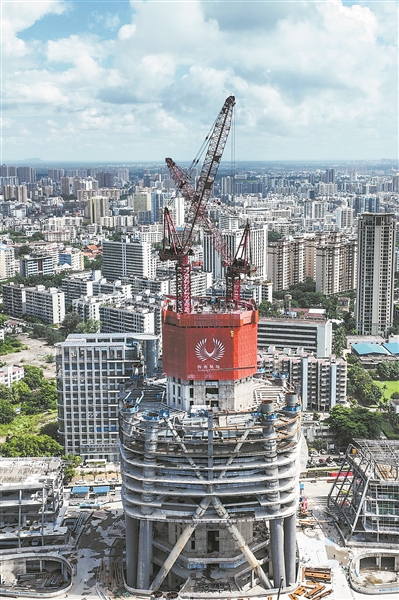
Group 1 - The article discusses the transformation of urban areas through innovative construction technologies such as prefabricated building technology, light-storage direct-flex technology, and aerial construction factories, which significantly enhance construction efficiency and sustainability [3][4][6] - Prefabricated building technology allows for factory pre-fabrication and on-site assembly, drastically reducing construction time and improving quality by minimizing common issues like wall cracks and leaks [4][5] - Light-storage direct-flex technology integrates photovoltaic systems and energy storage, leading to a 10% reduction in carbon emissions for renovated buildings, while also providing economic benefits to households through reduced electricity costs [6] Group 2 - The aerial construction factory, a new intelligent construction equipment platform, integrates materials, equipment, and personnel, allowing for a significant reduction in construction time by 1 to 2 days per floor [7][8] - This technology enhances safety by minimizing high-altitude work and reducing dust and noise pollution, thus creating a safer environment for both workers and residents [8] - The application of aerial construction factories in urban renewal projects is still in the exploratory phase, with plans for broader implementation in the future [8]

山西武宿零碳机场成为国家示范项目
Zhong Guo Fa Zhan Wang· 2025-05-15 06:45
Core Viewpoint - The Taiyuan Wusu Zero Carbon Airport project has been recognized as a green low-carbon advanced technology demonstration project by the National Development and Reform Commission, aiming to significantly reduce carbon emissions and promote sustainable development in Shanxi Province [1][2]. Group 1: Project Overview - The project is expected to generate approximately 100 million kilowatt-hours of renewable energy annually, equivalent to a reduction of about 120,000 tons of carbon emissions each year [1]. - It incorporates advanced technologies such as photovoltaic energy storage, multi-energy complementary utilization, and intelligent carbon management, featuring a 109 MW photovoltaic system, 200 vehicle-grid interactive charging piles, and a 17 MWh energy storage station [1][2]. Group 2: Economic and Environmental Impact - The project will reduce reliance on traditional energy sources, optimizing Shanxi's energy structure and providing valuable experience for green transformation in other sectors [2]. - The annual reduction of 120,000 tons of carbon emissions will significantly improve local air quality and contribute to climate change mitigation efforts [2]. Group 3: Operational Innovations - The use of advanced technologies will enhance the airport's energy self-sufficiency, ensuring stable power supply during daily operations and unexpected energy demands [3]. - The construction of 200 vehicle-grid interactive charging piles aligns with the global trend of electric vehicle adoption, improving the airport's modern facilities and service capabilities [3]. Group 4: Investment Opportunities - The project presents a promising investment opportunity for social capital, supported by national and local policies that facilitate participation in project construction [3]. - With central budget support and various funding channels, social capital can benefit from policy incentives while contributing to the growth of the green industry [3]. Group 5: National Significance - The Wusu Zero Carbon Airport will serve as a model for other airports across the country, promoting green low-carbon development in the civil aviation sector and creating a demonstration effect nationwide [4].