全模态通用AI助手灵光

Search documents
豆包搅动风云,科技巨头打响AI入口争夺战?
Ge Long Hui· 2025-12-02 06:20
Core Insights - The AI market has been vibrant throughout 2025, with significant developments in AI smartphones, particularly the collaboration between Doubao and ZTE [1][5] - The launch of the Doubao AI smartphone has generated excitement in the financial markets, leading to a surge in related stocks [1][2] Group 1: Market Dynamics - The AI smartphone sector is witnessing intense competition, with major players like Apple, Google, and Samsung actively engaging in the market [9][10] - The collaboration between Doubao and ZTE marks a new phase of ecological synergy between consumer electronics manufacturers and internet giants [9][10] - Market research indicates that by September 2025, the number of active users of AI applications on mobile devices in China has surpassed 729 million, with a projected global AI smartphone penetration rate exceeding 35% by 2026 [9] Group 2: Product Launch and Features - The Doubao AI smartphone, featuring the Doubao assistant, has a starting price of 3,499 yuan and a limited initial stock of 30,000 units, which has already sold out [5] - The smartphone will receive updates approximately every two weeks until the end of Q1 2026, enhancing its functionality [5] - The Doubao assistant allows users to perform complex tasks such as cross-application service calls and price comparisons through voice commands [5] Group 3: Competitive Landscape - The competition in the AI sector is shifting from merely comparing model capabilities to a focus on ecological entry points [10][11] - Major tech companies are now prioritizing the development of user-friendly AI interfaces, as the performance gap among top models narrows [11][12] - Morgan Stanley suggests that existing smartphone manufacturers may prefer to develop their own AI solutions, which could complicate the integration of AI into their operating systems [12][13] Group 4: Future Outlook - Analysts believe that the collaboration between Doubao and ZTE may follow a path of outsourcing cloud AI solutions, which could impact user experience and long-term competitiveness [13][14] - Among Chinese smartphone manufacturers, Huawei and Xiaomi are seen as having the potential to succeed by developing their own comprehensive AI solutions [14]


11月25日每日研选 | 算力之后,AI的价值洼地轮到谁了?
Sou Hu Cai Jing· 2025-11-25 00:33
Core Insights - The AI industry is at a turning point, transitioning from "tool innovation" to "ecosystem integration," with major companies like Google and Alibaba making significant breakthroughs in models and applications, leading to a commercialization boom in AI applications [1][2] Group 1: AI Industry Trends - Since 2025, the AI industry chain has experienced a rotation from "overseas computing power to domestic computing power to storage and electricity," with downstream AI applications showing limited growth compared to other sectors, indicating a high cost-performance ratio for investment [1] - Major tech giants are accelerating the construction of consumer-facing AI application ecosystems, aiming to create a super entry point for AI that connects various aspects of life, work, and shopping [1][2] Group 2: Major Company Developments - Google and Alibaba have made further advancements in models and agents, with Google launching the Gemini 3 Pro model and the Nano Banana Pro image generation model, while Alibaba introduced the "Qianwen" app and Ant Group launched a multimodal AI assistant [2][3] - The capital market for Chinese hard tech is reaching a critical point, with companies like Moore Threads and Yushu Technology advancing their IPO processes, marking a significant step towards industrialization in AI computing power and robotics [3] Group 3: Investment Opportunities - Domestic software companies are showing signs of recovery, with institutions holding low expectations, suggesting that as large models iterate, AI application development will accelerate, highlighting companies like Kingsoft Office, Hehe Information, Nengke Technology, and others as key investment targets [4] - The AI application ecosystem is evolving, shifting the growth focus from technical competition to "entry point capture" and "scene deepening," with potential beneficiaries including Kuaishou, Tencent, NetEase, and others [4][5] - The gaming industry is poised for long-term growth with the emergence of native AI games, with companies like Kying Network, Giant Network, and Perfect World recommended for investment [4][6] - The collaborative evolution of computing power, models, and applications suggests investment in the computer sector, with recommended companies including Rilian Technology, Kingsoft Office, and Hikvision [4][6]
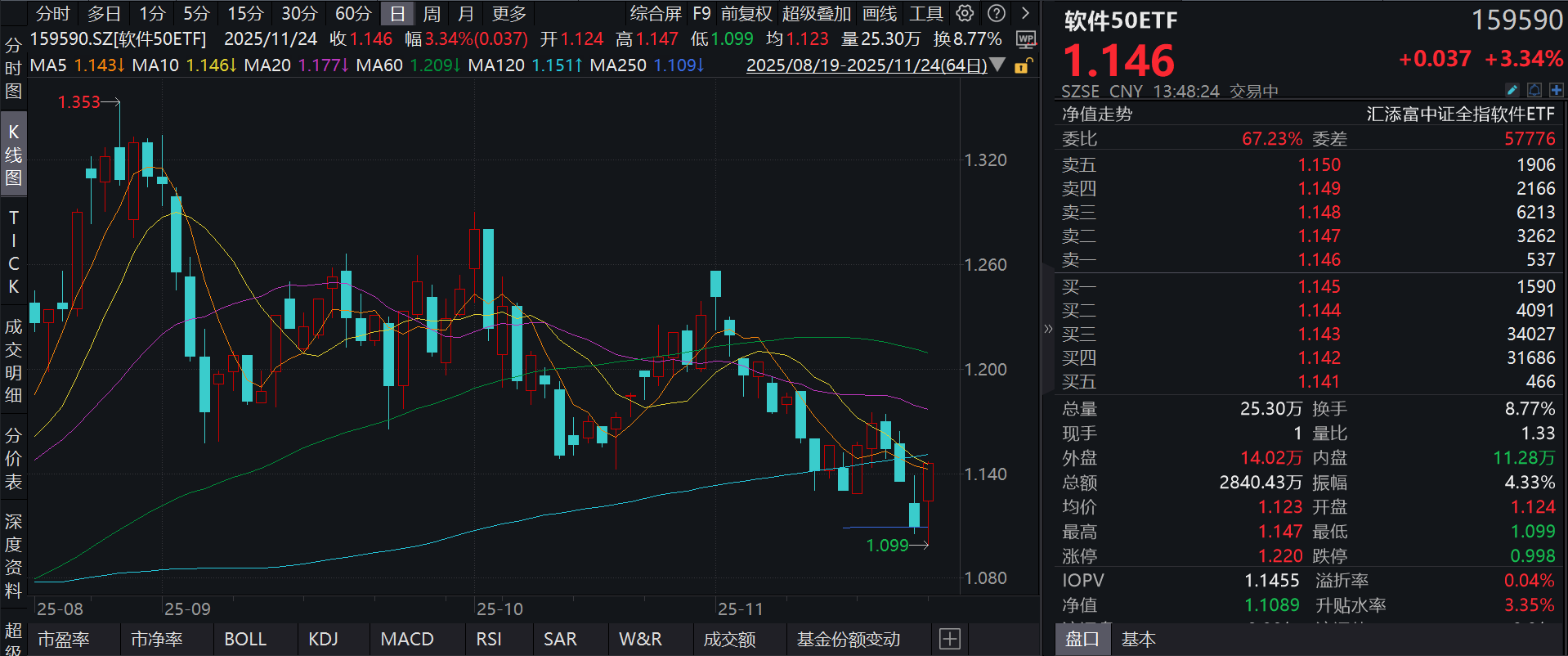
AIGC强势爆发!软件50ETF(159590)放量涨超3%,盘中资金涌入,近10日“吸金”超2600万!三六零涨停,金山办公涨超4%
Xin Lang Cai Jing· 2025-11-24 06:00
Core Viewpoint - The software sector is experiencing significant growth, driven by strong performance in the software 50 ETF and the rapid adoption of AI applications in China, indicating a bullish outlook for the industry [1][3][4]. Group 1: Software Sector Performance - The CSI Software Index (H30202) rose by 3.17%, with notable gains from stocks like Shiji Information (10.00%) and 360 (9.99%) [1]. - The Software 50 ETF (159590) increased by 3.34%, reaching a latest price of 1.15 yuan, and has seen a cumulative increase of 11.79% over the past six months [1]. - The latest share count for the Software 50 ETF reached 288 million, marking a one-year high, with a net inflow of 4.47 million yuan recently [3]. Group 2: AI Application Growth - Ant Group's AI assistant Lingguang achieved over 2 million downloads within six days, setting a record for rapid growth in the AI product sector [3]. - Alibaba's AI assistant Qianwen surpassed 10 million downloads in just one week, making it the fastest-growing AI application historically [3]. - These developments highlight China's competitive edge in the global AI market, with significant implications for the software industry [3]. Group 3: External Market Influences - Recent market corrections are attributed to declining expectations for U.S. Federal Reserve interest rate cuts and rising concerns over an AI bubble, yet domestic tech policies support a "slow bull" market for Chinese assets [4]. - Major U.S. tech companies have issued nearly $90 billion in bonds to fund AI infrastructure projects, indicating strong capital investment in AI [4]. - Cloud service providers like Amazon, Microsoft, and Google are significantly increasing capital expenditures on AI-related infrastructure, with Amazon's quarterly spending reaching $35.1 billion, a 55% year-over-year increase [4].