
养老辅助机器人

Search documents
跻身全球城市第五,“五个中心”如何再上新台阶
Guo Ji Jin Rong Bao· 2026-01-28 06:51
Core Insights - Shanghai achieved an economic total of 5.67 trillion yuan, ranking fifth among global cities, and is focused on building five key centers: international economy, finance, trade, shipping, and technology innovation [1] - The construction of these centers is not isolated but interlinked, enhancing Shanghai's global influence and resource allocation capabilities [5][6] Economic Performance - By 2025, Shanghai's major financial market transaction volume is expected to exceed 400 trillion yuan, with the total number of financial institutions reaching 1,813 [1] - Shanghai's port trade volume is projected to surpass 11 trillion yuan, maintaining its position as the leading global city in this regard [1] - The annual container throughput at Shanghai Port is anticipated to reach 55.06 million standard containers, continuing its streak as the world's busiest port for 16 consecutive years [1] Functional Enhancements - During the 14th Five-Year Plan, Shanghai's five centers transitioned from basic establishment to comprehensive functional upgrades, focusing on global resource allocation, technological innovation, high-end industry leadership, and open hub functions [4] - The International Trade Center Index indicates that Shanghai's port trade scale is expected to fluctuate between 3.1% and 3.6% of the global total from 2020 to 2025, solidifying its status as a leading trade port city [4] Competitive Landscape - Shanghai ranks third globally in service trade, trailing behind Singapore and London, with significant room for growth as its service trade volume is approximately 200 billion dollars compared to Singapore's 900 billion and London's over 400 billion [7][8] - The city's shipping center is positioned to enhance national maritime economic capabilities and global resource allocation [5] Innovation and Future Directions - The construction of the five centers is seen as a historical process of institutional innovation, with a focus on transforming policy advantages into competitive advantages [9] - Shanghai aims to strengthen its core functions and overall effects during the 15th Five-Year Plan, emphasizing the importance of technological breakthroughs in enhancing competitiveness [9][10] - The city is encouraged to develop into a global supply chain management center, integrating business, logistics, capital, and information flows [8] Talent and Environment - Shanghai's innovation and entrepreneurship environment has matured, facilitating access to funding and partnerships for startups [11] - The city is working towards becoming a "global livable innovation city" to attract and retain global talent, enhancing its soft power [8][11]

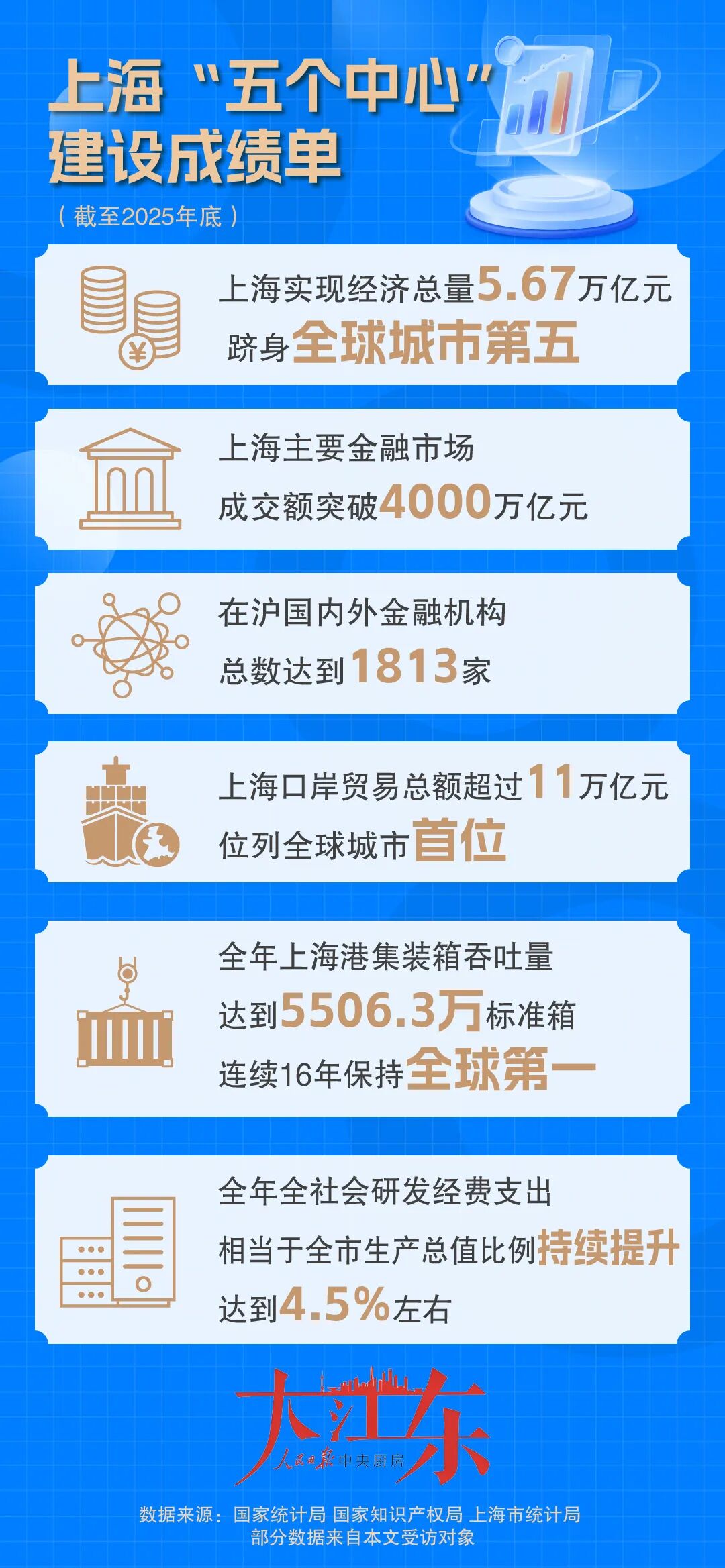
跻身全球城市第五,“五个中心”如何再上新台阶|大江东:开局看上海③
Guo Ji Jin Rong Bao· 2026-01-28 03:07
Core Insights - Shanghai achieved an economic total of 5.67 trillion yuan, ranking fifth among global cities, and is focused on building five key centers: international economy, finance, trade, shipping, and technology innovation [1] - The construction of these centers is seen as a strategic pivot for China to participate in global competition, with significant advancements in economic capability and innovation rankings [1][4] Economic Performance - By 2025, Shanghai's major financial market transaction volume is expected to exceed 400 trillion yuan, with the total number of financial institutions reaching 1,813 [1] - Shanghai's port trade volume is projected to surpass 11 trillion yuan, maintaining its position as the leading global city in this regard [1] - The annual container throughput at Shanghai Port is anticipated to reach 55.063 million standard containers, continuing its streak as the world's busiest port for 16 consecutive years [1] Functional Enhancements - During the 14th Five-Year Plan, Shanghai's five centers have transitioned from basic establishment to comprehensive functional upgrades, focusing on global resource allocation, technological innovation, high-end industry leadership, and open hub functions [4] - The Shanghai International Trade Center Index indicates that from 2020 to 2025, the port's trade scale will fluctuate between 3.1% and 3.6% of the global total, solidifying its status as a leading trade port city [4] Interconnected Development - The five centers are interlinked, enhancing each other's capabilities: the technology innovation center supports global influence, the economic center serves as a resource hub, the financial center ensures national financial security, the trade center facilitates dual circulation, and the shipping center strengthens maritime economic capabilities [6] - The domestic shipbuilding industry has seen significant growth, with over 50% of global new ship orders being fulfilled by China, supported by a robust industrial chain and financial backing [7] Competitive Gaps - Shanghai ranks third globally in service trade, trailing behind Singapore and London, with a significant gap in trade volume, indicating substantial room for growth in the 15th Five-Year Plan [9] - The city faces challenges in internationalization, including a low proportion of foreign financial talent and the need for improved cross-border financial services [11] Future Directions - The 15th Five-Year Plan aims to enhance the four major functions of the five centers, creating overall, platform, amplification, and radiation effects to better support national development [12] - Institutional innovation is crucial for Shanghai's development, transitioning from policy incentives to rule-based advantages to enhance competitive strength [14] - The focus on building a modern industrial system is essential, with an emphasis on foundational research, technology application, and financial services as key drivers [14] Innovation and Entrepreneurship - Shanghai's innovation ecosystem has matured, facilitating easy access to funding and partnerships for startups, which accelerates product development and market entry [15] - The city aims to enhance its role as an international urban hub by supporting enterprises in global markets, as highlighted by successful case studies in various industries [15]

业内专家:“银发科技”创新突破正重塑银发经济供给结构
Xin Hua Cai Jing· 2025-12-12 15:17
Core Viewpoint - The development of emerging technologies is expected to create new growth points for the silver economy, with a shift from passive care to proactive health management being a key transformation [1]. Group 1: Industry Trends - The supply structure of the silver economy is transitioning from reliance on human labor to intelligent applications [1]. - Key trends in the industry include integrated development reshaping the industrial ecosystem, precision services becoming core competitiveness, inclusive penetration expanding industry scale, and clustered development creating industrial hubs [1]. Group 2: Initiatives in Shanghai - Shanghai Xuhui is actively promoting the construction of an "AI + Elderly Care" innovation practice area, focusing on policy development, enterprise connections, and application scenarios [2]. - The first "AI + Elderly Care" experience store, "Xiyi AI Experience Hall," has opened in Xuhui, featuring AI life exploration pods and companion robots, aimed at transforming various elderly care scenarios [1][2]. - Xuhui has incorporated ten key areas into its support for intelligent elderly care development, including high-energy project cultivation, innovation in elderly care integration, and support for benchmark application scenario construction [2].