创金合信产业智选A

Search documents
同一基金经理操盘:两基金“拖后腿”超19% 一基金却大赚24%!
Hua Xia Shi Bao· 2025-12-18 03:12
Core Viewpoint - The performance differentiation of fund managers, particularly Li You from Chuangjin Hexin Fund, has become a focal point in the context of ongoing salary reforms in the fund industry, highlighting the impact of performance on compensation assessments [1][5]. Performance Disparity - The significant performance differences among the funds managed by Li You stem from contrasting portfolio structures, with Chuangjin Hexin Industry Select A underperforming its benchmark by 26.86% and 19.49% for Chuangjin Hexin Industrial Cycle Select A, while Chuangjin Hexin Resource Theme A achieved a 24.75% excess return [1][2]. - The underperformance of Chuangjin Hexin Industry Select A is attributed to its heavy concentration in manufacturing sectors like new energy and semiconductors, which faced valuation adjustments and increased competition from 2022 to 2024 [2]. - The lithium price decline in 2023 pressured the profitability of midstream material companies, and despite gradual reductions in holdings, the adjustment lagged behind market turning points, leading to sustained net value losses [2]. Investor Confidence and Fund Stability - The performance pressure has directly affected the stability of fund sizes, as seen with Chuangjin Hexin Industry Select A, which experienced net outflows despite a significant rebound in net value in Q3 2025 [3]. - The high volatility and valuation elasticity of high-growth sectors demand precise judgment and trading timing from fund managers, with concentrated holdings amplifying potential losses during market downturns [3]. Recent Performance Improvements - Recent data indicates improvements in excess returns for Chuangjin Hexin Industry Select A and Chuangjin Hexin Industrial Cycle, with respective one-year excess returns of 19.02% and 3.35% as of December 15, 2025 [3][5]. Salary Reform and Performance Assessment - The ongoing salary reform in the fund industry emphasizes a longer assessment period of over three years and a comprehensive view of all products managed by fund managers, which may lead to stricter evaluations for those with significant performance disparities [5][6]. - This reform is expected to encourage fund managers to distribute their research efforts more evenly across all products, rather than focusing solely on high-profile funds [5]. Implications for Fund Managers - Fund managers are required to reassess their investment capabilities within a more integrated and long-term evaluation framework, potentially leading to a focus on areas where they can consistently generate alpha [6]. - The core objective of the salary reform is to align individual capabilities, product positioning, and investor interests more accurately through optimized incentive mechanisms [6].
同一基金经理操盘:两基金“拖后腿”超19%,一基金却大赚24%!
Hua Xia Shi Bao· 2025-12-17 13:53
Core Viewpoint - The performance of fund managers and their compensation assessment have become focal points in the context of ongoing reforms in the fund industry, highlighted by the significant performance divergence of fund manager Li You's products [2][5]. Performance Discrepancy - The stark differences in performance among the funds managed by Li You stem from their contrasting portfolio structures, with the underperforming funds heavily invested in manufacturing sectors like new energy and semiconductors, which faced valuation adjustments and competitive pressures from 2022 to 2024 [3]. - The fund "Chuangjin Hexin Industry Smart Selection A" lagged its benchmark by 26.86%, while "Chuangjin Hexin Industrial Cycle Selection A" underperformed by 19.49%, whereas "Chuangjin Hexin Resource Theme A" achieved a 24.75% excess return [2][3]. Impact of Market Conditions - The decline in lithium prices in 2023 pressured the profitability of midstream material companies within the new energy sector, leading to a delayed adjustment in the fund's holdings compared to market trends [3]. - The fund manager acknowledged a mismatch between their foresight regarding the cyclical nature of new energy and the actual timing and extent of the market adjustments [3]. Fund Size and Investor Confidence - The performance pressure has directly affected the stability of fund sizes, as seen with "Chuangjin Hexin Industry Smart Selection A," which experienced net outflows despite a significant rebound in net value in Q3 2025 [4]. - Rebuilding investor trust is a major challenge for fund managers, especially after prolonged periods of underperformance [4]. Resource Stocks vs. Manufacturing Stocks - In contrast, "Chuangjin Hexin Resource Theme A" benefited from strong performance in resource stocks, with top holdings like Xinyi Silver, Zijin Mining, and Luoyang Molybdenum seeing gains exceeding 20% in three months, driven by global inflation expectations and supply-demand gaps [4]. - The allocation decisions made by fund managers significantly influence the degree of performance divergence among funds [4]. Compensation Assessment Reforms - The fund company noted improvements in excess returns for its products over the past year, with "Chuangjin Hexin Industry Smart Selection A" achieving a 30.97% increase compared to its benchmark's 11.95% [5]. - New assessment guidelines emphasize sustainability and a holistic view of fund managers' performance across all products, which may lead to stricter evaluations for those with significant performance disparities [6]. Long-term Focus for Fund Managers - Fund managers are now required to reassess their investment capabilities within a more comprehensive and long-term evaluation framework, which may encourage them to focus on areas where they can consistently generate alpha [7]. - The core objective of the industry’s compensation reform is to align individual capabilities, product positioning, and investor interests more accurately through optimized incentive mechanisms [7].


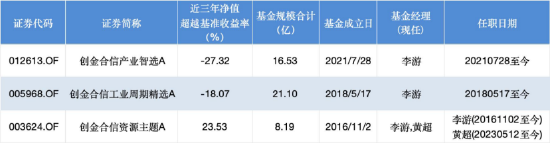
薪酬新规透视 | 聚焦新能源半导体,创金合信基金李游在管2产品跑输基准,创金合信产业智选A跑输超27%
Xin Lang Cai Jing· 2025-12-15 07:10
Core Viewpoint - The fund industry is undergoing significant salary reforms, impacting nearly a thousand fund managers, particularly those with poor performance and those managing larger funds with noticeable performance disparities [1][7]. Group 1: Fund Performance Analysis - Fund manager Li You's three public funds show significant performance differences over the past three years: - Chuangjin Hexin Industry Select A underperformed its benchmark by 27.32% with a fund size of 1.653 billion [1][7]. - Chuangjin Hexin Industrial Cycle Select A underperformed its benchmark by 18.07% with a fund size of 2.110 billion [1][7]. - Chuangjin Hexin Resource Theme A achieved an excess return of 23.53% with a fund size of 819 million [1][7]. - The total management scale of these three funds is 4.582 billion [1][7]. Group 2: New Salary Regulations - According to the latest guidelines from the Asset Management Association of China, fund companies must conduct weighted assessments of fund managers based on fund size and management duration [2][8]. - Li You's case, with significant performance disparities, will serve as an important observation sample under the new salary assessment regulations [2][8]. Group 3: Portfolio Structure and Performance - Li You's managed products exhibit clear thematic distinctions and performance attribution logic [3][9]. - The heavy overlap in top holdings between Chuangjin Hexin Industry Select A and Industrial Cycle Select A focuses on growth sectors like new energy and automotive components, with notable stocks such as Ningde Times and Top Group [5][11]. - In contrast, Chuangjin Hexin Resource Theme A focuses on resource cyclical stocks, with top holdings like Xingye Silver and Zijin Mining showing significant gains, contributing to its excess returns [5][11]. Group 4: Performance Pressure - With the implementation of new salary regulations, Li You faces direct assessment pressure, as funds with returns below the benchmark by more than 10 percentage points and negative profit margins will see performance pay reductions of at least 30% [6][12]. - Both of Li You's manufacturing-themed funds have significantly underperformed their benchmarks, which may directly impact his performance evaluation [6][12].