功率开关与集成电路产品

Search documents
华润微、士兰微、英飞凌等多家半导体厂商涨价!
Xin Lang Cai Jing· 2026-02-14 05:12
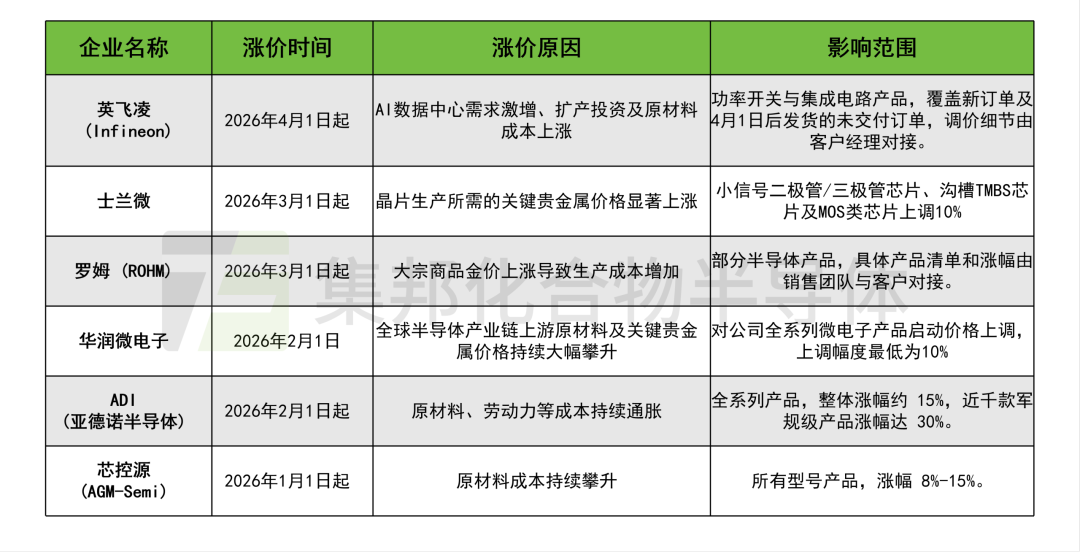
Core Viewpoint - The recent price increase announcements from multiple power semiconductor companies, including Silan Micro, Infineon, and China Resources Microelectronics, have drawn significant industry attention, indicating a broader trend of rising costs and demand in the semiconductor sector [1][14]. Price Increase Details - Infineon will raise prices for power switches and integrated circuit products starting April 1, 2026, due to surging demand from AI data centers, expansion investments, and rising raw material costs [2][19]. - Silan Micro will implement a 10% price increase on small signal diodes, transistors, trench TMBS chips, and MOS chips effective March 1, 2026, driven by significant increases in key precious metal prices [2][17]. - ROHM will also increase prices for certain semiconductor products starting March 1, 2026, due to rising commodity prices [2]. - China Resources Microelectronics will raise prices for its entire range of microelectronic products by at least 10% starting February 1, 2026, citing significant increases in upstream raw material prices [2][20]. - Analog Devices (ADI) will increase prices by approximately 15% across its entire product range, with some military-grade products seeing increases of up to 30% starting February 1, 2026 [2]. - AGM-Semi will raise prices by 8%-15% for all models starting January 1, 2026, due to rising raw material costs [2]. Reasons for Price Increases - The primary driver for the price increases is the sustained pressure on production costs, influenced by rising commodity prices, particularly precious metals, and increased costs in wafer manufacturing and packaging [10][23]. - The tightening of wafer foundry capacity, as leading foundries shift focus away from mature processes, has further exacerbated cost pressures [10][23]. - Demand for power semiconductors is structurally increasing due to rapid growth in sectors such as AI data centers, electric vehicles, energy storage, and industrial control [10][24]. Market Dynamics - The value of power components in AI servers has increased significantly, with the price per server component rising from $6-7 to $30-50, a nearly fivefold increase, which has driven demand for power switches and power management chips [11][24]. - The ongoing development in automotive electronics and energy storage is further amplifying the demand gap for power semiconductors, supporting price increases [10][25]. Impact on Third-Generation Semiconductors - The price increases from major power semiconductor manufacturers may facilitate a shift towards third-generation semiconductors, as the price gap between traditional silicon-based devices and SiC/GaN devices narrows [12][25]. - As traditional power device prices rise, downstream companies may reconsider their cost structures, potentially favoring SiC devices for their efficiency and reduced thermal management needs [12][26]. - In the AI server power market, rising traditional silicon power prices may drive manufacturers to adopt more efficient GaN solutions to lower operational costs [12][26]. Conclusion - The price increase trend among power semiconductor companies is a reflection of supply-demand imbalances, rising costs, and technological advancements, marking a significant phase of structural adjustment in the global power semiconductor industry [13][27]. - This trend not only accelerates the domestic substitution process for silicon-based power semiconductors but also acts as a catalyst for the cost-effective application of third-generation semiconductors, promoting a transition towards high-efficiency, energy-saving, and miniaturized high-end fields [13][27].




晚报 | 2月6日主题前瞻
Xuan Gu Bao· 2026-02-05 14:36
Group 1: Traditional Chinese Medicine Industry - The Ministry of Industry and Information Technology and seven other departments issued the "Implementation Plan for High-Quality Development of the Traditional Chinese Medicine Industry (2026-2030)", aiming to establish a collaborative development system for the entire industry chain by 2030, enhance the stable supply capacity of key Chinese medicinal materials, and improve digital and green levels significantly [1] - The plan includes cultivating 60 high-standard production bases for Chinese medicinal materials and establishing five innovation centers for the traditional Chinese medicine industry [1] - The industry has surpassed 1.2 trillion yuan in scale, but faces challenges such as quality fluctuations, low R&D investment, and international certification barriers [2] - The overall industry is transitioning from traditional experience-driven to scientific and evidence-based practices, with favorable policies expected to enhance modernization and internationalization [2] - The valuation and institutional holdings in the traditional Chinese medicine sector are at historical lows, with improving fundamentals expected to lead to a recovery in the sector [2] Group 2: Semiconductor Industry - Infineon announced a significant increase in demand for power switches and integrated circuit products driven by AI data center deployments, leading to supply shortages [2] - The company plans to raise prices for related products due to rising costs of raw materials and infrastructure, with new pricing effective from April 1 [2] - The demand for power semiconductors and related chips is experiencing a non-linear increase, driven by AI applications, which is expected to benefit the entire sector [3] Group 3: Gas Turbine Industry - The construction boom of data centers in the U.S. has led to a power shortage, with natural gas being viewed as the best solution [4] - As of January 2026, the installed capacity of natural gas power generation under construction in the U.S. exceeds 29 GW, more than doubling in one year [4] - Major manufacturers like GE Vernova are experiencing an 80% increase in gas turbine contracts, but many projects may not commence for years due to a lack of available turbines [4] - GE Vernova has advanced its production capacity target to 20 GW by mid-2026 and plans to invest $10 billion in capital expenditures from 2025 to 2028 to support this expansion [5]