卫星基带芯片

Search documents
深圳华强(000062.SZ):积极拓展光模块、应用于高速光模块的光电芯片等产品的授权分销业务
Ge Long Hui· 2025-12-17 07:12
Group 1 - The company has a stake in Star Semiconductor, which focuses on 5G/6G communication technology, with products like satellite baseband chips applicable in satellite communication and IoT scenarios [1] - As a leading authorized distributor of electronic components in China, the company operates in mainland China, Hong Kong, Macau, Taiwan, and Southeast Asia, with a holding subsidiary in Taiwan [1] - The company supplies various components such as Murata's MLCC and silicon capacitors to customers in the optical module sector, while actively expanding its authorized distribution business for optical chips used in high-speed optical modules, having secured agency rights for products from Sony, Litrinium, and HiSilicon [1]

深圳华强:积极拓展光模块、应用于高速光模块的光电芯片等产品的授权分销业务
Ge Long Hui· 2025-12-17 07:12
Group 1 - The company has a stake in Star Semiconductor, which focuses on 5G/6G communication technology, with products like satellite baseband chips applicable in satellite communication and IoT scenarios [1] - The company is a leading authorized distributor of electronic components in China, covering regions including mainland China, Hong Kong, Macau, Taiwan, and Southeast Asia, with a holding subsidiary in Taiwan [1] - The company supplies various components such as Murata's MLCC and silicon capacitors to clients in the optical module field, while actively expanding its authorized distribution business for optical chips used in high-speed optical modules, having secured agency rights for products from Sony, Litrinium, and HiSilicon [1]
趋势研判!2025年中国卫星基带芯片行业产业链、发展现状、竞争格局及未来趋势分析:卫星基带芯片撬动空天经济新蓝海,开启6G时代万亿级市场机遇[图]
Chan Ye Xin Xi Wang· 2025-05-23 01:10
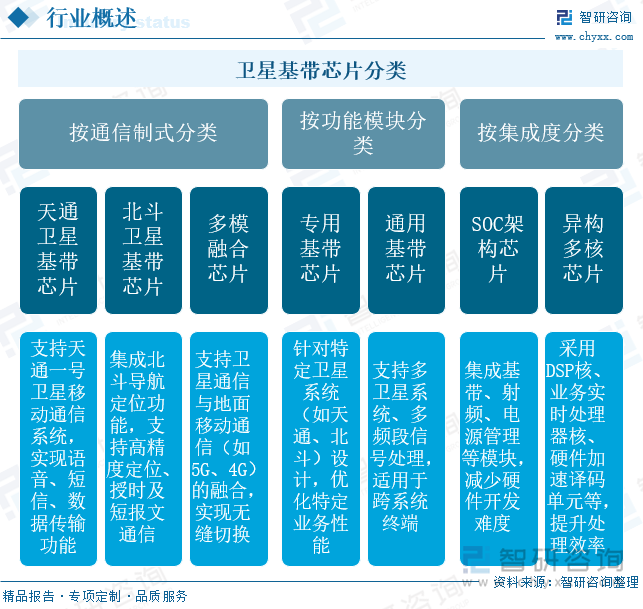
Core Insights - Satellite baseband chips are crucial for integrated air-ground communication, with market growth accelerated by the explosion of low-orbit constellations and the maturation of direct satellite connection technology [1][15] - Chinese companies, represented by Huawei HiSilicon and Unisoc, are making significant technological breakthroughs, laying the foundation for a self-controlled industrial chain [1][15] - By 2028, the Chinese satellite baseband chip market is expected to exceed 28 billion yuan, forming a tripartite structure among the vehicle networking, consumer electronics, and low-altitude economy sectors [1][15] Industry Overview - Satellite baseband chips are the core components of satellite communication systems, responsible for digital signal conversion, modulation, demodulation, protocol control, and data processing [2][4] - The industry has evolved from reliance on imports to achieving significant domestic innovation, with key milestones including the launch of the first fully autonomous "Navigation No. 1" chip in 2008 [6][8] Current Market Analysis - The penetration rate of smartphones supporting satellite communication is projected to rise from less than 10% in 2023 to over 30% by 2025 [1][15] - The demand for vehicle-mounted satellite communication chips is expected to maintain an annual growth rate of over 50% due to the rapid development of smart connected vehicles [1][15] - The market for satellite communication chips in the low-altitude economy is anticipated to surpass 10 billion yuan in the next three years [1][15] Competitive Landscape - The industry exhibits a "pyramid" competition structure, with leading companies like Huawei HiSilicon and Huali Chuantong at the top, followed by firms like Unisoc and Hezhong Star [17][19] - The overall landscape is characterized by military-driven innovation, civilian market expansion, and breakthroughs in technology, with a focus on high-reliability military chips and consumer applications [19] Future Trends - The industry is expected to undergo a transformation driven by technological autonomy, expanding application scenarios, and collaborative development across the supply chain [22][25] - Key advancements include the development of multi-mode compatible chips and quantum-safe encryption technologies, which will help break foreign technology monopolies [24][26] - The satellite baseband chip sector is becoming a core infrastructure of national digital economy strategy, with projections indicating a potential market impact exceeding 3 trillion yuan [27]