厚膜电阻

Search documents
涨!涨!涨!半导体行业掀涨价风暴
Xin Lang Cai Jing· 2026-02-11 10:16
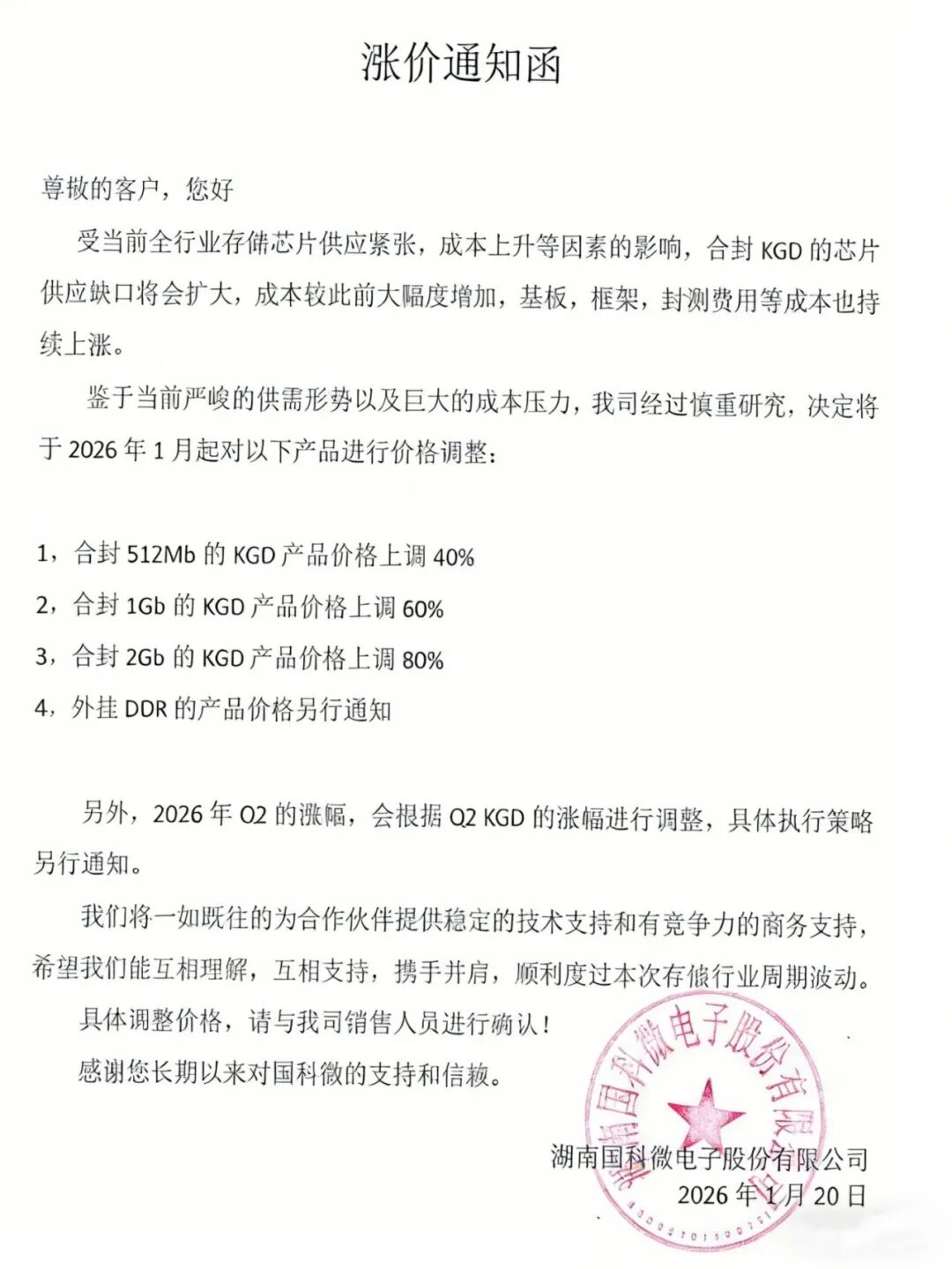
Core Viewpoint - The global semiconductor industry is experiencing a new wave of price increases across the entire supply chain, driven by surging AI demand and rising raw material costs [1][3][61]. Group 1: Price Increases in Domestic Semiconductor Companies - Over 20 semiconductor companies have officially announced price increases [2][62]. - Domestic chip manufacturers are significantly raising prices, with increases as high as 80% for certain products [4][63]. - Guokewai announced price hikes for its KGD storage products, with increases of 40% to 80% [6][66]. - Zhongwei Semiconductor is raising prices for MCU and NOR Flash products by 15% to 50% due to supply chain pressures [9][73]. - Biyiwei has also announced price increases across its entire product line, citing rising raw material costs [17][76]. Group 2: Price Increases in International Semiconductor Companies - International semiconductor giants are also raising prices, with ADI increasing prices by 15% to 30% starting February 1, 2026 [21][81]. - Infineon plans to raise prices for power switches and IC products due to increased demand from AI data centers [24][83]. - Texas Instruments is expected to raise prices by over 30% across nearly all categories due to rising costs [21][81]. Group 3: Price Increases in Wafer Foundry and Packaging - Wafer foundries are increasing prices, with TSMC raising advanced process prices by 3% to 10% [25][85]. - Packaging and testing services are seeing price increases of up to 30%, driven by high demand and capacity constraints [27][86]. Group 4: Impact of Raw Material Costs - The prices of precious metals like gold, silver, and copper are rising, significantly impacting chip manufacturing costs [57][116]. - The increase in raw material costs is leading to a ripple effect across the semiconductor supply chain, prompting many companies to raise their product prices [57][116]. Group 5: Effects on End Markets - The price increases in storage chips are affecting end markets, with PC manufacturers like Dell and Lenovo planning price hikes of 10% to 30% [59][118]. - In the smartphone sector, rising storage costs are pressuring new product pricing, particularly for low-end models [59][118]. - The automotive electronics sector is also feeling the impact, with companies like Xiaomi and NIO reporting cost pressures due to rising semiconductor prices [59][119].



最高上调30%!被动原件大厂二月再涨价,AI服务器带来需求数倍增长
Xuan Gu Bao· 2026-01-05 08:18
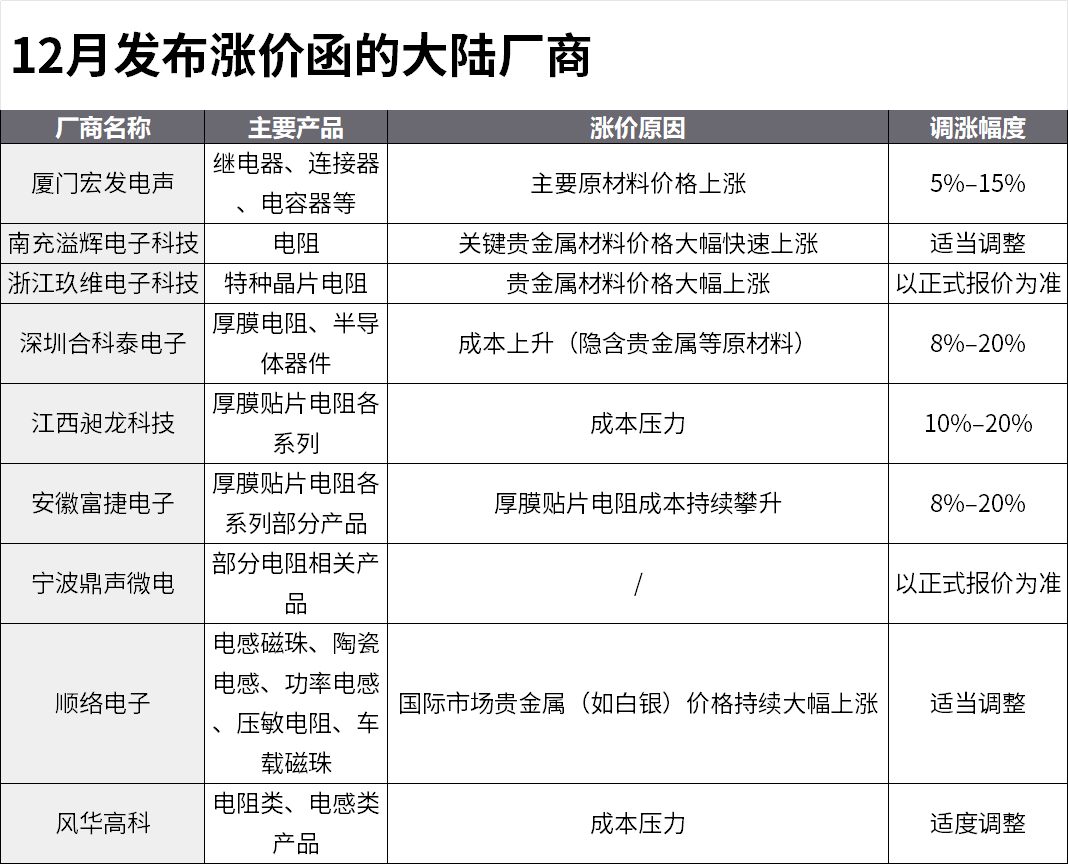
Group 1 - Panasonic has announced a price increase for certain tantalum capacitor models by 15-30%, effective from February 1, 2026, covering 30-40 types of tantalum polymer capacitors [1] - Multiple passive component manufacturers in China have also issued price increase notices, with adjustments ranging from 5% to 20% due to rising raw material costs [1] - The passive component industry is entering a new round of price increases, driven by both raw material cost pressures and surging demand from AI applications [2][3] Group 2 - The primary reasons for the price increases in passive components are the rising costs of raw materials such as silver, tin, copper, and other metals, alongside increased demand driven by AI technology [3] - The price of silver has surged approximately 143% in 2025, contributing to the overall increase in production costs for passive component manufacturers [3] - AI servers require significantly more passive components compared to traditional electronics, with one AI server using an average of 30,000 MLCCs, which is 30 times more than a smartphone [3] Group 3 - Guosen Securities projects that the tantalum capacitor market will reach $21.7 billion by 2026, a 45% increase from 2024, with an anticipated supply-demand gap due to limited production expansion by leading companies [4] - Yageo Corporation announced a price increase for polymer tantalum capacitors starting November 1, 2025, in response to the surge in demand from AI applications [5] - Companies like Winhao Technology and Sunlord Electronics are also adjusting prices for various electronic components due to rising precious metal costs [7]

这类元器件,价格暴涨
半导体芯闻· 2025-12-25 10:20
Core Viewpoint - The article discusses the anticipated price increase in chip resistors driven by rising raw material costs and production cuts from key manufacturers, indicating a potential price surge across the passive components sector [1][2]. Group 1: Price Increase Announcement - Anhui FJ Electronics has announced a price increase of 8-20% for thick film resistors, following the lead of the industry leader, Fenghua Advanced Technology [1]. - The price hike is attributed to significant increases in the prices of key metals such as silver, palladium, ruthenium, nickel, and tin, with silver prices rising over 100% compared to the same period last year [1]. Group 2: Production Cuts and Market Dynamics - FJ Electronics recently announced a production cut of 20-60%, warning of extended delivery times, which is seen as a precursor to the price increase [1]. - Taiwanese passive component manufacturers believe that the production cuts by FJ Electronics and other firms will help stabilize the supply of chip resistors, which is crucial given the increased demand from AI server applications [2]. - The demand for chip resistors in AI servers is estimated to be 1-2 times higher than that of general servers, indicating a tightening supply-demand structure [2]. Group 3: Industry Outlook - The overall passive components market, including tantalum capacitors, multilayer chip inductors, and aluminum foil, is expected to experience a price increase due to the rising costs of raw materials and increased demand from AI infrastructure [1]. - The industry outlook for chip resistors is optimistic, with expectations of a price increase opportunity in the second half of next year as supply constraints improve [2].