
原镁

Search documents
宝武镁业:五台宝镁矿山安全设施设计审批的手续还在办理中,还没有开始采矿
Mei Ri Jing Ji Xin Wen· 2026-02-02 01:29
Group 1 - The core issue raised by investors concerns the cost of raw magnesium for Qingyang Baomai and whether it can achieve a competitive advantage over market prices once it reaches full production [2] - Baowu Magnesium Industry stated that its joint venture, Anhui Baomai Light Alloy Co., Ltd., is currently in the ramp-up phase of production, resulting in low output and high costs. However, costs are expected to decrease as production increases [2] - The annual production project of 40 million tons for Anhui Baomai has received approval, but reaching this sales volume will take some time [2] Group 2 - The mining operations at Wutai Baomai are currently not operational due to ongoing approval processes for safety facility designs, and mining has not yet commenced [2]


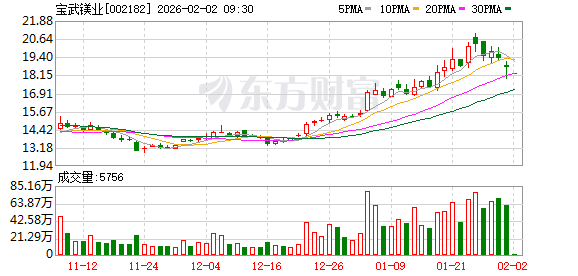
宝武镁业:2025年1月-12月中国共产原镁约为104.21万吨
Zheng Quan Ri Bao Zhi Sheng· 2026-01-28 09:39
Core Viewpoint - The magnesium production in China is projected to reach approximately 1.0421 million tons in 2025, reflecting a year-on-year growth of 1.59% according to the China Nonferrous Metals Industry Association Magnesium Branch [1] Production by Region - Shaanxi region is expected to produce about 685,200 tons, showing a year-on-year increase of 7.57% [1] - Shanxi region's production is estimated at 187,600 tons, indicating a year-on-year decrease of 1.37% [1] - Inner Mongolia region's output is projected to be 37,800 tons, with a year-on-year decline of 1.56% [1] - Xinjiang region is anticipated to produce 58,900 tons, reflecting a year-on-year growth of 11.55% [1] - Other regions combined are expected to contribute approximately 72,700 tons [1]
山西镁产业调研报告
Ge Lin Qi Huo· 2026-01-27 06:54
Report Summary 1. Investment Rating No investment rating information is provided in the report. 2. Core Viewpoints - China is a major producer of primary magnesium, with its production capacity accounting for about 85% of the global total. Shanxi Province holds a significant advantage in the magnesium industry due to its abundant resource reserves, complete industrial chain, and strong technological innovation capabilities [3]. - The magnesium - to - aluminum price ratio has dropped to 0.7 times, highlighting the cost - effectiveness of magnesium. However, the downstream application of magnesium has not yet been fully launched. The demand for magnesium is expected to gradually increase with the growth of the market for lightweight automobiles, two - wheeled electric vehicles, and new energy vehicles [4]. - Shanxi magnesium enterprises face intensified industry competition, especially from the acceleration of central and state - owned enterprises' entry into the market [4]. - Most Shanxi magnesium enterprises have an open attitude towards futures tools and will gradually strengthen their futures - related team building and the application of these tools after the listing of magnesium futures [4]. 3. Summary by Company Company A - **Enterprise Situation**: Privatized in 2001 and reorganized in 2015. It has an annual production capacity of 65,000 tons of primary magnesium, 30,000 tons of magnesium alloy, and 50,000 tons of deep - processed magnesium products, with 10 production lines for deep - processed products. It has its own mine with a reserve of 2 - 3 million tons per year. Its annual revenue from the magnesium industry is less than 1.5 billion yuan, and the annual R & D investment is about 40 million yuan [5]. - **Business Model**: The domestic mainstream magnesium smelting process is the Pidgeon process. Different from the production in Yulin, Shaanxi, which uses coke oven gas, this enterprise has been focusing on deep - processing since 2020 and has a large environmental protection investment. The pricing model varies, with different payment terms for different customers. Overseas sales account for 10% of the total [6]. - **Production Profit**: In 2025, the sales revenue of magnesium alloy was less than 1.5 billion yuan, and that of the deep - processing sector was more than 200 million yuan. The gross profit rate of deep - processed products varies, with military products at 40 - 50%, general products at 15 - 20%, and magnesium alloy products at 20% [7]. - **Future Plan**: Focus on increasing the deep - processing capacity and market development, especially for high - end products such as magnesium alloy automobile wheels. Continuously invest in the green transformation of smelting technology. Be cautious about entering the automotive industry [8]. - **Futures Participation**: Willing to participate in the futures market after the listing of magnesium futures [9]. Company B - **Enterprise Situation**: Mainly engaged in primary magnesium, extrusion, and control processes. It has an annual production capacity of 50,000 tons of primary magnesium (40,000 tons at full capacity), 30,000 - 50,000 tons of magnesium alloy, and 50,000 tons of precision die - castings. It has a complete industrial chain from dolomite mining to deep - processing of magnesium alloy. Its subsidiary new materials company plans to go public in the future [10]. - **Cost and Price**: The break - even point of the comprehensive cost of magnesium ingots in the industry is about 17,500 yuan/ton, and the current magnesium price is around 16,500 yuan/ton. The magnesium - to - aluminum ratio has dropped to 0.7, but the downstream application has not increased [11]. - **Downstream Application and Customers**: The utilization rate of the production capacity for two - wheeled electric vehicles is 50 - 60% due to the new national standard. The development of magnesium alloy in the automotive industry is slow. There is cooperation with Huawei and SAIC, and there is demand in the aerospace and satellite Internet fields [12]. - **Future Plan**: Plan to expand the primary magnesium production capacity by 50,000 tons after obtaining energy consumption and carbon emission indicators. Aim to increase the local magnesium production capacity from 42% to 50 - 60% of the national total and build a magnesium industrial cluster [13]. - **Futures Participation**: Will train professional futures talents to hedge price risks if magnesium futures are listed [14]. Company C - **Enterprise Situation**: Its market share of magnesium alloy ranks among the top three globally. It has a production capacity of 30,000 tons of primary magnesium, 60,000 tons of magnesium alloy (actual output of 40,000 tons), 6,000 tons of magnesium anodes, and 15,000 tons of magnesium powder. It has a large investment in high - pressure magnesium die - casting [15]. - **Cost and Raw Material Procurement**: It has a short - to - medium - term irreversible disadvantage in energy and environmental protection operation costs compared with northern Shaanxi. It locks in part of the silicon - iron procurement volume at the long - term average price and replenishes the insufficient supply of primary magnesium through waste recycling [16]. - **Downstream Application and Customers**: Automobile parts account for 70 - 80% of the demand for magnesium materials. It is also involved in two - wheeled vehicles, stage supports, household items, 3C products, and medical parts. The domestic demand for magnesium alloy is expected to reach 2 - 3 million tons in 3 - 5 years [17]. - **Future Plan**: Interested in accessing the capital market but has no clear listing plan [18]. - **Futures Participation**: Will consider using futures for hedging if the problems of small industry scale and product preservation are solved [19]. Company D - **Enterprise Situation**: Listed in 2020, it covers multiple industries such as smart home, new energy vehicles, industrial equipment, and power components. Its subsidiary has an annual production capacity of 30,000 tons of various parts and an annual sales revenue of 1.2 billion yuan, and it has a 5G + industrial Internet platform [20]. - **Downstream Application and Customers**: Its customers are mainly in the new energy vehicle, industrial robot, and aero - engine fields. Its aluminum alloy products are mainly for military enterprises. The difficulty of obtaining automobile orders has decreased compared to three years ago [21]. - **Future Plan**: Plan to build a global - scale industrial base for smart home, new energy vehicle, and industrial equipment parts, with an investment of 150 million yuan in 2026 and 300 million yuan in 2027. Also, invest more in military products and is involved in the commercial aerospace field [22]. - **Futures Participation**: Has previously contacted the futures market in pig iron smelting but did not participate due to its small scale [23].
宝武镁业(002182) - 2026年1月22日投资者关系活动记录表
2026-01-23 08:06
Production and Export Data - In 2025, China's total magnesium production reached approximately 1.0421 million tons, a year-on-year increase of 1.59% [1] - Production by region: - Shaanxi: 685,200 tons (+7.57%) - Shanxi: 187,600 tons (-1.37%) - Inner Mongolia: 37,800 tons (-1.56%) - Xinjiang: 58,900 tons (+11.55%) - Other regions: 72,700 tons [1] - Total magnesium product exports in 2025 were 447,600 tons, a decrease of 2.65% year-on-year [2] - Magnesium ingots: 251,300 tons (-5.53%) - Magnesium alloys: 99,600 tons (+4.51%) - Magnesium powder: 73,600 tons (-10.79%) [2] Market Trends and Demand - The global aluminum price has been steadily rising, while magnesium alloy prices remain low, enhancing their cost-effectiveness [3] - Since October, magnesium alloy sales have increased by approximately 10%, reaching a historical high, driven by the demand from the electric vehicle sector [3] - The usage of magnesium in electric two-wheelers is expected to continue rising during the 14th Five-Year Plan period [3] Technological Advantages - The company has developed mature process control solutions for semi-solid magnesium alloy processing, particularly for thin-walled components [4] - Unique temperature control module designs and differentiated temperature management in key areas effectively address casting defects [4] Comprehensive Design Solutions - The company provides a full suite of design solutions for lightweight automotive components, adapting materials based on performance requirements: magnesium alloys for internal structures, aluminum for high-strength needs, and steel for load-bearing parts [4] - This approach promotes collaboration across the group to meet the lightweight demands of the automotive industry [4] Compliance and Communication - The company ensured accurate and timely information disclosure during investor communications, adhering to regulatory requirements [5]
未知机构:中邮有色镁供给或受扰动镁铝比加速需求替代事件近日陕西发-20260121
未知机构· 2026-01-21 01:55
Summary of Conference Call Notes Industry Overview - The focus is on the magnesium industry, particularly in Shaanxi Province, China, which is a significant producer of magnesium, accounting for 65.75% of the national output in 2025, primarily concentrated in the Yulin area [1][2]. Key Points and Arguments - **Policy Changes**: The Shaanxi Development and Reform Commission plans to implement differential electricity pricing for seven high-energy-consuming industries, including magnesium production, starting July 1, 2026. This includes an increase of 0.1 CNY/kWh for restricted capacity and 0.3 CNY/kWh for eliminated capacity [1][2]. - **Cost Implications**: Although the policy does not directly target the magnesium industry, the complete industrial chain involving coal, lanthanum carbon, electricity, silicon iron, and magnesium may see cost increases due to the shutdown of silicon iron capacity, which could indirectly affect magnesium output [2]. - **Impact on Magnesium Enterprises**: Several magnesium companies, such as Tianlong Magnesium, Fangzheng Magnesium, and Wanyuan Magnesium, have been listed under restricted capacity due to outdated silicon iron production capabilities [2]. - **Potential for Further Policy Tightening**: The region's reliance on outdated production methods and environmental policies may lead to stricter regulations and differential pricing directly affecting magnesium production in the future [2]. - **Magnesium-Aluminum Ratio**: The magnesium-aluminum ratio has decreased to 0.68, significantly lower than the 2.4 peak in 2021. This trend indicates a growing preference for magnesium over aluminum, particularly in the context of cost advantages amid price wars in the electric vehicle sector and high lithium carbonate prices [3]. Additional Important Content - **Weight Advantage of Magnesium**: Under similar conditions, magnesium alloy castings are approximately 25% lighter than aluminum castings, enhancing the appeal of magnesium in various applications [3]. - **Investment Recommendations**: Companies to watch include Baowu Magnesium and Xingyuan Zhuomai, with noted risks including price volatility and policy changes [4].
宝武镁业(002182) - 2026年1月14日投资者关系活动记录表
2026-01-15 05:44
Group 1: Company Advantages - Resource and complete industrial chain advantages: The company has established an integrated magnesium industry chain from "dolomite mining - primary magnesium smelting - magnesium alloy melting - magnesium alloy processing - magnesium alloy recycling," which reduces production costs and enhances price competitiveness [1][2]. - Layout advantages: The company has three primary magnesium supply bases and four magnesium alloy supply bases, optimizing resource allocation and improving operational efficiency [2]. - Technological innovation advantages: The company focuses on technological innovation and product development, investing in new technologies and key production techniques, enhancing core competitiveness [2]. Group 2: Resource and Production Data - Dolomite resource reserves: The company's subsidiary, Chaohu Baomag, has dolomite reserves of 90 million tons, while another subsidiary, Wutai Baomag, has 580 million tons, and a joint venture holds 1.3 billion tons [3]. - Domestic primary magnesium production: In December 2025, China's primary magnesium production was 124,700 tons, with a month-on-month increase of 25.5% and a year-on-year increase of 30.2% [4]. The total production for 2025 was approximately 1,042,100 tons, a year-on-year increase of 1.59% [4]. Group 3: Magnesium Applications - Magnesium alloy usage: Approximately 49% of magnesium is used to produce magnesium alloys, 26% is added to aluminum alloys, 12% is used for steel desulfurization, 8% as a metal reducing agent, and 5% in other fields [5]. Group 4: Production Technology and Market Trends - Semi-solid injection molding technology advantages: Material utilization rates can reach 70%-85%, and production efficiency is significantly improved, with production cycles compressed by 20%-30% [6]. - Growth in electric drive housing orders: The company has begun mass production of magnesium alloy electric drive housings, with expected growth driven by the acceleration of lightweighting in the new energy vehicle sector [6].
宝武镁业(002182) - 2025年12月31日投资者关系活动记录表
2025-12-31 07:12
Production Overview - In 2025, China's total primary magnesium production reached approximately 917,400 tons, a year-on-year increase of about 5.78% [1] - Production by region: - Shaanxi: 591,200 tons (+13.82%) - Shanxi: 174,100 tons (-6.50%) - Inner Mongolia: 34,200 tons (-1.72%) - Xinjiang: 52,300 tons (+9.41%) - Other regions: 65,700 tons [1] Export Data - From January to November 2025, China exported approximately 408,800 tons of various magnesium products, a decrease of 2.83% year-on-year [2] - Breakdown of exports: - Magnesium ingots: 229,800 tons (-5.12%) - Magnesium alloys: 90,400 tons (+2.73%) - Magnesium powder: 67,700 tons (-11.05%) [2] Application Areas - In 2024, global primary magnesium production was 1,120,000 tons, with the following application proportions: - Magnesium alloys: 49% - Added to aluminum alloys: 26% - Steel desulfurization: 12% - Metal reducing agents: 8% - Other applications: 5% [3] Product Development - The company has successfully developed and mass-produced magnesium alloy electric drive housings in collaboration with Nanjing Precision and Chongqing Boao, anticipating significant growth in this sector due to the acceleration of lightweight electric vehicles [4] Deep Processing Expansion - The company operates six die-casting bases nationwide, equipped with over 200 die-casting units and nearly 1,000 processing centers, capable of surface treatment and mold design [5] - Key areas for magnesium alloy deep processing include: - Automotive components (e.g., steering wheels, seat supports) - Electric bicycle parts - Robotics components (e.g., covers, bases) - Magnesium construction templates (e.g., ceiling and wall panels) - Applications in low-altitude economy [5] Compliance and Communication - The company ensured thorough communication with investors, adhering to information disclosure regulations to maintain transparency and prevent the leakage of undisclosed significant information [6]
东兴证券:供需或进入持续性紧平衡状态 多领域共振推动镁需求增长
智通财经网· 2025-04-21 08:42
Group 1 - The core viewpoint is that the development of automotive lightweighting will significantly increase global magnesium demand, with additional contributions from the robotics industry, magnesium alloy construction templates, magnesium-based hydrogen storage, and low-altitude economy sectors [1] - Global magnesium demand is projected to grow from 1.12 million tons in 2024 to 2.001 million tons in 2027, with a CAGR of 21% during this period [1] - The automotive industry is identified as the main driver of magnesium demand growth, with magnesium alloy production demand reaching 550,000 tons in 2024, accounting for nearly half (49%) of global magnesium demand [1] Group 2 - By 2024, the magnesium consumption in the automotive sector is expected to reach 385,000 tons, representing 70% of magnesium alloy consumption, and the total magnesium usage in the automotive industry could reach 560,000 tons, accounting for 50% of global magnesium demand [1] - The penetration rate of automotive lightweighting is expected to drive magnesium alloy demand from 570,000 tons in 2024 to 1.35 million tons in 2027, with a CAGR of 34% [2] Group 3 - The robotics industry is emerging as a new variable for magnesium alloy demand growth, with industrial robot magnesium alloy demand projected to increase from 3,100 tons in 2024 to 6,700 tons in 2027, reflecting a CAGR of 28% [3] - The demand for magnesium alloys in humanoid robots is expected to grow from 200 tons in 2024 to 8,500 tons by 2030, with a remarkable CAGR of 93% [3] - Overall, the robotics sector's magnesium demand is anticipated to rise from 3,300 tons in 2024 to 8,100 tons in 2027, with a CAGR of 34% [3]
