创新药ETF

Search documents
港股创新药再迎反弹
第一财经· 2026-03-16 13:30
Core Viewpoint - The Hong Kong innovative drug sector is experiencing a rebound, with multiple innovative drug ETFs rising over 3%, indicating renewed market interest after a prolonged adjustment period [3][4]. Market Performance - On March 16, the Hong Kong market saw a collective rise in major indices, with the Hang Seng Index, Hang Seng Tech Index, and Hang Seng China Enterprises Index increasing by 1.45%, 2.69%, and 1.67% respectively [5]. - The Hang Seng Innovative Drug Index led the gains with a 3.18% increase, while 18 cross-border ETFs related to "innovative drugs" and "pharmaceuticals" collectively rose over 2%, averaging a 2.67% increase [5][6]. - Trading activity was robust, with the total trading volume of the mentioned ETFs exceeding 12.5 billion yuan, a 45% increase from the previous trading day [6]. Fund Flows - Since the fourth quarter of last year, approximately 22 billion yuan has flowed into innovative drug ETFs, with 4.93 billion yuan entering in 2023 alone [6][7]. - Notable inflows were seen in the Huatai-PB Hang Seng Innovative Drug ETF and the GF Hang Seng Innovative Drug ETF, which attracted 2.105 billion yuan and 1.578 billion yuan respectively [7]. Sector Analysis - The innovative drug sector has faced a significant adjustment, with the Hang Seng Innovative Drug Index dropping over 21.5% since the fourth quarter of last year [8]. - The recent adjustments are viewed as a normal market correction rather than a deterioration of the industry's fundamentals, with the sector's valuation returning to a reasonable range [8][9]. - The potential for profitable companies to emerge is highlighted, as many firms are expected to reach profitability between 2026 and 2028, which could lead to significant alpha generation [9]. Investment Outlook - The market is anticipated to shift from broad valuation reassessment to a focus on fundamental performance, with only companies demonstrating profitability and core competitiveness likely to thrive [9][10]. - Concerns remain regarding the impact of AI technology on the pharmaceutical industry, prompting some fund managers to adopt a cautious stance [9][10]. External Factors - Southbound capital has been a significant support for the Hong Kong market, with a cumulative net inflow exceeding 180 billion yuan in 2023 [10][11]. - The overall market dynamics are influenced by external liquidity conditions and the U.S. interest rate environment, which could affect the pace of valuation recovery [11][12]. - The rebound in the Hong Kong market is expected to be driven by corporate earnings realization, sustained southbound capital inflows, and marginal improvements in the domestic macroeconomic environment [12].


医药健康行业研究:Q4基金医药持仓情况出炉,关注板块调整后布局机遇
SINOLINK SECURITIES· 2026-01-25 07:50
Investment Rating - The report suggests a positive outlook for the innovative drug sector, indicating it will continue to be a core investment direction in 2026 due to the maturation of the industry chain and normalization of medical insurance negotiations [4]. Core Insights - The public fund's pharmaceutical holdings decreased to 8.11% in Q4 2025, down by 1.66 percentage points (pp) from the previous quarter. Excluding actively managed pharmaceutical funds, the holdings dropped to 3.90%, a decrease of 1.36pp [11][12]. - The innovative drug ETF reached a scale of 100.62 billion yuan in Q4, accounting for 13.11% of the pharmaceutical fund, which is a slight decrease of 1.35pp [13][15]. - The CXO sector saw a decline in holdings due to geopolitical disturbances, while the medical device sector benefited from innovations like brain-computer interfaces and surgical robots, leading to an increase in holdings [14][17]. - The report highlights the acquisition of PART by GSK for $2.2 billion to strengthen its position in the IgE antibody market, with the core product Ozureprubart showing significant market potential [2][31]. - The oral weight loss drug Wegovy has shown strong early commercial progress, with retail prescriptions reaching approximately 3,071 in the first four days post-launch, nearly three times that of its competitor Zepbound [2][31]. Summary by Sections Pharmaceutical Sector - The report indicates a significant decrease in public fund holdings in the pharmaceutical sector, with a noted resilience in the innovative drug segment [11][14]. - The report emphasizes the importance of focusing on leading companies with core pipeline competitiveness and global layout capabilities for investment [4]. Medical Devices - The introduction of new pricing guidelines for auxiliary medical services is expected to accelerate the adoption of innovative products in the medical device sector [3][17]. - The report suggests monitoring domestic leading companies in this sector for increasing product penetration [3]. Drugstores - The report discusses the potential for leading drugstore companies to increase market share, supported by recent government policies promoting high-quality development in the retail pharmaceutical industry [3][17]. - Specific companies like Yifeng Pharmacy and Dazhenglin are highlighted as having low valuations and significant cost reduction achievements [3]. CXO and Pharmaceutical Supply Chain - Several CXO companies have released optimistic earnings forecasts for 2025, indicating a clear upward trend in industry prosperity [2][31]. - The report recommends active investment in this sector due to the positive signals regarding industry growth [2][31].



权益ETF,谁是主题轮动下一棒?
HUAXI Securities· 2026-01-20 07:41
Group 1: Report's Investment Rating - No information about the industry investment rating is provided in the report. Group 2: Core Viewpoints - In early 2026, the market sentiment has significantly warmed up, and the market has risen strongly. However, the risk - return ratio of chasing the rising market may not be high. Thematic investment remains popular, and funds from previously over - heated themes are expected to shift to other thematic sectors [1][7]. - The technology main line is still the market consensus. Funds are likely to flow into sectors such as semiconductor computing power and robotics within the technology sector, while lithium battery, non - ferrous metals, power grid, chemical, and innovative drugs are important supplementary sectors for the market [2][22]. Group 3: Summary by Directory 1. Which theme ETFs are expected to be the direction of capital return? - **Market situation**: In early 2026, the market has risen strongly, with commercial aerospace, AI applications, and non - ferrous metals becoming the focus. But there are signs of the market correcting irrational behaviors under regulatory guidance, and the risk - return ratio of chasing the rising market may be low. Thematic investment is still very popular. As of January 19, 2026, the cumulative net capital inflow of thematic index ETFs in the past five days exceeded 42.254 billion yuan, while industry index ETFs only had a net inflow of 9.763 billion yuan, and broad - based index ETFs showed a large net outflow [1][7]. - **Analysis from the perspective of rise and valuation**: Technological industries generally have high rises, while traditional cyclical industries such as liquor, coal, and breeding have relatively low rises. New energy sectors like lithium battery, photovoltaic, and new - energy vehicles, as well as the chemical industry, have risen but still have room to reach previous highs. From the valuation dimension, the current valuations of the game, intelligent driving, lithium battery, and breeding sectors are low [8]. - **Analysis using the quadrant chart**: - **First quadrant (high rise and high congestion)**: Mainly includes commercial aerospace, communication, AI, and non - ferrous metals. Non - ferrous metals (such as copper) and AI have relatively moderate congestion, and relevant sectors are still worthy of attention [2][17]. - **Second quadrant (high rise and low congestion)**: There are relatively few relevant industries, mainly semiconductor equipment (including related industrial chains such as storage) and lithium battery. The sector sentiment is not over - heated, and the industrial supply - demand pattern is optimized, so they are still worthy of attention [2][17]. - **Third quadrant (low rise and low congestion)**: Sectors such as innovative drugs, chemicals, and games have both industrial logic and market capacity, with large potential for a supplementary rise. For example, since 2026, the chemical ETF has re - entered the state of net inflow [2][17]. - **Fourth quadrant (low rise and high congestion)**: Includes robotics, power grid equipment, consumer electronics, and software. Power grid equipment has received renewed attention due to the unexpected increase in the 14th Five - Year Plan expenditure, and robotics has also been favored by the market because Tesla's third - generation robot has entered the scheme confirmation stage [2][21]. - **Specific ETF selection**: For ETFs tracking the same index, products with larger scale, relatively lower fees, and smaller tracking errors are selected. Specific ETF lists are provided in the report [22].
创新药概念股走强,相关ETF涨超2%
Mei Ri Jing Ji Xin Wen· 2026-01-13 02:33
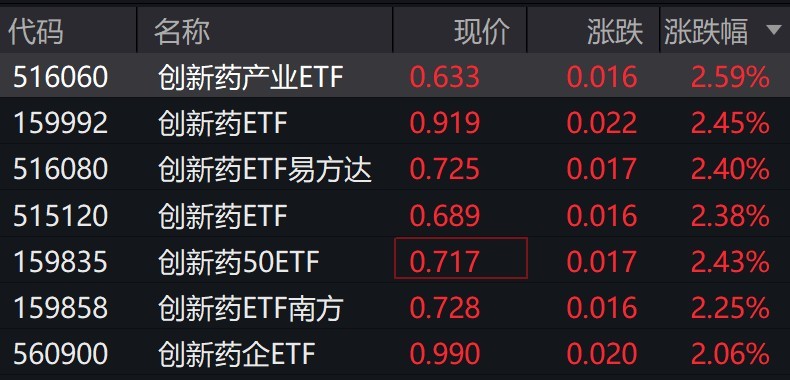
Group 1 - The core viewpoint of the news highlights a strong performance in innovative drug concept stocks, with notable increases in companies such as WuXi AppTec and Kanglong Chemical, which rose over 7%, and others like Xinlitai, which increased over 3% [1] - The innovative drug-related ETFs also saw significant gains, with an overall increase of over 2% [1] Group 2 - Specific ETF performance includes the Innovative Drug Industry ETF rising by 2.59% to 0.633, and other ETFs like the Innovative Drug ETF and the EasyGo Innovative Drug ETF also showing increases of 2.45% and 2.40% respectively [2] - Analysts indicate that core assets in innovative drugs are expected to continue rising, with new opportunities emerging in areas such as small nucleic acids and in vivo CAR technologies [2] - The long-term trend of innovative drug business development (BD) is seen as a pathway for China's innovative drug capabilities to gain recognition on the global stage, with core assets licensed to multinational corporations (MNCs) expected to realize value as clinical progress continues [2]



赛道躺赢成过去式 公募港股投资逻辑生变
Zheng Quan Shi Bao· 2026-01-11 17:00
Group 1 - The core investment logic for public funds in Hong Kong stocks is shifting from chasing market hotspots to deeply exploring internal alpha opportunities within industries as the era of "beta" gains from popular sectors comes to an end [1][2] - The valuation repair of Hong Kong stocks is nearly complete, making it difficult to rely solely on index strategies or betting on hot sectors for sustained success [1][2] - The investment perspective is transitioning from emotion-driven narratives to profit-driven fundamental verification, with a focus on "distilling the truth" becoming key to evaluating research and investment capabilities [1][2] Group 2 - The performance of public funds in Hong Kong stocks is increasingly seen as a test of fund managers' true stock-picking abilities, with the ability to identify companies with sustainable growth and explosive performance becoming crucial [2][4] - The consensus among public funds is that the previous beta-driven market rally is over, and the focus will shift to companies with tangible performance rather than those relying on storytelling [3][4] - Fund managers emphasize the importance of actual performance metrics, such as operating cash flow and successful overseas business development (BD) transactions, as indicators of a company's viability [6][7] Group 3 - The investment strategy is evolving towards a balanced approach, combining growth-oriented investments with high-dividend defensive positions to achieve risk and return balance [8][9] - There is a growing interest in sectors that are currently at the bottom of the cycle, such as consumer stocks, which are seen as having potential for recovery and attractive valuations [8][9] - The focus for 2026 will be on two main areas: AI applications and non-AI growth sectors, as well as the real estate chain, which may present unique investment opportunities [9]
从“贝塔躺赢”到“阿尔法精选”!公募2026年南下新打法曝光
券商中国· 2026-01-11 06:56
Core Viewpoint - The logic of industry-themed funds is changing, moving away from a passive "beta" strategy focused on popular sectors, and towards a more active search for "alpha" opportunities within industries as public funds increasingly focus on performance-driven investments by 2026 [1][2]. Group 1: Market Dynamics - The simple strategy of investing in popular sectors for easy gains has ended, with a shift towards showcasing fund managers' stock-picking abilities in an "alpha" market [2]. - The 2025 annual ranking of Hong Kong QDII funds showed that industry allocation was key to the top-performing funds, indicating a transition to a more competitive investment landscape [2]. - The influx of southbound capital into Hong Kong stocks in 2025 has started to influence pricing in popular sectors, but the market is expected to balance between southbound and foreign capital in 2026 [3]. Group 2: Investment Strategy - Fund managers are now less willing to invest based on "stories" and are demanding tangible performance metrics, indicating a shift towards profitability-driven investments [4]. - The 2026 investment landscape will likely see reduced opportunities for broad-based gains across sectors, with a greater emphasis on individual company performance [4]. - The focus will be on companies that can demonstrate real financial performance rather than those that rely solely on narrative-driven growth [6]. Group 3: Sector-Specific Insights - The importance of overseas business development (BD) deals is highlighted, as they serve as a credibility endorsement for domestic innovative drug companies, impacting their valuation [7]. - In the AI sector, while hardware remains a strong investment, concerns about the application side's profitability are emerging, suggesting a need for careful evaluation of cash flow sources [7]. - The investment strategy for 2026 will emphasize a balanced approach, combining growth-oriented investments with high-dividend stocks to manage risk and return effectively [8]. Group 4: Future Outlook - The market is expected to transition from extreme growth to a more balanced strategy, with a focus on sectors that are currently undervalued and have potential for recovery [8]. - Fund managers are advised to explore non-consensus opportunities, particularly in consumer sectors that are at historical low levels of market expectations and institutional holdings [8].

连续6日超2万亿,沪深两市成交再度爆量!证券ETF(159841)放量飙升,跟踪指数涨超4%
Sou Hu Cai Jing· 2026-01-06 06:56
Core Viewpoint - The securities sector is experiencing significant growth, with a notable increase in trading volume and stock prices, indicating a bullish market trend [1][2]. Market Activity - As of January 6, 2026, the Securities ETF (159841) recorded a turnover of 10.27% and a transaction volume of 1.091 billion yuan, reflecting active market trading [1]. - The CSI All Share Securities Company Index (399975) surged by 4.13%, with key stocks such as Huayin Securities (002945) and Huazheng Securities (600909) both rising by 9.99% [1]. Product Highlights - The securities sector is characterized by strong beta attributes, closely linked to capital market performance, making it a "bull market flag bearer" [1]. - Historical data shows that during market rebounds, the securities sector significantly outperforms the broader market [1]. Industry Performance - In the first three quarters of 2025, 46 comparable listed securities firms achieved adjusted revenues of 432.6 billion yuan and net profits attributable to shareholders of 179 billion yuan, marking year-on-year growth of 45% and 62%, respectively [2]. - The increase in brokerage net income and proprietary trading net income has been a core driver of industry performance [2]. Structural Changes - The securities industry's role as an intermediary in financing new productive forces and facilitating long-term capital allocation is becoming increasingly prominent [2]. - Policy measures aimed at encouraging long-term funds, such as social security, insurance, and wealth management, to enter the market are expected to provide structural business growth for the brokerage sector [2].
ETF日报:市场有望在政策、流动性、基本面三重共振下迎来跨年行情
Xin Lang Cai Jing· 2025-12-19 10:53
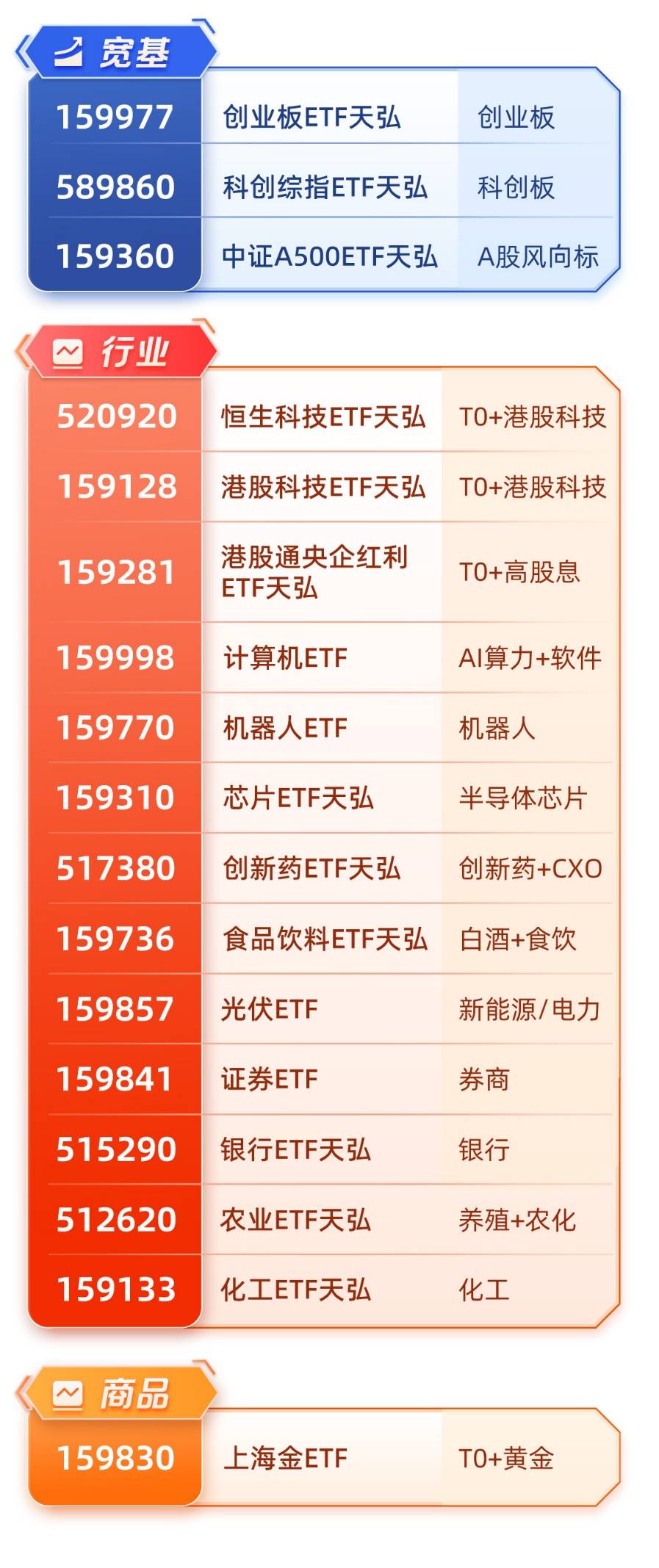
Market Overview - The A-share market showed a high-level fluctuation with the Shanghai Composite Index rising by 0.36%, the Shenzhen Component Index increasing by 0.66%, and the ChiNext Index up by 0.49% [1][13] - The total trading volume in the Shanghai and Shenzhen markets reached 1.73 trillion yuan, an increase of 704 billion yuan compared to the previous trading day, with over 4,400 stocks rising [1][13] - The Hong Kong market also saw gains, with the Hang Seng Index up by 0.75% and the Hang Seng Technology Index rising by 1.12% [1][13] Sector Performance - Main capital inflows were observed in sectors such as general equipment, automotive, and retail, while there were outflows from semiconductor, aerospace, and electronics sectors [2][14] - The consumer sector experienced a surge, particularly in retail and duty-free shops, while sectors like Hainan Free Trade Zone, nuclear fusion, rare earth permanent magnets, cross-strait integration, and intelligent driving concepts were active [2][14] Economic Data and Policy Impact - The U.S. inflation data for November showed a significant drop, with the overall CPI year-on-year falling to 2.74%, below the expected 3.06%, which has raised questions about data accuracy due to the government shutdown affecting previous data [3][15] - The Bank of Japan raised its target interest rate by 25 basis points to 0.75%, marking a 30-year high, which aligns with market expectations for ongoing monetary policy normalization [3][15] Innovation Drug Sector - The innovation drug sector is rebounding due to several catalysts, including a recovery in valuation after months of correction and upcoming key clinical data disclosures at the ASCO annual meeting in May 2026 [4][17] - The sector is entering a commercialization phase, with policy support extending from process optimization to full-chain empowerment, enhancing competitiveness [4][17] Hong Kong Technology Sector - The Hong Kong technology market has faced short-term pressure but is expected to rebound, with potential for capital inflows post-Christmas [6][18] - The market anticipates a recovery in January, although the extent of the rebound may be limited [6][18] Commodity Sector - The commodity sector, particularly non-ferrous metals, is performing well due to multiple factors, including a slowdown in U.S. CPI data, which has raised expectations for liquidity easing and supported metal prices [8][20] - The easing of rare earth export controls and a balanced supply-demand situation in industrial metals are also contributing to the sector's strength [8][20] Investment Opportunities - Investors are encouraged to consider ETFs focused on innovation drugs, Hong Kong technology, and commodities, as these sectors show potential for growth and recovery [4][21][22]

流感创新药亮“中国方案”!创新药替代进口加速?
市值风云· 2025-12-16 10:12
Core Viewpoint - The article highlights the rapid approval and commercialization of domestic influenza antiviral drugs in China, suggesting that 2025 may be regarded as the "Year of Domestic Influenza Innovation Drugs" due to the continuous improvement of China's pharmaceutical innovation capabilities [1]. Group 1: Commercialization of Domestic Influenza Drugs - From March to July 2025, three domestic antiviral drugs (Mashu Lashawei Tablets, Angladwei Tablets, and Mase Luoshawei Tablets) were approved for market entry, with two more (Madu Nuo Shawei and Mapaqi Shawei) completing clinical trials and applying for approval [3][4]. - Sales of these domestic innovative drugs are steadily increasing, indicating recognition of their efficacy and safety [3]. Group 2: Market Potential and Competition - The global seasonal influenza cases are estimated at around 1 billion annually, with 3 to 5 million severe cases, indicating a vast market for antiviral drugs [4]. - The Chinese antiviral drug market is projected to grow at a compound annual growth rate (CAGR) of 20.2% from 2024 to 2028, potentially reaching 26.9 billion yuan by 2028 [4]. - Despite strong demand, the domestic market has been dominated by imported drugs, with Oseltamivir holding over 80% market share in 2023 [4]. Group 3: Factors Driving Innovation - The rise of domestic influenza innovative drugs is attributed to a combination of policy support, technological advancements, and capital investment, marking a significant transformation in the industry [6]. - The National Medical Products Administration has implemented measures to accelerate drug approval processes, resulting in a rapid increase in the number of approved innovative drugs, with 48 approved in 2024 and 43 in the first half of 2025, a 59% year-on-year increase [7]. - The Chinese biopharmaceutical industry is developing rapidly, with the total value of biopharmaceutical business development (BD) transactions exceeding 100 billion USD in 2025, expected to reach 265.9 billion USD by 2030, with a CAGR of 31.3% from 2024 to 2030 [7]. Group 4: Market Sentiment and Future Outlook - Recent catalysts in the innovative drug sector, including the results of national health insurance negotiations and international conferences, are expected to improve market sentiment [8]. - The article suggests that despite recent adjustments in the sector, the trend of "innovation + internationalization" remains strong, with potential for recovery in the innovative drug sector [8].

流感创新药亮“中国方案”!创新药替代进口加速?
Xin Lang Cai Jing· 2025-12-15 09:07
Core Insights - Multiple domestic innovative antiviral drugs for influenza have been approved this year, leading to significant market attention, with 2025 being referred to as the "Year of Domestic Influenza Innovative Drugs" [1][10] - The rapid progress in domestic influenza innovative drugs reflects the continuous improvement of China's pharmaceutical innovation capabilities [1][10] Group 1: Market Dynamics - From March to July 2025, three antiviral drugs (Mashurashave tablets, Angladive tablets, and Maseiluo tablets) were approved, with two more (Madiroshave and Mapashirashave) completing clinical trials and applying for market entry [2][11] - The sales of these domestic innovative drugs are steadily increasing, indicating recognition of their efficacy and safety [2][11] - The global influenza antiviral market is projected to grow significantly, with China's market expected to reach 26.9 billion yuan by 2028, growing at a compound annual growth rate (CAGR) of 20.2% from 2024 to 2028 [3][12] Group 2: Competitive Landscape - The domestic new drugs are not mere copies of imported drugs but have undergone targeted optimizations, such as reducing drug resistance risks and improving safety for pediatric use [2][11] - Despite strong demand, the Chinese influenza drug market has been dominated by imported drugs, with Oseltamivir holding over 80% market share in 2023 [3][12] - The acceleration of domestic new drug approvals is expected to lead to rapid sales growth, enhancing company performance [3][12] Group 3: Policy and Industry Support - Recent regulatory reforms by the National Medical Products Administration have improved drug approval efficiency, with 48 innovative drugs approved in 2024, ranking second globally [7][16] - The Chinese biopharmaceutical industry is rapidly developing, with the total value of innovative drug business development (BD) transactions exceeding 100 billion USD in 2025, projected to reach 265.9 billion USD by 2030 [7][16] Group 4: Future Outlook - The overall industry sentiment is expected to improve as positive catalysts continue to emerge, with recent developments in innovative drug insurance negotiations and international conferences [8][17] - Investors are encouraged to consider ETFs that cover high-quality innovative pharmaceutical companies in both Hong Kong and A-shares to mitigate individual stock risks and capitalize on the opportunities in China's innovative drug sector [8][17]