ETF基金

Search documents
20260323-20260327:ETF 周报-20260330
Mai Gao Zheng Quan· 2026-03-30 08:16
Report Industry Investment Rating - Not provided in the content Core Viewpoints - The report analyzes the secondary market situation, ETF product profiles (including market performance, fund inflows and outflows, trading volume, margin trading, and new issuance and listing) of ETF funds from February 23 - February 27, 2026, and presents data on various indexes and ETFs [1][10][19] Summary by Directory 1 Secondary Market Overview - **Index Returns**: Among A - shares, overseas major broad - based indexes, gold index, and Nanhua Commodity Index, CSI 2000, Nikkei 225, and Nanhua Commodity Index had the highest weekly returns, which were 0.35%, 0.00%, and - 0.25% respectively. The highest - return industries among Shenwan primary industries were non - ferrous metals (2.78%), public utilities (2.50%), and basic chemicals (2.31%), while the lowest - return industries were non - bank finance (-3.98%), computer (-3.44%), and agriculture, forestry, animal husbandry and fishery (-2.94%) [1][10][15] - **Index Valuations**: The PE valuation quantile of the Hang Seng Index was the highest at 90.24%, and that of the S&P 500 was the lowest at 15.14%. Among industries, the highest - valuation quantile industries were public utilities (98.76%), coal (98.35%), and communication (97.11%), while the lowest - valuation quantile industries were non - bank finance (1.24%), food and beverage (2.07%), and beauty care (5.79%) [10][14][15] 2 ETF Product Profile 2.1 ETF Market Performance - **By ETF Type**: Bond ETFs had the best average performance with a weighted average return of 0.22%, while commodity ETFs had the worst performance with a weighted average return of - 3.81% [19] - **By Index and Listing Board**: ETFs corresponding to CSI 2000 and CSI 500 had better market performance with weighted average returns of 0.31% and - 0.14% respectively, while those related to ChiNext Innovation 50 and ChiNext had worse performance with weighted average returns of - 1.78% and - 1.65% respectively [19] - **By Industry Sector**: Biopharmaceutical sector ETFs had the best average performance with a weighted average return of 2.41%, while financial real - estate sector ETFs had the worst performance with a weighted average return of - 3.33% [22] - **By Theme**: Innovative drug and new - energy ETFs had better performance with weighted average returns of 4.40% and 0.70% respectively, while non - bank and consumer electronics ETFs had relatively poor performance with weighted average returns of - 3.70% and - 3.04% respectively [22] 2.2 ETF Fund Inflows and Outflows - **By ETF Type**: Bond ETFs had the largest net fund inflow of 211.55 billion yuan, while industry - themed ETFs had the smallest net fund inflow of - 197.31 billion yuan [2][24] - **By Index and Listing Board**: CSI 300 ETFs had the largest net fund inflow of 45.56 billion yuan, while Hong Kong stock ETFs had the smallest net fund inflow of - 49.87 billion yuan [2][24] - **By Industry Sector**: Traditional manufacturing sector ETFs had the largest net fund inflow of 32.95 billion yuan, while cyclical sector ETFs had the smallest net fund inflow of - 121.65 billion yuan [2][28] - **By Theme**: New - energy and dividend ETFs had the largest net fund inflows of 34.78 billion yuan and 20.57 billion yuan respectively, while chip semiconductor and non - bank ETFs had the smallest net fund inflows of - 28.10 billion yuan and - 12.79 billion yuan respectively [2][28] 2.3 ETF Trading Volume - **By ETF Type**: Commodity ETFs had the largest increase in the average daily trading volume change rate of 47.73%, while bond ETFs had the largest decrease of - 10.53% [34] - **By Index and Listing Board**: US stock ETFs had the largest increase in the average daily trading volume change rate of 52.99%, while ChiNext Innovation 50 had the largest decrease of - 12.87% [36] - **By Industry Sector**: Biopharmaceutical sector had the largest increase in the average daily trading volume change rate of 18.48%, while the cyclical sector had the largest decrease of - 34.76% [39] - **By Theme**: Non - bank and innovative drug ETFs had the largest average daily trading volumes in the past 5 days, which were 127.49 billion yuan and 91.83 billion yuan respectively. Low - carbon environmental protection and new - energy ETFs had the largest increase or the smallest decrease in the average daily trading volume change rate, which were 40.73% and 19.86% respectively. Military and central and state - owned enterprise ETFs had the largest decrease or the smallest increase in the average daily trading volume change rate, which were - 28.80% and - 21.80% respectively [43] 2.4 ETF Margin Trading - The net margin purchase of all stock - type ETFs was - 4.54 billion yuan, and the net margin short - sale was 4.17 billion yuan. During the sample period, Cathay CSI All - Index Securities Company ETF had the largest net margin purchase, and Southern CSI 1000 ETF had the largest net margin short - sale [2][49] 2.5 ETF New Issuance and Listing - During the sample period, 9 funds were established and 4 funds were listed [3][51]
Top Brazilian stocks with high growth factor grade (EWZ:NYSEARCA)
Seeking Alpha· 2026-03-16 15:21
Core Viewpoint - The iShares MSCI Brazil ETF (EWZ) has experienced a decline of -2.18% over the past week, indicating recent weakness in Brazilian equities [2]. Group 1: Economic Indicators - A significant increase in Brazil's inflation expectations for 2026 has been noted, which may impact economic stability and investment sentiment [2].


全球三层次流动性风险预警模型
HTSC· 2026-03-15 05:47
Quantitative Models and Construction Methods Model Name: Three-Tier Global Liquidity Risk Warning Model - **Model Construction Idea**: The model aims to dynamically monitor liquidity risk from the policy source to the trading end, capturing the full chain of liquidity risk transmission[1] - **Model Construction Process**: 1. **Central Bank Liquidity**: Monitors central bank policy movements from three dimensions: price, quantity, and expectations. The price dimension uses the global central bank policy rate diffusion index to track the policy movements of 27 major central banks. The quantity dimension uses the Federal Reserve liquidity support indicator to measure the expansion of the Fed's balance sheet through term transformation and credit enhancement channels. The expectation dimension uses the Bloomberg Fedspeak index and market implied interest rate expectations to track the marginal changes in Fed interest rate expectations[2][3] 2. **Funding Liquidity**: Monitors leverage funding tightness through repo financing and cross-border arbitrage indicators. The Secured Overnight Financing Rate (SOFR) represents the short-term financing cost in the interbank market with Treasury collateral. The Risk Reversal (RR) monitors the abnormal jumps in risk reversal options of major carry trade currency pairs to capture the deleveraging pressure in the foreign exchange market[4][5] 3. **Market Liquidity**: Utilizes implied volatility across multiple assets to depict market trading friction. Constructs a multi-period comprehensive stress index using VIX, VXN, RVX, MOVE, GVZ, OVX, VXEEM, and COP to identify abnormal mutation points using a rolling threshold Zscore framework[6][7] - **Model Evaluation**: The model effectively avoids periods of broad asset declines, significantly reduces strategy drawdowns, and optimizes risk-adjusted returns of the strategy. It is universally applicable in global asset allocation[1][8] Model Backtesting Results - **Baseline Strategy**: Annualized return 5.31%, Sharpe ratio 0.56, maximum drawdown -34.55%, Sortino ratio 0.75[9] - **Three-Tier Liquidity Stress Signal Timing Strategy**: Annualized return 8.76%, Sharpe ratio 1.22, maximum drawdown -14.09%, Sortino ratio 1.77[9] Quantitative Factors and Construction Methods Factor Name: Central Bank Liquidity - **Factor Construction Idea**: Monitors central bank policy movements from three dimensions: price, quantity, and expectations[2] - **Factor Construction Process**: 1. **Price Dimension**: Uses the global central bank policy rate diffusion index to track the policy movements of 27 major central banks. The index is constructed by calculating the net easing score of each country using a one-year rolling window and then equally summing the scores to obtain the global central bank policy rate diffusion index. The pressure signal is generated by quarterly differencing the diffusion index[2][3] 2. **Quantity Dimension**: Uses the Federal Reserve liquidity support indicator, defined as the ratio of medium- and long-term Treasury bonds, MBS, and agency bonds to the sum of cash in circulation, reverse repos, and reserves. The pressure signal is generated by quarterly differencing the smoothed series of the indicator[3][10] 3. **Expectation Dimension**: Uses the Bloomberg Fedspeak index and market implied interest rate expectations. The Fedspeak index is constructed by sentiment scoring of Fed officials' speeches using a fine-tuned RoBERTa model. The market implied interest rate expectations are derived from the difference between the 3M1M Swap OIS and the EFFR. The pressure signals are generated by quarterly differencing the series[3][11][12] - **Factor Evaluation**: The comprehensive pressure signal of central bank liquidity effectively distinguishes the performance of liquidity-sensitive assets during stress and non-stress periods, providing early warning of systemic risk accumulation[13][14] Factor Backtesting Results - **Central Bank Liquidity Stress Signal Timing Strategy**: Annualized return 7.55%, Sharpe ratio 1.18, maximum drawdown -14.09%, Sortino ratio 1.67[9][15] Factor Name: Funding Liquidity - **Factor Construction Idea**: Monitors leverage funding tightness through repo financing and cross-border arbitrage indicators[4] - **Factor Construction Process**: 1. **Repo Market**: Uses the Secured Overnight Financing Rate (SOFR) to represent the short-term financing cost in the interbank market with Treasury collateral. The pressure signal is generated when SOFR exceeds at least two of the key rates: IORB, EFFR, FFRU, and OIS[4][16] 2. **Foreign Exchange Market**: Uses the Risk Reversal (RR) of major carry trade currency pairs to monitor the deleveraging pressure. Constructs a comprehensive RR stress index by calculating the Zscore of the RR indicators and averaging the scores of five currency pairs. The pressure signal is generated when the comprehensive score exceeds the rolling threshold upper limit for at least two days within the past ten trading days[4][17][18] - **Factor Evaluation**: The comprehensive pressure signal of funding liquidity effectively identifies liquidity risk at the funding level, providing complementary insights to single indicators[19][20] Factor Backtesting Results - **Funding Liquidity Stress Signal Timing Strategy**: Annualized return 8.43%, Sharpe ratio 0.99, maximum drawdown -21.65%, Sortino ratio 1.38[9][21] Factor Name: Market Liquidity - **Factor Construction Idea**: Utilizes implied volatility across multiple assets to depict market trading friction[6] - **Factor Construction Process**: 1. **Market Liquidity Stress Index**: Constructs a multi-period comprehensive stress index using VIX, VXN, RVX, MOVE, GVZ, OVX, VXEEM, and COP. The index is constructed by calculating the Zscore of the implied volatility indicators and averaging the scores. The pressure signal is generated when the comprehensive score exceeds the rolling threshold upper limit for at least two days within the past ten trading days[6][22] - **Factor Evaluation**: The market liquidity stress signal effectively provides early warning of liquidity crises, enhancing the risk-adjusted returns of liquidity-sensitive asset strategies[23][24] Factor Backtesting Results - **Market Liquidity Stress Signal Timing Strategy**: Annualized return 7.42%, Sharpe ratio 0.91, maximum drawdown -23.65%, Sortino ratio 1.28[9][25]
ETF周报(20260302-20260306)-20260309
Mai Gao Zheng Quan· 2026-03-09 09:26
Market Overview - The performance of major indices during the sample period shows that the South China Commodity Index, SGE Gold 9999, and CSI 300 had returns of 6.43%, -0.49%, and -1.07% respectively [1][10] - Among the Shenwan first-level industries, the top performers were Oil & Petrochemicals, Coal, and Utilities with returns of 8.06%, 3.79%, and 3.42% respectively, while Media, Non-ferrous Metals, and Computers lagged with returns of -6.97%, -5.47%, and -5.29% respectively [1][14] ETF Product Overview Market Performance - The weighted average return for style ETFs was the highest at 0.79%, while industry theme ETFs had the lowest average return at -3.44% during the sample period [18][20] - MSCI China A-share concept and US stock ETFs performed relatively well with weighted average returns of -0.62% and -0.82% respectively, while Japan stock and Sci-Tech Board related ETFs performed poorly with returns of -6.10% and -4.94% respectively [18][22] Fund Flow - Industry theme ETFs saw the highest net inflow of 356.80 billion, while broad-based ETFs experienced the largest net outflow of -389.41 billion [2][25] - The US stock ETFs had the highest net inflow of 12.54 billion, while the CSI 500 ETF had the lowest net outflow of -100.91 billion [2][29] - The cyclical sector ETFs had the highest net inflow of 363.76 billion, while the technology sector ETFs had the lowest net outflow of -85.15 billion [30][32] New Issuance and Listing - During the sample period, one new fund was established and seven funds were listed [3] Trading Volume - The trading volume for style ETFs increased the most, with a daily average trading volume change rate of 30.27%, while commodity ETFs saw the largest decrease at -10.07% [35][41] - US stock ETFs had the highest increase in daily average trading volume change rate at 39.40%, while the CSI 500 had the largest decrease at -19.13% [37][39]
未知机构:盘前03061昨晚美股震荡调整盘中因为传美国考虑出台法规-20260306
未知机构· 2026-03-06 02:20
Summary of Conference Call Notes Industry Overview - The notes reflect the current state of the U.S. stock market, particularly focusing on the impact of geopolitical tensions and regulatory considerations on technology and energy sectors [1][2][3][4][5][6][7][8]. Key Points and Arguments 1. **U.S. Stock Market Volatility**: The U.S. stock market experienced fluctuations due to rumors of new regulations requiring global approval for AI chip purchases, leading to a significant drop in chip stocks [1]. 2. **Geopolitical Tensions**: Ongoing tensions in the Middle East have created uncertainty, with fluctuating oil prices impacting market sentiment. Initial spikes in oil prices were followed by a recovery after news of potential U.S. measures to stabilize the market [2][3][5][6]. 3. **Government Policy Response**: The recent government work report from the two sessions was largely in line with expectations, lacking new initiatives to alleviate geopolitical concerns. This resulted in a significant outflow of capital from the market, indicating a cautious investor sentiment [7]. 4. **Market Dynamics**: The A-share market followed global trends with moderate performance, suggesting limited buying interest. The market is expected to take 2-3 weeks to digest recent volatility, with no immediate expectations for a rebound [7]. 5. **Sector Rotation**: The market is experiencing a rotation between cyclical and technology stocks, with a focus on computing power and related sectors. Recent performance in mechanical and electrical equipment, as well as public utility ETFs, has been positive [7][8]. 6. **Investment Strategies**: There is a potential shift in investor focus towards mid-term asset impacts, with interest in oil and agricultural ETFs. The notes suggest that recent volatility has allowed for speculative sentiment to be digested, creating opportunities in certain sectors [8]. 7. **Technology Sector Outlook**: The technology sector is expected to see increased investment, particularly in ETFs that have experienced significant declines. Recommendations include the Science and Technology Innovation 100 ETF and others that have shown potential for recovery [8]. Additional Important Content - The notes highlight the importance of monitoring geopolitical developments and their potential impact on market dynamics, particularly in the energy and technology sectors [2][3][4][5][6][7][8]. - The mention of specific ETFs indicates a strategic approach to investment, focusing on sectors that may benefit from current market conditions and investor sentiment [8].
恒生科技险守4800点,较去年高点回撤27%,恒生科技ETF天弘(520920)连续40日“吸金”60亿,中信证券:港股将迎来估值修复及业绩复苏行情
Ge Long Hui· 2026-03-05 01:30
Group 1 - The Hang Seng Technology ETF Tianhong (520920) index has seen a decline, with the Hang Seng Technology Index dropping below 4800 points, marking a cumulative decrease of 27% since last October [1] - The Hang Seng Technology ETF Tianhong (159128) has also experienced a decline of 28.99% during the same period [1] - Despite the downturn, there has been a consistent inflow of funds into the Hang Seng Technology ETF Tianhong (520920), with a net inflow of 10.1 billion last year and an additional 6.07 billion this year, marking 40 consecutive days of net subscriptions [1] Group 2 - The upcoming peak of lock-up releases in March, particularly in sectors such as non-ferrous metals, tea beverages, automotive, and pharmaceuticals, may lead to a resolution of current market pressures [2] - The earnings report peak for major components of the Hang Seng Technology Index is expected in mid to late March, which may alleviate negative market sentiment [2] - A potential visit by Trump to China at the end of March or early April could boost market sentiment [2] Group 3 - A report from CITIC Securities forecasts a rebound in the Hong Kong stock market by 2026, driven by a recovery in fundamentals and significant valuation discounts [2] - The report suggests focusing on the technology sector, including AI-related sub-sectors and consumer electronics, as well as the healthcare sector, particularly biotechnology [2]

香港交易所:嘉实中美科技50ETF将于3月6日上市及买卖
Zhi Tong Cai Jing· 2026-03-04 10:52
Core Viewpoint - The Hong Kong Stock Exchange announced that the Harvest Tech 50 ETF (03169) will be included as a qualified security in the Central Clearing System and will start trading on March 6, 2026, providing investors with a convenient investment tool to access core assets in the US and China technology sectors [1] Group 1: Fund Overview - The Harvest Tech 50 ETF aims to offer a one-stop investment solution focusing on core assets in the two major global technology innovation hubs, China and the US, capitalizing on opportunities driven by artificial intelligence [1] - The ETF closely tracks the Solactive Harvest Tiger G2Tech50 Select Index, which creatively includes 50 of the most influential technology companies globally, comprising 30 leading Chinese tech firms listed in Hong Kong and 20 global tech giants listed in the US [1] Group 2: Index Composition - The index maintains a regional weight of approximately 62% in Hong Kong stocks and 38% in US stocks, aiming to balance risk diversification and growth potential [1] - A clear weight limit is set for individual components, with a maximum of 8% for Hong Kong stocks and 5% for US stocks, to reduce the impact of individual stock volatility on overall performance [1]

ETF市场“冷热不均”港股主题ETF受青睐
Zheng Quan Ri Bao· 2026-02-25 02:43
Group 1 - The ETF market has shown a "mixed" trend this year, with broad-based ETFs experiencing net outflows while Hong Kong-themed ETFs have gained traction, indicating a structural allocation logic in the current market [1] - Specific data shows that as of February 24, the Hang Seng Tech ETF saw a net inflow of 29.6 billion, the Hong Kong Stock Connect Internet ETF had a net inflow of 11.3 billion, the Hong Kong Stock Connect Innovative Medicine ETF recorded a net inflow of 3.015 billion, and the Hong Kong Stock Connect Tech ETF had a net inflow of 2.625 billion [1] Group 2 - Investors are increasingly focused on the investment opportunities in the Hong Kong market, with a notable interest in low valuations, sector focus, and liquidity-driven strategies [2] - The outlook for the Hong Kong market remains positive, with expectations of marginal improvements in corporate earnings and liquidity factors, which could provide a buffer against external volatility [2] - The ongoing AI technology wave is expected to continue driving growth, with a focus on technology and innovative sectors, while the supply-demand balance in the metals sector is also highlighted as a potential area of interest [2]
3 Dividend ETFs Designed for Conservative Retirees
Yahoo Finance· 2026-02-24 13:44
Core Insights - The article discusses the importance of dividend ETFs for retirees seeking stable income during retirement [4][5] - It emphasizes the need for conservative investors to focus on financially healthy companies with low volatility and consistent dividend payments [5] Dividend ETF Overview - The Schwab U.S. Dividend Equity ETF (SCHD) is highlighted as a strong option, offering a yield of approximately 3.51% and a diversified portfolio of 101 stocks across various sectors [6] - The ETF's main sectors include energy (19.88%), consumer staples (18.50%), and healthcare (16.20%), which are known for their stability during market downturns [9] Investment Strategy - Conservative retirees are encouraged to consider dividend ETFs that provide reliable income streams and focus on companies with growth potential [5] - The article suggests that these ETFs can be a core part of a conservative retiree's investment portfolio due to their low fees and diversified nature [8]
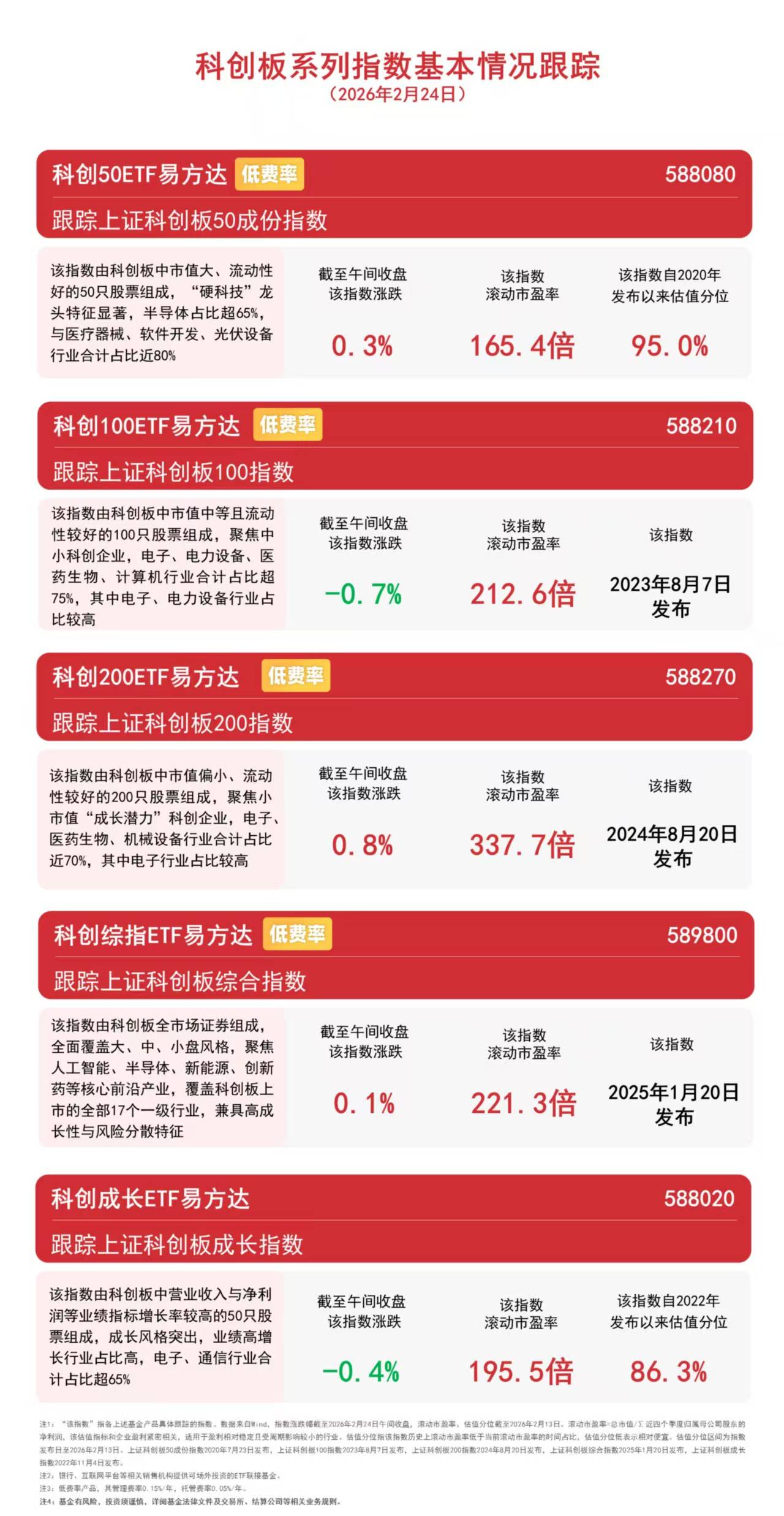
科创板系列指数走势分化,持续关注科创200ETF易方达(588270)、科创50ETF易方达(588080)投资价值
Sou Hu Cai Jing· 2026-02-24 05:01
Group 1 - The core viewpoint of the news highlights the performance of various indices in the technology sector, indicating a mixed trend with the Sci-Tech 200 Index up by 0.8% and the Sci-Tech Growth Index down by 0.4% [1] - Historical data from 2017 to 2025 suggests that A-share investor sentiment tends to decline before long holidays due to external uncertainties and increased cash withdrawal demands during the Spring Festival, with a subsequent rise post-holiday [1] - The TMT index shows a higher probability of positive performance in the five and ten trading days following the Spring Festival, indicating that the technology sector typically performs better in the post-holiday phase [1] Group 2 - The Sci-Tech Comprehensive Index ETF by E Fund tracks the Shanghai Stock Exchange Sci-Tech Comprehensive Index, covering all market securities and focusing on core industries such as artificial intelligence, semiconductors, new energy, and innovative pharmaceuticals [4] - As of the midday close, the Sci-Tech Comprehensive Index has increased by 0.1% with a rolling price-to-earnings ratio of 221.3 times [4] - The Sci-Tech Growth ETF by E Fund tracks the Sci-Tech Growth Index, consisting of 50 stocks with high growth rates in revenue and net profit, predominantly in the electronics and communications sectors, which together account for over 65% [5] Group 3 - The rolling price-to-earnings ratio for the Sci-Tech Growth Index is reported at 86 times, reflecting its growth-oriented nature [5] - The historical performance of various indices, including the Sci-Tech 50 and Sci-Tech 100, indicates their respective release dates and the ongoing trends in the market [6] - The low-fee structure of the ETFs includes a management fee of 0.15% per year and a custody fee of 0.05% per year, making them attractive investment options [6]