
稀有金属ETF

Search documents
地缘冲突引爆资源行情,油气ETF单周吸金超206亿
第一财经· 2026-03-09 13:33
Core Viewpoint - The article discusses the significant shift in the A-share ETF market, driven by geopolitical conflicts, leading to a substantial inflow of funds into resource-related ETFs, particularly in oil and gas sectors, while core broad-based ETFs experienced notable outflows [3][4][11]. Fund Flows and Market Dynamics - As of March 6, nearly 400 billion yuan was withdrawn from core broad-based ETFs like the CSI 300 and CSI 500, while industry-themed ETFs saw a net inflow of 443.23 billion yuan, indicating a clear trend of funds moving from broad-based to thematic investments [4]. - Oil and gas ETFs emerged as the top performers, attracting over 206 billion yuan in a single week, with several products seeing their shares increase by over 300% [4][5]. - Specific oil and gas ETFs, such as the Guotai CSI Oil and Gas Industry ETF and the Penghua Oil ETF, attracted more than 40 billion yuan each within a few trading days, leading to significant increases in their share volumes [4][5]. Performance of Thematic ETFs - Other sectors, including electric grid, rare metals, and non-ferrous metals, also received substantial investment, with the Huaxia Electric Grid Equipment ETF seeing over 10 billion yuan in net inflows for six consecutive trading days [5]. - The trading activity for these thematic ETFs surged, with the Guotai CSI Oil and Gas Industry ETF recording a weekly trading volume exceeding 225 billion yuan, a 13-fold increase from the previous week [5]. Discrepancies in Fund Performance - There is a notable lag in the performance of some fund connection products compared to their corresponding ETFs, leading to investor confusion regarding the slower net value growth of these connection funds [7][8]. - The differences arise because ETF connection funds are designed to track the net value of the ETFs rather than their trading prices, which can lead to discrepancies during periods of high market volatility [8][9]. Future Market Outlook - The article highlights that geopolitical uncertainties are likely to continue affecting market risk preferences, with expectations of a volatile A-share index [11]. - Strategic resource products are anticipated to benefit from price increases, particularly in the oil and gas sector, which may see prices reach historical highs due to ongoing geopolitical tensions [12][13]. - The demand for rare metals is expected to grow due to their critical role in various industries, while traditional cyclical industries like coal and steel may also present investment opportunities [13].


ETF收评 | 稀有金属板块领涨,稀有金属ETF、稀土ETF嘉实涨4%
Ge Long Hui· 2026-02-27 07:35
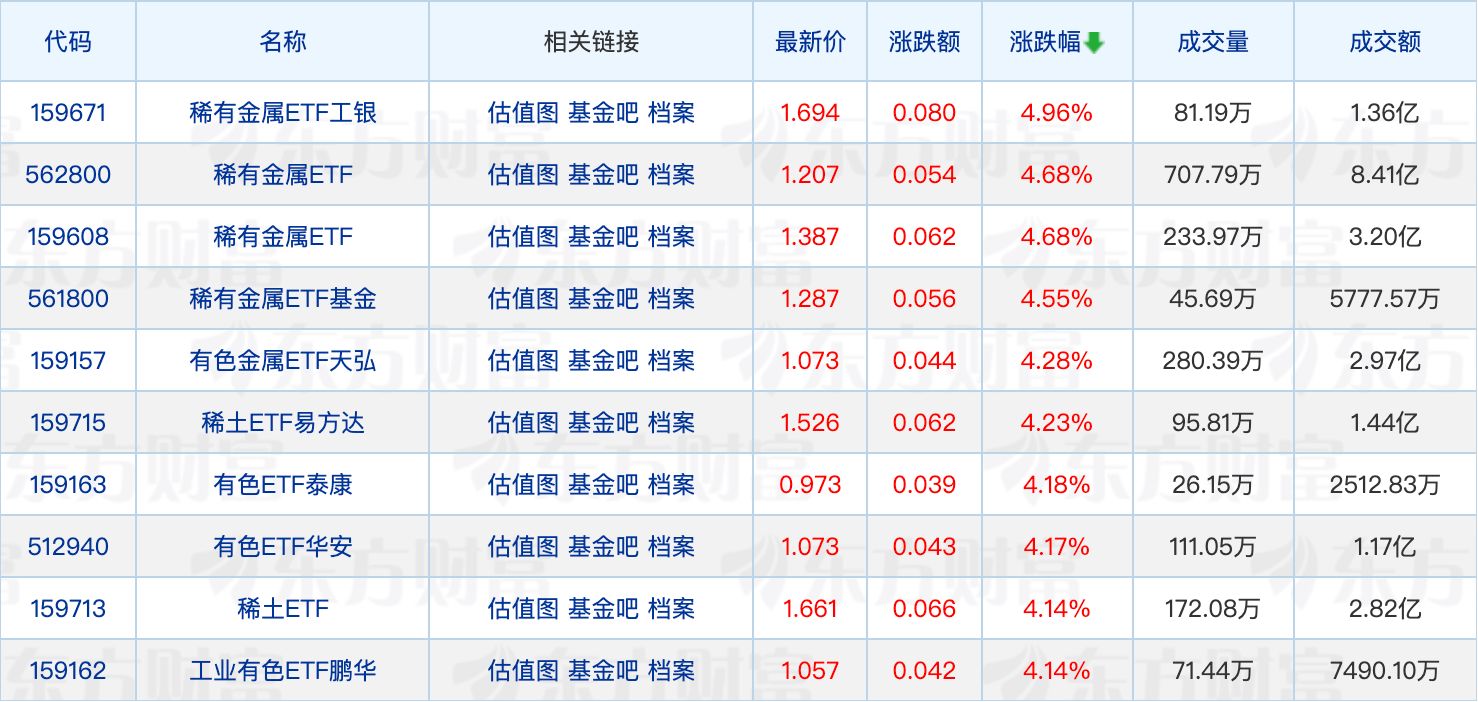
Market Overview - The Shanghai Composite Index rose by 0.39%, while the ChiNext Index fell by 1.04% [1] - The total trading volume in the Shanghai, Shenzhen, and Beijing markets was 25,055 billion yuan, a decrease of 512 billion yuan compared to the previous day [1] - Over 3,200 stocks across the three markets experienced gains [1] Sector Performance - Rare metal stocks saw a surge, with significant increases in magnesium and tungsten stocks [1] - The rare metal ETFs, including the Rare Metal ETF and Rare Earth ETF, reported gains of 4.68% and 4.11% respectively [1] - The power sector showed strength, with the Power ETF and Green Power ETF rising by 2.73% and 2.53% respectively [1] - The steel sector also performed well, with the Steel ETF increasing by 2.45% [1] Declining Sectors - The ChiNext Growth ETF and the Deep Growth ETF both fell by 2% [1] - The semiconductor sector experienced declines, with the Semiconductor Equipment ETF and the Sci-Tech Semiconductor ETF dropping by 2.16% and 2.15% respectively [1]
天赐良基日报|年内新发基金规模突破2100亿份;首批商业不动产REITs审核问询出炉
Mei Ri Jing Ji Xin Wen· 2026-02-27 07:24
Group 1 - The total number of newly established funds in 2023 has reached 228, with a total issuance of over 210 billion units, marking a significant year-on-year increase [1] - The first batch of commercial real estate REITs has been accepted for review, with regulatory feedback focusing on asset quality, compliance, revenue stability, and governance mechanisms [2] - Huang Feng has been appointed as the new Chief Information Officer of Guolian An Fund as of February 25 [3] Group 2 - A fund managed by Li Xiaoxing has appointed a new fund manager, Sun Haotian, who has 7.5 years of experience in the securities industry [4] - The ETF market showed mixed performance, with the Shanghai Composite Index rising by 0.39% and the ChiNext Index falling by 1.04%, while sectors like rare metals and coal saw significant gains [5] - Rare earths are highlighted as a strategic resource with a notable supply-demand mismatch, driven by increased demand for neodymium-iron-boron, leading to rising prices for neodymium oxide [8] Group 3 - The Tianhong Zhongzheng Quality Leading 50 Index fund is set to launch, managed by Sha Chuan, with a performance benchmark linked to the index and a portion to bank deposits [9] - The Huashan Innovation Momentum Mixed Fund, managed by Sang Xiangyu, has a performance benchmark that combines multiple indices [10]
ETF午评 | AI应用回暖,创业板软件ETF华夏涨2.9%
Ge Long Hui· 2026-02-27 03:57
Market Overview - The three major A-share indices experienced a collective decline in the morning session, with the Shanghai Composite Index down by 0.17%, the Shenzhen Component Index down by 0.68%, and the ChiNext Index down by 1.46% [1] - The North China 50 Index fell by 0.74%, and the total trading volume in the Shanghai and Shenzhen markets reached 1.5966 trillion yuan, a decrease of 53.2 billion yuan compared to the previous day [1] - Over 2,300 stocks in the market saw an increase [1] Sector Performance - The sectors that performed well included small metals, computing power leasing, cloud computing, coal mining and processing, cross-border payments, steel, photovoltaic equipment, AI applications, and tourism and hotel industries [1] - Conversely, the sectors that faced declines included paper making, PCB, CPO, storage chips, batteries, photolithography machines, and PET copper foil [1] ETF Performance - In the ETF market, AI applications showed a rebound, with the ChiNext Software ETF from Huaxia rising by 2.9%, the Software ETF increasing by 2.33%, and the Online Consumption ETF from Southern rising by 1.84% [1] - The small metals sector also strengthened, with the Rare Earth ETF from Jiashi and the Rare Metals ETF rising by 2.57% and 2.52%, respectively [1] - The computing power leasing sector saw gains, with the Computer ETF from Southern and the Big Data ETF increasing by 2.5% and 2.4%, respectively [1] - Growth sectors faced declines, with the ChiNext Growth ETF and the Shenzhen Growth ETF from Dacheng falling by 3% and 2.79% [1] - The semiconductor equipment sector experienced a pullback, with various ETFs in this category declining between 2.20% and 2.77% [1]

再聊一次牛市的几条主线
表舅是养基大户· 2026-02-25 13:35
Group 1 - The A-share market continues to show positive momentum, with the median increase of stock ETFs at approximately 0.7% and individual stocks at 0.6%, indicating a strong profit effect as trading volume approaches 2.5 trillion yuan, an increase of over 200 billion yuan from the previous day [4] - The A-share index has reached a new high, closing near 6900 points, surpassing the previous peak on January 23, marking a significant recovery since the lows [6] - Key supporting factors for the stock market include the recovery from pandemic effects, unprecedented attention from authorities towards the stock market, the rise of leading industries, and an historically low interest rate environment [8][9] Group 2 - The recovery from pandemic effects is evident, with the offshore RMB exchange rate reaching 6.86, a three-year high, and tourist numbers and spending during the recent Spring Festival recovering to 151% and 135% of 2019 levels, respectively [11][13] - The trend of leading industries gaining market share is highlighted by the significant decline in German automotive exports to China, which dropped by one-third compared to 2022, indicating a shift in global manufacturing dynamics [23][25] - The low interest rate environment has led to a substantial increase in insurance capital investment in stocks and funds, with a year-on-year growth of 38.9%, reflecting the urgency for capital to seek opportunities in the stock market [27][28] Group 3 - The market strategy for the upcoming year emphasizes embracing quality equity investments, maintaining a balanced asset allocation, and focusing on opportunities outside of the US and technology sectors [32] - The importance of managing short-term volatility and focusing on overall portfolio performance rather than individual asset fluctuations is stressed [34] - The ongoing AI revolution is reshaping investment priorities, with a focus on maintaining core competencies in the workforce to ensure stable cash flow, suggesting a shift in investment management strategies [34] Group 4 - The recent surge in physical assets, termed "HALO" assets, is driven by global capital seeking sectors less affected by AI, leading to significant gains in related markets [35][37] - The South Korean stock market has surpassed the total market capitalization of major European economies, driven by the performance of its semiconductor giants, indicating a strong position in the AI era [40][41]

【ETF洞察】稀土爆发,多只ETF大涨超6%!两大指数差别一文看懂
Sou Hu Cai Jing· 2026-02-25 13:25
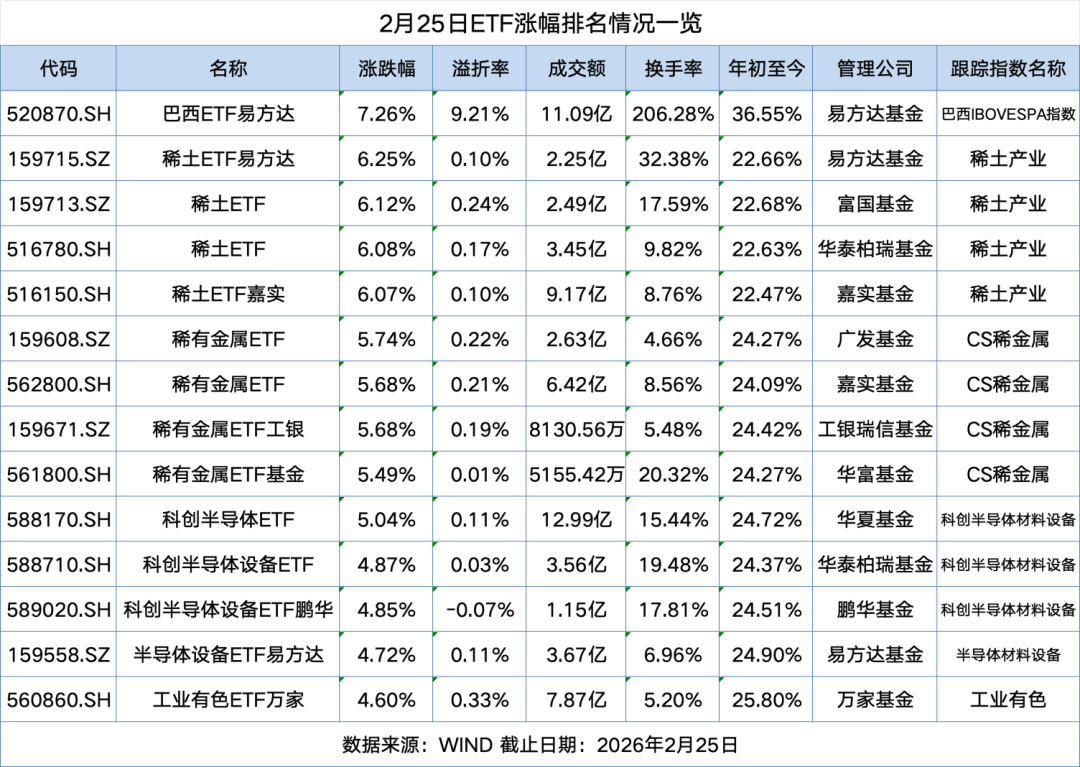
Core Viewpoint - The rare earth sector has shown significant growth, with related ETFs experiencing strong performance, particularly on February 25, when the A-share market surged and the rare earth sector rose by 8% [1][5]. ETF Performance - On February 25, a total of 1,052 ETFs increased in value, with the highest gain reaching 7.26% [1]. - The top-performing ETFs included the Brazil ETF from E Fund, which rose by 7.26%, and several rare earth ETFs, such as the E Fund Rare Earth ETF, which increased by 6.25% [2][8]. - The trading volume for the Brazil ETF was 1.109 billion, indicating high investor interest [2]. Sector Analysis - The rare earth industry accounts for 29.23% of the CSI Rare Earth Industry Index, while the CSI Rare Metals Theme Index has a lower allocation of 18.72% to rare earths [6]. - The demand for rare earth materials is driven by the explosive growth in AI hardware, which has increased the need for rare earth permanent magnet materials [7]. Market Sentiment - The market sentiment is bullish, with significant inflows into stock ETFs, totaling 5.634 billion on February 24, reversing the trend of outflows seen prior to the holiday [9]. - The overall market is experiencing heightened enthusiasm, with various sectors, including semiconductors and steel-related ETFs, also showing considerable gains [8].

ETF午评 | 周期股全线霸屏,稀土ETF嘉实、稀有金属ETF涨超6%
Ge Long Hui· 2026-02-25 04:55
Market Performance - The Shanghai Composite Index rose by 1.2%, while the ChiNext Index increased by 1.43% [1] - Cyclical stocks, including steel, non-ferrous metals, chemicals, and construction, showed strong performance [1] Sector Highlights - The following ETFs saw significant gains: - Rare Earth ETF by 6.64% - Rare Metals ETF by 6.50% - Steel ETF by 5.76% - Industrial Non-Ferrous ETF by 5.49% - Non-Ferrous ETF by 4.91% - Mining ETF by 4.80% - Other related ETFs also reported increases ranging from 4.13% to 4.61% [1] - The semiconductor sector also performed well, with the following ETFs rising: - Sci-Tech Semiconductor ETF by 4.03% - Semiconductor Equipment ETF by 3.69% - Sino-Korean Semiconductor ETF by 3.69% [1] Weak Performers - The artificial intelligence sector experienced declines, with several ETFs dropping over 1%, including: - Sci-Tech AI ETF by Bosera - Sci-Tech Chip Design ETF - Online Consumption ETF by ICBC - Media ETF by Huaxia - Online Consumption ETF by Southern [1] - Other ETFs related to innovation and big data also reported declines [1]
黄金涨完有色涨,2026年这波行情能持续多久?答案可能出乎你意料
Sou Hu Cai Jing· 2026-02-21 09:57
Core Viewpoint - The article emphasizes that the investment opportunities in the non-ferrous metals sector will continue into 2026, driven by inflation, resource scarcity, and expected interest rate cuts by the Federal Reserve. Group 1: Inflation and Resource Demand - The article highlights that inflation has surged due to unprecedented monetary expansion by central banks, leading to a significant increase in the prices of commodities, particularly non-ferrous metals like copper and silver [2][3]. - The demand for industrial metals is expected to remain robust due to the growth in AI infrastructure and renewable energy investments, with companies like Google and Amazon planning to invest heavily in AI-related capital expenditures [3][4]. Group 2: Federal Reserve's Interest Rate Policy - The article discusses the anticipated interest rate cuts by the Federal Reserve, with market expectations suggesting a reduction of 50 basis points in 2026, which would likely weaken the dollar and boost commodity prices [4][5]. - The dynamics between former President Trump and Fed Chair Powell are noted, indicating a potential shift in monetary policy that could favor lower interest rates [4]. Group 3: Market Trends and Investment Strategies - The article suggests that while the copper market may experience short-term fluctuations due to increased inventory levels, the long-term demand remains strong, and investors should look for entry points during price corrections [6][8]. - The small metals market, particularly tungsten and antimony, is highlighted as having significant growth potential due to supply constraints and strategic importance, with prices already showing substantial increases [7][8]. Group 4: Investment Approaches - The article recommends using ETFs as a way to mitigate risks associated with individual stock selection in the non-ferrous metals sector, allowing investors to benefit from overall market trends without the need for extensive research [9][10]. - It emphasizes the importance of maintaining a disciplined investment strategy, focusing on long-term trends rather than short-term market fluctuations [11][12].
ETF份额剧变,量化数据看清新增量的偏爱
Sou Hu Cai Jing· 2026-02-17 01:53
Group 1 - The core message emphasizes the importance of understanding the underlying trading behaviors behind market movements rather than reacting to superficial price changes [1] - Many investors fall into the trap of making decisions based solely on market trends, leading to losses when they chase after rising stocks or sell off during declines [1][2] - Quantitative data can reveal four core trading behaviors: bullish dominance, profit-taking, bearish dominance, and short covering, which help in understanding the true market intentions [2][5] Group 2 - The article illustrates that even when a stock appears to be on an upward trend, it may be dominated by profit-taking behavior, indicating potential price adjustments ahead [5][11] - It highlights that profit-taking does not necessarily lead to a market decline, as large funds may realize profits during upward trends, similar to a store clearing inventory during a sale [6][12] - The article also points out that negative news does not always result in market downturns; sometimes, it can create opportunities for investors who recognize the underlying buying activity [12][14] Group 3 - The core value of quantitative thinking is to help investors avoid subjective judgments based on emotions and news, instead relying on objective data to understand market behaviors [15][17] - By utilizing quantitative data, investors can maintain a rational perspective and avoid making impulsive decisions based on market fluctuations [16][17] - The article encourages a shift from emotional trading to a more analytical approach, which is essential for responsible capital management [17]
欧盟拟提对俄让步清单,地缘风险升温推动资金流向避险资产
Jing Ji Guan Cha Wang· 2026-02-11 22:54
Group 1 - The EU plans to submit a list of concessions to Russia, including demands for the return of kidnapped Ukrainian children and restrictions on military forces, potentially using approximately €210 billion of frozen Russian assets as leverage in negotiations [1] - Recent talks between Russia, the US, and Ukraine in Abu Dhabi have not resolved core territorial issues, and ongoing conflicts have persisted before and after the discussions [1] - An Estonian intelligence report suggests that Russia may be using negotiations as a "delay tactic" to restore relations with the US rather than genuinely seeking peace [1] Group 2 - Multiple explosions occurred in Kyiv on February 8-9, with Russian forces targeting Ukrainian military airports and infrastructure, while Russian Foreign Minister Lavrov warned of a "full military response" if Europe attacks [2] - The expiration of the US-Russia New START treaty on February 5 without a new agreement has increased geopolitical uncertainty [2] Group 3 - Data indicates that rare metals ETFs are leading in cross-border investments, reflecting a shift of funds towards resource defensive sectors [3] - Although Eastern European funds are not explicitly mentioned, rising geopolitical risks may drive capital towards safe-haven assets [3] - Hongyi Yuanfang Fund received an increase in shareholder capital of 29 million yuan, with a shift in FOF allocation towards passive instruments, which may indirectly affect the liquidity of regional funds [3]