
固定收益交易

Search documents
巴克莱银行2025财年业绩超预期,交易业务创纪录
Jing Ji Guan Cha Wang· 2026-02-12 19:27
Core Viewpoint - Barclays Bank reported strong performance for the fiscal year 2025, with multiple indicators exceeding market expectations and announced an upgraded capital return plan [1] Financial Performance - For the fiscal year 2025, Barclays Bank achieved a pre-tax profit of £9.1 billion, a year-on-year increase of 12.3%, surpassing the market expectation of £9.01 billion [2] - Total revenue for the year rose to £29.14 billion, also exceeding expectations [2] - In the fourth quarter, pre-tax profit reached £1.9 billion, reflecting a year-on-year growth of 11.8% [2] Business Progress - In the fourth quarter, the fixed income trading division's revenue grew by 9.6% to £1.02 billion, while the equity trading division's revenue increased by 16% to £703 million, both marking the best fourth-quarter performance since the structural adjustment in 2016 [3] Capital Movements - Barclays announced plans to return at least £15 billion to shareholders through dividends and buybacks by 2028, significantly up from the previous plan of £10 billion [4] - Based on fourth-quarter performance, the company has initiated a £1 billion stock buyback program [4] Company Performance Targets - The return on tangible equity (ROTE) for 2025 is set to increase from 10.5% in 2024 to 11.3%, with a new target of over 14% by 2028 [5] - The company plans to achieve approximately £2 billion in "efficiency savings" on top of the already exceeded £700 million cost reduction [5] Financial Metrics - The return on equity (ROE) for fiscal year 2025 was 10.03%, with a net profit margin of 11.31% [6] - Basic earnings per share were $2.31, representing a year-on-year increase of 19.8% [6]

巴克莱银行2025财年业绩超预期,宣布升级资本回报计划
Jing Ji Guan Cha Wang· 2026-02-11 16:21
Core Viewpoint - Barclays Bank's fiscal year 2025 and fourth-quarter performance exceeded market expectations, leading to an upgraded capital return plan [1][2]. Financial Performance - The pre-tax profit for the full year 2025 was £9.1 billion, surpassing market expectations of £9.01 billion and representing a 12.3% increase from £8.1 billion in 2024 [2][5]. - The fourth-quarter pre-tax profit reached £1.9 billion, up 11.8% year-on-year, exceeding the market forecast of £1.72 billion [2][3]. - Total revenue for the year increased to £29.14 billion (approximately $71.97 billion), exceeding market expectations and up from £26.79 billion in 2024 [2]. Operational Performance - The fixed income trading division saw a 9.6% year-on-year revenue increase to £1.02 billion, marking the best fourth-quarter performance since 2016 [3]. - The equities trading division's revenue grew by 16% to £703 million, also setting a record for the same period [3]. - Investment banking revenue was £606 million, remaining stable compared to the previous year but slightly below expectations [3]. Capital Return Plan - Barclays announced plans to return at least £15 billion (approximately $20.5 billion) to shareholders through dividends and buybacks by 2028, significantly up from the previous £10 billion plan [4]. - A £1 billion stock buyback program was initiated based on the fourth-quarter performance [4]. Financial Ratios - The return on tangible equity (ROTE) improved from 10.5% in 2024 to 11.3% in 2025, with a new target set to exceed 14% by 2028 [5]. - The return on equity (ROE) was reported at 10.03%, and the net profit margin stood at 11.31% [5]. - Earnings per share (EPS) reached $2.31 (basic), reflecting a year-on-year increase of 19.8% [5]. Stock Performance - Following the earnings report on February 10, Barclays' stock price rose by 1.72% in pre-market trading, continuing the positive momentum from the previous day [6].
巴克莱利润超预期 承诺向投资者回馈150亿英镑
Xin Lang Cai Jing· 2026-02-10 10:00
Group 1 - Barclays plans to return at least £15 billion ($20.5 billion) to shareholders by the end of 2028 and will continue its long-term cost-cutting and profitability improvement strategy [1][3] - The bank achieved a tangible equity return of 11.3% in 2025 and aims to increase this to over 14% by 2028, intending to save approximately £2 billion through efficiency improvements [1][3] - Barclays announced a £1 billion share buyback program following better-than-expected fourth-quarter results, primarily driven by strong trading performance [1][3] Group 2 - Fixed income trading revenue reached £1.02 billion, a 9.6% year-on-year increase, while equity trading revenue was £703 million, up 16%, marking the best fourth-quarter performance for both segments since at least 2016 [1][3] - However, investment banking revenue was slightly below expectations, remaining flat at £606 million for the fourth quarter [2][4]
2008年来第一次!德银PB重回1以上,2020年最低点曾跌至0.19
Hua Er Jie Jian Wen· 2026-01-06 00:38
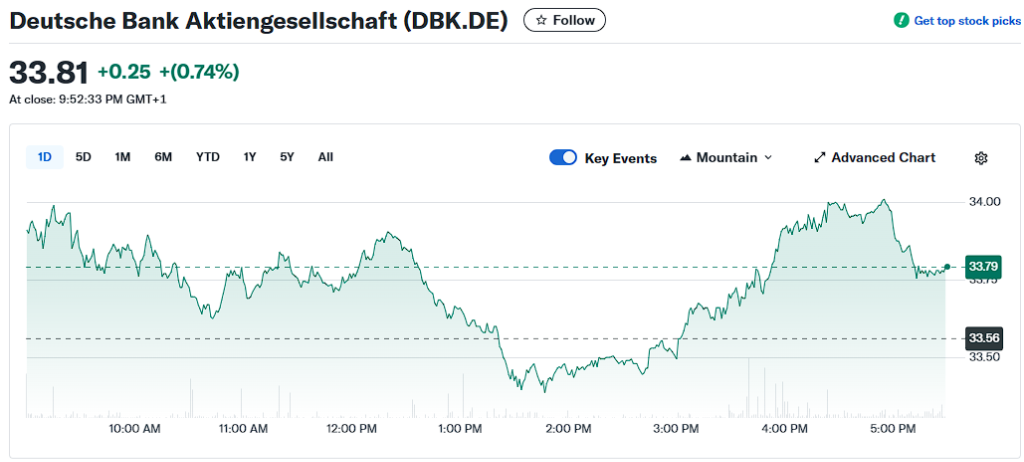
Core Viewpoint - Deutsche Bank's stock price has surpassed its book value for the first time since the 2008 global financial crisis, marking a significant milestone in the bank's transformation after years of legal setbacks, asset write-downs, and restructuring [1][4]. Group 1: Stock Performance and Valuation - On January 5, Deutsche Bank's stock reached €33.95, exceeding its reported book value of €33.66 per share, closing at €33.81, indicating a critical turning point [1]. - The price-to-book ratio, a key indicator of bank valuation, reflects investor confidence in the bank's asset quality and growth prospects, which had been trading below book value since early 2008 due to market concerns [4]. - The stock price had previously plummeted to below €5 in March 2020, with a price-to-book ratio of only 0.19, highlighting the significant recovery [4]. Group 2: Strategic Adjustments and Profit Recovery - Deutsche Bank's recovery is attributed to strategic adjustments, including exiting non-core businesses and focusing on competitive areas, resulting in the highest profit levels since 2007 for the first nine months of the previous year [5]. - The German government's debt-financed investment plans are expected to benefit Deutsche Bank's investment banking division, enhancing its role as a sovereign bond issuer and corporate restructuring advisor [5]. - Rising corporate credit demand is anticipated to boost the bank's loan business profitability [5]. Group 3: Investor Sentiment and Market Challenges - Despite significant progress, investor sentiment remains cautious, with some analysts suggesting that the recent stock price increase merely reflects a return to average profitability from minimal earnings [7]. - Concerns persist regarding Deutsche Bank's ability to achieve profitability levels comparable to peers like BBVA or Santander due to its capital-consuming investment banking division [7]. - The bank's long-term total return over the past decade has lagged behind the Stoxx 600 bank index and competitors such as UniCredit and BNP Paribas, with its performance overshadowed by domestic rival Commerzbank [7]. Group 4: Operational Integration and Business Challenges - Deutsche Bank continues to face integration challenges, particularly with Postbank, which has previously hindered its retail business, although branch closures and layoffs have improved profitability [8]. - The asset management division, DWS, has attracted significant inflows into low-margin passive products like ETFs but faces pressure in the alternative investment sector [8].

美股Q3财报季将迎开门红?投行业务复苏料助推六大银行业绩强势增长
智通财经网· 2025-10-10 13:32
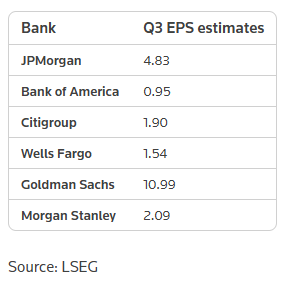
Core Viewpoint - The upcoming earnings season for major U.S. banks is expected to show strong performance driven by a recovery in investment banking and resilient economic conditions supporting consumer and commercial lending [1][2]. Group 1: Earnings Expectations - JPMorgan is projected to see a more than 10% increase in earnings per share (EPS) for Q3, with investment banking revenues expected to grow in the low double digits [1]. - Bank of America anticipates nearly a 17% year-over-year increase in EPS, with investment banking revenues expected to rise by 10% to 15% [2]. - Citigroup's EPS is expected to surge by 26%, primarily driven by capital markets activities [2]. - Goldman Sachs forecasts a 31% increase in EPS, benefiting from a rebound in investment banking and trading [2]. - Morgan Stanley expects over an 11% increase in EPS, supported by its strengths in capital markets and wealth management [2]. - Wells Fargo's EPS is projected at 1.54, while other banks have specific EPS estimates as well [3]. Group 2: Investment Banking Activity - Investment banking activities have rebounded due to regulatory easing and expectations of further interest rate cuts, with JPMorgan describing the summer as one of its busiest merger seasons [4]. - As of mid-September, 49 merger deals were announced in Q3, up from 39 in Q2 and 32 in the same period last year, with a total global merger volume reaching $2.6 trillion, the highest since the pandemic peak in 2021 [4]. Group 3: Trading and Interest Income Outlook - Trading revenues are expected to grow, with analysts noting that Q3 typically sees lower trading activity, but 2025 appears to break this trend [6]. - Net interest income (NII) is anticipated to remain robust due to the resilient U.S. economy, with banks reporting that consumer financial conditions are stable [6]. - Concerns are emerging regarding potential increases in default rates among small businesses, despite the overall positive outlook for investment and commercial banking [6].


特朗普搅局全球市场,华尔街大行在“动荡”中赚翻了!
Hua Er Jie Jian Wen· 2025-07-16 06:19
Group 1: Trading Revenue Surge - Major banks in Wall Street reported record trading revenues in Q2, driven by market volatility from Trump's tariff policies [1] - JPMorgan's fixed income trading generated $5.69 billion, while equity trading reached $3.25 billion, marking the best Q2 performance ever [1] - Citigroup's equity trading revenue was $1.61 billion, and fixed income trading surged 20% to $4.27 billion, exceeding forecasts [1] Group 2: Investment Banking Recovery - Investment banking fees showed unexpected growth, with JPMorgan's fees increasing by 7%, contrary to analysts' expectations of a 14% decline [2] - Citigroup's investment banking fees rose 13% year-over-year, surpassing $1 billion [2] Group 3: Mixed Performance Among Banks - Wells Fargo did not achieve similar success, with investment banking fees growing about 9% but falling short of analyst expectations [3] - Market volatility has led to cautious behavior among clients regarding borrowing and investment, impacting Wells Fargo's trading revenue [3]