
贷款业务

Search documents
因相关贷款业务管理不审慎等,交通银行重庆市分行被罚190万元
Bei Jing Shang Bao· 2026-02-12 11:15
Group 1 - The core viewpoint of the article highlights that the Chongqing branch of Bank of Communications was fined for improper management of loan and related business practices [1] - The penalty imposed on the bank amounts to 1.9 million yuan due to non-compliance in loan management and scrutiny of related bill and letter of credit businesses [1] - Two responsible individuals, Jiang Tianyi and Miao Honggang, received warnings as part of the administrative penalties [1]

银行业开年首张千万级罚单!三家被点名,都因这项业务违规
券商中国· 2026-02-08 06:23
Core Viewpoint - Recent regulatory actions indicate a strong stance on compliance within the banking sector, particularly regarding loan management practices, signaling a shift towards normalized governance in financial oversight [6][7]. Group 1: Regulatory Actions - Three banks have been penalized for violations related to loan management, with Hangzhou Rural Commercial Bank receiving a fine of 11.1 million yuan, marking the first significant penalty in the banking sector since 2026 [2][3]. - Other banks, including Bohai Bank's Wuhan branch and CITIC Bank's Hangzhou branch, were also fined for inadequate loan management practices, with penalties of 1.75 million yuan and 6.25 million yuan respectively [4][5]. Group 2: Compliance and Accountability - The regulatory environment is characterized by a "zero tolerance" approach towards compliance failures, emphasizing the importance of accurate data reporting and responsible loan management [6][7]. - The penalties imposed on multiple employees reflect a shift towards individual accountability, indicating that the regulatory framework is increasingly focusing on personal responsibility within financial institutions [6][7]. Group 3: Future Directions for Banking - To avoid future compliance issues, banks are encouraged to transition from a focus on scale to a focus on value, emphasizing strategic resource allocation towards innovation and sustainable development [7]. - The implementation of advanced technology for comprehensive risk monitoring is recommended to enhance loan management processes and reduce reliance on traditional methods [7].



Orrstown Financial Services(ORRF) - 2025 Q4 - Earnings Call Transcript
2026-01-28 15:02
Financial Data and Key Metrics Changes - Orrstown achieved a record annual net income of $80.9 million, or $4.18 per diluted share, with a return on average equity of 14.76% and a return on average assets of 1.49% [3] - For the fourth quarter, net income was $21.5 million, or $1.11 per diluted share, with a net interest margin of 4.00%, down from 4.11% in the previous quarter [10][11] - Fee income for the fourth quarter was $14.4 million, contributing to 22% of total revenues, marking the third consecutive quarter above 20% [5][12] Business Line Data and Key Metrics Changes - Loan growth was steady at 4% during the fourth quarter, with a balanced mix across commercial and real estate lending [7][16] - Non-interest income increased to $14.4 million in the fourth quarter from $13.4 million in the third quarter, driven by growth in wealth management and treasury management services [12][14] - The bank recorded minimal provision expense of $0.1 million and net charge-offs of $0.5 million, with classified loans decreasing by $5.7 million from the prior quarter [8][15] Market Data and Key Metrics Changes - Deposits were relatively flat, declining slightly by $5 million, with a loan-to-deposit ratio of 89% [17] - The cost of deposits was 1.98% for the fourth quarter, with expectations for reductions in funding costs starting in the first quarter of 2026 [11][17] Company Strategy and Development Direction - The company is focused on enhancing non-interest income and investing in talent to drive future growth, including the recent hiring of a Chief Wealth Officer [6][9] - There is a strong emphasis on building a middle-market commercial lending platform and expanding wealth management services in growth markets [40][41] - The company remains committed to organic growth rather than pursuing mergers and acquisitions, although capital build presents optionality for future opportunities [43] Management's Comments on Operating Environment and Future Outlook - Management expressed confidence in maintaining strong profitability and expects to continue building shareholder value through strong earnings and an attractive dividend [4][9] - The company anticipates a net interest margin in the range of 3.90%-4% for 2026, with a focus on managing funding costs [11][32] - Management remains optimistic about the future, citing a robust loan pipeline and the ability to responsibly grow the loan portfolio [8][20] Other Important Information - The board approved a quarterly dividend increase from $0.27 to $0.30 per share, marking the fourth increase in 18 months [9] - The investment portfolio is positioned to drive earnings growth, with recent purchases of $125 million in Agency MBS and CMOs [18][50] Q&A Session Summary Question: Increase in guidance for non-interest income and expenses - Management clarified that the increase reflects ongoing strategy to invest in talent to drive future earnings, not a change in strategy [24][25] Question: NIM trajectory for the year - Management indicated that core NIM should increase in Q1, with a projected decline of 2-3 basis points per quarter due to purchase accounting accretion [28][31] Question: Wealth management AUM and customer retention - Total AUM was over $3 billion, with no significant decline in the portfolio from Codorus Valley customers [37][38] Question: Focus areas for hiring - The company is focusing on building out the middle-market commercial lending platform and enhancing wealth management services [40] Question: Share buybacks and capital allocation - Management is monitoring share buyback opportunities but has not found the stock price favorable for repurchases [48] Question: Yields on recent securities purchases - The average yield on recent purchases was 4.92%, with expectations for continued benefits from the investment portfolio [50]

Amalgamated Financial (AMAL) - 2025 Q4 - Earnings Call Transcript
2026-01-22 17:00
Financial Data and Key Metrics Changes - Core earnings were $0.99 per diluted share, indicating consistent earnings power and potential for growing returns on tangible common equity [4] - Net income was $26.6 million, or $0.88 per diluted share, with core net income at $30 million, or $0.99 per diluted share [11] - Net interest income grew by 1.8% to $77.9 million, exceeding guidance [12] - Tangible book value per share rose $0.87, or 3.4%, with a strong tier one leverage ratio of 9.36% [13] Business Line Data and Key Metrics Changes - On-balance sheet deposits grew by $179 million to $7.9 billion, while off-balance sheet deposits increased by $789 million to $1.1 billion [4] - Loans increased by $167 million, or 3.5%, to $4.9 billion, with growth in multifamily, commercial real estate (CRE), and commercial and industrial (C&I) loans increasing by 7% [5][6] - The PACE portfolio saw total assessments grow by $38 million, or 3%, to $1.3 billion [6] Market Data and Key Metrics Changes - Political deposits increased by $287 million to $1.7 billion, reflecting growth in fundraising ahead of the midterm elections [5] - Not-for-profit deposits grew by $388 million, social and philanthropy deposits by $122 million, and climate and sustainability deposits by $77 million [5] Company Strategy and Development Direction - The company aims to cross $10 billion in assets and is focused on responsible expansion through investments in people and technology [6][10] - The business model emphasizes profitability tied to mission purpose, with a focus on maintaining a strong capital base and asset quality [10] - The company is positioned to leverage market opportunities and trends, with a strong track record of performance [44] Management's Comments on Operating Environment and Future Outlook - Management acknowledged the challenges faced in the banking sector, including rapid rate hikes and liquidity drains, but highlighted the bank's growth from $6 billion to nearly $9 billion in assets [8][9] - The outlook for 2026 includes targets for net interest income growth of 10%-11% and core return on average assets growth to 1.35% [16][17] - Management expressed confidence in the bank's ability to deliver quality returns on tangible common equity consistently [17] Other Important Information - The company recognized a $1.5 million tax credit, with a new tax strategy aimed at simplifying financials and reducing non-core adjustments [14] - Asset quality metrics remained solid, although there was some credit turbulence related to specific borrowers [15] Q&A Session Summary Question: Outlook for provision in 2026 based on credit perspective - Management expects provision outlook to be similar to 2025, with a conservative approach due to past challenges [22][25] Question: Thoughts on political deposits over the next quarters - Management anticipates growth in political deposits leading up to the election, with a strong pipeline for fundraising [27][28] Question: Multifamily growth and geographic distribution - Multifamily growth was strong, with nearly half coming from outside New York City, indicating good geographic diversification [29][30] Question: NIM expansion and commercial loan yields - NIM expansion was noted, with loan yields expected to rise, particularly from repricing older real estate loans [34][35] Question: Growth outlook for the PACE portfolio - Management sees significant growth potential in the PACE portfolio, with no restrictions on adding assets [36][37]

Bank OZK(OZK) - 2025 Q4 - Earnings Call Transcript
2026-01-21 14:32
Financial Data and Key Metrics Changes - The company reported a significant increase in its allowance for credit losses (ACL), which rose from $300 million to $632 million, reflecting prudent preparation for potential credit losses in a challenging environment [38] - The tangible common equity increased by 35 basis points during the quarter, despite the company buying back $100 million of common stock [56] Business Line Data and Key Metrics Changes - The Corporate and Institutional Banking (CIB) segment has seen growth in fee income initiatives, including loan syndication and interest rate hedging, which are expected to contribute positively to revenue in the coming years [17][19] - The mortgage lending business is gaining traction, with expectations for continued growth in fee income from originating loans for resale in the secondary market [19] Market Data and Key Metrics Changes - The office market is showing positive trends, with good leasing activity and refinancing opportunities, particularly in high-quality buildings [30][32] - The life sciences sector is facing challenges due to macroeconomic factors, but there is a lack of new supply, which may support future demand as capital investment in AI stimulates interest in life science spaces [28][34] Company Strategy and Development Direction - The company aims to diversify its earning assets and increase fee income as a larger part of its revenue over the long term, with a focus on enhancing its trust and wealth business and launching a private banking service [16][19] - The management is cautiously optimistic about the recovery in the commercial real estate (CRE) cycle, expecting 2026 to be near the end of the current cycle with improvements in conditions for sponsors [12][13] Management's Comments on Operating Environment and Future Outlook - Management expressed confidence in the gradual improvement of credit conditions, citing a return of liquidity and a normalization of supply-demand metrics in the office space [12][34] - The company anticipates that the credit charge-offs in 2026 will be similar to those experienced in 2025, with a focus on managing the risks associated with the CRE cycle [66][69] Other Important Information - The company has been actively managing its non-performing assets, with a focus on working collaboratively with sponsors to resolve issues and maximize asset value [50][53] - The company has initiated a stock buyback program, purchasing 2.25 million shares at an average price of $44.45, which is expected to be accretive to earnings and tangible book value [56] Q&A Session Summary Question: Outlook on credit charge-offs and loan sales - Management confirmed that the recent loan sale was at par and does not reflect a change in strategy, emphasizing that they expect credit conditions to improve in 2027 [8][10] Question: Fee income growth potential - Management indicated that while fee income has not been a significant part of the story, there are long-term tailwinds expected from investments in CIB and other initiatives [16][18] Question: Life sciences market recovery - Management noted that the life sciences sector is facing headwinds but is seeing some positive developments, with sponsors willing to support projects [26][28] Question: Resolution timeline for non-performing assets - Management discussed various paths for resolving non-performing assets, emphasizing a collaborative approach with sponsors to maximize value [44][48] Question: Margin outlook and buyback strategy - Management highlighted that the margin performed well in the last quarter and discussed the opportunistic nature of the buyback program, with plans to remain active if trading conditions are favorable [56][58]

严监管趋势不断增强 2026年以来银行业收到超200张监管罚单
Zhong Zheng Wang· 2026-01-17 08:27
Group 1 - The core viewpoint of the news is that the Financial Regulatory Administration emphasizes the importance of risk prevention, strong regulation, and promoting high-quality development in the financial sector for 2026, aiming to avoid systemic financial risks [1] - In 2025, the banking sector received over 6,500 penalties totaling more than 2.6 billion yuan, with around 1,100 banks penalized [1] - The largest penalties in 2025 were imposed on China Bank (9.79 million yuan), Huaxia Bank (8.725 million yuan), and Bank of Communications (6.783 million yuan) for various management violations [1][2] Group 2 - In 2026, the trend of strict regulation is expected to continue, with over 200 penalties issued to banks and their branches since the beginning of the year [1] - Common violations leading to penalties include non-compliance in credit business, anti-money laundering issues, and inadequate internal controls, with approximately 2,900 penalties related to credit business violations, 1,380 related to anti-money laundering, and 1,360 related to internal control deficiencies in 2025 [2]


2008年来第一次!德银PB重回1以上,2020年最低点曾跌至0.19
Hua Er Jie Jian Wen· 2026-01-06 00:38
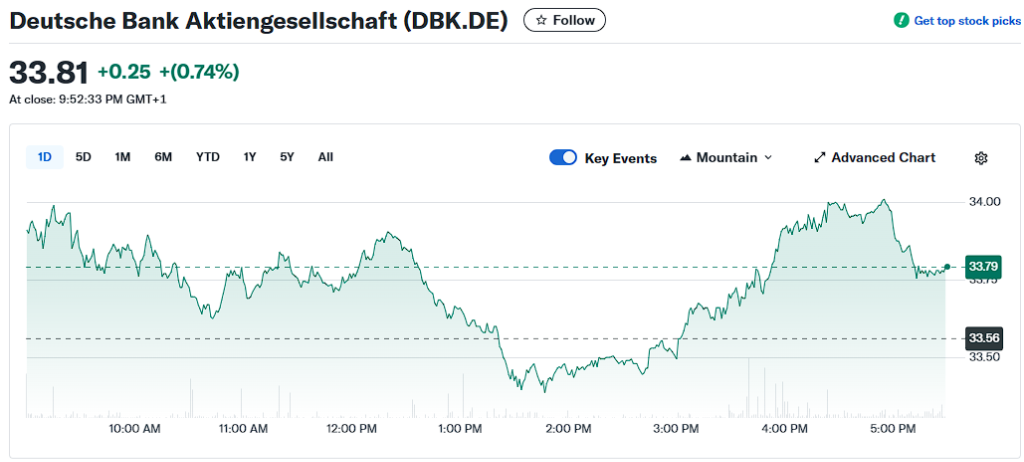
Core Viewpoint - Deutsche Bank's stock price has surpassed its book value for the first time since the 2008 global financial crisis, marking a significant milestone in the bank's transformation after years of legal setbacks, asset write-downs, and restructuring [1][4]. Group 1: Stock Performance and Valuation - On January 5, Deutsche Bank's stock reached €33.95, exceeding its reported book value of €33.66 per share, closing at €33.81, indicating a critical turning point [1]. - The price-to-book ratio, a key indicator of bank valuation, reflects investor confidence in the bank's asset quality and growth prospects, which had been trading below book value since early 2008 due to market concerns [4]. - The stock price had previously plummeted to below €5 in March 2020, with a price-to-book ratio of only 0.19, highlighting the significant recovery [4]. Group 2: Strategic Adjustments and Profit Recovery - Deutsche Bank's recovery is attributed to strategic adjustments, including exiting non-core businesses and focusing on competitive areas, resulting in the highest profit levels since 2007 for the first nine months of the previous year [5]. - The German government's debt-financed investment plans are expected to benefit Deutsche Bank's investment banking division, enhancing its role as a sovereign bond issuer and corporate restructuring advisor [5]. - Rising corporate credit demand is anticipated to boost the bank's loan business profitability [5]. Group 3: Investor Sentiment and Market Challenges - Despite significant progress, investor sentiment remains cautious, with some analysts suggesting that the recent stock price increase merely reflects a return to average profitability from minimal earnings [7]. - Concerns persist regarding Deutsche Bank's ability to achieve profitability levels comparable to peers like BBVA or Santander due to its capital-consuming investment banking division [7]. - The bank's long-term total return over the past decade has lagged behind the Stoxx 600 bank index and competitors such as UniCredit and BNP Paribas, with its performance overshadowed by domestic rival Commerzbank [7]. Group 4: Operational Integration and Business Challenges - Deutsche Bank continues to face integration challenges, particularly with Postbank, which has previously hindered its retail business, although branch closures and layoffs have improved profitability [8]. - The asset management division, DWS, has attracted significant inflows into low-margin passive products like ETFs but faces pressure in the alternative investment sector [8].
取消“开门红”?银行人:世界首富家底也扛不住三轮净增指标
Sou Hu Cai Jing· 2026-01-03 10:10
Core Viewpoint - The term "开门红" (literally "opening red") is not being canceled, but rather is expected to intensify in its significance and activities within the banking sector [2][3]. Group 1: Importance of "开门红" - "开门红" is crucial for banks as it sets the performance benchmarks for the entire year, with significant emphasis on achieving targets in the first quarter [13]. - The first quarter is vital for banks to secure deposits, especially during the Chinese New Year when cash flow is typically low, making it essential for banks to attract funds during this period [14]. - Many banks begin preparations for "开门红" as early as November or December, indicating its importance in annual planning [15]. Group 2: Perspectives from Banking Employees - Employees at various levels express mixed feelings about "开门红," with some feeling overwhelmed by the unrealistic targets set by upper management [4][6]. - The complexity of the performance indicators has increased, leading to internal competition and challenges in meeting these targets [7][9]. - There is a recognition that the performance metrics often conflict with operational realities, creating a challenging environment for employees [10][12]. Group 3: Operational Challenges - The banking sector faces a paradox where marketing departments are pressured to meet high performance targets while being restricted by compliance and risk management regulations [9][10]. - Employees often feel that the performance targets are set without consideration of market conditions, leading to frustration and a sense of futility in achieving these goals [6][9]. - The need for compliance checks during the busy "开门红" period adds to the operational burden on employees, detracting from their ability to focus on sales and customer service [10][12].

东方企控集团(00018.HK)中期净利润约128万港元 同比下降约94.8%
Ge Long Hui· 2025-11-21 11:54
Core Viewpoint - Oriental Enterprise Holdings Limited (00018.HK) reported a decline in revenue and profit for the six months ending September 30, 2025, primarily due to decreased income from its media and loan businesses [1] Financial Performance - The group's revenue was approximately HKD 239 million, a decrease of about HKD 41.13 million or approximately 15% compared to the same period last year [1] - After accounting for a net fair value loss of investment properties of approximately HKD 7.9 million and a provision for expected credit losses on receivables of approximately HKD 6.144 million, the profit attributable to owners was approximately HKD 15.33 million [1] - The unaudited consolidated profit attributable to owners for the reporting period was approximately HKD 1.28 million, down from approximately HKD 25.01 million in the same period last year [1] Business Segments - The decline in profit was mainly attributed to a drop in revenue from the group's media business, including publishing and advertising, as well as a decrease in income from the loan business [1]
东方企控集团发盈警 预期中期股东应占溢利不多于200万港元
Zhi Tong Cai Jing· 2025-11-13 10:56
Core Viewpoint - Oriental Enterprise Holdings (00018) anticipates a significant decline in unaudited consolidated profit attributable to owners for the six months ending September 30, 2025, projecting no more than HKD 2 million compared to approximately HKD 25.098 million in the same period last year [1] Financial Performance - The company expects unaudited consolidated profit attributable to owners to decrease from approximately HKD 25.098 million to no more than HKD 2 million [1] - The anticipated decline in profit is attributed to adverse macroeconomic conditions leading to decreased revenue from the group's media and loan businesses [1] Provisions and Losses - The company has made a provision for expected credit losses of approximately HKD 6.144 million due to a decline in the value of collateral for certain loans and related settlement arrangements [1]