国产公路车

Search documents
05后重塑二手消费市场:从“省钱”到“悦己”的兴趣经济崛起
Zhong Guo Jing Ji Wang· 2026-01-21 07:01
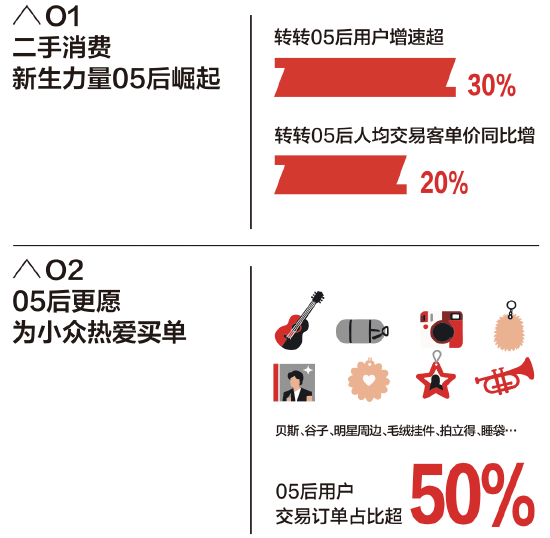
Group 1 - The core viewpoint of the articles highlights the transformation of second-hand consumption from a "tool for saving money" to a "projection of lifestyle," driven by the post-2005 generation's emergence as a significant force in the market [1][2] - The report indicates that the user growth rate for the post-2005 demographic on the platform exceeds 30% in 2025, with their transaction behavior showing a clear "interest-oriented" trend, particularly in categories like trendy toys and celebrity merchandise [1] - The average transaction value per user in the post-2005 group has increased by 20% compared to 2024, with orders for celebrity merchandise growing by 800% in 2025, indicating a shift towards "treasure hunting" for unique items rather than merely saving money [1] Group 2 - The circular economy is evolving from traditional essential consumption to a comprehensive lifestyle approach, with cross-category transaction users on the platform growing over 116% year-on-year in 2025 [2] - The report notes that users engaging in both buying and selling behaviors on the platform have increased by over 30%, reflecting a more mature and interesting consumption philosophy of "saving where possible, spending where necessary" [2] - Different age groups exhibit distinct preferences, with the 18-24 age group more inclined to buy second-hand items for enjoyment, while the 25-34 age group tends to sell unused items [2] Group 3 - The boundaries of second-hand consumption are rapidly expanding, with significant user growth in third-tier and lower cities, such as Jin Cheng and Yili, indicating strong purchasing demand in these regions [3] - The perception of second-hand goods as merely "depreciated" is challenged by data showing that certain second-hand items can retain or even increase in value, with high-end products like HERMES bags achieving a preservation rate of 271% [3] - Emerging consumer trends, such as cycling and sports, have led to a surge in the trading volume of specific categories like domestic road bikes and popular collectible figures, showcasing their strong market value [3]
二手消费年度洞察:循环经济步入“理智与情感”共存新周期
Huan Qiu Wang· 2026-01-19 08:13
Group 1 - The core viewpoint of the articles highlights the transformation of second-hand consumption from a "tool for saving money" to a "projection of lifestyle," driven by the post-2005 generation [1][2] - The post-2005 generation has emerged as a significant force in the second-hand market, with a user growth rate exceeding 30% on platforms like Zhuanzhuan in 2025 [1] - The transaction behavior of post-2005 users is characterized by a strong "interest orientation," with over 50% of users in categories like trendy toys and celebrity merchandise being from this demographic [1] Group 2 - The report indicates that the average transaction value per user in the post-2005 group increased by 20% compared to 2024, with a notable 800% growth in orders for celebrity merchandise in 2025 [1] - The circular economy is evolving from traditional essential consumption to a new lifestyle approach, with cross-category trading users on Zhuanzhuan increasing by over 116% in 2025 [2] - Emerging consumer trends, such as cycling and sports, have led to a surge in the trading volume of specific categories like domestic road bikes and popular IP figurines, showcasing strong circulation value [2]
转转发布2025二手消费年度洞察:05后用户占增速超30%
Xin Lang Cai Jing· 2026-01-19 03:58
Core Insights - The report from Zhuanzhuan Group indicates that by 2025, the user growth rate among post-2005 generation will exceed 30%, with over 50% of users in interest-based transactions being from this demographic [1][5] - The average transaction value per user in the post-2005 generation has increased by 20% compared to 2024, with a notable 800% growth in transaction orders for celebrity merchandise [1][5] - Cross-category transaction users on the Zhuanzhuan platform have grown by over 116% year-on-year, indicating a trend of users exploring multiple second-hand categories after initial purchases [1][5] User Demographics - Different generational and regional user preferences are evident, with individuals aged 18-24 primarily acting as buyers to enjoy affordable goods, while those aged 25-34 are more likely to sell second-hand items [1][5] - Rapid user growth is observed in third-tier and lower cities, with cities like Jincheng, Yili, Kashgar, Zhoushan, and Yichang ranking in the top 10 for user growth [2][6] Market Trends - Users in first-tier and new first-tier cities tend to supply idle resources to the second-hand market, while third and fourth-tier cities show strong purchasing demand [2][6] - The report highlights a significant transaction that spanned 5,684 kilometers, showcasing the extensive reach of the platform [2][6] Offline Expansion - Zhuanzhuan is accelerating the expansion of its offline store network, particularly in third and fourth-tier cities, enhancing the richness of offline consumption scenarios [2][6] - The first multi-category second-hand circular warehouse store, Super Zhuanzhuan, opened in Beijing in June 2025, covering over 3,000 square meters, followed by a store in Zhengzhou focusing on 3C digital products and leisure items in October 2025 [2][6][7] - The company has established over 1,100 small stores nationwide that integrate retail and recycling services, further penetrating third and fourth-tier cities [7] Emerging Consumption Trends - New consumption hotspots are emerging, with increased interest in cycling, sports consumption, and trendy collectibles, leading to a surge in transaction volumes for domestic road bikes, pool cues, and popular IP figurines like Labubu and Starry People [3][7]