基础款服装

Search documents
把消费者当小偷防,优衣库惹怒年轻人
虎嗅APP· 2025-12-23 00:14
Core Viewpoint - Uniqlo is facing significant backlash from consumers due to reports of invasive surveillance practices in stores, which are perceived as disrespectful and damaging to customer trust [9][21][30]. Group 1: Customer Surveillance Issues - Reports indicate that some Uniqlo stores have implemented a practice of monitoring customers, labeling those deemed suspicious as "11号" (No. 11) and sharing their images in internal groups [12][13][14]. - Employees are instructed to follow and monitor these "11号" customers, with some stores even resorting to taking photos of them for internal distribution [15][16]. - This practice has sparked outrage on social media, with many consumers feeling that it infringes on their privacy and dignity [18][21]. Group 2: Business Performance in China - Uniqlo's performance in the Chinese market is declining, with revenue dropping by 4% and operating profit decreasing by 12.5% in the latest fiscal year, marking the first time both metrics have fallen [26][27]. - The decline is attributed to changing consumer preferences, with younger shoppers seeking more unique and fashionable options rather than basic items, which Uniqlo primarily offers [28]. - The competitive landscape has intensified, with local brands providing similar products at better price points, leading to a loss of Uniqlo's customer base [28]. Group 3: Strategic Adjustments - In response to market challenges, Uniqlo is shifting its strategy from aggressive store expansion to focusing on fewer, higher-quality flagship stores that enhance customer experience [29]. - The company is also integrating online and offline shopping experiences, introducing features like online ordering with in-store pickup to improve convenience for customers [29][30]. - However, rebuilding consumer trust after the surveillance incident will be a significant challenge, and the company must also innovate in design, pricing, and brand reputation to regain market share [31].

把消费者当小偷防,优衣库惹怒年轻人
凤凰网财经· 2025-12-22 13:42
Core Viewpoint - The article discusses the negative consumer experience at Uniqlo stores in China, highlighting issues of surveillance and privacy violations, which have led to a backlash against the brand [2][6][18]. Group 1: Consumer Experience and Surveillance - Many consumers have reported feeling uncomfortable due to being closely monitored by staff, with some even being followed and photographed under the suspicion of theft [3][6]. - Internal reports indicate that certain Uniqlo stores have a practice of labeling suspicious customers as "11号" (No. 11), leading to invasive monitoring and sharing of their images among staff [7][10]. - The practice of surveillance is reportedly directed by regional managers, indicating that it is a systematic approach rather than isolated incidents [6][12]. Group 2: Impact on Business Performance - Uniqlo's parent company, Fast Retailing, reported a global revenue increase of 9.6% and a profit increase of 16.4% for the fiscal year 2025, but the Greater China region saw a revenue decline of 4% and a profit drop of 12.5%, marking the first time both metrics fell in this market [21][23]. - The decline in performance is attributed to changing consumer preferences, with younger shoppers seeking more unique and fashionable options rather than basic items, which Uniqlo primarily offers [27][28]. - The company has begun to shift its strategy from aggressive store expansion to focusing on fewer, higher-quality flagship stores that enhance customer experience [29][30]. Group 3: Future Strategies - Uniqlo is attempting to improve its market position by enhancing store experiences and integrating digital services, such as online ordering and in-store pickup [31][32]. - However, regaining consumer trust after the surveillance incident may take considerable time, and the competitive landscape in the Chinese apparel market is intensifying [33][34].

基础款重回时尚C位 强调品质确定性 七成消费者优选京东买服装
Xin Jing Bao· 2025-06-05 12:07
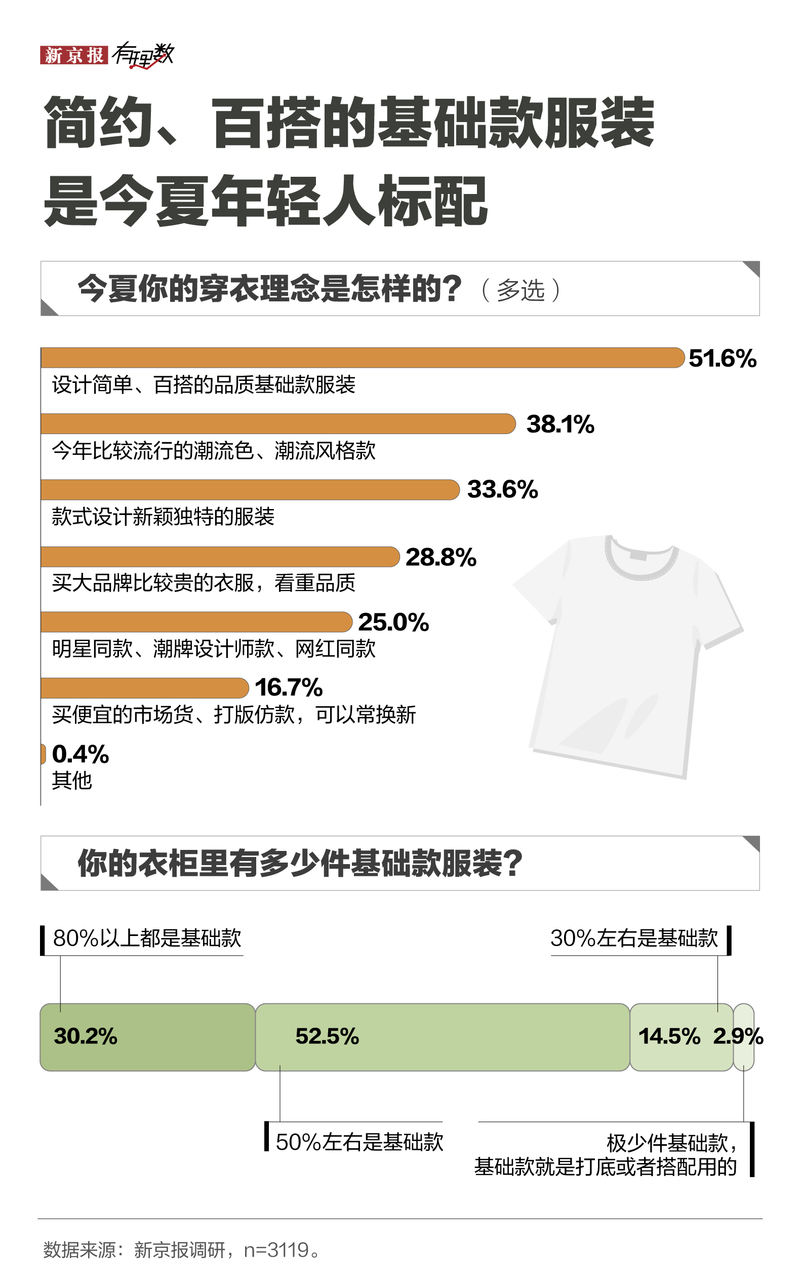
Core Insights - The fashion industry is experiencing a shift towards simple and versatile basic clothing, with 51.6% of consumers preferring such items for summer [1][5] - Consumers are increasingly valuing practicality and efficiency in their clothing choices, with over 80% indicating that more than half of their wardrobe consists of basic items [5] - The trend reflects a desire for timeless classics that can withstand changing fashion cycles, emphasizing quality and long-term use over fleeting trends [1][8] Consumer Preferences - 46.8% of consumers prioritize fabric quality when purchasing clothing, while 45.7% focus on practicality for multiple occasions [8] - There is a clear preference for brands that consumers trust, with 34.3% showing brand loyalty and 30.4% primarily purchasing basic items [12][15] - The demand for basic clothing is characterized by a focus on material quality and cost-effectiveness, with over 40% of consumers emphasizing these factors [8] Shopping Behavior - During the "6.18" shopping festival, over 72.2% of consumers either increased or maintained their clothing budget, indicating a willingness to invest in quality [19][24] - A significant portion of consumers (66.9%) chose to shop on JD.com for basic clothing due to its perceived quality assurance and reliable service [24][30] - The trend of "precise decentralized consumption" is evident, with consumers seeking platforms that offer a trustworthy shopping experience [30][31] Brand Insights - MUJI leads in consumer preference for basic clothing with a selection rate of 38.9%, while emerging brands like Bananahome and domestic brands like Li-Ning also show strong appeal [15] - The increasing focus on quality and brand reliability reflects a shift in consumer behavior towards established brands that offer practical and stylish options [15][19] Quality Assurance - JD.com has implemented quality standards for various clothing categories, enhancing consumer confidence in their purchases [32] - Nearly 60% of consumers are aware of JD.com's quality assurance initiatives, which contribute to a more reliable shopping experience [32]