壁仞BR100

Search documents
国产GPU的大时代
3 6 Ke· 2025-12-22 01:05
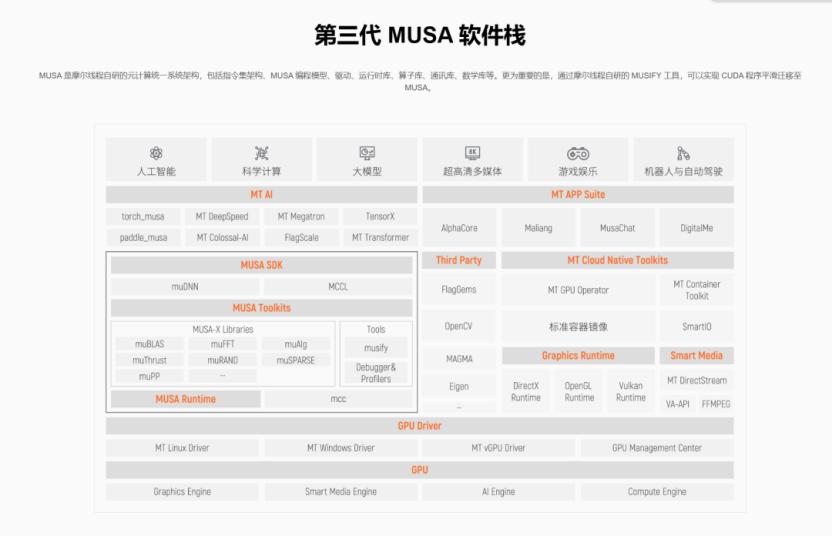
Core Viewpoint - The recent surge in the stock prices of domestic GPU companies, particularly Moxing and Muxi, reflects a speculative enthusiasm in the market, despite their significant financial losses and the nascent stage of their commercialization efforts [1][2][18]. Group 1: Market Performance and Investor Sentiment - Moxing's stock price skyrocketed over 568% upon its debut on the STAR Market, with a market capitalization exceeding 300 billion yuan, leading to substantial profits for investors [1]. - The combined market value of Moxing and Muxi has surpassed 600 billion yuan, indicating a fervent optimism in the capital market [1]. - Despite the companies' financial losses, investors remain undeterred, viewing their GPUs as essential assets in the AI era, with significant market potential [3][18]. Group 2: Financial Performance and Business Models - Moxing, Muxi, and Biran are currently experiencing substantial losses, with Moxing reporting a loss of 724 million yuan in the first three quarters of 2025, Muxi at 346 million yuan, and Biran at 1.601 billion yuan in the first half of the year [2]. - All three companies are in the phase of increasing R&D investments, with no immediate prospects for profitability [2]. - Moxing's fundraising of 8 billion yuan has raised questions about its allocation, as it announced plans to invest up to 7.5 billion yuan in wealth management products shortly after [4]. Group 3: Competitive Landscape and Differentiation - Moxing, Muxi, and Biran are differentiated in their approaches: Moxing aims for full functionality and ecosystem compatibility, Muxi focuses on high-performance computing for data centers, and Biran emphasizes extreme computing capabilities [6][17]. - Moxing's strategy closely mirrors NVIDIA's trajectory, with its founder having a background in NVIDIA, aiming to create a versatile GPU capable of handling multiple tasks [7]. - Muxi's core team originates from AMD, targeting AI computing without venturing into gaming graphics cards, while Biran has gained attention for its aggressive design and high-performance metrics [14][17]. Group 4: Commercialization and Market Adoption - Moxing has made strides in commercialization, with 90% of its sales now direct, indicating a capability to meet customer demands effectively [22]. - Muxi has successfully implemented large-scale applications, with over 25,000 units sold, primarily in national AI public computing platforms [25]. - Biran's revenue for the first half of the year was 587 million yuan, indicating a gap compared to Moxing and Muxi, and it faces challenges in converting its technical advantages into sustained orders [17]. Group 5: Future Outlook and Market Potential - The AI computing market is projected to grow significantly, with estimates suggesting that China's total computing power will reach 3442.89 EFLOPs by 2029, with a compound annual growth rate of 40% [19]. - The current valuations of Moxing and Muxi are seen as detached from traditional valuation metrics, with Moxing and Muxi's price-to-sales ratios exceeding 300 and 150 times, respectively [19][21]. - The sentiment in the market is driven by the potential for domestic GPU companies to fill the supply gap left by NVIDIA, with increasing interest from major domestic manufacturers [21][22].

围观!预算2100万GPU服务器别样标书
是说芯语· 2025-11-18 07:57
Core Insights - The article highlights a significant shift in the procurement strategy of AI computing power by top universities, moving from traditional hardware specifications to practical performance and compatibility with mainstream AI models like DeepSeek and Qwen [1][10]. Procurement Strategy - The procurement document emphasizes the importance of practical performance and compatibility over mere hardware specifications, marking a departure from the previous focus on "parameter stacking" [3][10]. - The core requirements include a focus on domestic production, ensuring real-world performance, and compatibility with existing CUDA ecosystems [3][10]. Technical Specifications - The procurement specifies the need for 13 GPU servers, with detailed requirements for CPU, memory, storage, and network capabilities, emphasizing the use of domestic components [4][6][8]. - Key performance indicators include the ability to run specific AI models under defined conditions, such as maintaining low latency and high throughput during inference tasks [9][11]. Trends in AI Computing Power Procurement - The article identifies three major trends in GPU server procurement by universities: 1. Transitioning from "indicator comparison" to "model testing" [10]. 2. Moving from a "NVIDIA-dominated ecosystem" to a "domestic compatible ecosystem" [10]. 3. Shifting focus from "hardware procurement" to "computing power system construction" [11]. Market Implications - The procurement strategy indicates a growing demand for domestic AI computing solutions that can effectively replace imported technologies, thereby fostering the development of a robust domestic AI ecosystem [12]. - Companies like Haiguang, Biran, and Muxi are highlighted as potential suppliers capable of meeting these stringent requirements, showcasing advancements in their GPU and CPU technologies [11][12].
易观分析:2025年中国AI算力基础设施发展趋势洞察报告
Sou Hu Cai Jing· 2025-08-29 15:44
Overview of AI Computing Infrastructure in China - The report by Analysys focuses on the development status, core driving factors, key trends, and stakeholder recommendations for AI computing infrastructure in China by 2025 [1] - The evolution path of computing infrastructure is shifting from "scale expansion" to "quality and efficiency improvement" [1] National Strategy and Scale Position - The "East Data West Computing" project is central to the national strategy, with plans to build national computing hubs in eight regions including Beijing-Tianjin-Hebei and the Yangtze River Delta, and to establish ten data center clusters [5] - As of 2024, the number of operational computing center racks in China is expected to reach 8.3 million, with a total computing power exceeding 280 EFLOPS, making it the second largest globally [7] - Intelligent computing power accounts for over 30% of the total, with a growth of nearly 13 times since 2019, averaging an annual growth rate of about 90% [7] Development Environment - National policies are solidifying top-level design, with local governments setting clear goals for intelligent computing construction [12] - Technological advancements in AI chips and cooling technologies are reducing Power Usage Effectiveness (PUE) [17] - The demand for computing power is surging due to generative AI, with applications expanding from the internet to traditional industries like finance and healthcare [19] - The supply of computing power is transitioning from heavy asset investment to platform-based services, lowering barriers for SMEs [21] Development Progress and Core Drivers - The development stages include an exploration phase (~2019), a market activation phase (2020-2022), and a high-speed growth phase (2023-2028) [26][34] - Five core driving factors include the iteration of large models, policy and capital linkage, industrial application scaling, long-tail computing power release, and cloud scheduling technology [35][36][37][38] Key Trends for AI Computing Infrastructure by 2025 - Trend 1: Accelerated breakthroughs in autonomous controllable computing power, with a goal for over 70% of computing power in Shanghai to be domestically controlled by 2027 [39] - Trend 2: Green computing becoming a hard constraint, with new data centers required to meet specific PUE standards [41] - Trend 3: Deepening cross-regional computing interconnection, enhancing the national backbone network for free flow of computing power [44] - Trend 4: Dual-track development of intelligent computing cloud platforms, offering comprehensive and vertical services [46] - Trend 5: New demands driven by large language models and knowledge bases, increasing the need for specialized computing centers [48] - Trend 6: Accelerated cloud computing for inclusivity, with a projected 80% growth in the smart computing service market by 2024 [49] Stakeholder Recommendations - Government: Strengthen regional computing network planning and provide financial/tax incentives for green computing and autonomous technology development [51] - Enterprises: Supply side should create high-quality computing cloud platforms, while demand side should prioritize cloud leasing over self-built solutions [52] - Industrial Parks: Develop intelligent computing industry clusters with supporting green energy and high-speed networks [53] - Ecosystem: Collaborate among chip, server, and cloud platform companies to tackle key technologies and establish industry standards [54]