
太阳能光伏产品

Search documents
横店东磁股价跌5.04%,广发基金旗下1只基金位居十大流通股东,持有913.45万股浮亏损失940.86万元
Xin Lang Ji Jin· 2026-02-05 03:42
Group 1 - The core point of the news is that Hengdian East Magnetic experienced a decline of 5.04% in stock price, reaching 19.42 yuan per share, with a trading volume of 4.51 billion yuan and a turnover rate of 1.40%, resulting in a total market capitalization of 31.591 billion yuan [1] - Hengdian Group East Magnetic Co., Ltd. was established on March 30, 1999, and listed on August 2, 2006. The company specializes in the production and sales of permanent magnetic ferrite, soft magnetic ferrite, other magnetic materials, batteries, and solar photovoltaic products [1] - The main business revenue composition includes photovoltaic products at 67.47%, magnetic materials at 16.24%, lithium batteries at 10.77%, devices at 3.62%, and others (including other business income) at 1.89% [1] Group 2 - From the perspective of the top ten circulating shareholders, a fund under GF Fund ranks among the top shareholders of Hengdian East Magnetic. The GF Guozhen New Energy Vehicle Battery ETF (159755) entered the top ten circulating shareholders in the third quarter, holding 9.1345 million shares, accounting for 0.56% of the circulating shares [2] - The GF Guozhen New Energy Vehicle Battery ETF (159755) was established on June 15, 2021, with a latest scale of 14.086 billion yuan. It has incurred a loss of 0.48% this year, ranking 5095 out of 5566 in its category; over the past year, it has achieved a return of 65.88%, ranking 450 out of 4285; and since its inception, it has returned 6.41% [2] Group 3 - The fund manager of GF Guozhen New Energy Vehicle Battery ETF (159755) is Luo Guoqing, who has a cumulative tenure of 10 years and 119 days. The current total asset scale of the fund is 116.678 billion yuan, with the best fund return during his tenure being 109.05% and the worst being -48.08% [3]

全球可再生能源就业增速趋缓
中国能源报· 2026-02-02 02:06
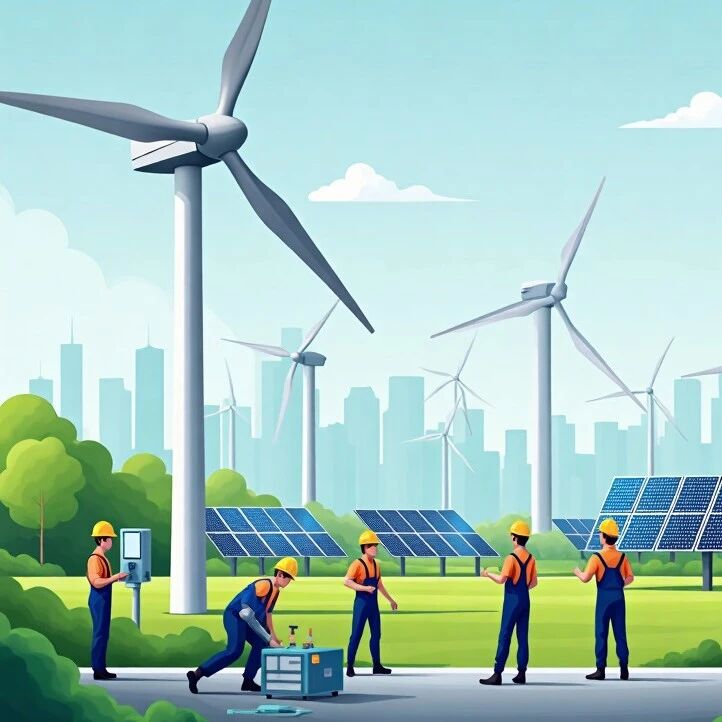
Core Viewpoint - The report by IRENA and ILO highlights a slowdown in employment growth in the renewable energy sector despite a continuous increase in installed capacity and investment, with global renewable energy employment growth dropping to 2%-3% in 2024, significantly lower than previous years [2][4][6]. Employment Growth Trends - In 2024, global renewable energy employment reached 16.6 million, marking a slight increase but with a growth rate of only 2.3%-2.5%, the lowest in recent years, contrasting sharply with over ten percent growth in 2023 [4][5]. - Solar photovoltaic (PV) remains the dominant sector, providing over 7.2 million jobs, accounting for more than 40% of total renewable energy employment [4]. Factors Influencing Employment - The slowdown in employment growth is attributed to several factors, including increased automation and economies of scale, which reduce the labor input required per unit of capacity [5][10]. - Delays in grid infrastructure and lengthy project approval processes also hinder the speed of project implementation, affecting job creation [5]. Regional Contributions - China plays a crucial role in global renewable energy employment, with over 4.2 million jobs in solar PV, representing nearly 60% of global solar employment [8]. - In 2024, China's renewable energy employment slightly declined due to increased labor productivity and economies of scale, rather than a decrease in demand [8]. - Other regions show varied employment levels, with the EU at approximately 1.8 million jobs, Brazil at 1.4 million, and limited growth in India and the US [8]. Industry Maturity and Challenges - The renewable energy sector is entering a more mature phase, with employment changes influenced by technological advancements, industry restructuring, and policy environments [10]. - Automation and digitalization are replacing traditional labor-intensive jobs, while overcapacity and structural adjustments are pressuring employment in certain regions [10]. - There is a significant regional imbalance in renewable energy employment, with Asia dominating while Africa faces challenges in attracting investment and developing local industries [10]. Policy Coordination and International Cooperation - The report emphasizes the need for enhanced policy coordination and international collaboration to create a balanced development environment for renewable energy [11]. - It suggests that countries should align trade, industry, and labor policies, focusing on the human aspect of energy transition [11].

南玻A四家子公司入选2025年广东高新技术企业名单
Zhong Jin Zai Xian· 2026-01-30 10:23
Core Viewpoint - The recognition of four subsidiaries of Nanbo A as high-tech enterprises in Guangdong Province for 2025 highlights the company's commitment to innovation and positions it to benefit from various policy incentives [1][3]. Group 1: Company Achievements - Four subsidiaries of Nanbo A, including Zhaoqing Nanbo Energy-saving Glass Co., Ltd., Dongguan Nanbo Engineering Glass Co., Ltd., Qingyuan Nanbo Energy-saving New Materials Co., Ltd., and Dongguan Nanbo Photovoltaic Technology Co., Ltd., have been recognized as high-tech enterprises [1]. - Nanbo A has received numerous honors, including national high-tech enterprise status, national manufacturing single champion products, and over 2,500 patent authorizations [2]. Group 2: Innovation and R&D - The company emphasizes independent, collaborative, and open innovation, with a robust R&D management system and strong intellectual property protection [2]. - In 2024, the number of R&D personnel is expected to reach 1,744, with R&D expenditure projected at 611 million yuan, placing it among the top 20 in A-share market [2]. Group 3: Policy Benefits and Future Outlook - The high-tech enterprise recognition allows Nanbo A to enjoy tax benefits, research funding, and financial support, reinforcing its long-term focus on R&D and professional fields [3]. - This recognition is expected to support the company's industrial layout and market position, contributing to its green and sustainable development in line with the "dual carbon" goals [3].

美经济学家:美国出现了严重战略失误,根本没料到中国会这么强大
Sou Hu Cai Jing· 2025-12-30 14:16
Core Viewpoint - The article highlights the misjudgments of the United States in economic decision-making, which stem from long-standing arrogance and misinterpretation of the international landscape [1] Group 1: Trade and Economic Competition - The U.S. initially believed it could easily maintain its leading position in trade and technology but has repeatedly faced setbacks in reality [3] - The U.S. underestimated China's ability to achieve comprehensive advancements within the existing rule framework, revealing shortcomings in U.S. strategic planning [4] - The U.S. has historically viewed China as a developing economy needing guidance, but China has instead followed a path suited to its own national conditions, focusing on long-term planning and industrial upgrades [6] Group 2: Industry and Technological Development - In the renewable energy sector, China began systematic investments over a decade ago, while the U.S. only recently started to catch up, resulting in a competitive disadvantage for the U.S. [6] - The electric vehicle industry exemplifies U.S. missteps, as China has built a complete industrial chain, achieving cost control and scale effects, while U.S. companies face supply chain dependencies and high costs [6] - The solar photovoltaic industry demonstrates U.S. strategic misjudgment, with China dominating global production capacity and continuously lowering costs through technological iterations [8] Group 3: Policy and Global Trade Dynamics - The U.S. has overestimated its control over global value chains, believing that technological barriers could indefinitely block latecomer countries [8] - U.S. trade policies, particularly during the Trump administration, have led to internal contradictions and inflationary pressures, while China has maintained stable growth and improved its export structure [10] - U.S. export controls in the semiconductor sector aimed at limiting China's development have inadvertently accelerated domestic R&D in China, increasing its self-sufficiency [10] Group 4: Renewable Energy and Supply Chain - China leads globally in wind and solar installation capacity, significantly outpacing Western countries due to long-term investments and policy support [12] - The U.S. struggles with supply chain dependencies on Chinese raw materials in the renewable energy sector, hindering its ability to achieve independence [12] Group 5: Global Supply Chain and Economic Governance - The U.S. attempts to relocate production to other countries have highlighted efficiency and cost issues, while China has expanded its partnership network through the Belt and Road Initiative [14] - The article emphasizes that the U.S. needs to reflect on its own model rather than solely blaming others, as China's development illustrates the viability of diversified paths within the framework of fair rule application [14]

深交所向广东泉为科技股份有限公司、褚一凡、雷心跃发出监管函
Mei Ri Jing Ji Xin Wen· 2025-12-25 14:34
Group 1 - The core issue involves regulatory actions against Guangdong Quanwei Technology Co., Ltd. for violations including non-operating fund occupation and internal control deficiencies [1] - The company borrowed 1.3 million yuan from a related party, Shanghai Yunjin Trading Co., Ltd., between January 19 and February 7, 2023, which constitutes non-operating fund occupation [1] - Internal control deficiencies were identified, including lack of board approval for guarantees and improper use of company seals in contracts totaling 52.7986 million yuan [1] Group 2 - As of the report date, the market capitalization of ST Quanwei is 1.6 billion yuan [3] - For the first half of 2025, ST Quanwei's revenue composition shows that solar photovoltaic products account for 96.06% of total revenue, while other businesses contribute 3.94% [2]

阿特斯太阳能上涨3.57%,报24.05美元/股,总市值16.11亿美元
Jin Rong Jie· 2025-12-17 15:21
Core Viewpoint - Canadian Solar Inc. (CSIQ) has experienced a stock price increase of 3.57% on December 17, reaching $24.05 per share, with a total market capitalization of $1.611 billion [1] Financial Performance - As of September 30, 2025, Canadian Solar reported total revenue of $4.378 billion, reflecting a year-over-year decrease of 2.11% [1] - The company recorded a net profit attributable to shareholders of -$17.788 million, which represents a significant year-over-year decline of 928.12% [1] Company Overview - Canadian Solar is recognized as one of the largest providers of solar photovoltaic products and energy solutions globally, as well as one of the largest developers of solar power plants [1] - The company's operations span across North America, South America, Europe, South Africa, the Middle East, Australia, and Asia [1] - Canadian Solar's business is divided into two segments: CSI Solar and Global Energy [1]


斯凯蒙太阳能上涨2.59%,报0.867美元/股,总市值2340.36万美元
Jin Rong Jie· 2025-12-16 15:19
Core Viewpoint - SkyMoon Solar (PN) has shown a modest increase in stock price, reflecting market interest despite a decline in net profit, indicating potential challenges ahead for the company [1]. Financial Performance - As of March 31, 2025, SkyMoon Solar reported total revenue of $24.1763 million, representing a year-over-year growth of 7.53% [1]. - The company experienced a net profit of -$65,800, which is a significant decrease of 117.41% compared to the previous year [1]. Company Overview - SkyMoon Solar Group Limited is a foreign holding company registered in the Cayman Islands, primarily operated by its domestic subsidiaries [1]. - The company designs, develops, manufactures, and sells solar photovoltaic products and solar system solutions through its wholly-owned subsidiaries, including Ningbo SkyMoon and Zhejiang Punait [1]. - Additionally, SkyMoon Solar provides high-performance computing (HPC) products through its subsidiaries Ningbo Dcloud Information and Zhejiang SkyMoon [1].

斯凯蒙太阳能上涨6.85%,报0.807美元/股,总市值2178.09万美元
Jin Rong Jie· 2025-12-15 15:16
Group 1 - The core viewpoint of the article highlights the performance of SkyMoon Solar, which saw a stock price increase of 6.85% on December 15, reaching $0.807 per share, with a total market capitalization of $21.78 million [1] - As of March 31, 2025, SkyMoon Solar reported total revenue of $24.18 million, reflecting a year-on-year growth of 7.53% [1] - The company experienced a net profit attributable to shareholders of -$6.58 thousand, which represents a significant decline of 117.41% compared to the previous year [1] Group 2 - SkyMoon Solar Group Limited is a foreign holding company registered in the Cayman Islands, primarily operated by its domestic subsidiary, SkyMoon Solar Group Co., Ltd [1] - The company designs, develops, manufactures, and sells solar photovoltaic products and solar system solutions through its wholly-owned subsidiaries, including Ningbo SkyMoon and Zhejiang Punait [1] - Additionally, SkyMoon Solar Group provides high-performance computing (HPC) products through its indirect wholly-owned subsidiaries, Ningbo Dcloud Information and Zhejiang SkyMoon [1]
ST泉为:泉为绿能本次被司法冻结股份数量为83万股
Mei Ri Jing Ji Xin Wen· 2025-12-05 09:44
Group 1 - The core point of the news is that ST Quanwei has announced that part of the shares held by its controlling shareholder, Quanwei Green Energy Investment (Hainan) Co., Ltd., has been judicially frozen, affecting 830,000 shares [1] - As of the announcement date, the total number of frozen shares for shareholder Guangdong Guoli is 9.3324 million shares, while Quanwei Green Energy has 6.33 million shares frozen [1] - The company's market capitalization is reported to be 1.7 billion yuan [3] Group 2 - For the first half of 2025, ST Quanwei's revenue composition indicates that solar photovoltaic products account for 96.06% of total revenue, while other businesses contribute 3.94% [2]
南玻A:公司产品出口至全球多个国家和地区
Zheng Quan Ri Bao· 2025-12-02 14:09
Group 1 - The company, South Glass A, is recognized as a leading brand in energy-saving glass in China and is also well-known for its solar photovoltaic products and display devices [2] - The products and technologies of the company are highly regarded both domestically and internationally, with exports to multiple countries and regions around the world [2]
